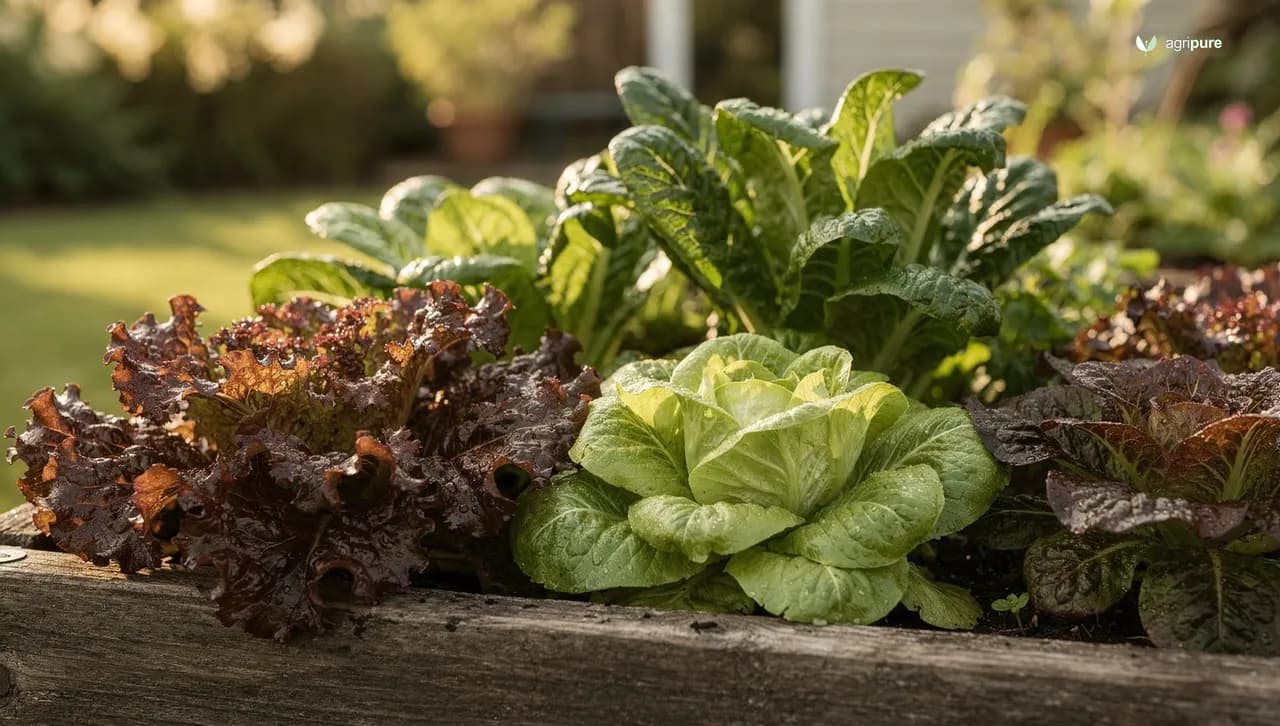
How to grow lettuce: continuous salad from spring to frost
“Lettuce is one of the few crops where the harder you harvest, the more it gives you back.”
Lettuce is the crop that rewards impatience. Leaf varieties are ready in 30 to 45 days from transplant — faster than almost any other vegetable — and the right harvest technique means a single planting keeps giving for weeks. The challenge is not growing lettuce; it is keeping it coming. Because lettuce is a cool-weather crop that bolts and turns bitter the moment summer heat sets in, most home gardeners get a three-week spring flush and then nothing until October. This guide fixes that problem. It covers every type, from variety selection through succession sowing, soil prep, spacing, pest and disease management, container and shade-cloth strategies for summer, and cut-and-come-again harvesting — so you can have salad greens from the first mild days of March through the last frost of November.
Lettuce fits naturally into the kind of intensive, layered kitchen garden that raised-bed and square-foot growers already use. Its shallow root system occupies the top six inches of soil, which means it coexists happily with deeper-rooted neighbors and tucks into the gaps of a companion-planted bed without competition.
The most important number to know going in: 75°F. Above that threshold, lettuce shifts its energy from leaf production to seed set — what gardeners call bolting. Every strategy in this guide is designed to keep lettuce below that line, or to buy you extra weeks when the temperature rises anyway.
Choosing the right lettuce type and variety
There are five distinct lettuce types, and they are not interchangeable in the garden. Each has a different cold tolerance, bolt resistance, days to maturity, and ideal harvest method. Picking the wrong type for your season is the most common reason a planting fails before pests or weather ever become a factor.

University of Minnesota Extension identifies the five types as loose-leaf, butterhead, French crisp (Batavian), romaine, and crisphead (iceberg). Here is how they line up for a home kitchen garden:
| Type | Days to maturity (transplant) | Heat tolerance | Best season | Harvest method |
|---|---|---|---|---|
| Loose-leaf | 30–45 days | Low–medium | Spring / fall | Outer leaves or cut-and-come-again |
| Butterhead (Bibb) | 45–55 days | Low | Spring / fall | Head or outer leaves |
| Batavian / French crisp | 55–65 days | High | Spring through summer | Head or outer leaves |
| Romaine (cos) | 55–65 days | Medium | Spring / fall | Head or outer leaves |
| Crisphead (iceberg) | 60–70 days | Very low | Cool spring only | Full head |
For succession planting across the full season, the practical approach is to run three variety rotations: start with loose-leaf (Black Seeded Simpson, Red Sails, Salad Bowl) in early spring when the soil is barely workable; shift to Batavian types (Nevada, Sierra, Tahoe) for late-spring and early-summer successions; then return to romaine and butterhead (Buttercrunch, Parris Island Cos) for the fall flush. Research from UC Master Gardeners of Sacramento County found that Batavian cultivars did not bolt all season — even during the warmest weather of the trial — making them the most reliable bridge between spring and fall windows. Butterhead and romaine become bitter under high summer temperatures, so hold them for the bookend seasons. Crisphead requires a long, cool window that most North American home gardens cannot reliably provide, and University of Maryland Extension notes that many gardeners find it the most difficult type to grow.
Starting from seed vs. transplanting — and timing by zone
Lettuce germinates fast and resents root disturbance, which makes direct sowing the default for leaf types. But transplants have a real place in the season, especially for the spring fast-start and the late-summer fall succession.
Seeds germinate best between 55 and 65°F, according to Utah State University Extension. Germination slows significantly above 80°F and stops above 95°F — the biological reason summer direct sowing fails without cold water or refrigerator pre-chilling. Sow seeds one-quarter to one-half inch deep. At optimal soil temperatures, seedlings emerge in seven to 10 days.
For transplants, start seeds indoors four to six weeks before your last frost date. Oregon State University Extension recommends a seven-to-10-day hardening period before moving seedlings outside permanently. Transplants three to four weeks old eliminate the thinning step and allow earlier harvests — University of Maryland Extension notes this as the main practical advantage of starting under lights.
Timing by zone breaks down as follows: In USDA Hardiness Zones 3–5, the outdoor direct-sow window opens in late April once soil tops 40°F, with a fall succession beginning in late July for September and October harvests. In Zones 6–7, push the spring start to late March and the fall sow to mid-August. In Zones 8–9, lettuce is essentially a cool-season annual — grown October through April, with the summer months treated as a full rest period regardless of shade-cloth strategies. Young transplants survive light frosts down to 32°F, which means fall crops can keep going well past the first frost in most zones.
Soil, sun, and spacing
Lettuce is a shallow-rooted, fast-moving crop that puts almost all its roots in the top six inches of soil. That concentration means it responds quickly to both fertility and moisture — and equally quickly to deficits of either.

Soil: Lettuce prefers a loamy, well-drained soil rich in organic matter with a pH between 6.0 and 6.7, a range that Clemson University Cooperative Extension and NC State Extension both specify. Before planting, incorporate two to three inches of finished compost and apply a balanced pre-plant fertilizer — Clemson recommends 5-10-10 at three pounds per 100 square feet, while University of Minnesota Extension calls for 10-10-10 at two pounds per 100 square feet. Both approaches are sound; the goal is available phosphorus for root establishment. Sidedress once growth accelerates: Utah State University Extension suggests one-quarter cup of 21-0-0 (ammonium sulfate) per 10 feet of row, four weeks after transplanting. Nitrogen feeds the leafy growth that is the whole point of the crop. Avoid over-applying, however — too much nitrogen in warm weather accelerates the very bolting you are trying to prevent.
Sun: Lettuce needs full sun — six or more hours — in spring and fall, when temperatures are low enough to prevent heat stress. In summer, four to six hours of direct light is sufficient. University of Maryland Extension notes that baby-leaf lettuce can be grown in indirect light only during summer months, making it one of the few crops that adapts to a shaded garden corner. That adaptability is the basis for the summer strategy in the container section below.
Spacing: Spacing is the variable most dependent on your harvest method. For cut-and-come-again baby-leaf production, sow thickly and thin to five inches. For full-sized leaf heads harvested outer-leaf by outer-leaf, final spacing is eight to 10 inches in-row with rows 12 to 18 inches apart. Butterhead and romaine need 10 to 12 inches between plants. Crisphead requires 12 to 15 inches with rows at least 20 to 30 inches apart — which is partly why it is impractical in a square-foot or intensive raised-bed context. In a 4-by-8-foot raised bed, a standard spring mix sown at five-inch spacing across the full width yields roughly 60 to 80 plants per sowing.
Watering, feeding, and tipburn
Lettuce is roughly 95% water by fresh weight, and that number tells you almost everything about its irrigation needs. Irregular moisture — a dry week followed by heavy watering — triggers tipburn: the brown, papery edges on inner leaves that look like disease but are actually a calcium deficiency caused by inconsistent water uptake. NC State Extension and Oregon State Extension both flag tipburn as one of the most common quality problems in lettuce, and both point to consistent, uniform moisture as the prevention.
Target one to two inches of water per week. Sandy or coarse-textured soils need more frequent irrigation than loam. Drip irrigation is the preferred delivery method across multiple extension sources because it keeps foliage dry, reducing the risk of fungal diseases like downy mildew and gray mold, and it delivers water directly to the shallow root zone without runoff. When overhead watering is your only option, water in the morning so foliage dries before evening. Moisten the soil to six inches deep at each irrigation. Lettuce grown in containers dries out faster — check daily in warm weather and consider self-watering containers with a water reservoir for the summer months.
Side-dress feeding matters more than pre-plant fertility for lettuce, because the crop’s short season means the roots never explore deeply enough to access slow-release nutrients. Apply a nitrogen source — calcium nitrate (15-0-0) at two pounds per 100 feet of row, or the equivalent — once the plants are actively growing. This single feeding carries leaf lettuce through to harvest without further intervention in most soils.
Succession sowing and the cut-and-come-again method
A single sowing of lettuce, even in perfect conditions, gives you a two-to-three-week harvest window before the crop bolts or exhausts itself. Two techniques extend that window dramatically: succession sowing and cut-and-come-again harvesting. Used together, they are the engine behind continuous salad production from spring through frost.
Succession sowing means starting a fresh batch of seeds — or putting in a new flat of transplants — every 10 to 14 days rather than all at once. University of Minnesota Extension specifies 10 days as the standard interval; Oregon State Extension suggests 10 to 14 days depending on season length. The key added step is variety rotation by season, not just by date: switch from romaine to Batavian types as temperatures climb past 65°F, and back to butterhead or romaine as they fall below that mark in late summer. Running two or three successions simultaneously at different sow dates means at least one planting is always at the ideal harvest stage.
A practical succession schedule for a Zone 6 garden:
- Sowing 1 (early March): Butterhead and loose-leaf direct-sown under row cover as soon as soil reaches 40°F.
- Sowings 2–4 (mid-March through mid-April): Loose-leaf and romaine, direct-sown every 12 days.
- Sowings 5–7 (late April through late May): Batavian types (Nevada, Sierra) as temperatures warm; shade cloth deployed.
- Sowing 8 (late July): Romaine and butterhead transplants started indoors in early July for a September harvest.
- Sowing 9 (mid-August): Loose-leaf direct-sown for October baby-leaf harvest under row cover.
Cut-and-come-again harvesting works on the same regeneration principle a lawn uses after mowing: remove the growing tips and the plant redirects energy into new leaf production. University of Maryland Extension describes the method: sow thickly with a mix of salad greens, then cut the entire planting with sharp scissors two inches above the soil level when plants reach six to 10 inches tall. Within two to three weeks — assuming consistent water and a side-dress of nitrogen after each cut — the bed is ready to harvest again. Most leaf varieties yield three to four cuts before the plants weaken or bolt. That triples the productive life of a single sowing without additional seed, space, or soil prep. For seed-starting in containers, this method also works well in window boxes and shallow trays.
Common pests and diseases
Lettuce’s short season means pest and disease pressure has a narrow window to accumulate, and most problems can be managed with row covers, consistent scouting, and a few targeted interventions rather than a pesticide schedule.
Aphids are the most common lettuce pest across all regions. They cluster on young leaves and the undersides of older ones, causing crinkling and distortion. Knock them off with a strong water jet in the morning, or apply insecticidal soap directly to infested leaves. Populations tend to spike in late spring when natural predator populations lag behind pest emergence — row covers prevent colonization but also block beneficial insects, so remove them once daytime temperatures are consistently above 50°F.
Slugs chew ragged holes in leaves, particularly in cool, moist conditions and at night. Set out beer traps or iron phosphate bait around the bed perimeter. Row covers reduce slug access, and morning watering (rather than evening) keeps the soil surface drier at night when slugs are most active.
Flea beetles make tiny holes in seedling leaves and can devastate young transplants within days. Row cover at planting is the most reliable prevention; floating row cover removes the need for any spray. Once plants reach six inches tall, flea beetle damage becomes largely cosmetic.
Tip burn, as noted in the watering section, is a physiological disorder, not a disease — brown papery edges caused by inconsistent calcium uptake from irregular irrigation. It is not transmissible and does not spread, but it does reduce marketable leaf quality. Fix the watering cadence, not the fertilizer program.
Disease-wise, downy mildew is the most serious fungal threat, especially in cool, humid springs. Yellow patches appear on upper leaf surfaces with gray-purple fuzz below. Improve air circulation by spacing plants correctly, avoid overhead evening watering, and use resistant varieties where available. Lettuce drop (Sclerotinia) causes entire plants to wilt suddenly; it spreads through infected soil and survives for years, so rotate lettuce out of affected beds for at least three seasons. Lettuce mosaic virus, spread by aphids, causes mottled, distorted leaves — controlling aphids is the most effective prevention since there is no curative treatment.
Growing lettuce in containers and managing summer heat
Containers and shade cloth are the two tools that extend lettuce production into months when ground-bed growing becomes impractical. Used together, they can push the harvest window four to six weeks past what an unprotected bed allows.

Container selection: Use containers at least eight to 10 inches deep with good drainage holes. Window boxes 24 inches long and eight inches wide support four to six leaf plants at cut-and-come-again spacing. Self-watering containers with reservoirs reduce the daily watering burden in summer and prevent the moisture swings that cause tipburn. Avoid dark-colored containers in full sun — they absorb heat and push root-zone temperatures above 80°F, accelerating bolt.
Shade management: UC Master Gardeners of Sacramento County recommends a 30 to 50% shade cloth suspended four to six inches above the canopy — not draped directly on the leaves, which traps humidity and encourages disease. This reduces air temperature around the plants by 5 to 10°F. Move containers to a spot that gets morning sun (cooler) and afternoon shade once daytime highs push past 80°F. University of Maryland Extension confirms that baby-leaf lettuce can be grown entirely in indirect light during summer, making north-facing patios and the shade cast by taller crops useful growing space that most gardeners ignore.
Variety selection for heat: In the container or shade-cloth setup, lead with the Batavian types — Nevada, Sierra, Tahoe — which UC ANR trials found did not bolt all season even without shade assistance. Back those up with heat-tolerant loose-leaf varieties like Jericho, Red Cross, Merlot, and Year Round Bronze Oak Leaf. Buttercrunch and most romaines are poor summer container choices regardless of shade; save them for fall.
One more trick for summer: pre-chill the seed before sowing. Thermoinhibition — the suppression of germination above 75–80°F — can be bypassed by placing moistened seeds on a damp paper towel in the refrigerator for 24 to 48 hours before sowing. The cold shock breaks thermal dormancy and dramatically improves germination rates in late-summer direct sowing, when soil surface temperatures can exceed 80°F even in the shade.
Harvesting, storing, and getting the most from each planting
How you harvest determines how much you get. The two methods — whole-head harvest and progressive outer-leaf picking — are not interchangeable, and choosing the wrong one for the variety wastes a significant portion of each planting’s potential.
For leaf and loose-leaf types, harvest outer leaves first when they reach five to six inches long, leaving the inner rosette intact to continue growing. This progressive method keeps a single plant producing for three to four weeks. Alternatively, use the cut-and-come-again method described above — cut the entire plant two inches above soil level and let it regrow. The first cut typically yields the most volume; subsequent cuts produce somewhat smaller leaves. After three cuts, plants are usually spent or beginning to bolt; compost them and direct-sow the next succession into the same space.
For butterhead, harvest when the center leaves begin cupping inward. For romaine, the head is ready when it is four inches wide at the base and six to eight inches tall with overlapping leaves. For crisphead, squeeze the head — harvest when it feels firm and compact. All types should be harvested in the cool of the morning, when leaf cells are turgid and sugar content is highest; afternoon harvest of a heat-stressed plant produces noticeably inferior quality.
For storage, NC State Extension recommends cooling harvested lettuce to 34–38°F as quickly as possible — the “field heat” in the leaves continues respiration and accelerates wilting. Long-term, maintain near 32°F at 95% relative humidity. Crisphead stores two to three weeks under these conditions; leaf and bibb types store one to two weeks in a general sense, but University of Maryland Extension notes that leaf and bibb varieties bagged dry (no surface moisture) can last up to four weeks at 32°F. Wash lettuce just before use rather than at harvest — surface moisture is the main driver of premature rotting in storage. Grown alongside compatible crops as part of a broader living soil system, lettuce is also an excellent indicator plant: its rapid growth cycle means you see the results of soil amendments and irrigation decisions within weeks, not months.
Frequently asked questions
How often should I water lettuce?
Target one to two inches of water per week, delivered consistently rather than in large infrequent doses. Irregular moisture causes tipburn — the brown papery leaf edges that signal calcium deficiency from uneven water uptake. Drip irrigation is the most reliable method; if you water overhead, do it in the morning so foliage dries before evening.
Why is my lettuce bolting?
Bolting — the rapid development of a central seed stalk — is triggered by temperatures above 75°F and lengthening day hours. Once it starts, the leaves turn bitter and the plant cannot be reversed. Prevention is the only remedy: switch to bolt-resistant Batavian varieties (Nevada, Sierra, Tahoe) for warm-season sowings, deploy 30–50% shade cloth, and move containers to afternoon shade. Time your successions so lettuce matures before the hottest weeks.
Can I grow lettuce in pots?
Yes. Containers at least eight to 10 inches deep work well for leaf lettuce, with self-watering models preferred for summer growing. Use a loose, compost-rich potting mix, choose heat-tolerant varieties, and move containers to morning-sun / afternoon-shade positions once daytime temperatures top 80°F. Baby-leaf lettuce in a shallow window box is one of the most productive uses of a patio or balcony.
What is cut-and-come-again lettuce?
Cut-and-come-again is a harvest method where the entire plant is cut two inches above the soil with sharp scissors. The crown and roots remain intact and regrow, producing a second full harvest in two to three weeks. Most leaf varieties yield three to four cuts from a single sowing. Side-dress with a nitrogen fertilizer after each cut to support regrowth.
How long does lettuce take to grow?
It depends on type: loose-leaf varieties are ready 30 to 45 days after transplanting, or 50 to 60 days from direct seed. Butterhead and romaine take 45 to 65 days from transplant. Crisphead takes 60 to 70 days from transplant and needs the longest unbroken cool period of the five types.
References
- Growing lettuce, endive and radicchio in home gardens — University of Minnesota Extension
- How to Grow Lettuce in Your Garden — Utah State University Extension
- Lettuce — Clemson University Cooperative Extension, Home & Garden Information Center
- Lettuce Production in North Carolina — NC State Extension
- Growing Lettuce in a Home Garden — University of Maryland Extension
- Growing Lettuce in Warm Weather — UC Master Gardeners of Sacramento County / UC ANR
- Growing Lettuce & Other Greens — Oregon State University Extension
