Key takeaways
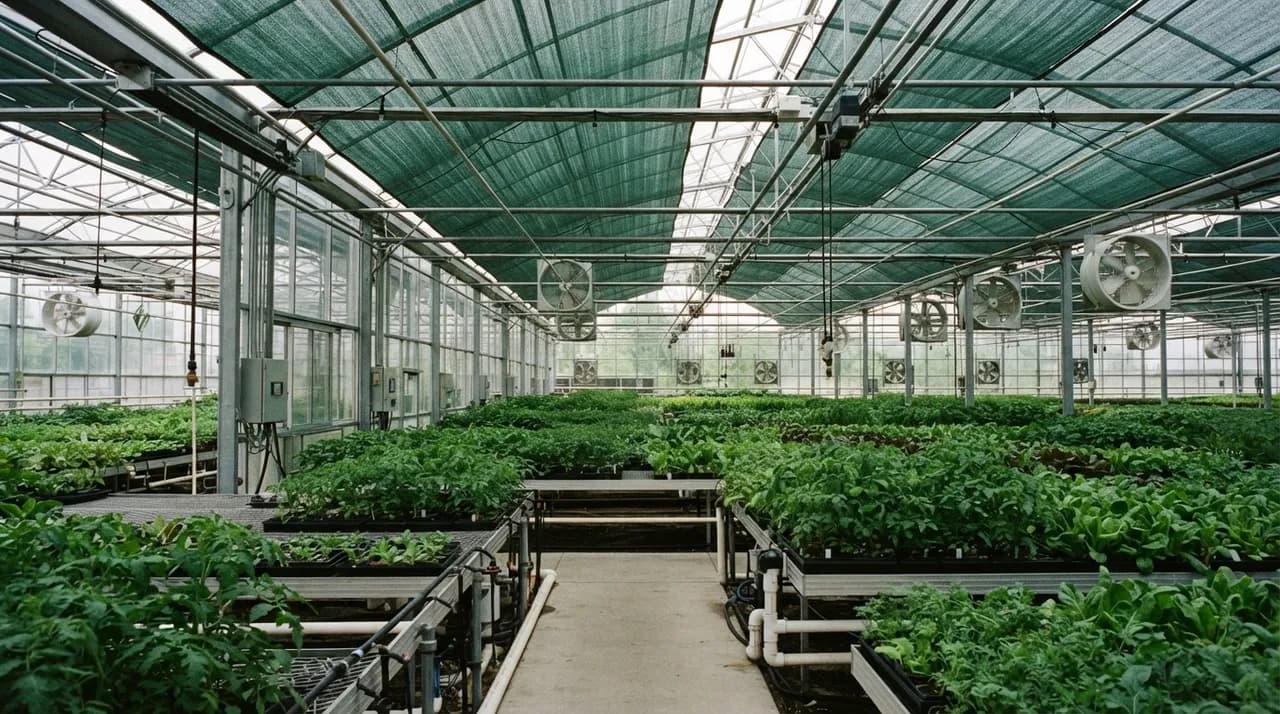
A climate-controlled greenhouse with shade cloth, automatic vent openers, exhaust fans, and bubble-wrap insulation maintains steady growing conditions.
Managing greenhouse temperature requires matching ventilation and shading to seasonal conditions. Shade cloth, exhaust fans, and evaporative cooling prevent overheating in summer, while simple automation maintains consistent airflow.
- Summer is the harder season: a sealed greenhouse can run 30 degrees F or more above outside, so cooling – shade, venting, and evaporative coolers – matters more than heating in most climates.
- Shade cloth is rated by the light it blocks: 30% to 50% suits most vegetables, and a 30% cloth alone can drop a tunnel 6 to 9 degrees F. Hang it once daytime highs hit 80 to 85 degrees F.
- For active cooling, size exhaust fans to move about 8 CFM per square foot of floor – one full air change a minute – and an evaporative cooler can pull intake air down to the high 60s F in dry climates.
- In winter, a single layer of large-bubble (20 to 24 mm) horticultural bubble wrap cuts heat loss through the glazing by roughly 30%, and lasts 3 to 5 seasons.
- Greenhouse automation can be as cheap as a wax-cylinder vent opener (no electricity, opens around 63 to 77 degrees F) or as full as a thermostat-and-sensor controller running fans, vents, and misting.
- A greenhouse pairs naturally with hydroponics: an NFT system feeds leafy greens a thin film of nutrient solution at 3 to 5 gallons per hour per channel, for fast year-round salad.
The mistake most new growers make is thinking a greenhouse is a heating problem. In most of North America it is a cooling problem first: a closed glass or polycarbonate box on a sunny afternoon can sit 30 degrees F or more above the air outside, hot enough to cook a tray of seedlings by noon. Climate control is the craft of keeping the inside inside a livable band all year – shedding heat in summer, holding it in winter, and managing humidity throughout. This guide walks the 4 levers that do it: summer cooling (shade, venting, evaporative coolers), winter insulation (bubble wrap and thermal screens), greenhouse automation (the controls that watch the house when you cannot), and running hydroponics inside for year-round greens. If you are still choosing the structure, it starts with the greenhouse style for your site; if winter is the goal, pair this with the cold-climate build in a four-season greenhouse.
Summer cooling: shade, venting, and evaporative coolers
Cooling is the first and hardest job, and it works in a stack: block the sun before it enters, move hot air out, then chill the incoming air if that is not enough. The 3 tools are shade cloth, ventilation, and an evaporative cooler, used in that order.
A greenhouse equipped with white shade cloth over the roof, an open roof vent, and an exhaust fan to cool summer crops.
Shade cloth: block the light before it becomes heat
Shade cloth is rated by the percentage of light it blocks, and for most edible crops the sweet spot is 30% to 50%. University of Minnesota Extension found that 30% shade cloth is the safe default – “50% shade cloth may provide too much shading and reduce yields” – and that a 30% cloth alone can “lower temperatures in a high tunnel by 6-9 degrees F.” Hang it once daytime highs in the house consistently reach 80 to 85 degrees F and leave it up until fall. An exterior cloth beats an interior one, because it stops the sun before it passes the glazing and turns to heat inside.
Venting and evaporative cooling
Shade reduces the load; ventilation removes what gets through. Sized exhaust fans should move about 8 cubic feet per minute per square foot of floor area, roughly 1 full air change a minute, pulling fresh air across the house. When the outside air is itself too warm, an evaporative (fan-and-pad) cooler adds the final step: fans draw air through wet pads so it is “saturated and cools the greenhouse.” In dry air the drop is dramatic – intake air “would be cooled to about 67 degrees F if the relative humidity is 30%” – though in humid weather the same system barely helps, cooling only to about 82 degrees F at 70% humidity.
Cooling step | What it does | Target number |
|---|---|---|
Shade cloth | Blocks light before it heats the air | 30% to 50%; drops 6-9 F |
Exhaust fans / venting | Exchanges hot air for outside air | ~8 CFM per sq ft floor |
Evaporative cooler | Chills incoming air through wet pads | To ~67 F in dry air |
Order matters: shade first, vent second, evaporative-cool last. Shade is the cheapest watt of cooling you will ever buy – blocking 30% of the sun at the glass costs a few dollars of cloth and removes load that fans would otherwise fight all afternoon.
Winter insulation: bubble wrap and thermal screens
That summer cooling problem reverses in winter: the greenhouse must retain heat instead of shedding it. The single cheapest upgrade is horticultural bubble wrap, with thermal screens for a heated house that needs more insulation.
Bubble wrap works on the same principle as double glazing: trapped still air. A single layer of large-bubble (20 to 24 mm) horticultural wrap lining the inside of the glazing “reduces heat loss through greenhouse glazing by approximately 30%,” and the horticultural grade is UV-stabilized so it lasts 3 to 5 seasons instead of yellowing in 1. Use the large-bubble kind rather than standard packing wrap, because bigger bubbles trap more air. On glass you can dampen the pane and press the wrap on bubble-side-down with no clips; on a polycarbonate kit, double-sided tape around each panel holds it. Seal the gaps too, since a draft through a single cracked seam wastes more heat than the wrap saves.
Thermal screens for a heated house
A thermal (energy) screen is a retractable fabric curtain pulled across the greenhouse at dusk and opened at dawn. It traps a blanket of warm air below it and blocks the radiant heat loss to a cold sky, the same move as the night blanket on a four-season passive-solar house. For a hobby grower, bubble wrap on the glazing plus a screen overhead is most of the winter heating savings available before you spend a dollar on fuel.
Watch-out – light: every layer that holds heat also costs light, and winter light is already scarce. Bubble wrap shaves a few percent of transmission, so pull thermal screens back fully on bright days and consider clear large-bubble wrap rather than tinted, to keep the short winter day as bright as possible.
Automation: vents, fans, and sensors that run themselves
Those cooling and insulation measures only help when someone acts on them, and that is where most climate control fails – the house hits 110 degrees F while you are at work. Greenhouse automation is the fix, and it scales from a $30 mechanical gadget to a full sensor-driven controller – you can start at either end.
An automatic wax-cylinder vent opener mounted on an open greenhouse roof vent with a nearby sensor.
The no-power option: a wax-cylinder vent opener
The simplest automation needs no electricity at all. An automatic vent opener is a metal cylinder of mineral wax that “expands with heat, pushing a piston which opens the auto vent,” then closes it with a spring as the wax cools. Most models let you set the opening point between 63 and 77 degrees F with a thumbscrew, reaching their full 18-inch opening about 20 degrees F above that. For a small hobby greenhouse, 1 or 2 of these on the roof vents is genuinely enough – heat-activated, reliable, and immune to power cuts.
The full system: thermostats, controllers, and sensors
For more control, an environmental controller reads temperature and humidity from sensors and switches exhaust fans, powered vents, heaters, and misting on set points – so the house cools, heats, and humidifies on its own. A basic thermostat that triggers a single fan is the entry version; a multi-stage controller that stages 2 or 3 fans, opens vents, and runs a misting line is the full one. The payoff is the same at every level: the greenhouse responds in minutes to a cloud passing or a heat spike, which hand-watching cannot match. On an off-grid site the low-draw fans and a wax opener keep that response running on a small solar setup.
Running hydroponics inside
Once the climate is steady, a greenhouse becomes an ideal home for hydroponics – growing in nutrient solution instead of soil. The controlled air and light that make the structure worth building are exactly what a hydroponic crop wants, and it is the fastest route to year-round greens.
The friendliest system for a greenhouse is the nutrient film technique (NFT). As Virginia Tech Extension describes it, “a thin film of nutrient solution is pumped through these channels to provide water and fertilizer to the roots of the plants,” with a flow rate of 3 to 5 gallons per hour into each channel. It suits “low-growing, leafy greens and culinary herbs” (various lettuces “work very well”) instead of tall fruiting crops, whose weight and root mass an NFT channel cannot carry. A greenhouse NFT bench of butterhead or romaine can cut a head of lettuce every few weeks through winter, on a fraction of the water that soil beds use.
Hydroponic detail | NFT in a greenhouse | Why it fits |
|---|---|---|
Method | Thin film of nutrient solution in channels | Simple, few parts, easy to inspect |
Flow rate | 3 to 5 gph per channel | Keeps roots fed and oxygenated |
Best crops | Lettuce, leafy greens, herbs | Light, low-growing, fast |
Payoff | Year-round salad on little water | Uses the steady greenhouse climate |
Hydroponics works alongside soil beds. Many growers run NFT lettuce along one bench for fast turnover and keep raised soil beds for the deeper-rooted crops, getting both out of 1 climate-controlled house.
Keeping it in range, all year
Climate control comes down to 4 levers, each with a target. In summer, stack the cooling: 30% to 50% shade cloth, exhaust fans at 8 CFM per square foot, and an evaporative cooler for the worst heat. In winter, hold the warmth: large-bubble bubble wrap on the glazing for a 30% cut in heat loss, plus a thermal screen overhead. Let automation do the watching (from a simple wax vent opener to a sensor-driven controller) so the house reacts in minutes, not hours. Then put the steady climate to work with NFT hydroponics for year-round greens. Managing these 4 systems turns the greenhouse into an effective, predictable growing tool. The structure those controls bolt onto starts with the kit or build that fits your budget.
Frequently asked questions
What percentage shade cloth do I need for a greenhouse?
For most vegetables, 30% to 50% – the percentage refers to how much incoming light the cloth blocks. University of Minnesota Extension found 30% shade cloth is the safe default and can lower a tunnel by 6 to 9 degrees F, while 50% may over-shade and cut yields. Hang the cloth once daytime highs in the house consistently reach 80 to 85 degrees F, and mount it on the outside of the glazing so it blocks the sun before it becomes heat inside.
How do I cool a greenhouse in summer?
Cool in three stages. First, block the sun with 30% to 50% shade cloth. Second, vent the heat with exhaust fans sized to move about 8 cubic feet per minute per square foot of floor – roughly one full air change a minute. Third, if the outside air is still too warm, add an evaporative (fan-and-pad) cooler, which draws air through wet pads and can chill it to the high 60s F in dry climates, though it does little in humid weather.
Does bubble wrap insulation work in a greenhouse?
Yes. A single layer of large-bubble (20 to 24 mm) horticultural bubble wrap lining the inside of the glazing cuts heat loss through the glass by roughly 30%, working the same way as double glazing by trapping still air. Use UV-stabilized horticultural wrap, which lasts 3 to 5 seasons rather than yellowing in one, and seal any gaps too, since a draft through a cracked seam wastes more heat than the wrap saves.
What is greenhouse automation, and what is the cheapest option?
Greenhouse automation is any system that controls temperature, ventilation, or humidity without you present. The cheapest is a wax-cylinder vent opener: a metal cylinder of mineral wax that expands with heat to push a roof vent open and closes it with a spring as it cools, with no electricity needed. You set the opening point between about 63 and 77 degrees F. A fuller setup uses a thermostat or environmental controller with sensors to run fans, vents, and misting on set points.
Can you grow hydroponics in a greenhouse?
Yes – a climate-controlled greenhouse is an ideal home for hydroponics. The most beginner-friendly system is the nutrient film technique (NFT), which pumps a thin film of nutrient solution through channels at 3 to 5 gallons per hour each to feed the roots. It suits low-growing leafy greens and herbs, especially lettuce, and lets you cut salad year-round on a fraction of the water soil beds use. Tall fruiting crops are better grown in beds or larger systems.
How warm does a greenhouse get without cooling?
Dangerously warm. A sealed glass or polycarbonate greenhouse on a sunny afternoon can run 30 degrees F or more above the outside air, which is hot enough to wilt or kill seedlings within hours. That is why cooling – not heating – is the harder climate-control problem in most of North America, and why even a small greenhouse needs vents, shade, or an automatic vent opener before its first hot day.
References
- University of Minnesota Extension. “Prepare your high tunnel for a hot summer” (shade cloth percentages and cooling). extension.umn.edu
- University of Connecticut IPM. “Fan and Pad Evaporative Cooling Systems.” ipm.cahnr.uconn.edu
- Virginia Cooperative Extension (Virginia Tech). “Hydroponic Production of Edible Crops: Nutrient Film Technique (NFT) Systems” (SPES-463). pubs.ext.vt.edu
- How to Go Solar. “Greenhouse Bubble Wrap Insulation: How to Do It, How Much It Helps.” howtogosolar.org
- ACF Greenhouses. “Automatic Greenhouse Vent & Window Opener” (wax-cylinder vent opener specs). acfgreenhouses.com
- University of Georgia Extension. “Greenhouses: Heating, Ventilation, and Cooling” (Bulletin 792). fieldreport.caes.uga.edu