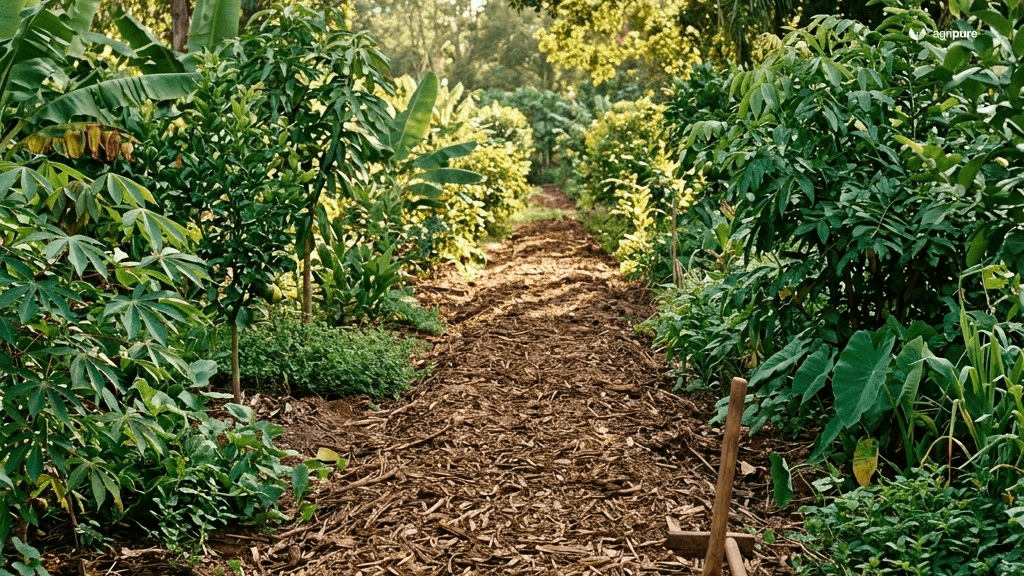
In syntropic agroforestry, the prune is the engine. Ernst Götsch, the Swiss farmer who developed the method on degraded land in Brazil, calls pruning “the fuel of transformations,” a strategic cut that pushes a plant into vigorous regrowth, feeds soil biology with fresh organic matter, and accelerates natural succession. Chop-and-drop is the simplest expression of that idea: you grow biomass on site, cut it, and leave it where it falls. No hauling, no compost heap, no bagged fertilizer.
The technique requires species suited to your local climate. A gliricidia hedge that thrives in Sri Lanka will rot in a Yorkshire winter. The sections below outline chop-and-drop species by hardiness zone and provide cutting cadences based on growth rate, using USDA zones alongside UK RHS ratings and Australian climate zones.
What makes a good chop-and-drop species

Coppiced biomass is distributed as soil cover to feed fungal networks in a syntropic system.
Before the zone lists, three traits separate a workhorse from a disappointment:
- It coppices or pollards willingly. You need a plant that resprouts hard from cut stems and stumps, season after season, without dying back completely. Nitrogen-fixing legumes and a few actinorhizal shrubs excel here.
- Nutrient-dense, fast-breaking foliage. Soft, low-C:N leaves decompose quickly and release nutrients in plant-available forms. Leucaena green leaf, for example, carries roughly 3.8–4.3% nitrogen at a C:N ratio near 18–20, so it mineralizes quickly without immobilizing nitrogen during decomposition.
- Fast biomass production. The whole point is volume. Pioneer legumes and grasses bulk up quickly, giving you mulch within a single season.
A balanced system blends two material types. Legume prunings are your nitrogen and rapid mineralization; carbon-rich grass biomass is your bulk, your slow mulch, and your soil-protecting blanket. Layer them, and you feed both the fast and slow cycles of decomposition.
Warm climates: USDA 9–12 (RHS H1–H2, AU tropical/subtropical)
This is chop-and-drop heaven. Frost-free or near-frost-free conditions let woody legumes grow and regrow almost year-round, so a single planting can produce many cuts per year.
Gliricidia sepium (USDA 10–12) is a widely planted agroforestry support tree. It establishes easily (even from large stem cuttings driven straight into the ground), fixes atmospheric nitrogen with Rhizobium bacteria, and resprouts vigorously from coppice buds after each cut. Its foliage is high in nitrogen and breaks down fast, providing a quick-release green manure. Prune before the dry season so the regrowth and the dropped mulch protect soil through the hardest months.
Leucaena leucocephala (USDA 9–11) is the classic alley-cropping biomass tree, cut on roughly three-month cycles for a steady stream of nitrogen-rich leaf manure. One caveat worth knowing: leucaena foliage contains mimosine, a toxic amino acid, so it is a poor choice if you also intend to graze the prunings to non-ruminant livestock. For pure chop-and-drop mulch, that is a non-issue.
For a herbaceous powerhouse in this band, Mexican sunflower (Tithonia diversifolia) is hard to beat where it is not invasive. Its green leaf biomass averages around 3.5% N, 0.37% P, and 4.1% K and decomposes rapidly, making it one of the few non-legumes that delivers a genuine phosphorus and potassium hit through chop-and-drop.
Warm-temperate, arid and Mediterranean: USDA 9–10 (RHS H2–H3, AU warm-temperate/arid)
Here you lose the year-round growing window but keep enough warmth for tender pioneers, especially as annuals or cut-back perennials.
Cajanus cajan (pigeon pea, USDA 9–12) is the standout. It is a hardy, drought-tolerant pioneer legume that grows quickly on poor soil, fixes nitrogen, and can be cut back hard as a chop-and-drop crop, with late-maturing types producing on the order of 11 tonnes of dry biomass per hectare. It bridges climates: a perennial shrub in the subtropics, an annual biomass-and-pulse crop in cooler temperate gardens. Pair it with fast pioneer grasses for carbon bulk.
Temperate and cool-temperate: USDA 6–8 (RHS H4–H5, AU cool-temperate)
Frost rules out tropical legumes, requiring cold-hardy nitrogen fixers: both true legumes and actinorhizal shrubs that fix nitrogen via Frankia bacteria.
Indigofera heterantha (Himalayan indigo, USDA 6–9) is an underused temperate answer to gliricidia: a nitrogen-fixing shrub that tolerates cutting and resprouts, suited to cool- and warm-temperate and Mediterranean gardens. Its prunings give you a legume-quality nitrogen contribution where leucaena would freeze.
Russian olive (Elaeagnus angustifolia, USDA 2–7) is the cold-climate biomass champion for nitrogen, hardy to roughly −40°C. As an actinorhizal fixer it is a strong nitrogen contributor, it tolerates trimming and coppicing, and it resprouts from old wood. One serious caveat: it is invasive across much of western North America and some other regions. Plant it only where it is legal and not naturalizing, manage it to prevent seed set, or substitute a less aggressive Elaeagnus such as goumi (E. multiflora) where invasion risk exists.
Fast pioneer grasses: the carbon engine across zones
Legumes supply nitrogen; grasses supply the sheer tonnage that keeps soil covered. Tropical biomass grasses such as napier and its bana-grass hybrids produce substantial cut-and-come-again material and tolerate repeated cutting, forming the carbon base of warm-climate syntropic rows. Pioneer grasses like Bermuda grass (Cynodon dactylon, USDA 7–11) and blue panic (Panicum antidotale) fill the same niche across warmer bands. Cogon grass (Imperata cylindrica) also produces bulk, but it is aggressively invasive and prohibited in many regions; grow it only where legal and contained. In cool-temperate plots, a simple cereal-rye or oat cover crop chopped at flowering works well. Because grass biomass has a higher C:N ratio than legume leaf, it breaks down more slowly, providing longer-lasting soil cover.
Pruning cadence by growth rate
Match your cutting rhythm to how fast the plant grows and how warm your season is. Faster growth and more heat mean more frequent cuts; the table below is a practical starting point, not a rigid rule.
Species type | Example | Typical zone | Cut cadence (in season) |
|---|---|---|---|
Fast woody legume | Gliricidia, leucaena | USDA 9–12 | Every 2–4 months; cut before dry season |
Short-lived pioneer legume | Sesbania, pigeon pea | USDA 9–12 | 1–2 hard cuts/year, then replace |
Hardy temperate N-fixing shrub | Indigofera, Russian olive | USDA 2–9 | 1–2x/year, late spring and mid-summer |
Fast biomass grass | Napier, Bermuda, cereal rye | Zone-dependent | Every 6–12 weeks when actively growing |
Herbaceous accumulator | Tithonia | USDA 9–11 | 2–3x/year before flowering |
Three field rules tie it together. Cut on the upswing: prune when a plant is flush with soft new growth, avoiding times of drought stress, so it rebounds fast. Never strip a system bare; in syntropic practice you stagger cuts so something is always covering the ground. And drop the material in place, chopped into 10–15 cm pieces so it stays put and contacts the soil to decompose.
Frequently asked questions
Do I need nitrogen-fixing plants for chop-and-drop to work?
Any biomass returned to the soil builds organic matter. Nitrogen fixers are valuable because their prunings are nitrogen-rich and decompose quickly, supplying fertility without temporarily immobilizing soil nitrogen the way high-carbon material can. The strongest systems combine a fixer with a bulk grass.
How do I do chop-and-drop in a cold climate with no tropical legumes?
Lean on cold-hardy fixers such as Himalayan indigo and (where non-invasive and legal) Russian olive for woody nitrogen, plus annual cover crops (vetch, clover, oats, cereal rye) chopped at flowering for fast seasonal biomass. You will cut less often than a tropical grower, typically once or twice per season.
Will chop-and-drop mulch attract pests or spread weeds?
Cutting before plants set seed prevents biomass species from self-sowing into a weed problem and is necessary for anything with invasive tendencies. Decomposing legume mulch generally suppresses weeds. Keep material chopped small and in contact with the soil so it breaks down quickly.
Sources
- Winrock International — Gliricidia sepium, the quintessential agroforestry species
- Agenda Götsch — Pruning instead of fertilizers and irrigation
- Wikipedia — Ernst Götsch (biography and syntropic agriculture)
- Jama et al., Agroforestry Systems — Tithonia diversifolia as a green manure for soil fertility improvement
- Nutrient Cycling in Agroecosystems — Green leaf manuring with Leucaena leucocephala prunings
- Feedipedia — Leucaena (Leucaena leucocephala)
- Agroforestry Systems — Pigeon pea (Cajanus cajan) fodder cutting management
- Nitrogen fixation by Elaeagnus angustifolia in the reclamation of degraded croplands of Central Asia