Key takeaways

Solar water pumps offer a practical and reliable solution for accessing groundwater and powering irrigation systems across diverse growing environments.
- Size on two numbers: flow rate (gallons per minute you need) and total dynamic head, the vertical lift plus pipe friction the pump must overcome.
- Flow and head trade off: as total dynamic head rises, the same pump delivers fewer gallons per minute.
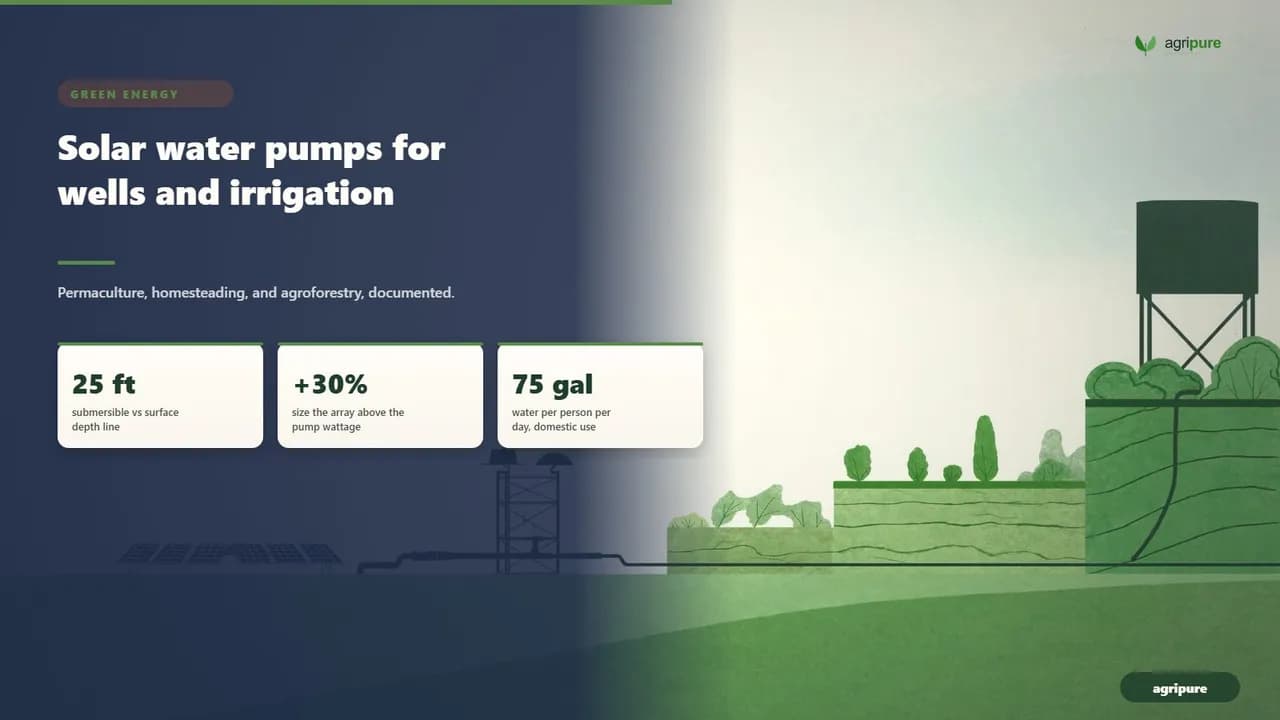
- Submersibles are the standard for wells deeper than 25 ft; surface pumps suit shallow lift under 25 ft, ponds, and cisterns.
- A common rule oversizes the array 30% above the pump’s wattage; a deep well needs far more panel than a shallow one.
- Solar-direct pumps skip batteries and fill a tank during daylight; a battery only earns its place when you must pump after dark.
- Daily need anchors the whole design: roughly 75 gallons per person per day for domestic use, plus livestock and irrigation.
A well 200 ft deep and a pond 10 ft down the slope ask completely different things of a solar pump, even if both households want the same 300 gallons a day. The pump does not size to how much water exists; it sizes to how hard it must work to lift and push that water, a single figure called total dynamic head. Get that number right and the panel count, the pump type, and the kit fall into place. This guide walks the 2 sizing numbers, the submersible-versus-surface choice, a worked panel-wattage example, and what a real solar well pump kit contains. It pairs naturally with the power side: how you store and route that energy lives in our guide to an off-grid or hybrid solar system.
The two numbers that size everything
Every solar pump decision starts with flow rate and total dynamic head. Flow rate is the gallons per minute (GPM) you need; the New Mexico State University Extension guide warns it “should be slightly lower than the well’s sustainable flow” so you never pump the well dry. Total dynamic head (TDH) is the harder concept, and the one that governs the rest.
NMSU defines TDH as “how hard a pump must work to move water from the well, through the total length of piping and all fittings, and to a discharge level.” AltE reduces it to a formula: Total Dynamic Head = Vertical Head + Effective Additional Head Due to Pipe Friction. Friction is not trivial: at 2 GPM through 3/4-inch pipe, AltE notes it adds “1 ft vertical head per 100 ft” of run, and most field guides budget 15% to 25% of well depth for it.
These two numbers fight each other, which is the single most important thing to understand. As NMSU puts it bluntly, “for bigger TDH values, the pump will move less water per minute.” A pump rated 10 GPM at 50 ft of head might deliver only 3 GPM at 200 ft. Read pump curves at your head, not at the headline number.
Measure before you shop: you need 3 figures before any pump fits: the depth to standing water, the height to your tank outlet, and the total pipe run. Those give you static lift and friction, and their sum is the total dynamic head every pump curve is read against.
Submersible or surface: the depth decision
Once you know your lift, the pump type nearly picks itself, and the dividing line is 25 ft. The Green Watt states the rule cleanly: a submersible is “the standard choice for wells deeper than 25 feet,” while a surface pump suits “shallow wells (under 25 feet to water) or pumping from ponds, springs, and cisterns.”
The reason is physics, not preference. A surface pump sits above ground and sucks water up, and suction has a hard ceiling: “most surface pumps can lift water a maximum of 20 to 25 ft vertically,” per The Green Watt. A submersible sits down in the water and pushes, so it can lift from 600 ft or more. NMSU, focusing on the common case, limits its own analysis to submersible centrifugal pumps running “up to 2000 watts of DC power at 30 to 180 V.”
Factor | Surface pump | Submersible pump |
|---|---|---|
Best depth to water | Under 25 ft | 25 ft to 600+ ft |
Source | Pond, spring, cistern, shallow well | Drilled well |
Action | Sucks (suction-limited) | Pushes (sits in water) |
Max vertical lift | 20-25 ft | 600+ ft |
Maintenance access | Above ground, easy | Pull from casing |
The fast test: measure the depth to the water surface, not the total well depth. If that standing water level is more than 25 ft down, you need a submersible, because a surface pump physically cannot pull it up.
Sizing the panel array to the lift
Panel wattage scales with both flow and head, so a deep well is a power problem long before it is a plumbing one. The Green Watt gives the underlying relation: pump power (watts) = GPM × TDH (ft) ÷ (5.308 × pump efficiency). Push more gallons or lift them higher and the wattage climbs in lockstep.

A worked example at 4 GPM
NMSU’s worked submersible case shows the numbers directly: at its design point the pump “can only pump up to 4 GPM and requires 257 W of power to operate.” You then size the array above that draw. AltE’s rule of thumb is explicit: oversize the panel wattage 30% above the pump rating; its example runs “116 W × 1.3 oversizing = 151 W of solar panels or greater.” The 30% cushion covers dust, heat, wiring loss, and off-angle sun.
Lift (depth to water) | Rough panels needed | Why |
|---|---|---|
25 ft (shallow) | ~2 panels | Low head, low wattage |
200 ft (typical well) | 6-10 panels | Moderate head |
800 ft (deep well) | ~18 panels | High head, high wattage |
Pump draw + 30% | Array minimum | AltE oversizing rule |
The depth-to-panel jump is steep: The Green Watt notes “a shallow well at 25 ft needs only 2 panels, while a very deep well at 800 ft needs 18.” That is a 9-fold difference in array for the same household, which is why you measure head before pricing panels.
Direct-drive or battery: how to run it
With the pump and array sized, one choice remains: run solar-direct or add a battery. Most homestead systems should run direct. RPS Solar Pumps describes the standard DC path: “DC power is routed from the solar panels, down through a charge controller (usually MPPT) which directs the DC power directly to the DC pump.” No inverter, no battery, fewer failure points.
The trick that replaces the battery is storage in a tank, not in cells. The Green Watt describes it plainly: “the pump runs only when the sun shines. Water is pumped into a storage tank during daylight hours and available on demand at any time through gravity or a pressure tank.” A 1,500-gallon cistern is a cheaper, longer-lived battery than any lithium bank when what you are storing is water.
When a battery does earn its place: only when you must pump after dark on demand, such as a pressurized house with no elevated tank or a pump that must run at a fixed night-time hour. Otherwise an MPPT controller, a DC pump, and a tank beat batteries on cost and lifespan every time.
DC also wins on efficiency at this scale. RPS notes DC pumps “are more efficient than running on solar with an inverter,” and they start in weak light. AC pumps earn their keep at the big end; RPS reserves them for “higher head (like deep wells, faraway tanks or high pressure irrigation), high volume flow rates (up to 400 GPM).” For a homestead well feeding a drip irrigation system, DC-direct into a tank is almost always the right call.
What is in a solar well pump kit
A packaged solar well pump kit bundles the matched parts so the DC voltages line up, but the 5 core pieces are the same whether you buy a kit or assemble them. Below is the checklist to vet any kit against before you buy.
- The pump: submersible or surface, rated for your flow at your TDH, not at zero head.
- The solar array: sized 30% above the pump’s wattage, from roughly 2 panels at 25 ft to 18 at 800 ft.
- The pump controller: usually MPPT, which matches panel output to the motor and adds dry-run and low-light protection.
- Storage: a tank or cistern sized to your days of autonomy, the water-side replacement for a battery.
- Wire, a disconnect, and a well seal: the balance-of-system parts kits most often skimp on.
Size storage by your daily need and local weather. NMSU recommends “a normal storage value for sunny regions like New Mexico is 3 days of water, but it may be up to 10 depending on various factors.” At AltE’s domestic figure of “75 gallons per day per person,” a family of 4 wanting 3 days holds about 900 gallons; wanting 7 days, about 2,100. For the wider self-reliant water picture, our guide to off-grid living sets the pump in context.
Irrigation changes the duty cycle
A pump that comfortably serves a house can fail an irrigation block, because irrigation is a different duty cycle. Domestic demand is small and spread across the day; irrigation is a large draw concentrated into a short window, often the same midday hours when the panels make the most power. That alignment is an advantage if you design for it.
The cleanest pattern is to pump to a tank, then irrigate from the tank. The solar-direct pump fills an elevated cistern through the sunny hours; gravity or a small pressure pump then feeds the field on your schedule. This decouples the pump’s solar-bound output from the crop’s watering window, and it lets a modest 4-GPM pump service a block that would need a far bigger pump if fed live. Match the tank to a full irrigation set plus a day of household use.
Sizing for irrigation: add the field’s set volume to the household daily need, then size storage and flow to fill that total within the 5 to 6 peak-sun hours a fixed array actually delivers. Pumping to storage beats pumping to pressure for almost every homestead block.
The takeaway
A solar water pump is a sizing problem with a clear order of operations. Start with total dynamic head (the lift plus friction), because it sets the flow you can expect and the wattage you must supply. Let the 25-ft line pick submersible versus surface. Size the array about 30% over the pump, from 2 panels at a shallow well to 18 at 800 ft. Then store water in a tank, not a battery, and run DC-direct through an MPPT controller unless you genuinely must pump after dark. Anchor the whole design to a real daily number (near 75 gallons per person, plus livestock and the irrigation set), and the kit, the panels, and the pump all follow from there.
Frequently asked questions
How do I size a solar water pump for my well?
Start with two numbers: the flow rate you need in gallons per minute, kept below your well’s sustainable yield, and the total dynamic head, which is the vertical lift from the water level to your tank plus friction losses in the pipe. Total dynamic head sets both the pump model and the panel wattage, because a pump delivers fewer gallons per minute as the head it must overcome rises.
Do I need a submersible or a surface pump?
Use the depth to the standing water, not the total well depth. If the water sits more than 25 feet down, you need a submersible, which sits in the water and pushes it up from depths of 600 feet or more. A surface pump suits shallow wells under 25 feet, ponds, springs, and cisterns, because suction can only lift water about 20 to 25 feet.
How many solar panels does a solar well pump need?
It scales with lift. The Green Watt notes a shallow well at 25 feet needs only about 2 panels, while a very deep well at 800 feet needs around 18. As a rule of thumb, size the array roughly 30 percent above the pump’s wattage rating to cover heat, dust, wiring loss, and off-angle sun, as AltE recommends with its 116 W to 151 W example.
Do I need a battery for a solar water pump?
Usually not. Most homestead systems run solar-direct: the DC pump runs only when the sun shines and fills a storage tank, which you then draw from any time by gravity or a pressure tank. A battery only earns its place when you must pump on demand after dark, such as a pressurized house with no elevated tank. A cistern is a cheaper, longer-lived store than a lithium bank.
What is in a solar well pump kit?
Five core parts: the pump (submersible or surface), the solar array sized about 30 percent above the pump wattage, an MPPT pump controller that matches panel output to the motor and adds dry-run protection, water storage such as a tank or cistern, and the balance-of-system parts: wire, a disconnect, and a well seal. Kits bundle these so the DC voltages match.
How much water storage do I need?
Size it by daily demand and local weather. NMSU recommends about 3 days of water for sunny regions, up to 10 days where clouds are common. At roughly 75 gallons per person per day, a family of four wanting 3 days of buffer holds about 900 gallons; wanting a full week, about 2,100 gallons, before adding livestock and irrigation.
References
- New Mexico State University Extension. “Solar-Powered Water Pump Design.” pubs.nmsu.edu
- AltE Store. “Solar Water Pumping Part 2 — How to Size a System.” altestore.com
- The Green Watt. “Solar Powered Well Pump: Complete Sizing and Installation Guide.” thegreenwatt.com
- RPS Solar Pumps. “Which Solar Pump Is Better, AC or DC?” rpssolarpumps.com
- Flowatt. “Solar Water Pump Flow and Head Explained.” flowatts.com
- Deye Solar. “Calculating Solar Panel Needs for Water Pumping.” deyesolar.com