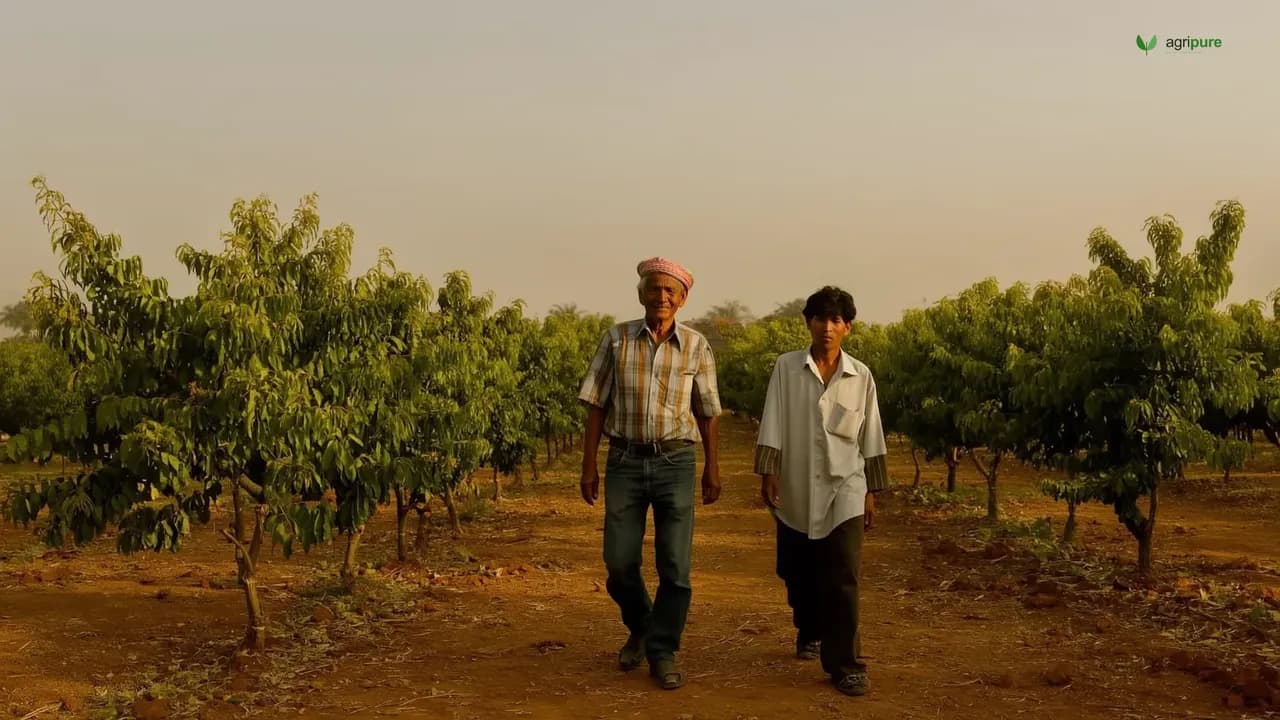
A syntropic planting is a thirty-year argument with time. The grower who designs it in year one will, if the system works as intended, not be the one harvesting its climax canopy at full maturity. That is the quiet condition of all agroforestry: you plant for a future you may not personally pick. Which makes succession — the deliberate passing of the farm, intact and understood, from one generation to the next — not a sentimental afterthought but the final design problem. Year fifteen owes year thirty a farm that can still be inherited as a working whole.
Related Agripure guides

The legacy of the land: ensuring the sustainable transfer of an agroforestry system from one generation to the next is the ultimate design challenge, preserving not just soil, but a way of life.
How productive farms dissolve
The failure modes are well documented and largely structural. The first is inheritance partition: under Pakistani personal law a holding is divided among heirs, and a mature agroforest split into fragments among several siblings often ceases to function as the integrated system it was: the canopy ends up on one plot, the water source on another, the orchard sliced across boundaries that ignore how the system actually works. The second is sibling conflict over a holding that is worth more whole than divided but that no mechanism keeps whole. The third is urban migration: inheritors who have left for the city and neither work nor understand the land let it decline or sell it for its development value. Each of these dissolves productive holdings that took decades to build. Each is, to some degree, designable against.
Source: [1] Pakistan Institute of Development Economics (PIDE) — land fragmentation & farm succession (institutional reference)Source: [2] FAO — Family Farming Knowledge Platform; intergenerational farm transfer
Keeping the holding whole
Mechanisms exist to hold land together across generations, though each must be approached with proper legal advice. The waqf (endowment) tradition has historically been used to keep productive assets intact and dedicated to a purpose across generations rather than fragmented by inheritance. Some families have tested this structure for exactly this end. Clearly documented family agreements, joint-ownership arrangements, and structured decision-making bodies have all been used to keep a holding operating as one even when title is shared. The right structure is a matter for a lawyer who knows the family’s circumstances. What matters is recognising that doing nothing is itself a decision, and the default it chooses is fragmentation.
What the multi-generational farms do differently
The Pakistani holdings that survive across generations — long-established date gardens in Sindh, walnut groves in the northern valleys — tend to share a way of organising people, not just land. They structure decision-making so that elders, working-age peers, and the next generation each have a defined role; they rotate labour and responsibility so the young learn the land by working it rather than inheriting it cold; and they keep the knowledge transfer continuous rather than deferring it to a single handover that may never properly happen. The farm passes as a living practice, carried in people who have grown up inside it, not merely as a deed.
Inheriting understanding, not just land
The most concrete thing year fifteen can leave year thirty is the record. A mature agroforest is illegible to a newcomer: which tree was planted when, why the rows run as they do, where the water moves, what the soil was and what it has become. FAO’s family-farming guidance and plain common sense both point to maintaining the design records that make the system inheritable as understanding — a planting map, a soil-organic-carbon baseline tracked over the years, a harvest history, the reasoning behind the species choices. A site-survey kit and a notebook, kept faithfully, are succession tools as much as any legal instrument. The next generation can only steward what it can read. Leave them a farm they can understand, and you have given the thirty-year argument with time its best chance of being won by someone who comes after you.
Source: [1] FAO — Family Farming Knowledge Platform; farm records for successionSource: [2] Götsch, E. — designing systems that outlast their planter (collected papers)
References
- Syntropic farming systems for reconciling productivity, ecosystem services and climate goals — One Earth (Cell Press). Defines syntropic farming as an agroforestry form built on ecological succession and multi-strata design that develops toward a forest-like climax over decades, supporting the “thirty-year argument with time” framing.
- Syntropic Farming & Agroforestry — Yale Forum on Religion and Ecology, Yale School of the Environment. Explains syntropic agriculture as a succession-based agroforestry approach developed by Ernst Götsch, reinforcing the long-horizon, plant-for-the-future logic of intergenerational farm stewardship.