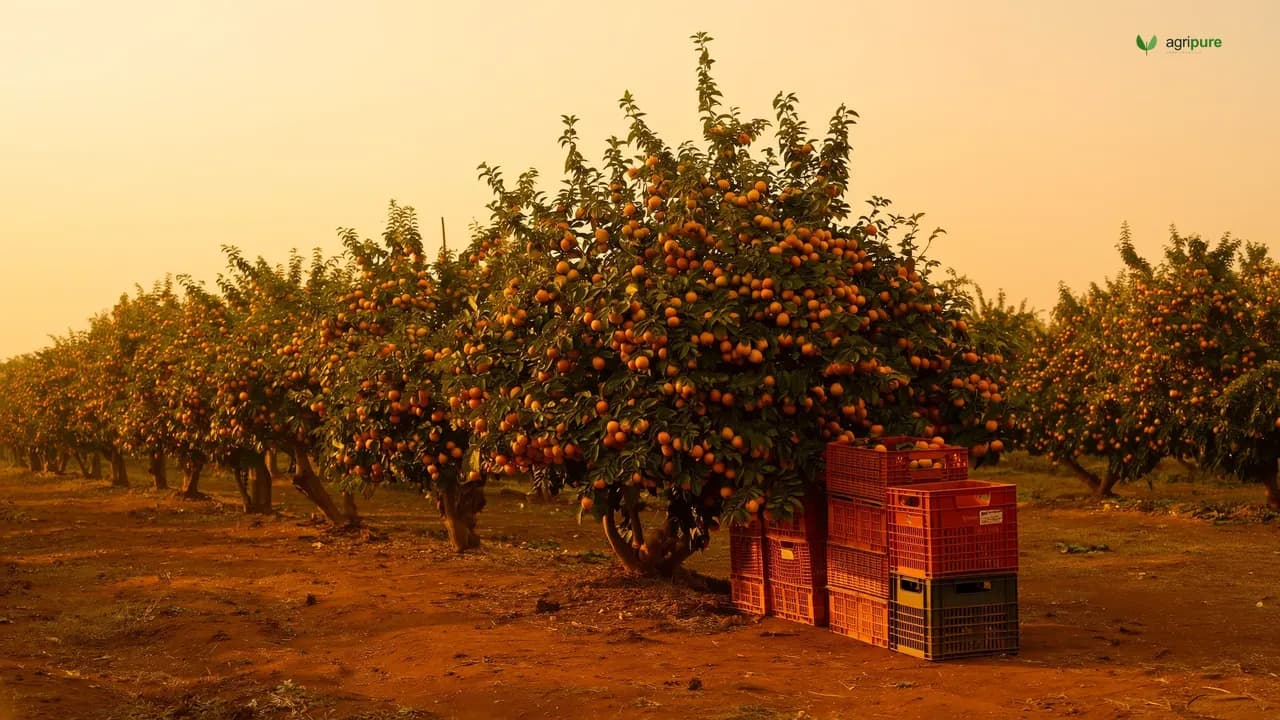
Most orchards are designed for planting and discover their harvest problem later. The trees go in by what grows well together and what the nursery had in stock, and then one November the whole place ripens at once — a glut no household can eat, no local market can absorb at a fair price, and no smallholder has the labour to pick. Harvest cycles are not an afterthought to be managed at the end; they are a design input to be planned at the beginning. Choose your species by when they pay you, not only by what they yield, and you design the glut out before you ever dig a hole.
The glut is a design failure, not a season
Toby Hemenway’s framing is that a well-designed system delivers a steady flow of yield, not a single flood. The single-November-glut orchard fails on three fronts at once: it overwhelms household consumption, it floods the local market exactly when everyone else’s identical trees are also ripe (so prices crater), and it concentrates all the labour demand into the few weeks when family labour is most stretched. Every one of those failures is fixable at the design stage by spreading the harvest across the calendar — and none of them is fixable after the trees are mature and synchronised.
Stacking the calendar with Pakistani species
The Pakistani agroforestry palette can fill almost the whole year if chosen for spread. Citrus carries the cool months (kinnow and oranges through winter). Loquat and early stone fruit open the spring. **Mango defines the summer (and within mango, staggering Sindhri, then Chaunsa, then late varieties spreads even the mango window across weeks). **Guava bears across two seasons. Dates, jujube (ber), and pomegranate carry late summer into autumn. Olive and walnut add autumn harvests in the cooler zones. Lay these on a twelve-month grid and the design question becomes obvious: which months are empty, and which species fill them? Plant to flatten the curve, not to maximise any single peak.
References
- Hemenway, T. — Gaia’s Garden (2009); designing for continuous yield
- PHDEC / PARC Horticulture — Pakistani fruit harvest calendars (institutional reference)