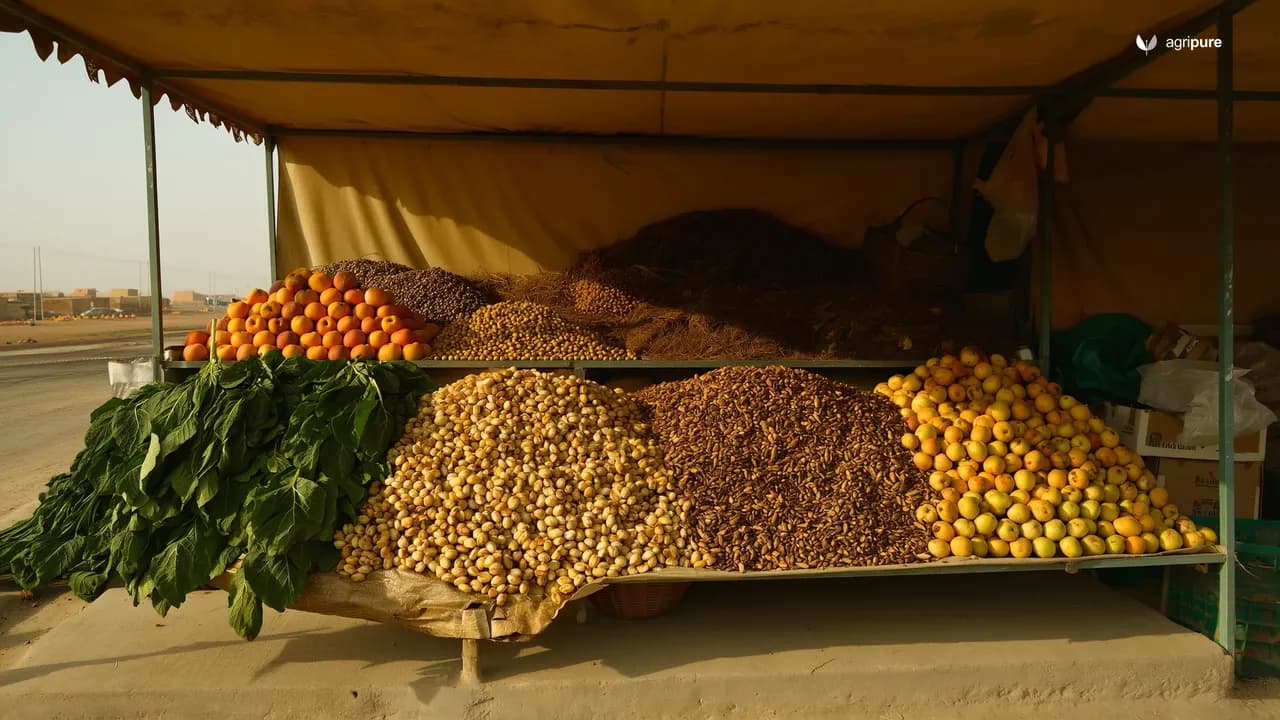
The economics of a Pakistani agroforest are made or lost after the harvest, at the point of sale — and the default channel, the mandi, is structured to take the grower’s margin. A smallholder who designs their selling as carefully as their planting keeps a far larger share of what the land produced. Farm-gate and direct sales are not a fallback for those who can’t reach the wholesale market; they are, increasingly, the channel where Pakistani agroforestry actually pays.
Related agripure guides

A Pakistani smallholder farmer sells his agroforest produce directly from the farm gate, bypassing intermediaries and keeping a larger share of the profit.
Why the mandi takes the margin
The wholesale market system price-discriminates against the smallholder by design. The grower arrives with a small, perishable load, no storage, and no leverage; the commission agent (arhti) sets the terms, deducts commission and charges, and the farmer accepts whatever the day’s clearing price is because the alternative is watching the fruit spoil on the cart. The structural problem is that the smallholder sells under maximum pressure: perishable goods, no holding capacity, no price information. The mandi is engineered to exploit exactly that pressure. Every rupee of margin the agent and the chain take is a rupee the grower’s land earned and the grower did not keep.
Source: [1] Pakistan Bureau of Statistics / PARC AgMark — farm-gate vs. retail price spreads (institutional reference)Source: [2] PHDEC — horticulture value-chain & marketing analysis (institutional reference)
The direct channels that work
The viable alternatives all share one feature: they cut out the pressure point. Farm-stand and roadside sales capture passing traffic at retail-adjacent prices with near-zero overhead. Direct-to-consumer through urban networks (WhatsApp groups, neighbourhood box schemes, the organic and specialty stores of Karachi, Lahore, and Islamabad) connect a grower to buyers who pay a premium for traceable, fresh, agroforestry produce and who value exactly the diversity a mandi flattens into anonymity. Community-supported subscriptions, where customers pay ahead for a weekly share, move the cash-flow risk off the farmer and guarantee a home for the harvest before it is picked. None of these require scale; they require relationships, reliability, and the willingness to sell in small, repeated lots rather than one pressured dump.
Value-add: selling the surplus twice
The most reliable margin in Pakistani smallholding comes from processing the surplus that would otherwise be dumped at glut prices. Solar drying turns glutted mango, jujube, and chilli into storable, higher-value product sold across the lean months. Oil pressing converts olives into a premium product with a long shelf life. Pickling and grading rescue the off-size and blemished fruit that the fresh market discounts to nothing. Each of these converts a perishable, price-crashing surplus into a durable good the grower can hold for a better price — selling the same harvest, in effect, twice: once fresh at the peak and once processed across the trough.
Certification: only when it pays its way
Organic, geographic-indication, and fair-trade certifications can lift prices, but they carry real cost and paperwork, and they only pay back where a buyer actually rewards them. For most smallholders the honest sequence is to build the direct relationships and the value-add first, where the premium is immediate and the cost low, and to pursue formal certification only once a specific, premium-paying buyer makes its cost worth bearing. Sell close to the customer, process the surplus, and certify last: that is the order in which the economics of a Pakistani agroforest actually work.
Source: [1] PHDEC / USAID Agriculture programs — value-addition & direct-marketing for smallholders (institutional reference)Source: [2] FAO — smallholder market access & short value chains
References
- Contribution of Small-Scale Agroforestry to Local Economic Development and Livelihood Resilience: Evidence from Khyber Pakhtunkhwa, Pakistan — Land (MDPI). Supports the claim that small-scale agroforestry raises farm financial capital and incomes in Pakistan while reducing soil erosion.
- Smallholder Farmers’ Perception on Ecological Impacts of Agroforestry: Evidence from Northern Irrigated Plain, Pakistan — Polish Journal of Environmental Studies. Backs claims that tree-crop systems improve soil fertility, water retention, and on-farm greenery for Pakistani smallholders.
- Socioeconomic Evaluation of Agroforestry Systems (Case Study: Northern Iran) — Journal of Forest Science. Documents that poplar-based agroforestry yields higher income and better returns than monoculture paddy or tea.