Key takeaways
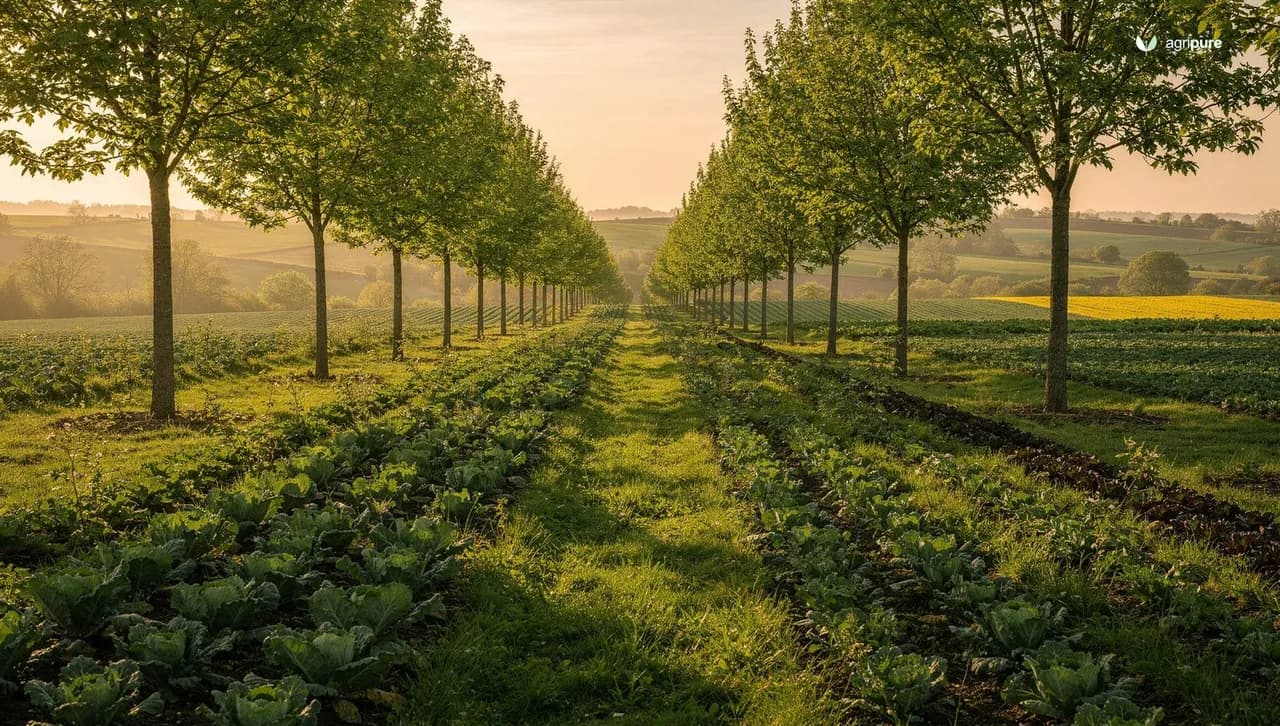
A photorealistic image of a diverse agroforestry farm. Rows of young fruit trees are interplanted with green cover crops in the foreground. In the mid-ground, sheep graze beneath mature deciduous trees, while a clear stream with a lush riparian buffer flows in the background under a warm, sunny sky. The scene exemplifies sustainable agriculture.
Agroforestry reimagines the farm, integrating trees and shrubs into agricultural systems for diversified income, ecological health, and sustainable land management. Here, a thriving agroforestry landscape blends fruit trees, cover crops, grazing livestock, and riparian buffers.
- Agroforestry is the intentional integration of trees and shrubs into crop and livestock systems.
- The USDA recognizes 5 practices: windbreaks, alley cropping, silvopasture, riparian buffers, and forest farming.
- Trees diversify income while crops and grazing pay the bills as the trees mature.
- Windbreaks and buffers store carbon, cut wind, and protect soil and water.
- Start with 1 practice that solves a problem you already have.
Agroforestry is what farming looks like when trees stop being the thing you clear and start being the thing you plant. Defined by the USDA as the intentional integration of trees and shrubs into crop and animal systems, it is the working backbone behind a permaculture design and the next step up from a backyard homestead. There are exactly 5 recognized ways to do it.
What agroforestry means
Agroforestry is deliberate: trees placed by design to do a job alongside crops or livestock. That intent is the line between an agroforest and a field with a few trees in it. The USDA groups the approach into 5 named practices, and almost every system is 1 of them or a blend of 2.
Agroforestry combines | To produce |
|---|---|
Trees plus annual crops | Grain or vegetables now, timber or fruit later |
Trees plus livestock | Grazing income while the trees mature |
Trees plus the waterway or field edge | Cleaner water, less wind, more wildlife |
The five practices
Those combinations sort into 5 practices, each solving a different problem. Pick by the problem in front of you: shelter, income, grazing, water, or shade-grown crops.
Rows of vegetables growing in wide grassy alleys between young tree lines on a farm, alley cropping in summer
Practice | What it does |
|---|---|
Windbreaks | Rows of trees that shelter crops, soil, and animals from wind |
Alley cropping | Crops grown in alleys between rows of maturing trees |
Silvopasture | Widely spaced trees over grazed pasture, like a savannah |
Riparian buffers | Strips of trees and grass that protect streams and water |
Forest farming | High-value crops grown under a managed forest canopy |
Why integrate trees at all
Those 5 practices share a payoff: trees turn a single income stream into several. Grazing or annual crops cash-flow the land while the trees mature into timber, nuts, or fruit, so 1 acre earns in 2 or 3 ways at once. On top of the money, windbreaks and buffers store carbon, lift crop yields by cutting wind, and shelter livestock from heat and cold.
A tall multi-row windbreak of trees sheltering a green field of crops from wind, with open sky beyond
How to start small
Those benefits do not require betting the whole farm. Start with 1 practice that fixes a problem you already feel: a single windbreak row on your windward edge, or a strip of silvopasture in 1 paddock. Give it 2 to 3 seasons, learn the management, then add the next.
The one-problem test: do not start with the practice that looks best in photos; start with the one that solves a cost you already pay. If wind dries your soil, plant a windbreak. If your stock bakes in July, try silvopasture. A tree planted against a real problem pays for itself the fastest.
The takeaway
Those 5 practices are 1 idea worn 5 ways: put trees back to work. Agroforestry is intentional, not accidental, and it rewards the farm that starts with a single windbreak or paddock and builds from there. Plant 1 practice this season, prove it over 2 or 3 years, and let the trees compound. A syntropic approach takes the same logic to its richest end.
Frequently asked questions
What is agroforestry in simple terms?
It is the intentional integration of trees and shrubs into crop or livestock farming, so the trees do a job, sheltering soil, feeding animals, or adding a future timber or fruit crop, rather than being cleared away. The key word is intentional: trees placed by design.
What are the five practices of agroforestry?
The USDA recognizes windbreaks (sheltering rows of trees), alley cropping (crops between tree rows), silvopasture (trees over grazed pasture), riparian forest buffers (trees protecting waterways), and forest farming (shade-grown crops under a canopy). Most systems are one of these or a blend.
How does agroforestry make money?
It stacks income streams. Annual crops or grazing pay the bills while the trees mature into higher-value timber, nuts, or fruit, so one acre can earn in two or three ways across different time horizons. Windbreaks also raise crop yields by cutting wind.
Is agroforestry good for carbon and the environment?
Yes. Trees in windbreaks, buffers, and silvopasture store carbon in wood and soil, improve water quality, create pollinator and wildlife habitat, and buffer the local microclimate. These benefits are a large part of why the USDA promotes the practice.
How do I start agroforestry on a small farm?
Begin with one practice that solves a problem you already have, such as a single windbreak row on a windy edge or a strip of silvopasture in one paddock. Run it for two or three seasons to learn the management, then expand into other practices.
References
- USDA National Agroforestry Center. “Agroforestry Practices.” fs.usda.gov
- Farmers.gov. “5 Ways Agroforestry Can Work for You and Your Land.” farmers.gov
- USDA. “Five Ways Agroforestry Can Grow Forest Products and Benefit Your Land.” usda.gov
- USDA ARS. “Agroforestry Helps Protect Crops and the Environment.” ars.usda.gov
- Britannica. “Agroforestry.” britannica.com