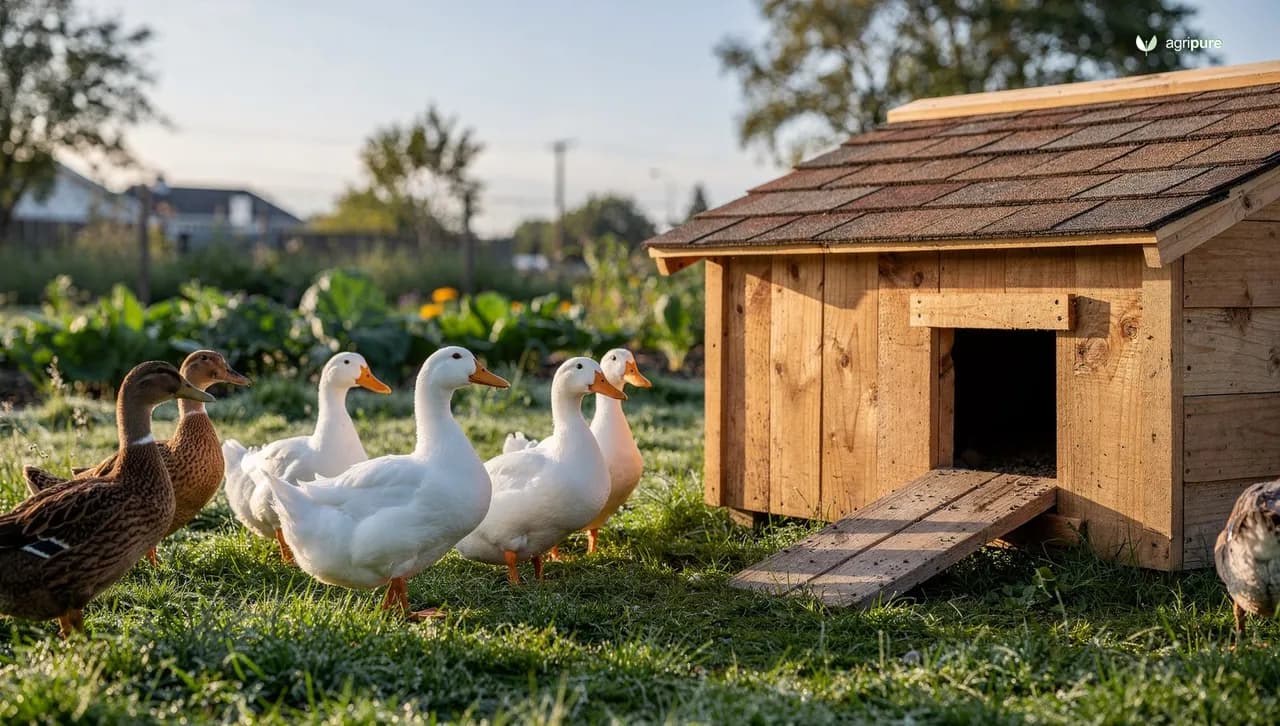
Ducks lay more eggs than most chickens, they do it through the winter, and they do it on bugs and slugs they find themselves — the case for ducks was always stronger than the stereotype.
Every homestead guide leads with chickens. Ducks come with a caveat — something about water and mud and mess — and get filed away for later. That is a mistake worth correcting, because the numbers are quietly in the duck’s favor. A Khaki Campbell or Indian Runner can top 300 eggs a year, lays through cold weather without the prodding that winter chickens need, and produces an egg that weighs 30% more than a large chicken egg and carries nearly twice the omega-3 fatty acids. The mud is real. The payoff is real too.
This guide covers the full arc of raising ducks — which breeds to choose and why, how to house them without constantly fighting wet bedding, what they need to eat (especially the niacin detail that trips up most beginners), common health problems and how to sidestep them, what to expect from eggs and meat, and an honest look at costs. Whether you are drawn to raising ducks for eggs, meat, pest control, or some of all three, the decisions below are the ones that separate a flock that works from one that is a chore.
If you have already got chickens, you will find a section on keeping a mixed flock — the practice works with some adjustments, but it is not quite as seamless as the forums suggest. And if you are starting from scratch, ducks are a strong first choice for anyone on a quarter-acre lot with a wet corner of the property they do not know what to do with.
Key takeaways

Beyond the stereotype, ducks offer a compelling case for the sustainable homesteader: exceptional layers, resilient in colder weather, and natural pest controllers. Dive into their world and discover the rich rewards.
- Top laying duck breeds, including Khaki Campbell, Indian Runner, and Welsh Harlequin, produce 280–340 eggs per year, often outpacing the best chicken layers and laying through winter without supplemental lighting adjustments.
- Ducks need at least 5 sq ft of indoor space per bird, prefer to lay before 9 AM (collect eggs before releasing them), and require water alongside every feeding to prevent choking.
- Niacin is the critical nutrient: ducks need 55–70 mg/kg of feed versus the ≥30 mg/kg in standard chick starter. Skip the supplement and leg deformities appear within weeks.
- Duck viral enteritis (duck plague) is the species-specific disease to vaccinate against; avian influenza biosecurity means keeping birds away from wild waterfowl above all else.
- A beginner flock of four to six ducks, a simple shelter, and a stock tank for swimming can be operational for $250–$500 in startup costs, producing eggs within five to seven months.
Why ducks: comparing ducks and chickens
Comparing ducks and chickens shows clear differences in management. The two species overlap in purpose (eggs, meat, and pest control), but require different housing and feed setups.
On eggs, the best laying duck breeds beat the best laying chicken breeds in annual output. A Khaki Campbell in peak production hits 300–340 eggs per year; commercial chicken breeds such as Leghorns and ISA Browns produce around 250–300. Duck eggs weigh 32–34 ounces per dozen versus 24–26 ounces for large chicken eggs, per eXtension data, meaning you get more egg per bird-day. Duck eggs also contain roughly 71.4 mg of omega-3 fatty acids compared to 37 mg in chicken eggs, a difference that matters for bakers and cooks who pay attention to it. Ducks lay 95–98% of their eggs by 9 AM, which makes collection predictable: let them out after morning rounds and the eggs are waiting.
Where chickens win is startup simplicity. They go for cheaper feed, they are less messy in confinement, and they do not require open water for bathing. Ducks create significantly more wet bedding than chickens, making moisture management a consistent part of weekly chores. On the other hand, ducks are harder to kill. They handle cold and rain without complaint, they forage aggressively for slugs, grubs, and insects (a serious benefit in a wet garden), and they rarely go broody in a disruptive way. They also have a productive laying lifespan that typically exceeds the chicken’s.
Trait | Top duck breeds | Top chicken breeds |
|---|---|---|
Annual egg production | 280–340 eggs | 250–300 eggs |
Egg weight (per dozen) | 32–34 oz | 24–26 oz |
Omega-3 per egg | ~71 mg | ~37 mg |
Age at first egg | 5–7 months | 4–5 months |
Winter laying | Continues reliably | Often slows or stops |
Daily feed (layer) | ~120 g (0.25 lb) | ~110 g (0.24 lb) |
Indoor space needed | 5 sq ft per bird | 3–4 sq ft per bird |
Mess level in coop | High (wet manure) | Moderate (dry) |
Tolerance for wet/cold | Excellent | Moderate |

Khaki Campbells are a productive laying breed: calm, prolific, and active foragers.
Choosing a breed for your goals
Duck breeds divide cleanly into three categories: layers, meat birds, and dual-purpose breeds. A few carry wild-card traits — Muscovies are arguably a genus apart, and Runners are so specialized in their egg-laying orientation that they barely touch the meat column. Choose by what you actually need in the first year.
The best layers
Khaki Campbell. The benchmark. Khaki Campbells produce 300–340 eggs per year consistently, begin laying at around six months, and continue through winter without the lighting interventions that keep chickens productive. They are calm enough for a suburban yard, forage well, and are less broody than other breeds. They are the duck most people should start with if eggs are the primary goal.
Indian Runner. Upright, active, and distinctive in posture, Runners lay four eggs per week for about eight months, with utility strains exceeding 300 annually, per eXtension. They are nervous and can stampede if startled, which makes them a second choice for households with young children or dogs, but they are outstanding foragers and excellent slug hunters in a kitchen garden.
Welsh Harlequin. A prolific producer of white or tinted eggs with a calm temperament and attractive coloring. Dual-purpose: the drakes put on enough muscle to be useful for meat, and the hens are among the best layers of any heritage breed. A good all-rounder for a small homestead.
Meat-focused breeds
Pekin. The commercial standard. Pekins reach 6–7 lb in 7–8 weeks on 3 lb of feed per lb of gain, making them an efficient meat duck in common use. The processing window is tight: beyond 10 weeks, pin feathers make dressing difficult and feed efficiency drops. They also lay a fair number of white-shelled eggs, so a small flock of Pekins serves double duty without being exceptional at either.
Muscovy. Muscovies are technically a different species (Cairina moschata). Drakes reach 10–12 lb; hens 5–6 lb. Their incubation period is 35 days versus 28 for standard ducks, and they can fly, so clipping one wing is standard practice for backyard birds. Muscovy meat is leaner than other ducks, closer in texture to veal, and they thrive free-range with minimal supplemental feed. They are also the broody option: Muscovy hens are exceptional setters and mothers, which matters if you want to breed your own replacements.
Dual-purpose and small-space choices
Silver Appleyard. A large, calm breed developed for both meat and egg production. The hens lay reliably, the drakes dress out well, and the birds have a reputation for gentleness that makes them a good choice for families with children. Less common than Campbells or Pekins, but worth tracking down from a specialty hatchery.
Bantam ducks (Call ducks). Where space is limited, such as in a small urban yard, bantam breeds like the Call duck offer a smaller footprint. Egg production is lower, but they are legal in many municipalities where standard ducks are not, and their noise level is actually higher than large breeds (Calls are vocal). Check local ordinances before ordering.
Housing: dry on the inside, wet on the outside
Ducks do not need a pond. They need access to enough water to submerge their bill and clean their nostrils and eyes; a stock tank, wading pool, or rubber tub does the job. What they need equally is a shelter that stays dry, because wet bedding in the coop quickly leads to respiratory problems and foot injuries, even in a species that spends half its day in water.
Space requirements
eXtension’s space allowance guide recommends 5 sq ft of indoor space per adult duck. That is more than chickens typically need (3–4 sq ft), and the reason is duck manure: it is over 90% moisture, which means it saturates bedding faster and spreads further. Crowd the birds and the moisture problem scales faster than you can manage it. A four-duck flock needs at minimum a 20 sq ft interior (a simple 4 × 5 ft shed works), but 6 × 8 ft gives you room to work and gives the birds room to move without stress.
Coop design
Unlike chickens, ducks do not roost. They sleep on the floor in a group, so roosting bars and elevated nest boxes are unnecessary. Nesting areas can be simple corners filled with straw or wood shavings at floor level. The critical design elements are:
- Ventilation. Wet manure produces ammonia. Open vents high on the walls allow gas to escape without creating ground-level drafts. In hot, humid summers, a small fan helps.
- Waterers outside. Put drinking water in the outdoor run, not inside the coop. Every time a duck takes a drink it dunks its bill and splashes water. That water becomes the bedding’s moisture problem. Moving waterers out reduces indoor humidity significantly.
- Bedding depth. Start with 3–4 inches of wood shavings, sawdust, or rice hulls. Avoid cardboard and smooth plastic, as ducks slip on slick surfaces and leg injuries follow. Add fresh bedding frequently instead of deep-cleaning weekly; a thick, composting layer manages moisture and keeps the floor warmer in winter.
- No perches needed; a low ramp in. Ducks walk in instead of flying. A low ramp or a door opening directly at ground level is all they need. Steep ramps cause breast injuries on the way down.
Water access
Ducks need a container deep enough to submerge their entire bill — at least 4 inches. A 50-gallon stock tank serves four to six birds. Position it over gravel or a drainage trench so the splash zone drains away from the main foraging area. Change it every two to three days; duck water turns to a nutrient-rich slurry quickly, which your garden will appreciate as fertilizer.

Situate the water tank on gravel outside the coop so spillage drains away without saturating bedding.
Feed and the niacin rule
Feeding ducks is straightforward once you understand the primary difference from chickens: niacin. Everything else follows the same logic (quality feed, age-appropriate protein, and constant fresh water), but the niacin gap between what chick starter provides and what ducks require has caused more leg deformities in backyard ducks than any other single mistake.
Why niacin matters
Ducks convert tryptophan to niacin less efficiently than chickens, which means their dietary niacin requirement is higher. Merck Veterinary Manual specifies 55–70 mg/kg of feed for ducks, geese, and turkeys. Standard chick starter is formulated to meet the chicken’s requirement of ≥30 mg/kg. Feed ducklings on chick starter alone and within two to three weeks you may see bowing of the legs and swelling of the hock joints, symptoms of an irreversible niacin deficiency. The fix is simple: add brewer’s yeast to their feed at roughly one tablespoon per cup of feed, which provides bioavailable niacin without requiring a specialty product. Or use a duck-specific starter formulated to 22–22.5% protein with the correct niacin level.
Feed by life stage
The protein requirements shift as ducks grow. Use the following schedule:
- Starter (0–2 weeks): 22–22.5% protein. Feed ad libitum — ducklings grow fast and should not be restricted.
- Grower (3 weeks to first egg): 17.5–19% protein. Twice-daily feedings after 8 weeks — morning and early afternoon.
- Layer: 17.5–18% protein, with calcium rising to 3.0% minimum to support shell production. Switch to layer feed when the first egg appears, or use an all-flock formula with oyster shell offered separately.
Laying ducks eat roughly 120 g (0.25 lb) of feed per bird per day, though this drops when foraging opportunities are good. Always offer feed and water together. Ducks toss dry feed to the back of their throat and can choke without water to wash it down.
Foraging and feed cost
Ducks are excellent foragers and will significantly reduce their supplemental feed consumption when given range access. Indian Runners and Campbells in particular cover ground efficiently, hunting slugs, snails, beetles, and aquatic insects. On a quarter-acre with decent grass and some wet edges, a flock of four can cut their feed bill by 20–40% in summer. This is the case ATTRA / NCAT makes for ducks in integrated crop-livestock systems: their pest control value in vegetable gardens and small orchards is measurable.
Health, biosecurity, and the vaccines worth getting
Ducks are hardy relative to chickens. They are less prone to respiratory infections from cold and damp, they rarely succumb to the predation-related stress that kills a broiler chicken, and they tolerate a range of weather conditions without special intervention. But they have their own disease risks, and two of them are serious enough to plan around before you bring birds home.
Duck viral enteritis (duck plague)
Duck viral enteritis (DVE) is the most consequential duck-specific disease in North America. It is a herpesvirus that spreads through direct contact between birds or through contaminated water, making wild waterfowl the primary vector. Mortality rates range from 5% to 100% depending on viral strain, and the first clinical sign is often sudden death with no preceding illness. Surviving birds show watery or bloody diarrhea, drooping, extreme thirst, and nasal discharge.
The good news: a modified live virus vaccine is available in the US for birds over two weeks old, and it elicits rapid protection even if given during an outbreak. Breeding flocks require annual revaccination. If you keep ducks near ponds, streams, or migratory flyways, vaccination is strongly recommended to protect the flock. Consult your veterinarian or state veterinarian’s office to obtain the vaccine, as it is not available over the counter in all states.
Avian influenza
Wild waterfowl, including mallards and related species, are the primary reservoir for highly pathogenic avian influenza (HPAI). Domestic ducks can contract HPAI and, critically, can spread it to chickens and turkeys before showing obvious signs themselves. The biosecurity measure that matters most is simple: prevent contact between your flock and wild birds. That means covered runs in flyway regions during migration season, no shared water sources with wild waterfowl, and prompt reporting of unusual mortality to your state veterinarian.
Niacin deficiency and leg problems
Covered under feed, but worth restating as a health issue: leg deformities from niacin deficiency are the most common husbandry failure in backyard ducklings. Bowed legs and swollen hocks in birds under six weeks old should be treated as a niacin problem first. Add brewer’s yeast immediately and consult a vet if the deformity is advanced.
Foot and eye problems
Ducks on rough or abrasive ground can develop foot injuries that lead to bumblefoot, a staph bacterial infection of the footpad. Keep substrate soft (deep bedding, grass, or sand) and check feet weekly. Eye irritation and discharge are usually a sign of insufficient clean water for the birds to flush their eyes; a deeper water container or more frequent changes resolves it in most cases.
Quarantine protocol
Any new birds joining an established flock should be isolated for at least 30 days in a separate space with separate equipment. This applies to birds from hatcheries, auctions, and neighbors alike. Introduce new ducks to an existing flock through a wire barrier for a week before full integration to reduce aggression.

A covered run that prevents contact with wild waterfowl is the single most effective avian influenza biosecurity measure.
Eggs, meat, and what to expect for yield
The numbers on duck production are more straightforward than most homesteaders expect, and they tend to be better than the chicken numbers on a per-bird basis when you factor in egg size and winter continuity.
Egg yield
A Khaki Campbell or Indian Runner in its first laying year will typically produce 280–340 eggs between month five or six and month 18. Egg size runs 30% larger than a large chicken egg. Duck eggs retail for $7–$12 per dozen at farmers markets and specialty grocers (roughly double the rate for chicken eggs), providing a practical return for small flocks selling surplus eggs. The omega-3 content (71 mg per egg versus 37 mg for chicken) is a selling point that resonates with customers who know the difference.
Collect eggs every morning before releasing the flock; 95–98% will be laid by 9 AM. Duck eggs left in a wet, soiled area deteriorate faster than chicken eggs, so morning collection is both a quality and a hygiene practice. Refrigerate promptly; duck eggs keep well for four to five weeks refrigerated.
Meat yield and timeline
Pekins are the fastest meat option: 6–7 lb live weight at 7–8 weeks, processing into a dressed carcass of roughly 4.5–5 lb. The window is narrow: process by 10 weeks before pin feathers develop and feed conversion worsens. Muscovies grow more slowly (drakes to 10–12 lb by 16 weeks) but produce leaner, more flavorful meat and tolerate a wider processing window. Heritage breeds like Silver Appleyard dress out at a smaller carcass but the meat quality is exceptional.
Duck fat is a byproduct worth noting. A dressed Pekin yields 1–2 lb of rendered fat, which stores refrigerated for months and works well for roasting and sautéing, making it a practical byproduct from a meat flock.
Can ducks live with chickens?
Raising ducks with chickens works with clear management expectations instead of assuming the flock will sort itself out. Many backyard chicken keepers add a few ducks to an existing flock and find it workable. The friction points are predictable and manageable.
Feed compatibility
The biggest issue is the niacin gap. Standard layer feed formulated for chickens does not supply the 55–70 mg/kg of niacin that ducks need. In a mixed flock, you have two options: use an all-flock feed formulated for waterfowl and chickens together, and offer oyster shell separately for the chickens (who need more calcium than an all-flock formula provides); or feed ducks a duck-specific pellet and supplement their brewer’s yeast regardless. Never use medicated chick starter in a mixed flock; it is not labeled for ducks and the amprolium dosage can be toxic to them.
Water and coop moisture
Ducks make the coop wetter. This is not a problem you solve; it is a problem you manage. Position the drinking water outside, clean wet bedding promptly, and ensure the coop has enough ventilation. Chickens roosting on wet litter develop foot and respiratory problems faster than ducks do, so the chickens are the more vulnerable party in a moisture-management failure.
Drake aggression
Drakes will attempt to mate hens. This is harmful to chickens, whose anatomy is not compatible, and can injure or kill a hen. The standard recommendation is to keep no more than one drake per four to six ducks, and to separate drakes from chickens unless you can observe interactions closely. Many mixed-flock keepers keep only female ducks (ducks) and avoid the problem entirely.
Disease separation
Ducks can silently carry avian influenza and transmit it to chickens. The biosecurity concern is real, particularly near flyways during migration. If you are in a high-risk area, HPAI-season separation of waterfowl and land poultry is the safest practice. Duck viral enteritis does not appear to infect chickens, per Merck, which is reassuring for the duck-plague risk specifically.
For most backyard flocks in low-flyway-pressure areas, a mixed flock of three or four ducks with six to eight chickens is manageable. The ducks will lay through winter when the chickens slow down, patrol raised beds for slugs in autumn, and generally outrun hens to the scratch pile, which is usually the only territorial friction.
Getting started: costs and first steps
A backyard duck setup is within reach of any budget that can accommodate a basic chicken coop, and the recurring costs are comparable to chickens once the flock is established.
Startup costs
Day-old ducklings from a reputable hatchery run $7–$15 each for most common breeds, slightly more for specialty heritage breeds or sexed females. A starter flock of four to six birds costs $30–$90 for the birds themselves. The shelter, a simple 6 × 8 ft weatherproof shed with hardware cloth predator-proofing, can be built for $200–$400 with reclaimed or off-the-shelf lumber, or purchased as a pre-built kit for a similar price. Add a 50-gallon stock tank ($40–$80), a feeder and waterer, and a 50-lb bag of duck starter feed ($30–$40), and your initial outlay lands between $300 and $600 for a functional four-to-six bird setup.
Timeline to first eggs
Khaki Campbells and Welsh Harlequins begin laying at five to six months. Indian Runners follow at five to seven months. Order ducklings in spring and you can reasonably expect eggs by late summer or early fall of the same year. Pekins raised for meat are processed at eight to 10 weeks, a timeline that allows two or three batches per season in most climates.
First steps in order
- Check local ordinances: many municipalities allow ducks without a permit for small flocks of four or fewer, but some restrict or ban waterfowl specifically.
- Order from a National Poultry Improvement Plan (NPIP) certified hatchery, which tests breeding flocks for pullorum, typhoid, and avian influenza.
- Set up the brooder before birds arrive: a plastic storage tote or cardboard box, a heat lamp at 90–95°F (week one, dropping 5°F per week), duck starter feed, and water deep enough for bill submersion.
- Supplement with brewer's yeast from day one if using chick starter instead of duck-specific feed.
- Consult your state veterinarian or local extension office about duck viral enteritis vaccination, especially if wild waterfowl are nearby.
- Plan your water management before birds arrive: know where tank water drains, where you will put wet bedding, and how frequently you can commit to refreshing both.
The chicken-keeping fundamentals you may already practice, such as NPIP sourcing, predator-proofing, and biosecurity between batches, apply directly. The add-ons specific to ducks are the niacin supplement, the DVE vaccine, and the water management discipline. Get those three right and the rest of duck keeping falls into place.
For those thinking about expanding beyond ducks into a broader small-flock system, the same infrastructure (covered runs, reliable feed storage, and simple housing) supports pastured chickens alongside ducks. The species complement each other well in a rotational grazing setup, where ducks handle wet ground and slugs and chickens follow to scratch through drier areas.
Frequently asked questions
How many eggs do ducks lay per year?
Top laying breeds, including Khaki Campbell, Indian Runner, and Welsh Harlequin, produce 280–340 eggs per year, often exceeding the best chicken layers. Commercial duck breeds average 300–350 eggs annually per eXtension’s cooperative extension data. Production is more consistent through winter than most chicken breeds.
Do ducks need a pond?
No. Ducks need access to enough water to submerge their entire bill and clean their nostrils and eyes; a rubber stock tank, a plastic wading pool, or even a deep rubber tub works. Actual swimming space is beneficial for welfare but not strictly required for healthy, productive birds. Position the water container outside the coop to control moisture inside the shelter.
Can ducks and chickens live together?
Yes, with management. The key adjustments: use an all-flock or duck-appropriate feed (ducks need 20–60% more niacin than chicks), never use medicated starter in a mixed flock, keep drakes away from hens to prevent mating injuries, and manage the additional moisture ducks bring to the coop. In avian influenza high-risk regions or seasons, separating waterfowl from land poultry during peak migration is advisable.
What is the best duck breed for a backyard flock?
For eggs: Khaki Campbell. It produces 300–340 eggs per year, lays through winter, and has a calm enough temperament for a suburban yard. For meat: Pekin, which reaches market weight in 7–8 weeks. For dual-purpose and small-space keeping: Welsh Harlequin or Silver Appleyard. For free-range pest control with some egg production: Indian Runner or Muscovy.
What diseases should I vaccinate my ducks against?
Duck viral enteritis (duck plague) is the primary vaccine-preventable disease in domestic ducks in North America. A modified live virus vaccine is available for birds over two weeks old; breeding flocks need annual revaccination. Avian influenza is managed through biosecurity (no contact with wild waterfowl) instead of routine vaccination in most backyard settings. Consult your state veterinarian for current recommendations.
References
- Selecting a Duck Breed for Small or Backyard Poultry Flocks — eXtension / Small and Backyard Poultry (USDA cooperative extension)
- Feeding Ducks for Egg Production in Small Flocks — eXtension / Small and Backyard Poultry
- Raising Meat Ducks in Small and Backyard Flocks — eXtension / Small and Backyard Poultry
- Space Allowances in Housing for Small and Backyard Poultry Flocks — eXtension / Small and Backyard Poultry
- Vitamin Deficiencies in Poultry — Merck Veterinary Manual
- Duck Viral Enteritis — Merck Veterinary Manual
- Mixed Flock 101: Can You Raise Ducks and Chickens Together? — Kalmbach Feeds
- Comparing Chicken Eggs vs Duck Eggs: Everything You Need to Know — Grubblyfarms