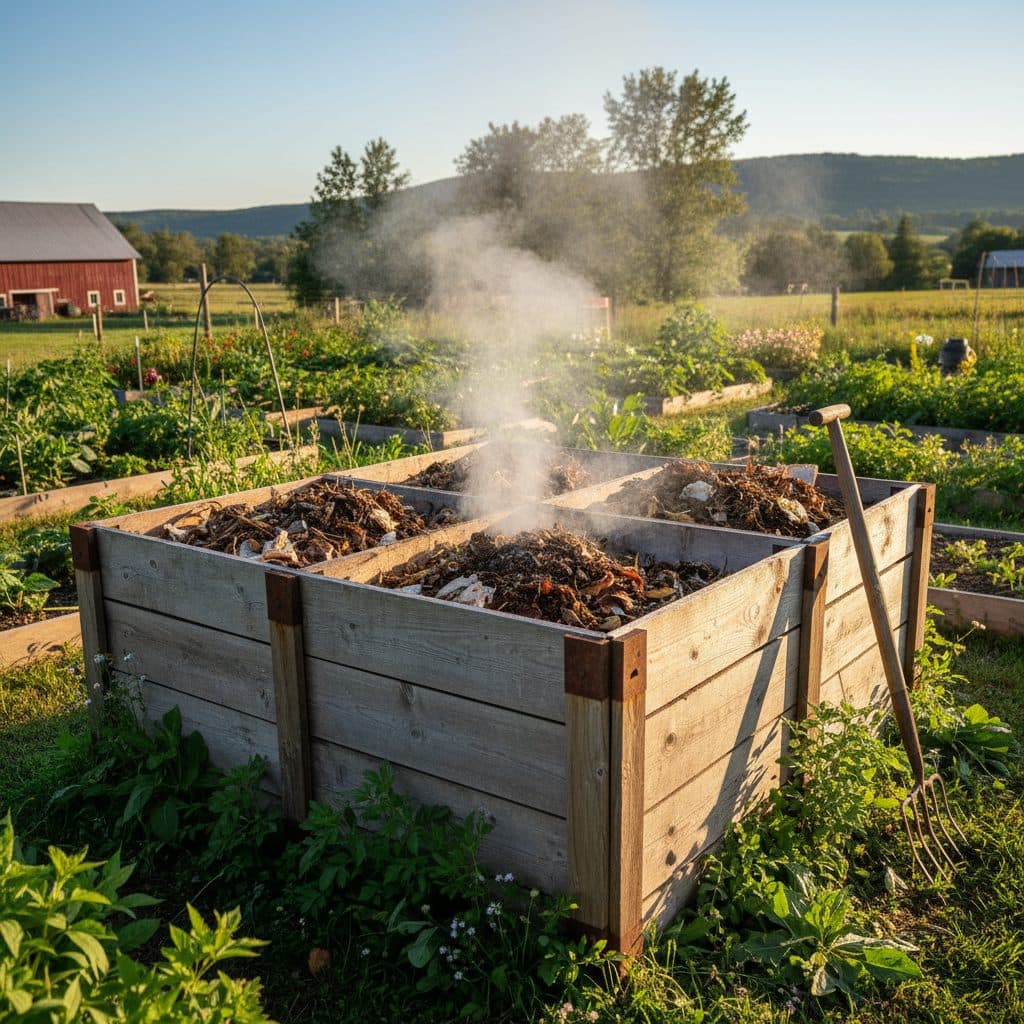
Key takeaways
- Maintain a 30:1 carbon-to-nitrogen ratio for efficient decomposition and to prevent odors.
- Address overly wet piles by adding dry, carbon-rich materials like wood chips or shredded paper, and increasing aeration.
- Rehydrate dry piles by adding water gradually and incorporating fresh, nitrogen-rich greens, especially in arid regions.
- Combat slimy conditions by ensuring proper moisture balance and adequate oxygen flow throughout the pile.
- Vermicomposting offers a compact, odor-free solution for kitchen scraps, producing nutrient-rich castings in 3-6 months.
- Biochar improves soil structure, water retention by up to 20%, and nutrient availability over decades.
Quick answer: To fix compost problems, maintain an ideal 30:1 carbon-to-nitrogen ratio and 40-60% moisture. Address wet piles with dry carbon and aeration, and dry piles with water and nitrogen-rich greens.
In the humid summers of the Southeast, maintaining a compost pile can be a challenge, often leading to a sodden, smelly mess. Conversely, growers in arid regions like Arizona’s Sonoran Desert frequently battle piles that are too dry to break down effectively. Whether your compost is a mucky, anaerobic soup or a dusty, dormant heap, understanding the core principles of decomposition can help you get it back on track. A healthy compost pile is a living system, teeming with billions of microorganisms that convert organic waste into nutrient-rich soil amendment.
Achieving the right balance of carbon, nitrogen, moisture, and air supports successful composting. This balance ensures rapid decomposition, minimizes unpleasant odors, and produces high-quality finished compost. We will explore practical strategies for fixing common compost problems, from overly wet and ‘slimy’ conditions to piles that are too dry, and also discuss advanced methods like vermicomposting and biochar application to boost your soil fertility efforts across the US, from USDA zone 3 to zone 10.
Getting the ratio right: carbon, nitrogen, and moisture
The foundation of a productive compost pile lies in its carbon-to-nitrogen (C:N) ratio and consistent moisture. Microorganisms, the tiny workers responsible for decomposition, thrive when they have access to both energy (carbon) and protein (nitrogen) in the right proportions. An ideal C:N ratio for rapid composting is approximately 30:1. Too much nitrogen, often from excessive green materials like fresh grass clippings, can lead to a dense, wet, and smelly pile, as the microbes quickly consume the nitrogen and release ammonia gas. Too much carbon, from materials such as wood chips or straw, will slow decomposition to a crawl, potentially taking over a year to break down.
maintaining ideal moisture levels
Moisture content is equally critical, ideally hovering between 40% and 60%. Imagine a wrung-out sponge — that is the texture you are aiming for. If your pile is too dry, microbial activity grinds to a halt, and decomposition ceases. If it is too wet, oxygen is displaced, creating anaerobic conditions that produce foul odors and slow breakdown. Regularly checking the moisture level, perhaps with a 3-in-1 soil moisture meter, can help maintain this balance. Turning the pile every few days also introduces oxygen, which is vital for the thermophilic bacteria that generate heat, pushing temperatures up to 140°F to 160°F in a well-managed pile.
- Greens (Nitrogen-rich): Fresh grass clippings, fruit and vegetable scraps, coffee grounds, fresh manure.
- Browns (Carbon-rich): Dry leaves, shredded cardboard, wood chips, straw, sawdust.
- Water: Essential for microbial activity; use a hose or watering can to moisten dry spots.
- Air: Provided by turning the pile and ensuring coarse materials are mixed in.
When your pile is too wet: combating sliminess
An overly wet compost pile is a common issue, especially in regions with high rainfall, such as the Pacific Northwest, where annual precipitation can exceed 30 inches. This excess moisture displaces air, leading to anaerobic decomposition which produces foul, sulfurous odors and a dense, ‘slimy’ texture. The adjective ‘slimy’ describes something having a viscous, slippery, or glutinous consistency, and in a compost pile, it indicates a lack of oxygen and proper breakdown [1]. Some medical literature even uses the term ‘slimy-myxoid’ to describe certain tumor characteristics [2].
drying out and aerating a soggy pile
To fix a wet, slimy pile, the primary goal is to introduce dry, carbon-rich materials and increase aeration. Start by adding a significant amount of brown materials like shredded dry leaves, straw, wood chips, or even torn newspaper. For every 5 gallons of wet material, consider adding at least 1 gallon of dry browns. Turning the pile thoroughly will help distribute these dry materials and introduce much-needed oxygen. If you have a large pile, consider using an aeration tool or pitchfork to create air channels. For smaller, very wet kitchen scraps, dehydrating food waste before adding it to the pile can prevent future issues. Aim to turn the pile every two to three days until the moisture content feels like a damp sponge, not a soaked one.
- Add dry carbon: Incorporate shredded cardboard, wood shavings, or dry leaves to absorb excess moisture.
- Turn frequently: Mix the pile every 2-3 days to introduce oxygen and dry out wet pockets.
- Create air pockets: Use a stick or aerator to poke holes, especially in dense, wet areas.
- Reduce wet inputs: Temporarily decrease additions of high-moisture items like fresh fruit scraps.
Too dry to decompose: bringing life back to a parched pile
While a wet pile is problematic, a dry compost pile is equally ineffective. In dry climates, such as the high desert regions of Nevada or the Central Valley of California, piles can quickly become desiccated, halting microbial activity. Without sufficient moisture, the microorganisms cannot move or process nutrients, and decomposition effectively stops. Your pile might look like a dusty collection of materials, with little to no heat generated, even if it contains a good mix of browns and greens. A soil moisture meter can confirm if your pile is below the optimal 40% moisture threshold.
rehydrating and reactivating
Rehydrating a dry pile requires a measured approach. Start by thoroughly wetting the pile, adding water slowly with a hose or watering can. Aim to add about 1 to 2 gallons of water per cubic foot of dry material, checking frequently to avoid over-saturating it. As you add water, turn the pile to ensure even distribution and break up any dry clumps. Incorporating fresh, nitrogen-rich ‘greens’ like grass clippings or vegetable scraps can also help, as these materials contain significant moisture (often 70% to 90% water) and provide a boost of nutrients for the reactivating microbes. After rehydration, monitor the pile daily for the first week, and turn it every 3 to 4 days to maintain aeration and consistent moisture levels, ensuring temperatures begin to rise again.
- Add water gradually: Moisten the pile until it feels like a damp sponge, avoiding saturation.
- Mix in fresh greens: Incorporate nitrogen-rich materials with high moisture content to jumpstart activity.
- Turn the pile thoroughly: Distribute water and greens evenly throughout the entire heap.
- Cover the pile: Use a tarp or thick layer of browns to prevent rapid moisture evaporation, especially in sunny, windy areas.
Worms at work: the benefits of vermicomposting
For those with limited space or a desire to compost kitchen scraps without odors, vermicomposting offers an excellent alternative. This method uses specific species of composting worms, primarily red wigglers (Eisenia fetida), to break down organic matter into a nutrient-dense soil amendment called worm castings. Unlike traditional composting, vermicomposting can be done indoors or in small outdoor spaces, making it suitable for urban growers in cities like Seattle or apartment dwellers across the US. A typical worm bin measuring 18 in x 24 in x 12 in can process up to 1 pound of food scraps per week with just one pound of worms.
harvesting nutrient-rich castings
Vermicomposting is a relatively fast process; usable castings can be harvested in as little as 3 to 6 months, depending on the volume of inputs and the number of worms. These castings are rich in beneficial microbes, enzymes, and plant-available nutrients, often containing 5 times more nitrogen, 7 times more phosphorus, and 11 times more potassium than typical garden soil. They can be used as a top dressing, mixed into potting soil at a 10% to 20% ratio, or brewed into a ‘worm tea’ for liquid feeding. While fermented soybean meal provides a concentrated nitrogen boost, worm castings offer a broader spectrum of benefits, improving soil structure and microbial diversity over time. The USDA Natural Resources Conservation Service (NRCS) emphasizes the importance of diverse organic matter for healthy soil systems [5].
- Red Wigglers (Eisenia fetida): The preferred worm species for their efficiency in consuming organic waste.
- Kitchen Scraps: Fruit and vegetable peels, coffee grounds, tea bags, bread, and eggshells are ideal.
- Bedding Material: Shredded newspaper, cardboard, or coconut coir provides habitat and carbon.
- Moisture: Maintain a damp, but not wet, environment, similar to a wrung-out sponge.
Biochar: a stable solution for soil structure and water retention
Beyond traditional composting and vermicomposting, biochar offers a long-term solution for improving soil fertility and structure. Biochar is a highly porous, carbon-rich material created by heating biomass (like wood, crop residues, or manure) in a low-oxygen environment, a process called pyrolysis. Unlike compost, which continues to decompose, biochar is extremely stable and can persist in soil for hundreds, even thousands, of years. Its unique structure provides a vast surface area for beneficial microbes to colonize, and it acts like a sponge, significantly improving the soil’s ability to retain water and nutrients.
applying biochar for lasting benefits
Research from various agricultural universities, including those in the Midwest, shows that adding biochar to soil can increase water holding capacity by up to 20% in sandy soils, reducing the need for frequent irrigation. It also helps to prevent nutrient leaching, making fertilizers more efficient by 10% to 30% and reducing runoff. This aligns with the EPA’s ‘Soak Up the Rain’ initiative, which advocates for healthy soils to manage stormwater effectively [6]. Biochar is typically applied at rates of 5% to 10% by volume, mixed into the top 6 inches of soil. For example, a 100 square foot garden bed would benefit from approximately 1.5 to 3 cubic feet of biochar. While it does not provide immediate nutrient release like compost, its long-term benefits for soil health and plant resilience are substantial, particularly in degraded or nutrient-poor soils.
- Increased Water Retention: Biochar’s porosity helps soil hold more water, reducing drought stress.
- Enhanced Nutrient Retention: It binds to nutrients, preventing them from leaching away from plant roots.
- Improved Soil Structure: Creates stable aggregates, leading to better aeration and drainage.
- Microbial Habitat: Provides a vast surface area for beneficial soil microorganisms to thrive.
Comparison of Soil Fertility Methods
Feature | Traditional Compost | Vermicompost | Biochar |
|---|---|---|---|
Decomposition Time | 3-12 months | 3-6 months | N/A (stable carbon) |
Nutrient Release | Slow, steady | Fast, concentrated | Very slow, long-term retention |
Odor Potential | Moderate (if unbalanced) | Low (if managed well) | None |
Space Required | Moderate to large | Small (indoor/outdoor) | N/A (amendment) |
Longevity in Soil | 1-3 years | 1-2 years | Hundreds to thousands of years |
Compost Temperature: A well-managed compost pile can reach temperatures of 140°F to 160°F, effectively killing weed seeds and pathogens within 72 hours.
Biochar Water Retention: Adding just 5% biochar by volume can increase soil water holding capacity by up to 20% in sandy soils, reducing irrigation needs.
Browse soil fertility solutions
Frequently asked questions
How do I know if my compost pile is too wet?
If your compost pile smells like rotten eggs or ammonia, and feels soggy or ‘slimy’ when squeezed, it is likely too wet. An ideal pile should feel like a wrung-out sponge, with moisture content between 40% and 60%.
What is the ideal carbon-to-nitrogen ratio for composting?
The optimal carbon-to-nitrogen (C:N) ratio for efficient decomposition in a compost pile is approximately 30:1. This balance ensures microorganisms have enough energy and protein to break down organic materials effectively, often leading to finished compost in 3 to 6 months.
Can I add meat scraps to my compost?
It is generally not recommended to add meat scraps, bones, or dairy products to home compost piles. These items can attract pests like rodents and flies, and may not break down completely in smaller, cooler piles, potentially taking over 6 months to decompose.
How long does vermicomposting take to produce usable castings?
Under optimal conditions, vermicomposting can produce usable worm castings in as little as 3 to 6 months. Factors like the type and volume of food scraps, the number of worms, and maintaining a consistent temperature between 55°F and 77°F will influence the speed of decomposition.
What are the long-term benefits of using biochar?
Biochar provides long-term benefits by improving soil structure, increasing water retention by up to 20% in sandy soils, and enhancing nutrient availability over decades. Its stable carbon structure can persist in soil for hundreds of years, making it a lasting soil amendment.
How much water should I add to a dry compost pile?
When rehydrating a dry compost pile, add water gradually, aiming for about 1 to 2 gallons per cubic foot of dry material. The goal is to achieve a moisture level similar to a damp sponge, which is typically 40% to 60% moisture by weight.
References
- slimy, adj. (2023). slimy, adj..
- Mutable and Slimy-Myxoid Pleomorphic Liposarcoma (2023). Mutable and Slimy-Myxoid Pleomorphic Liposarcoma.
- ‘All Those Horrible, Slimy Things’ (2018). ‘All Those Horrible, Slimy Things’.
- ‘All those horrible, slimy things’ (2018). ‘All those horrible, slimy things’.
- USDA Natural Resources Conservation Service (2024). USDA Natural Resources Conservation Service.
- EPA — Soak Up the Rain (2024). EPA — Soak Up the Rain.