Key takeaways
A well-designed drip irrigation system delivers water evenly across beds. Proper emitter spacing and pressure regulation prevent dry spots and line blowouts so plants receive consistent moisture.
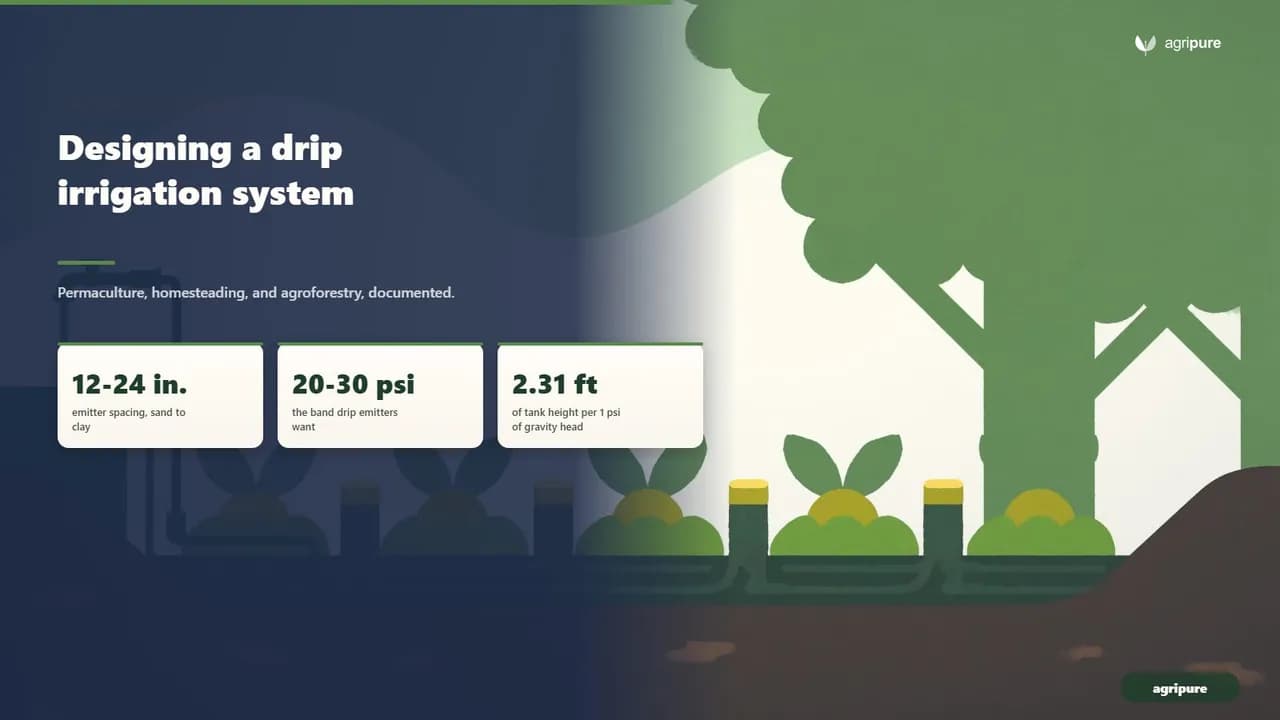
- Space emitters to the soil: roughly 12 in. apart in sand, 18 in. in loam, and 24 in. in clay, because water spreads wide in clay and straight down in sand.
- Drip runs best at about 20 to 30 psi; a fixed regulator after the filter holds it there and stops emitters from blowing off or misting.
- Match emitter flow to soil: low 0.5 gph in clay so it soaks in, higher 2 gph with closer spacing in fast-draining sand.
- Zone the system so each valve serves beds with similar water needs, and keep zones short enough that pressure stays in range end to end.
- Gravity works from a tank (every 2.31 ft of height adds 1 psi), but most beds want the tank elevated or a small solar pump for steady flow.
- Pressure-compensating emitters hold the same flow across a long run or a slope; pressure-sensitive ones drift, so pick PC for anything uneven.
A drip system that waters the first 3 beds beautifully and starves the last 2 is the most common backyard irrigation failure, and it almost always traces to 2 design choices made by default rather than on purpose: emitter spacing and pressure. Soak those two and a drip layout becomes reliable plumbing. This guide walks emitter spacing by soil, pressure regulation and zoning, the choice between a gravity tank feed and a solar pump, and a worked tank-to-drip sizing example. For the catchment that feeds it, see our guide to rainwater harvesting and storage; for the pure no-power mechanics, see running drip without electricity.
Emitter spacing follows the soil
The single most useful number in drip design is emitter spacing, and it is set by your soil, not your plants. Colorado State University Extension gives the rule directly: “locate emitters 12 inches apart in sand, 18 inches apart in loam, and 24 inches apart in clay.” The reason is how water moves underground.
Water behaves completely differently in each soil. DripWorks puts it plainly: in clay “water is absorbed slowly and moisture spreads out laterally,” while “in sandy soil, water travels vertically, straight down.” So a clay bed wets a wide disc from each emitter and you can spread them to 24 in.; a sandy bed makes a narrow deep plume and needs them at 12 in. or closer to avoid dry gaps between plants.
Plant count follows the same logic. Colorado State notes that “if 1 to 2 emitters are recommended for a plant in a clay soil, 2 or 3 may be required in a sandy soil” to wet a wide enough root zone. Design to the wetting pattern, not to a tidy grid; the soil decides how far one emitter’s water actually reaches.
Dig a test hole first: run 1 emitter for 1 hour, then dig beside it. A narrow plume 12 in. down means sandy soil and close spacing; a wide shallow disc 18 to 24 in. across means clay and room to spread emitters.
Match emitter flow to the soil too
Spacing is half the soil story; flow rate is the other half. Emitters are sold by gallons per hour, and Colorado State lists the common range: “emitters are sold by flow rates and typically are 1/2, 1, 2 and 4 gph.” Picking the right one is again a soil question, not a guess.
In clay, slow is the whole point. DripWorks recommends you “use emitters with a low 1/2 gallon per hour rating” in clay because “these give the water time to soak in and spread out in a nice wide pattern”; a faster emitter just pools and runs off the tight surface. In sand, the advice flips: “use higher flow emitters like the 2 or 5 gallon per hour emitter with closer emitter spacing,” because fast-draining sand can take the water and you need volume to wet a useful width.
The soil-to-emitter cheat sheet: heavy clay wants 0.5 gph emitters spaced up to 24 in.; loam takes 1 gph at about 18 in.; fast sand wants 2 gph (or more) at 12 in. or tighter. Flow and spacing move together: slower and wider in clay, faster and closer in sand.
One more emitter choice matters on any uneven ground: pressure-compensating versus pressure-sensitive. Colorado State draws the distinction: “pressure sensitive emitters deliver a higher flow at higher water pressures; pressure compensating emitters provide the same flow over a wide pressure range.” On a 100 ft run or a sloped bed, pressure-compensating (PC) emitters keep the far end watering at the same rate as the near end.
Pressure: the quiet make-or-break
Emitters are calibrated for a narrow pressure band, and missing it is why far beds go dry or lines blow apart. Colorado State sets the target: “drip systems are designed to operate at around 20 to 30 psi depending on the manufacturer.” Most household hose bibs deliver 40 to 80 psi (far too high), so a pressure regulator is not optional.
A drip irrigation manifold at a garden bed: a hose-thread backflow preventer, a Y-filter, and a pressure regulator feeding poly tubing into raised beds
The fix is a fixed regulator placed after the filter and before the tubing, set to about 25 psi. There is a catch worth knowing: Drip Depot notes that “most pressure regulators require at least 5 psi above the preset pressure in order to regulate,” so a 25 psi regulator needs at least 30 psi coming in to do its job. Feed it too little and it passes whatever it gets.
The standard order at the source is fixed: backflow preventer, then filter, then regulator, then tubing. A filter goes ahead of the regulator so grit never reaches the emitters, which clog at the 0.5 to 2 gph orifices that make drip efficient. Skip it and a single season of well sediment can plug half a zone.
The 5-psi headroom trap: a 25 psi regulator needs at least 30 psi feeding it. On a gravity tank that may be physically impossible, which is exactly why low-pressure dripline exists: it is built to meter water below the 20 psi a regulated system assumes.
Zoning a system that stays even
Past about 200 to 400 ft of drip line, a single zone runs out of pressure before it runs out of tubing, and the last plants suffer. Zoning solves this by splitting the garden into valved sections, each short enough to hold pressure end to end. The grouping rule is about water need, not just geography.
Group beds that drink alike onto one valve: thirsty summer vegetables on one zone, established perennials on another, a lawn strip on a third. That way each zone can run for the right duration without over- or under-watering its neighbours. A lawn drip zone, for instance, runs longer and less often than a salad bed, so the 2 do not belong on the same valve.
Zone | Typical plants | Emitter / line | Run pattern |
|---|---|---|---|
Vegetable beds | Tomatoes, squash, greens | 0.5-1 gph, 12-18 in. | Short, frequent |
Perennials / shrubs | Berries, established trees | 1-2 gph, wider | Long, infrequent |
Lawn strip | Turf | Inline dripline, 6-12 in. | Long, less frequent |
Containers | Pots, raised planters | 0.5 gph button | Short, daily |
Keep each zone within the flow your source can deliver. A 25 psi heavy-duty regulator handles a flow range of about 0.5 to 12 gallons per minute; tally your emitters (a bed of 50 emitters at 1 gph draws under 1 GPM) and keep every zone comfortably under the source ceiling. Short, well-matched zones beat one heroic long line every time.
Feeding it: gravity tank or solar pump
A drip system needs a source, and on a homestead that usually means a rainwater tank, fed either by gravity or by a small pump. Gravity is elegant but pressure-limited, and the governing number is simple: every 2.31 ft of tank height adds 1 psi, so “for every 10 feet of rise you will gain 4.3 psi.”
That math is humbling for drip. Drip Depot notes a tank “would have to be 35 feet off the ground” to reach 15 psi by gravity alone, which is rare on a homestead. Below about 4 psi, emitters “will allow the water through, but they won’t be able to regulate the flow properly,” so true gravity drip needs either low-pressure emitters or a tank up on a stand. The gravity exception is real, though: Drip Depot confirms you can skip the regulator entirely “if you are using a gravity system with very low pressure, or very low flow.”
When gravity cannot reach 20 psi, a small solar pump bridges the gap, pulling from a ground-level tank and pressurizing the zones during daylight. Our guide to a solar water pump covers sizing that pump; the pattern that works best is to pump into an elevated tank or a small pressure tank, then drip from there. For the no-power purist, running drip without electricity details the gravity-only build.
A worked tank-to-drip example
Put the numbers together for a real plot: 4 raised beds, loam soil, 40 plants total, fed from a rainwater tank. Loam means 18-in. spacing at roughly 1 gph, so 40 emitters draw about 40 gph, or two-thirds of a gallon per minute, an easy load for any source.
For pressure, you have 2 honest paths. Elevate the tank: at 2.31 ft per psi, a stand about 30 ft high would be needed for a full 13 psi, which is impractical, so most growers either run low-pressure dripline rated for gravity off a 4 to 8 ft tank, or add a small solar pump to hit the 25 psi a standard regulator wants. Size the tank to a week of watering: 40 gph over a 30-minute daily set is 20 gallons a day, so a 150-gallon tank carries a 7-day buffer with margin.
Design step | This example | Rule used |
|---|---|---|
Soil and spacing | Loam, 18 in. | CSU: 18 in. in loam |
Emitter flow | 1 gph x 40 = 40 gph | ~0.7 GPM total draw |
Daily volume | 30-min set = 20 gal/day | Set length x flow |
Tank for 7 days | ~150 gal | Daily x days of buffer |
Feed | Gravity dripline or solar pump | 2.31 ft = 1 psi |
Sanity check the whole run: add every emitter’s gph, divide by 60 for GPM, and confirm your source and regulator handle it (a 25 psi unit passes 0.5 to 12 GPM). If the total exceeds the source, split into more zones rather than starving the far end.
The takeaway
A drip system is not hard to design once you respect the 2 numbers that govern it. Space and size emitters to the soil (12 in. and 2 gph in sand, 24 in. and 0.5 gph in clay, loam in between) because the soil decides where the water goes. Hold pressure near 25 psi with a filter and regulator at the source, and use pressure-compensating emitters on any long or sloped run. Zone beds that drink alike, keep each zone under your source’s flow, and feed it from a tank by gravity where height allows or a small solar pump where it does not. Do that and every bed, first to last, gets the same steady drink.
Frequently asked questions
How far apart should drip emitters be?
Space them to your soil. Colorado State University Extension recommends about 12 inches apart in sand, 18 inches in loam, and 24 inches in clay. Water spreads wide and laterally in clay so emitters can sit far apart, but travels straight down in sand, so they must be close to avoid dry gaps. On closely planted beds, inline dripline at 6 to 12 inch spacing is often easier than individual emitters.
What pressure should a drip irrigation system run at?
Around 20 to 30 psi, depending on the emitter manufacturer. Most home water supplies run 40 to 80 psi, so install a fixed pressure regulator (commonly 25 psi) after the filter. Note that a regulator needs at least 5 psi above its preset to work, so a 25 psi regulator wants at least 30 psi coming in. Too much pressure makes emitters mist or pop off; too little starves the far end.
What flow-rate emitter should I use for my soil?
Match flow to drainage. Use low 0.5 gph emitters in heavy clay so water has time to soak in and spread wide, and higher 2 gph (or more) emitters with closer spacing in fast-draining sand, where you need volume to wet a useful root zone. Loam sits in the middle at about 1 gph. Slower and wider in clay, faster and closer in sand.
Can I run drip irrigation from a rainwater tank by gravity?
Yes, within limits. Every 2.31 feet of tank height adds about 1 psi, so a tank gains 4.3 psi for every 10 feet of rise. Reaching a full 15 psi by gravity needs a tank roughly 35 feet up, which is rare, so gravity drip usually uses low-pressure dripline off a 4 to 8 foot elevated tank. Below about 4 psi, standard emitters cannot regulate flow properly.
When do I need more than one zone?
Split into zones when the total drip line exceeds what one valve can pressurize (often past a few hundred feet) or when beds have different water needs. Group beds that drink alike: thirsty vegetables on one valve, established perennials on another, a lawn strip on a third. Keep each zone’s total emitter flow under your source and regulator capacity, which is about 0.5 to 12 gallons per minute for a 25 psi heavy-duty regulator.
Should I use pressure-compensating emitters?
Use them on any long run or slope. Pressure-sensitive emitters deliver more flow at higher pressure, so the near end of a long line waters faster than the far end. Pressure-compensating emitters hold the same flow across a wide pressure range, keeping output even from the first plant to the last and across changes in elevation. On flat, short beds either type works.
References
- Colorado State University Extension. “Drip Irrigation for Home Gardens (4.702).” extension.colostate.edu
- DripWorks. “Irrigation Tips for Clay Soil, Sandy Soil and Loam.” dripworks.com
- Drip Depot. “Irrigation Pressure Regulator Buying Guide.” dripdepot.com
- Drip Depot. “Gravity Feed System Basics: Elevation, Pressure, Water Quality.” dripdepot.com
- DripWorks. “Top 15 Drip Irrigation Questions.” dripworks.com
- DIG Corporation. “25 and 30 PSI Heavy Duty Pressure Regulator.” digcorp.com