Key takeaways

Learn to identify and safely forage common wild edible greens like dandelion, purslane, and plantain. Always ensure 100% positive identification before consumption.
- Be 100% certain of an identification before you eat anything; cross-check against at least 3 plant guides, and when in doubt, leave it out.
- Skip foraging within about 30 feet of roadsides, sprayed lawns, and industrial ground, where herbicides and heavy metals concentrate.
- Never guess on mushrooms — assume every wild mushroom is poisonous until an expert confirms it, because several deadly Amanita species mimic edibles.
- Six beginner greens — dandelion, purslane, plantain, lamb’s quarters, chickweed, and violet — share one clear ID trait each that separates them from lookalikes.
- The riskiest lookalike pair is purslane versus spurge: a broken stem that bleeds milky sap is toxic spurge, not the clear-sapped purslane.
A backyard lawn left unsprayed will grow at least 5 or 6 edible plants on its own, and most beginners walk past them every day. The trouble is that 1 wrong guess among hundreds of green rosettes can mean a hospital visit, so the order of learning matters: safety rules first, identification traits second.
This guide front-loads the 3 rules that keep foragers alive, then profiles 6 plants that are common across North America, hard to confuse once you know the single trait to check, and useful enough to be worth learning first. Every figure below traces to a named university extension or research source listed at the end.
The safety rules that come before any plant
No identification trait matters until 3 habits are automatic. Mississippi State University Extension is blunt about the first one: be 100 percent certain a plant is correctly identified and not poisonous before eating it, and cross-check the plant against at least 3 different plant resource guides rather than a single app photo. Plant lookalikes are everywhere, and some are poisonous, so the working motto is simple — when in doubt, leave it out.
The second rule is about location. The same extension warns foragers to avoid ground where herbicides, pesticides, heavy metals, and industrial runoff collect — roadsides, power-line right-of-ways, and old industrial zones. A dandelion 6 feet from a sprayed driveway is not the same plant as one in a clean meadow, even if it looks identical.
Why mushrooms are a separate, harder game
The third rule is a hard line: do not apply plant confidence to fungi. Ohio State University Extension states that no mushroom should be eaten unless edibility is absolutely certain and that you should assume every mushroom is poisonous until it is properly identified. At least 2 all-white Amanita species, the destroying angels, grow in mixed woods across North America and are deadly, and a beginner cannot reliably tell a safe dinner from a fatal one. Greens are forgiving; mushrooms are not.
Edibility-test caveat: the old “universal edibility test” — taste a crumb, wait, escalate — is a last-resort survival tactic, not a foraging method. It does nothing against the slow-acting toxins in plants like spurge, so use positive identification instead, never a taste test.
Dandelion and plantain: the two no-fuss starters
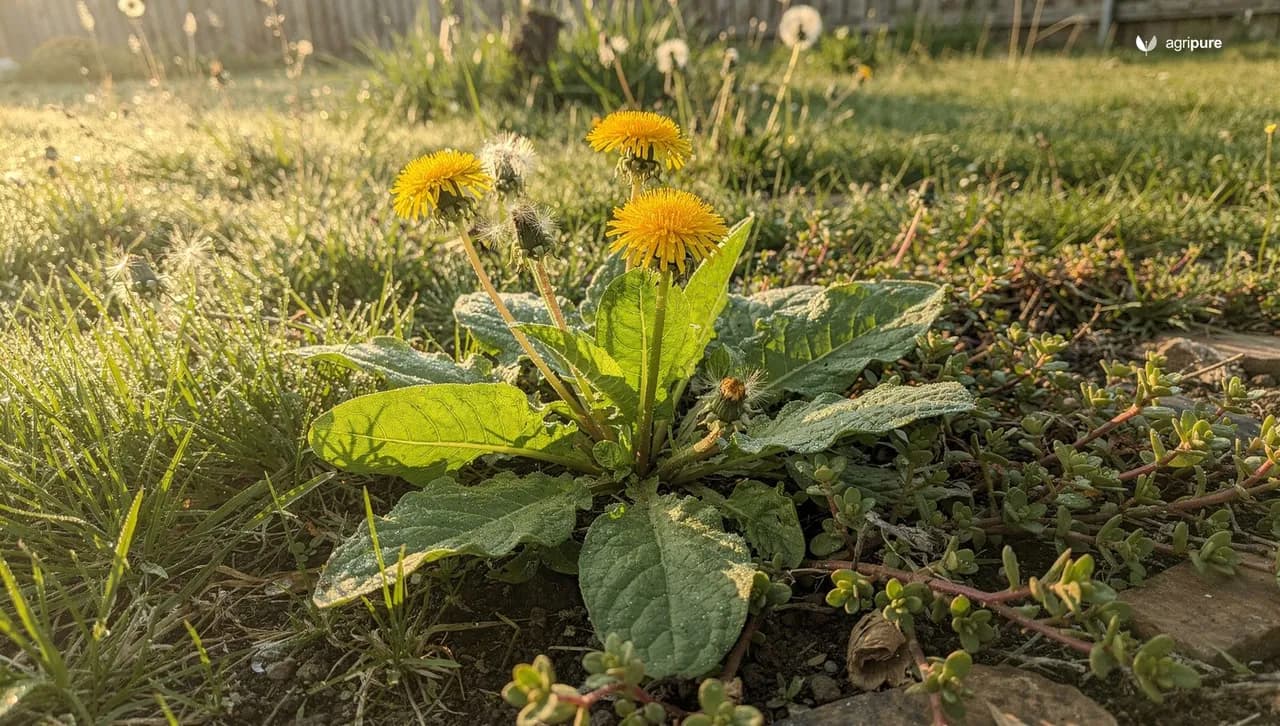
Those safety rules in hand, the two easiest plants to learn share a habit: both grow as a flat basal rosette with no toxic rosette lookalike that will seriously hurt you. Dandelion (Taraxacum officinale) is identified by University of Wisconsin-Madison Horticulture as a rosette of lobed leaves topped by a single yellow flower head on one smooth, hollow stalk that bleeds milky latex sap. The 1-stalk-1-flower rule is the key: branching, multi-flower lookalikes are different plants.
Broadleaf plantain (Plantago major) is even simpler. NC State Extension describes a rosette of broadly egg-shaped leaves 2 to 8 inches long with 5 to 7 prominent parallel veins and a leafless flower spike like a rat tail. The parallel veins are the tell — most edible broadleaf weeds have branching veins, so a rosette with stringy parallel ribs is almost certainly plantain.
- Dandelion trait: 1 hollow stalk, 1 flower, milky sap; young leaves raw, older leaves cooked, roots roasted.
- Plantain trait: parallel-veined oval leaves in a rosette; young leaves used like spinach, older leaves boiled.
- Shared caution: both absorb roadside contaminants readily, so the 30-foot rule from sprayed ground matters most here.

Purslane and lamb’s quarters: the nutrition powerhouses with one dangerous twin
These two summer greens carry the most nutrition and, in purslane’s case, the most dangerous lookalike on this list. Purslane (Portulaca oleracea) is a low mat of thick, succulent, paddle-shaped leaves on reddish stems. Its toxic twin is spurge, and Penn State Extension gives the 1 test that settles it: spurge bleeds milky sap when a stem is broken, and is not succulent like purslane. Clear sap and fat juicy leaves mean purslane; thin stems and milky sap mean leave it.
Lamb’s quarters (Chenopodium album) is told apart by texture, not sap. NC State Extension notes its white mealy or powdery coating, densest on the leaf undersides, over goosefoot-shaped leaves on a plant that runs from 4 inches to 6 feet tall. Rub a young leaf and the powder smudges — no common toxic weed shares that coating.
Eat in moderation: both plants hold oxalates, and NC State notes lamb’s quarters in large quantities can cause digestive upset. Cook them like spinach and keep portions reasonable, especially if you are prone to kidney stones.
Chickweed and violet: the delicate spring greens
These last two plants are mild, tender, and best in cool weather, but each has a lookalike that demands a careful look. Common chickweed (Stellaria media) is edible across leaves, stems, and flowers, and NC State Extension flags its 2 signature traits: a single line of white hairs running down one side of the stem and tiny white flowers about 1/4 inch across with 5 petals so deeply notched they look like 10. Its toxic lookalike, scarlet pimpernel, has hairs all around the stem and coral-red flowers — so the 1-line-of-hairs check is decisive.
Common blue violet (Viola sororia) closes the list. NC State Extension describes heart-shaped basal leaves and 5-petaled purple flowers, with young leaves and flowers both used in salads. The catch is that violet leaves can resemble toxic lesser celandine, so a cautious beginner harvests only the unmistakable purple flowers until violet leaves are second nature.
The trait-and-lookalike cheat sheet
One trait per plant, plus the lookalike to rule out, is enough to forage all 6 safely. The table below is the version worth keeping on your phone, drawn from the 6 extension profiles cited here.
Plant | Key ID trait | Lookalike to rule out | Eat which part |
|---|---|---|---|
Dandelion | 1 hollow stalk, 1 flower, milky sap | Cat’s ear (also edible) | Leaves, flowers, roots |
Broadleaf plantain | 5 to 7 parallel leaf veins | None serious | Young leaves |
Purslane | Succulent leaves, clear sap | Spurge (toxic, milky sap) | Leaves, stems |
Lamb’s quarters | White mealy leaf coating | None serious | Leaves (cooked) |
Common chickweed | 1 line of hairs on the stem | Scarlet pimpernel (toxic) | Leaves, stems, flowers |
Common blue violet | Heart leaves, 5-petal purple flower | Lesser celandine (toxic) | Flowers (leaves once expert) |
Across all 6, only 3 carry a genuinely toxic lookalike — purslane, chickweed, and violet — and each of those 3 is settled by 1 visible trait. Learn those traits and the failure modes shrink to almost nothing.
How to start your first season of foraging
These six plants are best learned over a first season that works as a slow build rather than a single big harvest. Pick the 2 safest starters — dandelion and plantain, the ones with no serious toxic twin — and learn them cold before adding the rest. When you do try a new plant, introduce it slowly: a few bites, then a 24-hour wait to rule out an unexpected reaction, since wild greens carry stronger phytonutrients than supermarket produce.
Pair foraging with what you already grow. Many of these common weeds, including the perennial layers of a food forest, double as deliberate edibles, and learning to read them in the wild sharpens how you manage them at home. A clean cut above the crown lets the plant regrow for a second picking 2 to 3 weeks later.

Conclusion
Wild edible plants reward patience over boldness. Lock in the 3 safety rules — 100% positive identification, clean ground away from spray, and never a guess on mushrooms — and the 6 beginner greens here become some of the safest free food in a North American yard. Start with the 2 plants that have no toxic twin, add 1 new plant at a time, and let the single ID trait for each do the heavy lifting.
Frequently asked questions
What are the safest wild edible plants for a beginner?
Dandelion and broadleaf plantain are the safest starters because neither has a toxic lookalike that will seriously harm you. Both grow as flat basal rosettes and are identified by a single trait — dandelion’s lone hollow flower stalk with milky sap, and plantain’s 5 to 7 parallel leaf veins.
How do I tell purslane apart from poisonous spurge?
Break 1 stem and watch the sap. Purslane is succulent with clear sap, while its toxic lookalike spurge bleeds a milky white sap and is not succulent. If a broken stem oozes white, discard the plant; only clear-sapped, fat-leaved purslane is safe to eat.
Can I forage plants from the roadside?
No. Roadsides, sprayed lawns, power-line corridors, and old industrial sites concentrate herbicides, pesticides, and heavy metals. Extension guidance is to avoid all 4 of these areas and harvest only from clean ground at least 30 feet from traffic and spray drift.
Are wild mushrooms safe to forage as a beginner?
Treat mushrooms as off-limits until you have expert training. Assume every wild mushroom is poisonous until properly identified, because at least 2 deadly all-white Amanita species mimic edible ones. Unlike greens, a single misidentified mushroom can be fatal.
Do I need to cook wild edible greens before eating them?
It depends on the plant. Dandelion, chickweed, and violet are fine raw in small amounts, while lamb’s quarters is best cooked like spinach because it holds oxalates and can cause digestive upset in large quantities. Introduce any new green slowly and wait 24 hours.
References
- Mississippi State University Extension — Forgotten Foods: Introduction to Wild Edible Plants
- Ohio State University Extension — Wild Mushrooms: Edible or Poisonous?
- University of Wisconsin-Madison Horticulture — Dandelion, Taraxacum officinale
- Penn State Extension — Purslane
- NC State Extension Gardener Plant Toolbox — Plantago major (Broadleaf Plantain)
- NC State Extension Gardener Plant Toolbox — Chenopodium album (Lamb’s Quarters)
- NC State Extension Gardener Plant Toolbox — Stellaria media (Common Chickweed)
- NC State Extension Gardener Plant Toolbox — Viola sororia (Common Blue Violet)