Search “nitrogen-fixing plants” and you will drown in advice written for places that barely freeze. Acacias, leucaena, pigeon pea, sunn hemp: all excellent, none of which will see April if your January routinely drops below -20 C. If you garden or farm where the soil heaves with frost and snow lies for months, you need a shorter, harder-tested list. The good news is that it exists. Cold-hardy nitrogen-fixing plants are real, well documented, and capable of feeding your soil through winters that would kill most of the species on a typical permaculture chart.
This guide is built around plants with proven performance in USDA zones 2 through 6 (broadly RHS hardiness H6-H7, and the cool-temperate band in Australian terms). It covers both halves of the nitrogen-fixing world, the legumes and the often-overlooked actinorhizal shrubs, and shows how to use them as support species in a cold-climate syntropic or food-forest system rather than as a crop in their own right.
Two routes to free nitrogen, and why the cold matters
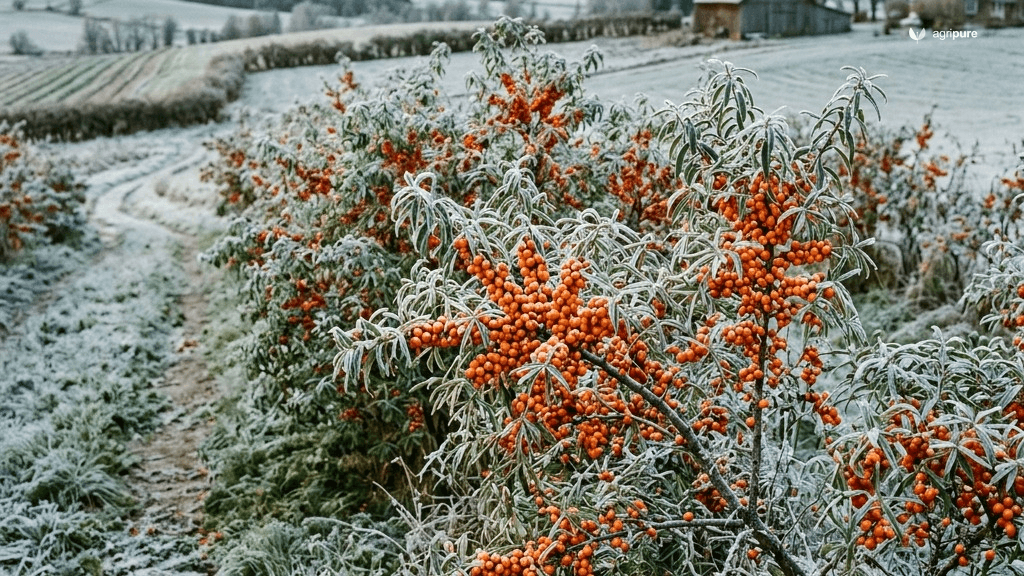
Frost-kissed branches of a Sea Buckthorn shrub loaded with bright orange berries in winter.
A winter-hardy Sea Buckthorn (Hippophae rhamnoides) bearing nutritious berries in cold climates.
Nitrogen fixation is a partnership between a plant and a microbe that converts inert atmospheric nitrogen (N₂) into a form roots can use. There are two distinct guilds, and the distinction is practical, not academic.
- Legumes (clovers, vetches, medicks, peas) partner with Rhizobium bacteria in root nodules. They are fast, often annual or short-lived, and ideal as ground-layer cover crops.
- Actinorhizal plants (sea buckthorn, Russian olive, alders, goumi) partner with a filamentous soil actinobacterium called Frankia. These are woody, long-lived, and built for hostile ground. Frankia can fix nitrogen even free-living and forms tough resting structures, which is part of why actinorhizal plants are classic pioneers on moraines, dunes, and disturbed sites where available nitrogen is scarce.
Cold matters because nitrogenase, the enzyme doing the work, is temperature-driven. In sea buckthorn stands, nitrogen-fixing activity in the root nodules is high from roughly May to September, when air temperatures are up and photosynthesis is active, and falls away in the cold months. So in a hard-frost climate your fixers are not feeding the soil year-round; they are loading it during a compressed warm season. That is exactly why winter survival is the first thing to screen for, ahead of how much nitrogen a plant fixes on paper.
The cold-hardy shortlist
Below are species with documented hardiness into the coldest zones, drawn from cover-crop research and the AgriPure plant database. Figures for fixation are field estimates and vary widely with inoculation, soil, and stand age; treat them as ranges, not guarantees.
Plant | USDA / RHS | Type | Role in system |
|---|---|---|---|
2-7 / H7 | Actinorhizal shrub-tree | Windbreak + N (use with caution) | |
3-8 / H7 | Actinorhizal shrub | Edible berry + N pioneer | |
4-9 / H6 | Legume (winter annual) | Overwinter cover crop | |
4-8 / H6 | Legume (short-lived perennial) | Living mulch, fodder | |
4-9 / H7 | Legume (perennial groundcover) | Permanent understorey | |
3-9 / H7 | Legume (self-seeding annual) | Gap-filler, weed suppressor |
The actinorhizal shrubs: woody fixers for the structure layer
Sea buckthorn (Hippophae rhamnoides) is the standout for cold climates. Hardy to USDA zone 3 (RHS H7), it forms Frankia nodules and has been measured fixing on the order of 179 kg N per hectare per year in a UK stand, while also yielding orange berries that are among the richest natural sources of vitamin C. That dual function, soil-feeder and cash crop, is rare in a single hardy plant. It tolerates poor, sandy, and saline ground, making it a genuine pioneer for degraded sites.
Russian olive (Elaeagnus angustifolia) is the hardiest fixer on this list, rated to USDA zone 2 (H7), and an aggressive nitrogen contributor that raises soil nitrogen and mineralisation rates beneath its canopy. It also makes an excellent windbreak. But it carries a serious caveat: in much of North America it is a damaging riparian invasive, appearing on dozens of state noxious-weed lists, precisely because it fixes nitrogen so well that it out-competes natives on marginal land. Treat it as a tool for contained, managed plantings only, and check local regulations before planting. Where it is restricted, sea buckthorn or goumi (Elaeagnus multiflora) are safer woody alternatives.
The legumes: the cover-crop workhorses
Hairy vetch (Vicia villosa) is the most winter-hardy of the vetches, reliably overwintering through zone 4 and into zone 3 with snow cover, and surviving to around -29 C. Well-nodulated stands commonly add roughly 80-150 lb of nitrogen per acre, making it one of the few legumes that matches its spring biomass with a heavy nitrogen handoff to the next crop. Sow it in late summer or early autumn so it establishes before freeze-up.
The clovers give you perennial, low-maintenance coverage. Red clover (Trifolium pratense), a short-lived perennial hardy through zone 4 (often listed to zone 3), typically fixes 70-150 lb N per acre and persists two to three years, doubling as fodder. White clover (Trifolium repens, H7) is the tougher long-term choice: a stoloniferous perennial that knits into a permanent living mulch and can fix 100-200 lb N per acre, with Dutch white types being a safe bet for zones 3-4.
Black medick (Medicago lupulina, H7, zone 3) is the quiet workhorse. A self-seeding annual that re-establishes from its own seed bank year after year, it thrives in poor soils, suppresses weeds, and in prairie rotations has lifted soil nitrogen supply by an average of around 38 kg per hectare. It is the plant to under-sow where you want fixation to take care of itself.
Inoculation: do not skip this step
A legume without the right bacteria fixes nothing. Rhizobium strains are crop-specific, so buy seed pre-inoculated or apply the correct inoculant at sowing, especially on ground that has not grown that legume before. Clovers and medicks share some strains; vetch needs its own. Actinorhizal shrubs partner with Frankia, which is often already present in soils near existing alders or Elaeagnus, but on sterile or heavily disturbed sites nursery stock raised with the symbiont gives the most reliable start. Most legumes also fix best at a near-neutral soil pH of about 6.0-7.0.
Designing with fixers in a cold-climate system
In syntropic agroforestry the guiding idea is to grow a generous fraction of your plants purely for biomass and nitrogen, then return that growth to the soil. A common rule of thumb is to dedicate roughly a third of plantings to biomass producers, of which about a third are nitrogen fixers. Cold climates change the timing, not the principle.
- Stack by layer. Use actinorhizal shrubs (sea buckthorn) and coppiced supporters in the shrub and canopy layers as windbreak and long-term nitrogen banks; use clovers, medick, and vetch in the ground layer between and beneath your productive crops.
- Chop and drop in autumn. In temperate systems, biomass and support species are typically cut back at the end of the growing season, returning leaf and stem litter as a mulch that breaks down over winter and frees nitrogen for the spring flush. Sea buckthorn responds well to coppicing.
- Pair fixers with feeders. Site heavy nitrogen users (fruit trees, brassicas, leafy crops) downhill or directly adjacent to the fixers so released nitrogen moves toward the plants that need it.
- Let the self-seeders work. Black medick and white clover, once established, maintain the ground layer with little intervention, which matters when the working season is short.
A note for international readers
Hardiness ratings translate imperfectly. A plant listed as USDA zone 3 sits around RHS H7 (hardy to roughly -15 to -20 C) and fits the cooler end of the UK and the cool-temperate zones of southern Australia and New Zealand uplands. But USDA zones measure only winter minimum temperature; they say nothing about summer heat, season length, or rainfall. A short, cool northern summer can limit how much nitrogen even a hardy fixer accumulates, since fixation tracks warmth and active growth. Use the zone as a survival screen, then judge real-world yield by your own season.
Frequently asked questions
What is the most cold-hardy nitrogen-fixing plant?
Among woody species, Russian olive (Elaeagnus angustifolia) is rated to USDA zone 2, the hardiest on this list, but it is invasive in many regions and should be used cautiously. Sea buckthorn (zone 3) is the safer, more useful choice for most growers. Among herbaceous legumes, hairy vetch, white clover, and black medick are reliable into zones 3-4.
Do nitrogen-fixing plants release nitrogen to nearby plants while alive?
Only modestly. Most of the nitrogen a fixer captures stays locked in its own tissue until that tissue dies and decomposes. The big transfer to neighbouring crops happens when you terminate, chop and drop, or till in the plant, releasing nitrogen as the residue breaks down. Living root turnover and exudates contribute a smaller, slower trickle.
Can I just plant clover and skip fertiliser?
Clover and other fixers can substantially reduce nitrogen inputs, but they supply nitrogen on their own schedule, mostly during warm-season growth and after residue breakdown, not on demand. For heavy feeders or short seasons you may still need supplemental nitrogen for timing. Think of cold-hardy fixers as building long-term soil fertility, not as an instant substitute for a fast-release feed.
Sources
- SARE, Managing Cover Crops Profitably — Hairy Vetch and Medics profiles: sare.org
- USDA NRCS Plant Guide, Hairy Vetch (Vicia villosa): plants.usda.gov
- USDA Forest Service FEIS, Elaeagnus angustifolia (hardiness and invasiveness): fs.usda.gov
- Wikipedia, Sea buckthorn (179 kg N/ha England stand; seasonal nitrogenase activity; vitamin C): Sea buckthorn
- Wikipedia / NCBI PMC, actinorhizal symbiosis and Frankia in Hippophae rhamnoides: Actinorhizal plant; Frankia strain CH37 genome (NCBI PMC)
- University of Missouri Extension, Red Clover (G4638): extension.missouri.edu
- Saskatchewan Pulse Growers, Black Medick — Friend or Foe?: saskpulse.com