Key takeaways
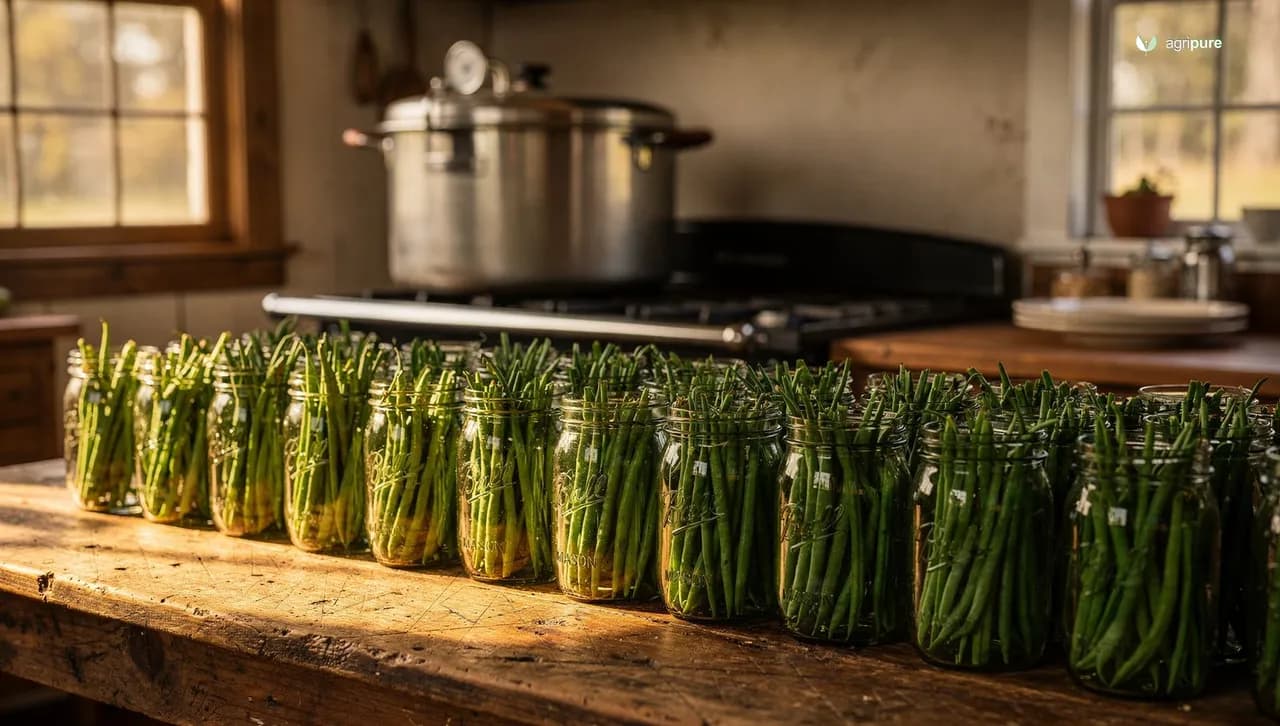
A domestic kitchen scene showing fresh, raw green beans alongside several glass canning jars, some empty and some filled with home-canned green beans. A stainless steel pressure canner is visible in the background, signifying safe preservation methods for low-acid vegetables.
For safe preservation of low-acid foods like green beans, pressure canning is essential. This method reaches the temperatures needed to destroy harmful spores.
- Green beans are low-acid (pH ~5.5–6.5) — they must be pressure canned. Water-bath or steam canning is not a safe substitute, no matter what you read elsewhere.
- Pressure canners reach 240°F (116°C), the minimum temperature needed to destroy Clostridium botulinum spores. A rolling boil tops out at 212°F and leaves spores intact.
- The NCHFP-tested processing times are 20 minutes for pints and 25 minutes for quarts. Altitude changes the required pressure, not the time.
- Raw pack and hot pack both work. Raw pack is faster; hot pack fits more beans per jar and often produces better color retention.
- Botulism toxin can be odorless and tasteless — never taste-test a jar you suspect is improperly processed. When in doubt, throw it out.
“A pressure canner is required equipment for canning green beans.”
Every summer, home canners fill jars with the season’s most reliable harvest. Green beans (snap beans, string beans, or pole beans) come off the vine faster than most families can eat them fresh, and canning is the obvious answer. But green beans sit in a different category from tomatoes, peaches, and pickles. They are a low-acid vegetable, and that single fact changes everything about how you process them safely.
Water-bath canning, the technique that works perfectly for jams, fruit, and pickles, cannot get hot enough to eliminate the spores of Clostridium botulinum in a low-acid environment. The National Center for Home Food Preservation (NCHFP), the USDA’s research partner on all tested home-canning guidelines, is unambiguous: “There is no safe option for processing green beans in a boiling water canner.” A pressure canner is the only tool that works.
This guide walks through the science behind that rule, the equipment you need, the step-by-step USDA-tested process for both raw-pack and hot-pack methods, processing times adjusted for altitude, and how to troubleshoot the problems that catch beginners off guard. If you are new to home preservation, the complete home canning guide covers the fundamentals of pressure and water-bath methods side by side; read that first, then return here for green beans.
Why green beans must be pressure canned
A pressure canner gauge showing 11 PSI with steam venting beside jars of green beans.
The dial holds the answer: 11 PSI at low altitudes drives the canner to 240°F, the threshold that destroys botulism spores.
The safety case for pressure canning rests on two facts about Clostridium botulinum. First, its spores survive a full rolling boil at 212°F (100°C) indefinitely. You can boil a jar of green beans for two hours in a water-bath canner and the spores will still be alive when the jar cools. Second, the spores need only three conditions to germinate and produce one of the most potent toxins known: an anaerobic environment (a sealed jar), low acidity (green beans at pH 5.5–6.5), and a temperature above about 50°F during storage (an ordinary pantry).
A pressure canner changes the physics. By trapping steam under pressure, it drives the internal temperature to 240°F (116°C), which is hot enough to destroy the spores. At 10 PSI, water inside the canner boils at approximately 240°F. At 15 PSI, it reaches around 250°F. Either is adequate for green beans per USDA guidelines. A water-bath canner, by contrast, is open to the atmosphere and can never exceed 212°F at sea level, dropping lower as altitude rises.
The stakes are real. A peer-reviewed case report in Annals of Internal Medicine describes a married couple who ate improperly home-canned green beans at a family dinner. Both required approximately five months of mechanical ventilation and eight to eleven months of total hospitalization. The husband and wife survived. Their son, who skipped the beans because of an odd odor, was unaffected. The beans had been canned without a pressure canner. The toxin had produced itself silently in the sealed jars (with no obvious mold or dramatic color change), which is what makes botulism uniquely dangerous among foodborne illnesses.
Green beans are not the only culprit. Corn, beets, asparagus, carrots, and meats all require pressure canning. But green beans are among the most commonly home-canned vegetables, which means they show up most often in botulism incident reports. The rule is simple: if it is not a high-acid food (pH 4.6 or below), it goes in the pressure canner.
Equipment and jar preparation
You do not need much equipment to pressure can green beans, but every item on the short list matters. Cutting corners on the canner or the jars introduces failure points that are not worth the risk.
What you need
- Pressure canner, not a pressure cooker: A true pressure canner holds at least four quart jars and has a rack to keep jars off the bottom. A dial-gauge canner shows the exact PSI; a weighted-gauge canner uses a 5-, 10-, or 15-pound weight that jiggles to signal the right pressure. Both work for green beans. Have your dial-gauge tested for accuracy once a year at your local cooperative extension office, as an inaccurate gauge is one of the most common causes of under-processing.
- Mason-style canning jars — pints or quarts only. No commercial pasta-sauce or mayonnaise jars. Canning jars are tempered to handle pressure and thermal shock; recycled commercial glass is not.
- New flat lids each time — the sealing compound on flat lids is a one-use item. Bands (screw rings) can be reused if free of rust and dents.
- Jar lifter, wide-mouth funnel, and bubble remover — a jar lifter handles 240°F jars safely; the funnel keeps jar rims clean; the bubble remover (or a thin non-metallic spatula) clears air pockets that can interfere with heat penetration.
- Clean canning salt (optional) — regular table salt contains anti-caking agents that can cloud brine. Canning or pickling salt dissolves cleanly. One teaspoon per quart, half a teaspoon per pint, purely for flavor.
Jar prep
Wash jars in hot soapy water and rinse well, or run them through the dishwasher on a hot cycle. Keep jars hot until you fill them: setting a hot jar on a cold counter can crack it, and cold jars placed into a hot canner can also crack. The simplest method: fill the canner with a few inches of hot water, set the rack in, and stand the empty jars in the canner while it preheats on low heat. Do not pre-sterilize jars for pressure canning; the pressure process itself sterilizes the contents.
Wash lids in hot soapy water and keep them in hot (not boiling) water until you’re ready to apply them. Boiling lids can soften the sealing compound prematurely.
Selecting and prepping your beans
The quality of canned green beans tracks directly with the quality of fresh beans going in. Canning does not improve a limp or over-mature pod; it preserves whatever you start with, texture included. Choose beans that pass what growers call the snap test: bend a pod in half and it should snap crisply, not bend. That crispness signals adequate moisture content and cell structure, both of which hold up better through pressure processing.
Best varieties for canning
Bush beans are the practical choice: they mature more uniformly than pole beans, making it easier to harvest a full canner load at one time. Look for varieties described as “stringless”: strings survive processing intact and are unpleasant in the jar. Well-regarded options include Blue Lake 274, Provider, and Contender. Pole varieties like Kentucky Wonder can be canned successfully, but harvest timing is more critical because the pods toughen quickly.
How to prep
- Wash beans under cold running water. Do not soak, as soaking can leach flavor and texture without improving cleanliness.
- Snip or snap off both ends. Remove any strings running along the seam.
- Cut or snap into 1- to 2-inch pieces, or leave whole if they fit the jar. Uniform size matters for even heat penetration; a mix of 1-inch pieces and 4-inch pods will not process evenly.
- Sort out any blemished, spotted, or over-mature pods. Spotty beans can introduce off-flavors; over-mature beans with developed seeds can become mushy.
Penn State Extension notes that 14 pounds of fresh beans fill a canner load of seven quarts; nine pounds fill nine pints. A 30-pound bushel yields 12–20 quarts depending on trim loss and pack density. If you are growing your own beans, companion planting snap beans with corn and squash (the three sisters system) maximizes yield per square foot while fixing some nitrogen back into the bed.
Raw pack vs hot pack: which to choose
Two jars packed side by side show the difference in color and fill level between raw-packed and pre-cooked beans.
Raw pack (left) keeps a brighter initial color in the jar; hot pack (right) fits more beans and often produces better color after processing.
Both packing methods are USDA-tested for green beans, and both use identical processing times. The choice comes down to convenience and texture preference.
Factor | Raw pack | Hot pack |
|---|---|---|
Prep time | Faster (no pre-cooking) | Adds 5-minute boil step |
Beans per jar | Fewer (raw beans shrink during processing) | More (pre-shrunk, pack more tightly) |
Texture after processing | Slightly firmer | Softer, more uniform |
Color after processing | Some color loss common | Often better color retention |
Best for | Speed, large harvests, first-timers | Maximizing jar count from a harvest |
Raw pack method
Pack clean, raw beans tightly into hot jars, leaving 1 inch of headspace. Add half a teaspoon of canning salt per pint or one teaspoon per quart, if desired. Ladle boiling water over the beans, again leaving 1 inch of headspace. Remove air bubbles with your bubble tool. Wipe jar rims with a clean, damp cloth. Apply lids and bands fingertip-tight (until resistance is felt, not as tight as possible).
Hot pack method
Bring a pot of water to a boil. Add trimmed beans and boil for five minutes. Drain, then pack beans loosely into hot jars, as pre-cooked beans are more fragile. Leave 1 inch of headspace. Add salt as above, then ladle the hot cooking liquid back over the beans to the 1-inch mark. Remove air bubbles, wipe rims, and apply lids fingertip-tight.
The one headspace rule
One inch of headspace is required for both methods and both jar sizes. Too little headspace and food can expand and push up under the lid, preventing a seal. Too much headspace leaves excess air in the jar, which can affect color and may hinder the seal. Use a headspace ruler or the markings on your wide-mouth funnel.
Processing: the step-by-step pressure canning method
With filled jars ready, the canning process itself follows a fixed sequence. Do not rush the venting step or skip the cool-down; both matter for a reliable seal and accurate processing.
- Load the canner. Add two to three inches of hot (not boiling) water to the canner (check your canner manual for the exact amount). Some canners specify a measured amount rather than eyeballing it. Set the rack in place and load filled, lidded jars using your jar lifter. Leave the canner lid off for now.
- Vent the canner. Place the canner (without the weight or with the petcock open) over medium-high heat. Let steam vent steadily from the opening for a full 10 minutes. This exhausts air from the canner; trapped air reduces the actual temperature inside even when the gauge reads the correct pressure.
- Build pressure. After 10 minutes of venting, place the counterweight or close the petcock. Watch the gauge rise. Do not leave the kitchen, as the gauge can overshoot quickly.
- Start timing. Begin your processing time once the canner reaches the correct pressure for your altitude (see table below). Maintain steady pressure throughout; fluctuating pressure causes siphoning.
- Depressurize naturally. When the processing time is complete, turn off the heat and let the canner depressurize on its own. Do not run it under cold water, do not tilt or remove the weight to force depressurization. A weighted-gauge canner is ready when the weight stops jiggling and sits flat. A dial-gauge canner is ready when the gauge reads zero.
- Wait 10 more minutes. After the pressure is fully released, wait another 10 minutes before removing the lid. This prevents a sudden temperature change from cracking jars or causing liquid loss.
- Remove jars. Use your jar lifter to transfer jars to a towel-lined counter. Leave at least one inch of space between jars for airflow. Do not tilt the jars. Do not press the lids. You will hear pings as jars seal over the next hour or two, signaling that jars are contracting and sealing.
- Check seals after 12–24 hours. A sealed lid curves slightly downward and does not flex when pressed. Any jar that has not sealed should be refrigerated and used within a few days, or reprocessed with a new lid within 24 hours.
Processing times and altitude adjustments
Processing time is constant regardless of altitude: 20 minutes for pints, 25 minutes for quarts. What changes with altitude is the pressure required to reach the target temperature. As elevation rises, water boils at lower temperatures, so more pressure is needed to compensate. Use the tables below, sourced from the USDA Complete Guide to Home Canning via NCHFP.
Jar size | Pack style | Process time |
|---|---|---|
Pints | Raw or hot | 20 minutes |
Quarts | Raw or hot | 25 minutes |
Altitude | Dial-gauge canner (PSI) | Weighted-gauge canner (PSI) |
|---|---|---|
0–1,000 ft | 11 PSI | 10 PSI |
1,001–2,000 ft | 11 PSI | 15 PSI |
2,001–4,000 ft | 12 PSI | 15 PSI |
4,001–6,000 ft | 13 PSI | 15 PSI |
6,001–8,000 ft | 14 PSI | 15 PSI |
If you live above 1,000 feet and use a weighted-gauge canner, the only option is the 15-pound weight. Weighted-gauge canners are less precise than dial-gauge models at altitude, but they are also simpler because no annual calibration is required. If you are in Denver (5,280 ft) or higher, a dial-gauge canner gives you more precision at altitude, which is worth the calibration maintenance.
Do not know your altitude? Your county cooperative extension office can tell you, or use a topographic map. The USDA recommends erring on the side of the higher pressure tier if you are near a boundary (for instance, if you are at 1,050 feet, use the 1,001–2,000 ft row, not the 0–1,000 ft row).
Troubleshooting: seal failures, siphoning, and spoilage
A bulging lid and discolored liquid contrast with a properly sealed jar with a flat concave lid on a pantry shelf.
A bulging lid (left) is a discard; do not open it inside. A properly sealed jar (right) has a lid that curves slightly inward and does not flex.
Even experienced canners encounter problems. Most are preventable with consistent technique; some are salvageable; a few require discarding the jar without hesitation.
Seal failures
A jar that has not sealed within 24 hours will have a lid that flexes up and down when pressed. Common causes:
- Nicked jar rim. Run your finger around the rim before filling; even a hairline chip prevents a seal. Retire chipped jars from canning use.
- Food or fat on the rim. Always wipe jar rims with a clean, damp cloth immediately before applying the lid, even if you think the rim is clean.
- Bands too loose. Fingertip-tight means snug, not so loose the band wobbles. If liquid escapes during processing, the band was too loose.
- Reused flat lids. The sealing compound on the underside of a flat lid compresses on first use and will not re-form. New lid every time.
Siphoning
Siphoning is liquid loss during processing, where the liquid level inside the jar drops or residue appears on the outside of the jar. The jar may still be sealed and safe, but low liquid means the beans at the top of the jar are exposed and may discolor or dry out in storage. The University of Minnesota Extension notes the main causes: loose bands, pressure fluctuations, and inadequate headspace. To minimize siphoning:
- Use consistent, steady heat to maintain pressure without letting it spike and drop.
- Let the canner depressurize completely before opening.
- Do not add liquid to a jar that has siphoned: if it sealed, store it and use it first; if it did not seal, refrigerate and use within a few days.
Spoilage signs: when to discard without question
Botulism toxin is odorless and tasteless in most cases. Do not rely on your senses as the primary safety check. Instead, rely on process integrity: if you followed a tested NCHFP recipe with the correct pressure and time for your altitude, and the jar sealed, it is safe. If there is any doubt about the process, discard.
Visible signs that a jar must be discarded immediately, without tasting:
- Bulging, loose, or spurting lid when opened
- Cloudy liquid (clear brine is normal; cloudy brine is not, unless from starch and it settles)
- Rising bubbles, foam, or sliminess
- Any off odor (sour, fermented, or otherwise unnatural)
- Visible mold, any color
If a jar must be discarded, place it in a heavy trash bag without opening further, seal the bag, and dispose. Do not compost it, do not pour the contents down the drain, and wash your hands and any surfaces thoroughly after handling.
Storage, shelf life, and using what you canned
Properly sealed and processed green beans should be stored in a cool, dark, dry place, ideally between 50°F and 70°F (10°C and 21°C). A dedicated pantry, root cellar, or even a lower kitchen cabinet away from the stove works. Avoid garages and sheds in climates with freezing winters or sweltering summers; thermal cycling degrades the seal over time.
Penn State Extension notes that canned goods are best used within one year for peak quality, and remain safe as long as the lid stays vacuum-sealed. The quality (color, texture, and flavor) does decline after a year, even if the food is technically safe. Label every jar with the date and contents using a marker on the lid or a waterproof label on the band. Rotate your pantry so the oldest jars are at the front.
When opening a jar, check the lid first: it should require some effort to remove and should not flex. Once open, the beans smell fresh and the brine looks clear. Drain and rinse before using if you want to reduce sodium. Home-canned green beans shine in long-braised dishes: cassoulet, slow-cooker ham and beans, or simply warmed in butter with garlic and lemon zest. The texture is softer than fresh or frozen, which is exactly what makes them work so well in cold-weather braises.
If you grow your own beans, you will likely have more in some years than you can can in a single season. Freezing is the simpler option for any overflow: blanch beans in boiling water for three minutes, chill in ice water, drain, pack into freezer bags, and freeze up to 12 months. Frozen beans retain better texture and color than canned. Canning earns its place when you want shelf-stable storage without refrigeration, which is useful for root cellaring setups, off-grid pantries, or freeing up freezer space. Both methods are valid; they are not competing with each other.
For canners who want to expand their pantry beyond green beans, pressure-canned potatoes follow almost the same process: another low-acid vegetable that belongs in the pressure canner, not the water bath. And when you are ready to branch into high-acid foods where water-bath canning is safe, canning tomatoes (with mandatory added acid) is the natural next project.
Frequently asked questions
Can you water bath can green beans?
No. The National Center for Home Food Preservation states explicitly: “There is no safe option for processing green beans in a boiling water canner.” Green beans are a low-acid food (pH ~5.5–6.5), which means Clostridium botulinum spores can survive in them. A water-bath canner reaches only 212°F, which is not hot enough to destroy those spores. A pressure canner is the only safe method.
How long do you pressure can green beans?
20 minutes for pints and 25 minutes for quarts, per USDA/NCHFP guidelines. These times are the same for both raw-pack and hot-pack methods. Altitude changes the required pressure, not the time: use 11 PSI at 0–2,000 ft for a dial-gauge canner, and increase by 1 PSI per 2,000 feet of additional altitude.
What happens if you don’t pressure can green beans?
Clostridium botulinum spores that survive water-bath processing can germinate in the sealed, anaerobic jar and produce botulinum toxin, one of the most potent toxins known. The toxin can be odorless and tasteless. Real cases have resulted in months of intensive care. The risk is not theoretical.
Raw pack or hot pack for green beans?
Both are USDA-tested and safe. Raw pack is faster, requiring no pre-cooking. Hot pack fits more beans into each jar because the five-minute pre-boil shrinks them, and it often produces better color after processing. Processing times are identical for both methods.
How long do home-canned green beans last?
Best quality within one year, stored in a cool (50–70°F), dark, dry location. They remain safe as long as the vacuum seal holds; the lid should not flex when pressed and should require effort to remove. Quality (texture, color, flavor) declines after a year even if the seal is intact.
References
- Beans, Snap and Italian – Pieces, Green and Wax — National Center for Home Food Preservation (NCHFP) / University of Georgia
- Let’s Preserve: Snap Beans — Penn State Extension
- Foodborne botulism due to ingestion of home-canned green beans — PubMed Central / NCBI (peer-reviewed case report, Annals of Internal Medicine)
- Clostridium botulinum & Botulism — USDA Food Safety and Inspection Service (FSIS)
- Food preservation and canning troubleshooting guide — University of Minnesota Extension
- Acidity / low pH is what makes water bath canning safe — Healthy Canning (collaborative canning safety resource)