Key takeaways

Embrace the time-honored tradition of root cellaring. A well-designed cellar provides the perfect, electricity-free environment to store your harvest, keeping vegetables like carrots, potatoes, onions, and squash fresh for months, a true luxury for the sustainable homestead.
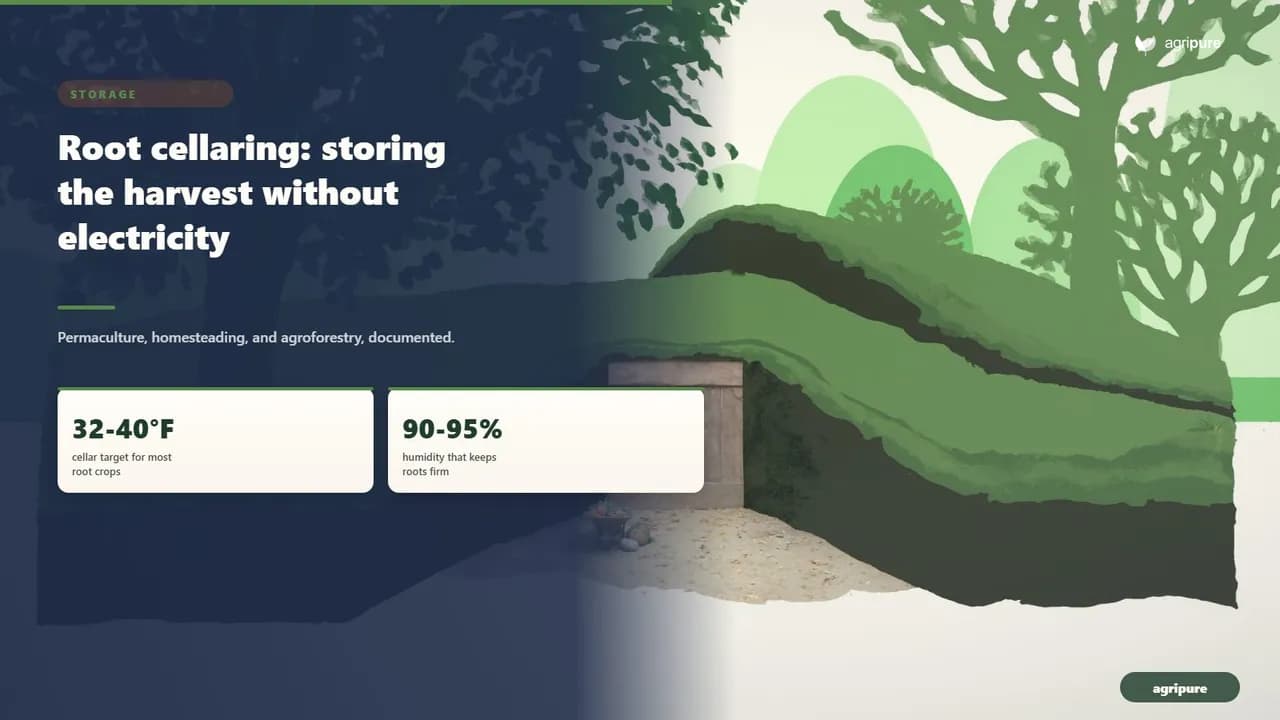
- A root cellar is a cold, dark, damp, ventilated space that keeps the harvest near 32 to 40 degrees F using the steady temperature of the earth, no electricity required. It manages 4 conditions at once: temperature, humidity, darkness, and airflow.
- Crops sort into 3 storage groups: cold and humid (carrots, beets, potatoes, cabbage, turnips) at 32 to 40 degrees F and 90 to 95% humidity; cold and dry (onions, garlic) at the same cold but about 65% humidity; and warm and dry (winter squash, pumpkins, sweet potatoes) at 50 to 60 degrees F.
- You do not need to dig a hillside cellar. An unheated basement corner, a buried barrel or trash can, an insulated bulkhead, or an unheated spare room each create one of those zones, with different trade-offs.
- Cure the crops that need it: onions 2 to 4 weeks at room temperature, potatoes 14 days at 50 to 60 degrees F, winter squash 7 to 10 days at 80 to 90 degrees F, sweet potatoes 4 to 7 days at 80 to 85 degrees F. Do not wash roots, cull every damaged one, and handle gently.
- Keep ethylene-producing fruit such as apples and pears away from potatoes and greens, and check the stores often for sprouting, rot, and shriveling.
A cellar full of food in February is one of the quiet luxuries of a homestead: bins of carrots still crisp after 6 months, potatoes that have not sprouted, onions hanging dry, a shelf of winter squash. None of it is plugged in. A root cellar trades the electric bill of a second refrigerator for a hole in the ground, a few shelves, and an understanding of what vegetables actually want. For most of human history this is how the harvest survived winter, and it still works in any climate with a real cold season. This guide covers what a root cellar is, the conditions it has to manage, the kinds you can build or improvise, which crops store and under exactly what conditions, and the prep and monitoring that decide whether you eat the harvest or compost it. It sits alongside the other no-waste skills of a homesteading kitchen, but it is the one that runs on dirt and physics rather than jars and heat.
What a root cellar actually is
A root cellar is not a magic box; it is a place engineered to hold 4 conditions steady through winter. The University of Alaska Fairbanks Cooperative Extension puts the core idea plainly: produce can be grouped into 4 storage needs, and a root cellar supplies the most common one, cold and moist. Get the 4 conditions right and almost any storage crop will keep for months. Get 1 wrong and the same crop sprouts, rots, or shrivels in weeks. Those conditions are temperature, humidity, darkness, and ventilation, and they are worth taking one at a time.
Temperature: cold, but above freezing
A root cellar’s first job is to stay cold without freezing. For most root-cellar crops the target is a temperature between 32 and 40 degrees F, the range Colorado State University Extension gives for a proper cellar. That band slows the vegetables’ metabolism to a crawl without rupturing their cells the way a hard freeze would. The earth does most of the work: soil a few feet down holds a far steadier temperature than the air above it, which is the whole reason an underground root cellar or a buried barrel stays cool in October and does not freeze solid in January. Stability matters as much as the number. Every swing forces the crops to react, and warmth is expensive in shelf life.
Humidity: high for most roots, low for the dry crops
Most root vegetables are most of the way to being water, and in dry air they give that water back and go limp. A root-cellar atmosphere for them runs humid, roughly 90 to 95% relative humidity, which keeps carrots and beets firm rather than rubbery. As UAF Extension notes, high humidity, between 80 and 95% relative humidity, keeps vegetables from drying out. The exceptions are the dry crops, onions and garlic, which rot in that kind of damp and want closer to 65% humidity instead. This split is why no single shelf suits everything, and why the storage groups below matter so much.
Darkness and ventilation
The last 2 conditions are easy to provide and easy to forget. Darkness keeps potatoes from greening and turning bitter; UAF Extension is blunt that potatoes need to be stored in the dark. Ventilation does 2 things at once. Stored vegetables are still alive and breathing, so they need oxygen and they give off carbon dioxide, moisture, and heat that must be carried away. As Colorado State University Extension explains, ventilation is used to help control the temperature and humidity, and excess moisture that encourages mold can be exhausted. A workable cellar has a low intake and a high outlet so cool air enters near the floor and stale, warm air leaves near the ceiling. Without that exchange, even a cold cellar grows stuffy and mold takes hold.

The kinds of root cellar you can build or use
You do not need a backhoe and a hillside to store food without electricity. A root cellar is really any space that hits the conditions above, and there are at least 5 honest ways to get there, from a full dug cellar to a corner you already own. The right root cellar idea depends on your climate, your house, and how much you want to build.
The traditional dug or earth-bermed cellar
The classic underground root cellar is a chamber dug into a slope or set below grade and bermed over with soil, entered through an insulated door. This is the gold standard for a reason: surrounded by earth on most sides, it naturally holds the cold-and-moist 32-to-40-degree, high-humidity conditions that the largest group of crops wants, and it holds them with almost no intervention. It is also the most work and the most permanent. If you are seriously building a root cellar from scratch, this earth-coupled approach, whether a poured-concrete root cellar or a buried culvert, is what root cellar plans usually mean, and it rewards the effort with the steadiest performance.
An unheated basement corner
For most North American homesteaders, the simplest root cellar is a basement root cellar: a partitioned corner of an unheated or barely heated basement, ideally on the north or east side away from the furnace. Walling off that corner and adding a vent to the outside turns it into a cold room that can hold the 32-to-40-degree range the roots need. The honest trade-off is that a modern heated basement is often too warm and too dry for the humid-loving roots, so a root cellar in basement form usually needs an outside-air vent to pull the temperature down and a pan of water or damp sand to push humidity up. Done right, it is the cheapest real cellar there is.
A buried barrel or trash-can mini-cellar
Where there is no basement and no appetite for excavation, a buried barrel or metal trash can makes a genuine mini-cellar. You sink a clean food-grade drum or a galvanized can into well-drained ground at an angle or upright, pack straw around and over the lid, and use it as an insulated, earth-cooled box for a single crop such as carrots or beets layered in damp sand. It is the lowest-cost do-it-yourself root cellar, and it holds the cold-and-moist conditions surprisingly well. The limits are real: capacity is small, you dig into it in the cold, and in the hardest climates it can still freeze, so it suits zone 6 and milder better than the far north.
An insulated bulkhead or an unheated spare room
Two more options use space you may already have. An exterior basement bulkhead, the slanted cellar entry common on older homes, is essentially a ready-made cold pocket; insulate the hatch and the inner door and the 4 or 5 stair steps become a graduated cold store, coldest at the bottom. Alternatively, an unheated spare room, attic stairwell, or attached but uninsulated porch can serve as a cool-and-dry store for onions, garlic, and the warm-and-dry squash group, even when it is too dry for roots. None of these is a textbook cellar, but each reliably creates one of the storage zones, which is the entire point.
Which crops store, and the conditions each one needs
Here is the heart of it: storing vegetables well means matching each crop to its zone, because the 3 storage groups want genuinely different things. Putting onions where the carrots are, or squash in the cold, is how good harvests spoil. Group the crops by what they need and the cellar organizes itself.
Cold and humid: carrots, beets, potatoes, cabbage, turnips
The largest group, and the one a classic root cellar is built for, wants cold and humid: about 32 to 40 degrees F and 90 to 95% relative humidity. Carrots and beets are the standouts, layered in damp sand they will hold for months. South Dakota State University Extension lists carrots keeping 5 to 6 months and beets an impressive 4 to 10 months under cold, humid conditions; University of Minnesota Extension puts well-grown carrots at up to 8 months. Potatoes belong here too but a touch warmer and drier in practice, stored dark at around 45 degrees F and 95% humidity for 2 to 9 months. Cabbage and turnips round out the group at the same cold, humid range, though cabbage stored indoors will scent the whole house, so it is a cellar-or-garage crop. To grow the storage staple this group is named for, the potato profile is the place to start.
Cold and dry: onions and garlic
Onions and garlic break the humidity rule. They want cold but dry, near the same low temperatures but only about 65% relative humidity, with good air movement. South Dakota State University Extension gives cured onion bulbs a 6-to-9-month life at 32 to 40 degrees F and 65% humidity. The damp that keeps carrots crisp makes onions and garlic mold and rot, which is why they hang in mesh or braids in an airy, dry spot rather than sitting in the humid cellar proper. They also taint other crops: stored too close to potatoes, the 2 trade flavors and both suffer. Give the alliums their own dry, breezy corner.
Warm and dry: winter squash, pumpkins, sweet potatoes
The last group does not belong in a cold cellar at all. Winter squash, pumpkins, and sweet potatoes are warm-season crops that suffer chilling injury in the cold and want warm and dry storage instead, roughly 50 to 60 degrees F. University of Minnesota Extension stores winter squash and pumpkins at around 50 to 55 degrees F and 50% relative humidity, where they last 1 to 6 months depending on variety. Sweet potatoes hold 6 to 9 months at 55 to 60 degrees F once cured, but drop them below about 50 to 55 degrees F and they take chilling injury, hard cores and off-flavor, as Penn State Extension warns. A shelf in a cool back room or a heated basement suits this group far better than the cellar floor.
A storage-conditions table to keep it straight
The differences are easy to lose track of, so the table below collects the verified targets for all 10 crops in one place. Temperatures and humidity are from the university extension sources cited in the references; treat shelf life as a well-grown, well-cured best case rather than a guarantee.
Crop | Storage group | Temperature | Humidity | Approx. shelf life |
|---|---|---|---|---|
Carrots | Cold + humid | 32 to 40°F | 90 to 95% | 5 to 8 months |
Beets | Cold + humid | 32 to 40°F | 90 to 95% | 4 to 10 months |
Potatoes | Cold + humid | about 45°F | about 95% | 2 to 9 months |
Cabbage | Cold + humid | 32 to 40°F | 90 to 95% | 1 to 6 months |
Turnips | Cold + humid | 32 to 40°F | 90 to 95% | 4 to 5 months |
Onions | Cold + dry | 32 to 40°F | about 65% | 6 to 9 months |
Garlic | Cold + dry | 32 to 40°F | about 65% | 6 to 9 months |
Winter squash | Warm + dry | 50 to 55°F | about 50% | 1 to 6 months |
Pumpkins | Warm + dry | 50 to 55°F | about 50% | 2 to 3 months |
Sweet potatoes | Warm + dry | 55 to 60°F | 85 to 90% | 6 to 9 months |
The ethylene problem: keep the fruit apart
One invisible factor wrecks more stored vegetables than any temperature error: ethylene gas. It is the reason a single box of apples can sprout your potatoes and yellow your cabbage from across the cellar, and it is the 1 storage problem you cannot see, smell, or measure without knowing to look for it. The fix costs nothing but attention.
What ethylene does
Ethylene is a gaseous plant hormone that triggers ripening and aging. University of Maine Cooperative Extension explains that most fruits produce a gaseous compound called ethylene that starts the ripening process, and that some apple varieties, such as McIntosh, produce prodigious amounts of it. In a closed, cold store that gas builds up and pushes nearby produce to age faster: extension lists 8 common storage crops, including potatoes and carrots, as ethylene-sensitive. The crops you most want to keep dormant all winter are exactly the ones that react.
Which crops to separate
The practical rule is to store ethylene-producing fruit apart from the ethylene-sensitive vegetables. South Dakota State University Extension is specific: all 8 of carrots, broccoli, cauliflower, cucumbers, lettuce, peas, potatoes, and acorn squash are sensitive to ethylene, which may be given off from apples, melons, tomatoes, and other fruit, so they should be stored separately from fruit to avoid off-tastes and color changes. In a homestead cellar that means 3 habits worth making automatic:
- Keep apples and pears out of the root-vegetable zone. Store them in a separate spot, or at least 3 feet away with ventilation between, never bin-to-bin with potatoes.
- Keep greens and leafy crops away from the fruit too. Lettuce, cabbage, and the like yellow and decay faster in ethylene-rich air.
- Vent the cellar. The same airflow that controls humidity also dilutes ethylene, which is one more reason a working vent matters.
The apple rule: a box of apples is an ethylene factory. If you store apples in the same cellar as your roots, put them as far from the potatoes and greens as the space allows, in their own bin, with the vent between them. Better yet, keep the fruit in a separate cold spot entirely. The same gas that ripens an apple sprouts a potato.
Harvest and prep: what you do before storage decides everything
A root cellar cannot rescue a crop that went in wet, bruised, or uncured. The work that determines whether the harvest lasts happens in the days around harvest, not in the cellar. These 3 habits carry most of the weight: cure the crops that need it, do not wash, and cull hard.
Curing the crops that need it
Several storage crops need a deliberate curing step first, a short period of warmth that toughens skins and heals harvest wounds so they resist rot. The numbers come straight from extension guidance and they differ across the 4 crops that need it:
- Potatoes: cure about 14 days at 50 to 60 degrees F (University of Minnesota Extension) to toughen the skins before they move to cold, dark storage.
- Onions and garlic: cure 2 to 4 weeks at room temperature with good airflow until the necks and outer skins are papery-dry.
- Winter squash and pumpkins: cure 7 to 10 days at about 80 to 90 degrees F, until nicks and small cuts have scabbed over (University of Minnesota Extension).
- Sweet potatoes: cure 4 to 7 days at 80 to 85 degrees F and 85 to 95% humidity (Penn State Extension), which also converts starch to sugar and sweetens them.
The other 4 staples, carrots, beets, turnips, and cabbage, need no curing; they go more or less straight from the ground to cold, humid storage.
Do not wash, and pack the roots right
It is tempting to scrub the soil off, but washing roots before storage drives water into tiny wounds and invites rot. Brush off loose dirt and store them dirty. For the cold-and-humid group, the traditional method still works best: layer the 3 main roots, carrots, beets, and turnips, in damp sand, sawdust, or peat. UAF Extension recommends layering vegetables in packing materials such as moist sawdust, sand, and peat moss, which holds humidity against the roots and keeps them from touching and spreading rot. Pack in single layers or shallow crates rather than deep piles that trap heat.
Cull hard and handle gently
The oldest rule in storage is that 1 bad apple really does spoil the barrel. Sort every crop as it comes in and store only the sound, unblemished, fully mature specimens; the cut, bruised, undersized, or insect-damaged ones go to the kitchen or the compost, never the cellar. Handle storage produce as if it bruises easily, because it does, and every bruise is an entry point for rot. The crops you grew in the raised beds out back are only worth cellaring if they go in clean and whole.

Monitoring and the problems that creep in
Storing the harvest is not set-and-forget. A cellar is a slow ecosystem, and the difference between losing a tenth of it and losing half is whether you walk through it with a flashlight every week or 2. Most failures announce themselves early to anyone looking, and each has a cause you can usually fix.
Sprouting
When potatoes, onions, or garlic begin to sprout, the cellar is telling you 1 of 3 things: it is too warm, getting too much light, or holding too much ethylene. Pull and use sprouting crops first, drop the temperature back toward the low end of the 32-to-40-degree range, confirm the space is truly dark, and move any apples or pears well away. A thermometer and a simple hygrometer on the wall turn guesswork into a number you can act on.
Rot and mold
Rot is usually a humidity-and-air problem, often seeded by a single damaged crop that should have been culled. The 3 tells are soft spots, fuzzy mold, and a sour smell, and they mean too much moisture, too little airflow, or a bad specimen quietly spoiling its neighbors. Remove anything turning at once, improve ventilation to carry off excess moisture, and avoid the deep, heat-trapping piles that let rot spread unseen. A musty cellar smell is an early warning to air the space out.
Shriveling
Limp, rubbery carrots and wrinkled beets are the opposite problem: not enough humidity. The crops are losing water to dry air faster than they can hold it, when they would hold firm at 90 to 95% humidity. The fix is to raise the humidity, repack the roots in damp sand, add a pan of water or a damp burlap sack, or move them into a tighter, more humid corner. Because shelf life shortens as temperature climbs, even 5 degrees too warm shows up as both faster shriveling and a shorter season, so chasing the temperature down often helps here too.
Two dollars of instruments: the single best upgrade to any root cellar is a wall thermometer and a hygrometer. Sprouting, rot, and shriveling are all symptoms of a temperature or humidity that drifted out of range, and you cannot fix a number you are not watching. Check both every visit and adjust the vent, the water pan, or what you pull first.
Bringing the harvest home
A root cellar is one of the most satisfying systems on a homestead because it closes the loop with almost no inputs: you grow the food, the earth keeps it cold, and you eat it through the months when nothing grows. The discipline is small and learnable. Hold the 4 conditions — cold near 32 to 40 degrees F, humid for the roots and dry for the onions, dark, and ventilated. Match each crop to its zone using the table above, cure what needs curing, store only clean and sound produce, keep the apples away from the potatoes, and walk the cellar with a light every week or 2. Start with a buried barrel of carrots or a vented basement corner this fall, and let the harvest carry you to spring on dirt and physics instead of a power bill. For homesteaders building toward more self-reliance, cold storage with no electricity is a natural piece of off-grid living.
Frequently asked questions
What temperature and humidity should a root cellar be?
For the largest group of crops, a root cellar should hold a temperature between 32 and 40 degrees F with high humidity, roughly 90 to 95% relative humidity. Onions and garlic want the same cold but much drier air, about 65% humidity, while winter squash and sweet potatoes want warmer storage near 50 to 60 degrees F. No single setting suits every crop, which is why crops are grouped.
Can I make a root cellar in my basement?
Yes. A partitioned corner of an unheated or barely heated basement, ideally on the north or east side away from the furnace and fitted with a vent to outside air, is the most common homestead root cellar. The main challenge is that a heated basement is often too warm and too dry for humid-loving roots, so a basement root cellar usually needs outside-air ventilation to pull it down toward 32 to 40 degrees F and a pan of water or damp sand to raise the humidity.
Which vegetables store best in a root cellar?
The best keepers are the cold-and-humid root crops: carrots and beets (often 4 to 8 months or more), potatoes (2 to 9 months), turnips, and cabbage. Onions and garlic store 6 to 9 months in cold, dry conditions, and winter squash, pumpkins, and sweet potatoes keep 1 to 9 months in warm, dry storage. Match each crop to the conditions it needs rather than storing everything together.
Why shouldn’t I store apples with potatoes?
Apples and pears give off ethylene gas, a ripening hormone that makes potatoes sprout and causes greens and other sensitive crops to yellow and decay faster. University extension guidance lists 8 common storage crops as ethylene-sensitive and recommends storing ethylene-producing fruit separately from them. Keep the fruit in its own space, or at least 3 feet away in a well-ventilated cellar, and never bin-to-bin with the roots.
Do I need to cure vegetables before storing them?
Some crops, yes. Potatoes cure about 14 days at 50 to 60 degrees F, onions and garlic 2 to 4 weeks at room temperature, winter squash 7 to 10 days at 80 to 90 degrees F, and sweet potatoes 4 to 7 days at 80 to 85 degrees F before storage. Curing toughens skins and heals wounds so the crops resist rot. Carrots, beets, turnips, and cabbage need no curing and go straight into cold, humid storage.
References
- University of Alaska Fairbanks Cooperative Extension Service. “Vegetable Storage in Root Cellars.” uaf.edu
- Colorado State University Extension. “Storage of Home-Grown Vegetables” (Fact Sheet 7.601). extension.colostate.edu
- University of Minnesota Extension. “Harvesting and storing home garden vegetables.” extension.umn.edu
- University of Minnesota Extension. “Harvesting and storing melons, squash and pumpkins.” extension.umn.edu
- Penn State Extension. “Sweetpotato Curing and Storage.” extension.psu.edu
- South Dakota State University Extension. “Storage Life of Vegetables.” extension.sdstate.edu
- University of Maine Cooperative Extension. “The Role of Ethylene in Fruit Ripening.” extension.umaine.edu
- University of Maine Cooperative Extension. “Bulletin #4135, Storage Conditions: Fruits and Vegetables.” extension.umaine.edu
- Lelmen, K. & Makatiani, K. “Phytochemical Changes in Root Vegetables during Postharvest Storage.” IntechOpen, 2023. doi.org