Key takeaways

Understanding the efficacy of natural weed killers like household and horticultural vinegar, and recognizing the superior, long-term benefits of mulching for weed prevention.
- Household vinegar is only about 5% acetic acid; it burns the tops of weeds but does not reach the roots, so perennials regrow.
- Horticultural vinegar at 20% kills 80 to 100% of weed top growth, but it is caustic and needs eye and skin protection.
- Adding salt is the real mistake: sodium destroys soil structure and can sideline a bed for years.
- Corn gluten meal cut weed cover by 50 to 82% in trials, but it also suppresses any seed, including vegetables you sow.
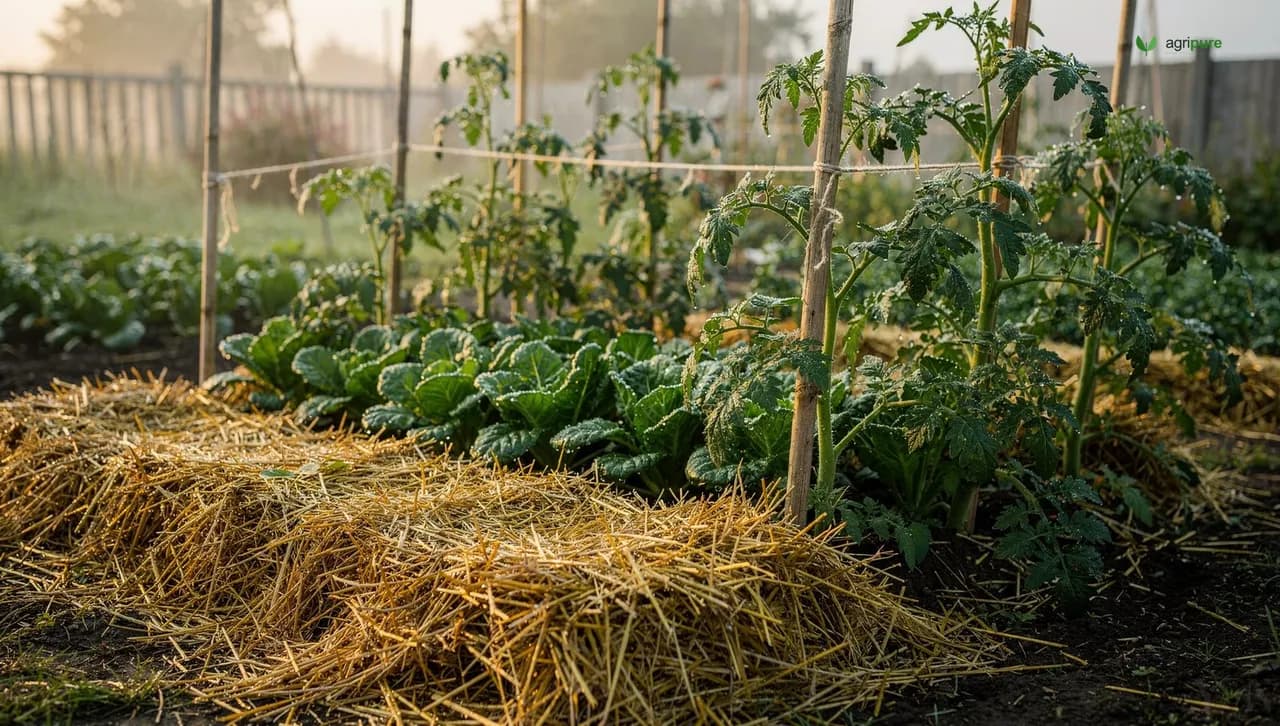
- A 3 to 4 inch layer of mulch prevents far more weeds over a season than any spray kills.
A jug of household vinegar is roughly 5% acetic acid, and on a warm afternoon it will brown the tops of young weeds within a few hours. Walk past the same crack in the path 10 days later and the dandelions and crabgrass are back, because nothing reached the root.
Most homemade weed killers work on contact and stop at the soil line. A few of the popular recipes also damage the ground for seasons to come. Here is what the research actually shows about vinegar, salt, boiling water, flame, and corn gluten meal, and why a 3 to 4 inch layer of mulch out-works all of them across a full season.
What 20% vinegar does that 5% can’t
Vinegar kills by burning plant tissue on contact. USDA Agricultural Research Service trials found that spot-spraying cornfields with 20% vinegar killed 80 to 100% of weeds without harming the corn, and higher concentrations reached an 85 to 100% kill rate across growth stages. The household 5% bottle, by contrast, only achieved a complete kill of a perennial weed’s top growth.
That last detail is the whole problem. UC Agriculture and Natural Resources notes household vinegar is 4 to 6% acetic acid and that it does not travel through the plant, so the roots survive and resprout. On a deep-rooted perennial like field bindweed, a 5% spray is a haircut, not a kill.
Burned tops, living roots
Match the tool to the weed. There are 3 situations to sort out before you reach for the spray bottle, because contact acids earn their place on some targets and waste your afternoon on others.
- Good fit: young annual seedlings, moss, and weeds in pavement cracks where there is no root reserve to bounce back.
- Poor fit: established perennials with taproots or running roots: bindweed, thistle, quackgrass.
- Handle with care: 20% horticultural vinegar is strong enough to burn skin and eyes, and some states require an applicator license to buy it.
Protection note: treat 20% vinegar like any concentrated acid: gloves, eye protection, and no spraying on a breezy day, since the drift is non-selective and will scorch crops too.

Why salt is the ingredient to leave out
Salt is the one addition that turns a weekend weed spray into a multi-year problem. The classic recipe folds table salt into vinegar and dish soap, and the salt is exactly what damages the ground. UC Integrated Pest Management reports that high sodium destroys the aggregate structure of fine and medium soils, which decreases porosity and stops the soil from holding enough air and water for plant growth. Even a single heavy dose (a few cups across a 4 by 8 foot bed) does lasting harm.
Unlike acetic acid, which breaks down rapidly and leaves no soil residue, sodium does not leave on its own. It injures roots and foliage, disperses clay, and must be deliberately leached out with low-salt water below the root zone. That is why salt belongs only where you never intend to grow anything. If you care about the living soil in a bed, keep salt out of it entirely.
Skip the salt-and-vinegar recipe anywhere near beds, tree roots, or ground you may replant. Reserve any salt-based mix for gravel and fence lines you want bare for the long term.
A field comparison of natural weed killers
Each method has a job it does well and a job it does badly. This table sorts them by what they actually kill and the risk they carry for the soil underneath.
Method | Kills roots? | Soil risk | Best use |
|---|---|---|---|
Household vinegar (5%) | No | Low | Annual seedlings, moss |
Horticultural vinegar (20%) | Partly | Low to moderate | Path and patio cracks |
Salt and vinegar mix | Partly | High and lasting | Gravel you want permanently bare |
Boiling water | Shallow only | Low | Cracks, small patches |
Flame weeding | No | Low (fire risk) | Young annuals, pre-emergence beds |
Corn gluten meal | No (pre-emergent) | None (adds nitrogen) | Established beds, lawns |
Mulch (3-4 in) | Prevents germination | None (builds soil) | Whole beds, paths, borders |
Across all 7 methods, contact sprays only burn the tops, salt is the only one that harms the soil for years, and mulch is the only one that prevents weeds while building the ground.
Heat, hands, and corn gluten meal
Beyond sprays, three approaches control weeds without leaving anything harmful in the ground. Boiling water scalds foliage and shallow roots and works well in the 1 to 2 inch gaps of a path, though it cools too fast to reach a deep taproot. Flame weeding ruptures plant cells with a quick pass of heat and suits young annuals, but it is a top-kill only and carries an obvious fire risk in dry weather.
The most reliable method on perennials is still the oldest one: pulling by hand after rain, when moist soil releases the whole root in 1 piece. Weeding at standing height from raised beds saves your back, and a good hand weeder and cultivator lifts taproots that snap off when you tug them by hand.
Where corn gluten meal earns its place
Corn gluten meal is a pre-emergent: it stops seeds from rooting rather than killing growing plants. Research in the American Journal of Alternative Agriculture found that 100 to 400 g per square metre cut weed cover by 50 to 82%, while also feeding the soil with its roughly 10% nitrogen. The catch is that it does not tell weed seed from crop seed.
- Use it on established beds, perennial borders, and lawns where nothing is being sown.
- Skip it on any bed you are about to direct-sow: the same trial cut vegetable seedling survival sharply, including a 67% drop for onions.
- Time it for early spring, before the first flush of weed seed germinates, then keep the surface dry for several days.
Prevention is the real weed killer
These contact methods all share one limit: they fight weeds one at a time, after the weeds have already won the light. Prevention flips that. UC Integrated Pest Management is blunt that mulch prevents weed seed germination by blocking sunlight, and recommends a 3 to 4 inch layer: coarse material up to 4 inches, finer material closer to 2 inches. Laying down a thick layer of mulch does more in an afternoon than a season of spraying.
Two design choices compound the effect. No-dig beds stop turning buried weed seed up to the surface where it can sprout, and dense planting shades the soil so the next flush never gets started. Combined with mulch, they shrink the weeding you do all year to under 10 minutes a week of hand-pulling.
Top up, don’t pile up: organic mulch breaks down, so refresh it to keep the full 3 to 4 inches. A layer that has thinned to 1 inch lets light through and weeds return.

Conclusion
Natural weed control is less about finding the perfect spray and more about matching the method to the weed and protecting the soil while you do it. A 5% vinegar spray buys a week on path cracks; salt buys bare ground at the cost of the bed; a 3 to 4 inch mulch layer plus a few minutes of hand-pulling buys a clean garden for the whole season.
Frequently asked questions
Does vinegar permanently kill weeds?
Not at household strength. A 5% bottle burns the top growth but does not travel to the roots, so perennials regrow within days. Horticultural vinegar at 20% kills 80 to 100% of top growth and is more effective, but it is caustic and still spares deep taproots.
Is salt a safe natural weed killer?
No. Sodium destroys soil aggregate structure, reduces porosity, and does not break down on its own; it has to be leached out with low-salt water. It is only appropriate on gravel or fence lines you want permanently bare, never in or near a growing bed.
Does boiling water kill weeds?
Boiling water scalds foliage and shallow roots and is useful in the 1 to 2 inch cracks of a path or patio. It cools too quickly to reach a deep taproot, so perennials usually resprout.
Does corn gluten meal work as a weed killer?
It works as a pre-emergent, cutting weed cover by 50 to 82% at 100 to 400 g per square metre in trials. Because it suppresses any germinating seed, use it on established beds and lawns, not where you plan to sow vegetables.
What is the most effective natural weed control?
Prevention. A 3 to 4 inch mulch layer that blocks light, paired with no-dig beds and hand-pulling perennials after rain, prevents far more weeds across a season than any contact spray kills.
References
- USDA Agricultural Research Service — Spray Weeds With Vinegar?
- UC Agriculture & Natural Resources — Can I Use Vinegar to Control Weeds?
- Evans & Bellinder, Weed Technology (2009) — Vinegar and Clove Oil Herbicide
- UC Statewide IPM Program — Weeds in Landscapes: Mulches
- American Journal of Alternative Agriculture — Corn Gluten Meal as a Pre-emergence Herbicide
- UC Statewide IPM Program — Salinity and Salt Toxicity