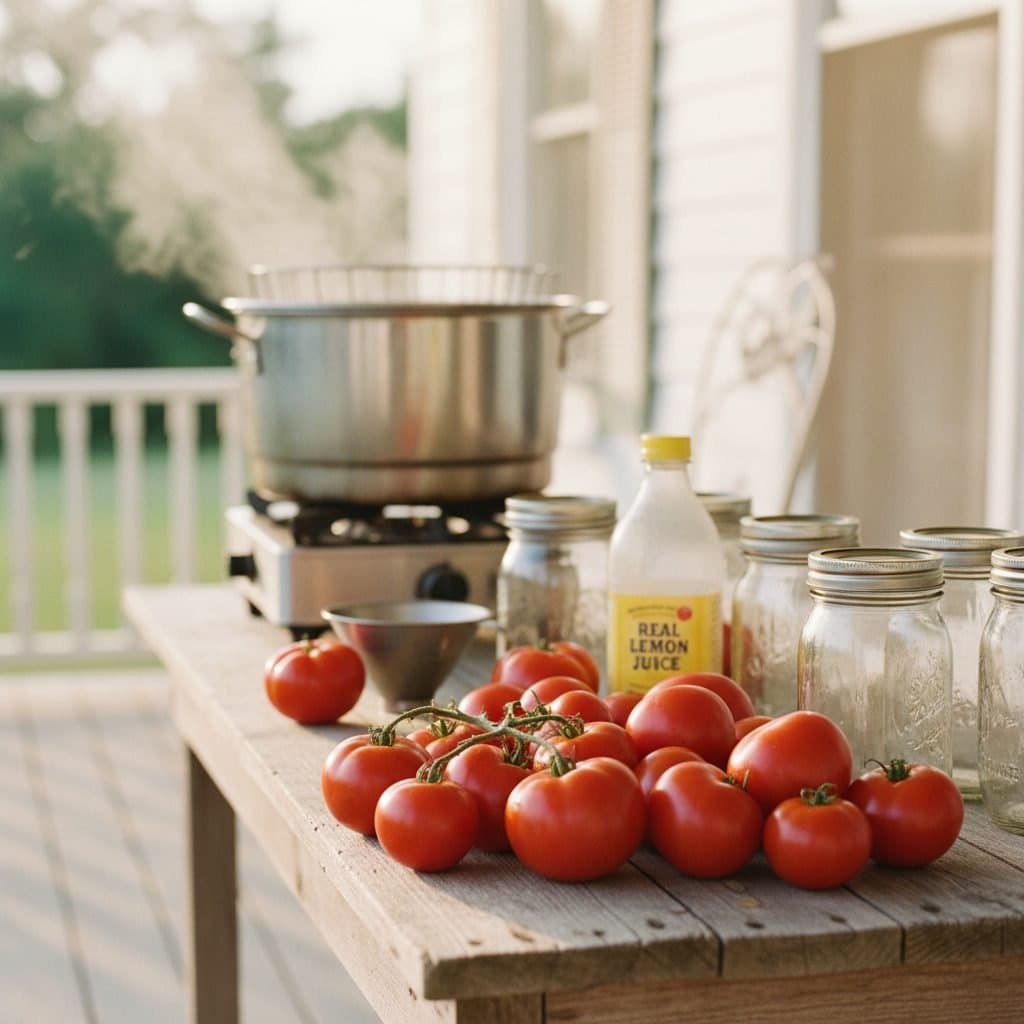
Key takeaways
- Always add acid to tomatoes for water bath canning to reach a pH of 4.6 or lower.
- Use bottled lemon juice (2 tablespoons per quart) or citric acid (1/2 teaspoon per quart) for reliable acidification.
- Follow tested recipes precisely for salsa, as its pH can vary significantly with ingredients.
- Pressure canning shortens the process time for tomatoes but does not remove the need for added acid — USDA tomato recipes require bottled lemon juice or citric acid in every jar regardless of canner.
- Inspect jars for proper seals after 12-24 hours; unsealed jars must be reprocessed or refrigerated immediately.
- Store canned goods in a cool, dark place below 70°F for optimal quality and shelf life up to one year.
Quick answer: To safely can tomatoes, salsa, and sauce at home, always add acid (bottled lemon juice or citric acid) to ensure the pH is 4.6 or lower, meeting USDA standards to prevent botulism. Pressure canning shortens the process time but does not remove the need for added acid.
Across the Midwest, many home growers face the annual challenge of preserving their tomato harvest each summer. A productive garden in USDA zone 5b can yield over 150 pounds of tomatoes, a bounty that demands safe and effective preservation methods. Canning offers a fantastic way to enjoy the flavor of summer all year long, but it requires careful attention to detail, especially when dealing with tomatoes, which are a borderline acidic food.
Understanding the science behind safe canning is crucial for preventing foodborne illness. Tomatoes typically have a pH between 4.0 and 4.6, making them just acidic enough for water bath canning with added acid [1]. This article will guide you through the precise steps for safely canning whole tomatoes, making delicious salsa, and preparing shelf-stable tomato sauce, ensuring your efforts result in safe, high-quality food for your family.
The critical role of acid in canning tomatoes
Tomatoes are a staple in many US gardens, from the sunny fields of California to the humid plots of Georgia, but their acidity profile presents a unique challenge for home canners. While some fruits like lemons have a pH below 3.0, tomatoes are considered a borderline acidic food, with pH levels typically ranging from 4.0 to 4.6 [1]. This range is critical because Clostridium botulinum spores, which cause botulism, can survive and produce toxins in environments with a pH above 4.6. Botulism is a serious, potentially fatal foodborne illness, making proper acidification a non-negotiable step for safe water bath canning of tomatoes.
Understanding pH and botulism
To ensure safety, the pH of canned tomatoes must be adjusted to 4.6 or lower [1]. This acidic environment prevents the growth of botulinum bacteria, rendering the food safe for long-term storage at room temperature. Acid is required for tomatoes in either canner. A pressure canner reaches 240°F to 250°F and shortens the process time, but USDA tomato recipes still call for bottled lemon juice or citric acid in every jar. For those using a water bath canner, which only reaches 212°F at sea level, adding acid is the only way to achieve safety.
- pH measurement: A pH meter or strips can confirm acidity, though standard recipes account for this.
- Botulism risk: Spores thrive in low-acid, oxygen-free environments, like sealed jars.
- Temperature: Water bath canning reaches 212°F, insufficient to kill botulism spores without added acid.
- Processing time: Varies by pack, jar size, and altitude — 40 to 45 minutes for quarts packed in water, and 85 minutes for quarts packed in tomato juice.
- Safety first: Never taste suspect canned food; when in doubt, throw it out.
Acidifying whole and crushed tomatoes for canning
When canning whole or crushed tomatoes, precise acid addition is paramount for safety. The most common and reliable methods involve using either bottled lemon juice or citric acid. These are preferred over vinegar because their acidity is consistent and predictable, unlike homemade or some commercial vinegars which can vary in acetic acid content. For every quart of tomatoes, you should add 2 tablespoons of bottled lemon juice or 1/2 teaspoon of citric acid [1]. For pint jars, halve these amounts to 1 tablespoon of bottled lemon juice or 1/4 teaspoon of citric acid.
Preparing and processing your tomatoes
Start by washing your tomatoes thoroughly. You can peel them by blanching in boiling water for 30-60 seconds, then plunging into ice water. Core and quarter them, or leave them whole if desired. Pack the prepared tomatoes into hot jars, leaving 1/2 inch of headspace. Add your chosen acid directly to each jar before filling. Process times depend on the pack: whole or halved tomatoes packed in water take 40 minutes for pints and 45 minutes for quarts; crushed tomatoes take 35 minutes for pints and 45 minutes for quarts; tomatoes packed in tomato juice, or packed raw with no added liquid, take 85 minutes for both pints and quarts — all at altitudes up to 1,000 feet. For higher altitudes, use the published altitude table for your recipe: for boiling water bath processes longer than 20 minutes, add 10 minutes at 1,001–3,000 feet, 20 minutes at 3,001–6,000 feet, and 30 minutes at 6,001–8,000 feet. For more detailed instructions, consider reviewing our guide on canning tomatoes: whole, crushed, and sauce.
- Bottled lemon juice: Use 2 tablespoons per quart for consistent acidity.
- Citric acid: A 1/2 teaspoon per quart is an effective alternative.
- Vinegar: Permitted in USDA tomato recipes at 4 tablespoons of 5% vinegar per quart, though it affects flavor more than lemon juice does.
- Headspace: Maintain 1/2 inch for proper sealing and vacuum formation.
- Processing time: 35 minutes for pints, 45 minutes for quarts at 0-1,000 feet altitude.
Crafting safe and delicious tomato sauce
Making your own tomato sauce is a rewarding way to preserve the summer harvest, but like whole tomatoes, it requires careful acidification. The density of tomato sauce can affect heat penetration during processing, so it’s vital to follow tested recipes. For a basic thin tomato sauce, you’ll generally need about 35 pounds of tomatoes to yield 7 quarts; a thick sauce takes closer to 46 pounds. After cooking and pureeing your tomatoes, add the required acid to each jar. For every quart of sauce, add 2 tablespoons of bottled lemon juice or 1/2 teaspoon of citric acid [1]. For pint jars, use 1 tablespoon of bottled lemon juice or 1/4 teaspoon of citric acid.
Processing tomato sauce safely
Once the acid is added, fill hot jars with the hot tomato sauce, leaving 1/4 inch of headspace. Remove air bubbles with a non-metallic spatula, wipe rims clean, and apply lids and bands finger-tight. Process pint jars for 35 minutes and quart jars for 40 minutes in a boiling water bath canner at altitudes up to 1,000 feet. If you’re canning a thicker sauce, like a spaghetti sauce with added vegetables, pressure canning is often recommended due to the lower acidity and density of other ingredients.
- Acidity check: Always add acid, even if your sauce contains acidic ingredients like vinegar.
- Headspace: Use 1/4 inch for sauces to ensure a proper seal.
- Processing time: 35 minutes for pints, 40 minutes for quarts in a water bath.
- Ingredient impact: Adding low-acid vegetables requires pressure canning or specific tested recipes.
- Quality: Use ripe, undamaged tomatoes for the best flavor and safety profile.
Canning safe and flavorful salsa
Salsa is a beloved condiment, but canning it at home requires strict adherence to tested recipes. Unlike plain tomatoes, salsa often combines tomatoes with low-acid ingredients like onions, peppers, and garlic, which significantly raise the overall pH. This means that a recipe for fresh salsa is almost never safe for canning without modification. You cannot simply add a bit of acid and hope for the best; the ratios of acidic to non-acidic ingredients, and the amount of added acid, must be precisely balanced. Always use USDA-tested salsa recipes that specify exact ingredient quantities and processing times.
Why tested recipes are essential
Even small changes to a salsa recipe, such as using less vinegar, more onions, or a different type of pepper, can alter the pH enough to make it unsafe for water bath canning. The pH of a homemade salsa can easily rise above 4.6, creating an environment where botulinum spores can thrive. This is why following a recipe from a reputable source, like the National Center for Home Food Preservation, is non-negotiable. Processing times for salsa typically range from 15 to 20 minutes for pint jars in a boiling water bath, depending on the specific recipe and altitude. For a reliable recipe, refer to our article on a safe salsa recipe for canning. The Girls’ Tomato Club Movement, active in the early 20th century, was instrumental in educating young women on safe canning techniques, processing thousands of jars annually [3].
- Tested recipes: Crucial for ensuring a safe pH when combining low-acid ingredients.
- Ingredient ratios: Do not alter the proportions of acidic to low-acid ingredients.
- Acid type: Use bottled lemon juice or vinegar (5% acidity) as specified in the recipe.
- Processing time: Typically 15-20 minutes for pints, adjust for altitude.
- pH variability: A small change in ingredients can drastically change the final pH.
General canning safety and storage tips
Beyond proper acidification, several general safety practices are essential for successful home canning. Always inspect your jars for chips or cracks before use, as damaged jars can prevent a proper seal or break during processing. Use new lids each time you can, as the sealing compound can degrade with reuse, compromising the vacuum seal. Bands can be reused if they are in good condition. After processing, allow jars to cool undisturbed on a towel for 12 to 24 hours. You should hear a ‘ping’ as the lids seal. Once cooled, check seals by pressing the center of the lid; if it doesn’t flex, the jar is sealed. Any unsealed jars must be reprocessed within 24 hours or refrigerated and consumed within a few days.
Storing your canned goods
Proper storage is just as important as proper processing. Store canned tomatoes, salsa, and sauce in a cool, dark, dry place, ideally between 50°F and 70°F. Avoid storing near heat sources like stoves or direct sunlight, which can degrade food quality and potentially compromise seals. Basements or root cellars are often ideal, maintaining a consistent temperature and humidity level. Properly canned goods can maintain their quality for up to one year. Label your jars with the contents and date of canning to ensure you use older preserves first. For more on general canning, see our home canning 101: water-bath and pressure canning safely.
- Jar inspection: Check for chips, cracks, or imperfections before every use.
- New lids: Always use new lids for reliable sealing; bands can be reused.
- Cooling period: Allow 12-24 hours for jars to cool and seals to form undisturbed.
- Seal check: Press the center of the lid; if it’s concave and doesn’t flex, it’s sealed.
- Storage conditions: Store in a cool, dark place between 50°F and 70°F for up to one year.
Acidification methods for tomato products (per quart)
Product | Bottled Lemon Juice | Citric Acid | Processing Method (Acidified) |
|---|---|---|---|
Whole/Crushed Tomatoes | 2 tablespoons | 1/2 teaspoon | Water Bath (40–45 min packed in water; 85 min packed in tomato juice) |
Tomato Sauce | 2 tablespoons | 1/2 teaspoon | Water Bath (40 min) |
Salsa (Tested Recipes Only) | Varies by recipe (often vinegar) | Varies by recipe | Water Bath (15-20 min) |
pH for Safety: The critical pH level for safe water bath canning of tomatoes is 4.6 or lower, preventing the growth of botulinum spores [1].
Acid per Quart: For every quart of tomatoes, add 2 tablespoons of bottled lemon juice or 1/2 teaspoon of citric acid to ensure proper acidification [1].
Frequently asked questions
Why do I need to add acid to tomatoes for canning?
Tomatoes are a borderline acidic food, with pH levels between 4.0 and 4.6. To safely water bath can them and prevent the growth of Clostridium botulinum bacteria, their pH must be adjusted to 4.6 or lower [1]. This ensures the food is safe for long-term storage at room temperature.
What types of acid are safe to use for canning tomatoes?
The safest and most recommended acids are bottled lemon juice or citric acid. For every quart of tomatoes, add 2 tablespoons of bottled lemon juice or 1/2 teaspoon of citric acid [1]. These provide consistent and reliable acidity, unlike vinegars which can vary in strength.
Can I use fresh lemon juice or vinegar instead of bottled lemon juice?
No, it is not recommended to use fresh lemon juice because its acidity can vary significantly. Vinegar is a different case: commercial 5% vinegar is standardized, and USDA tomato recipes allow 4 tablespoons per quart in place of lemon juice, though it changes the flavor more. Always use bottled lemon juice (5% acidity) or food-grade citric acid for consistent safety [1].
Is pressure canning an alternative to adding acid to tomatoes?
No. USDA tomato recipes require added bottled lemon juice or citric acid whether you use a boiling water bath or a pressure canner. Pressure canning shortens the process time and is often preferred for thicker sauces and mixed vegetable products, but it does not replace acidification.
How long do home-canned tomatoes, salsa, or sauce last?
Properly home-canned tomatoes, salsa, and sauce, stored in a cool, dark place below 70°F, can maintain their best quality for up to one year. While they may remain safe beyond this period, their nutritional value and flavor can diminish over time. Always check for proper seals and signs of spoilage before consuming.
Why are tested recipes so important for canning salsa?
Salsa combines tomatoes with low-acid ingredients like onions and peppers, which can raise the overall pH above the safe threshold of 4.6. Only tested recipes from reputable sources, like the USDA, have been scientifically evaluated to ensure the correct balance of acid and ingredients for safe water bath canning [1]. Deviating from these recipes can lead to an unsafe product.
References
- Canning Tomatoes (1992). Canning Tomatoes.
- Effect of a tomato sauce (OsteoCol) from vine-ripened tomatoes on lipids (2019). Effect of a tomato sauce (OsteoCol) from vine-ripened tomatoes on lipids.
- Canning Tomatoes, Growing “Better and More Perfect Women”: The Girls’ Tomato Club Movement (2009). Canning Tomatoes, Growing “Better and More Perfect Women”: The Girls’ Tomato Club Movement.
- Enrichment of tomato sauce and chopped tomatoes with tomato by-products increases antioxidant activity upon in vitro digestion (2023). Enrichment of tomato sauce and chopped tomatoes with tomato by-products increases antioxidant activity upon in vitro digestion.
- Reconstitutable instant tomato sauce powder: Development and characterization during storage (2025). Reconstitutable instant tomato sauce powder: Development and characterization during storage.