Key takeaways
An overhead view showing the life cycle of a pepper plant: tiny seedlings in a propagation tray, a thriving young plant with glossy green leaves, and finally, a mature plant laden with both crisp green and ripe red bell peppers and hot peppers.
Understanding pepper growth stages helps guide care from indoor germination through outdoor fruiting.
- Start pepper seeds indoors about 8 weeks before the last frost on a heating mat held at 80 to 90F until they sprout.
- Do not rush them outside: wait until soil hits 70F and nights stay above 50F, roughly 2 weeks after your last frost.
- Heat causes blossom drop: flowers fall when nights run warm, so plants set fruit best in the 60 to 75F night window.
- Sunken brown patches are blossom-end rot, a calcium-transport problem fixed by even watering and mulch, not by adding lime.
- Pick green for crunch or wait 2 to 3 weeks for red, sweeter fruit; most varieties mature 70 to 85 days after transplant.
A pepper plant is a slow starter with a long memory. It needs an 8-week head start indoors, soil that has climbed to 70F before it goes out, and steady warmth through a season that can run 70 to 85 days from transplant to the first ripe fruit. Skip any of those and the plant sulks: it sits still for weeks, drops its flowers, or rots its fruit from the bottom up.
The good news is that peppers are not fussy once their few real needs are met. This guide walks the full arc in 6 stages: starting seed indoors, timing the move outdoors to soil temperature, the temperature math behind blossom drop, the watering habit that prevents blossom-end rot, and when to pick green versus leave fruit to ripen red. The differences between sweet and hot types are smaller than most growers think, since both are usually grown from the same 8-week schedule.
Starting seeds indoors 8 weeks early
Peppers germinate slowly and grow slowly, so they get the longest indoor lead time of any common warm-season vegetable. The University of Minnesota Extension advises starting seed about 8 weeks before planting outside, and the University of Georgia gives a similar 6 to 8 week window. Count back from your last expected frost date and mark the calendar; late February to March suits most of the United States.
Warmth at the soil line is what wakes the seed. Pepper seed is sluggish below 70F and can take 2 to 3 weeks to emerge on a cool sill; on a heating mat held at 80 to 90F it often breaks ground in 7 to 10 days. Sow two seeds per cell about a quarter inch deep, keep the mix evenly damp, and thin to the stronger seedling once the first true leaves appear.
Light, not just heat, after they sprout
The moment seedlings emerge, the priority shifts from bottom heat to overhead light. A bright window rarely gives enough light, causing seedlings to stretch and flop. A shop light or LED held 2 to 3 inches above the leaves for 14 to 16 hours a day keeps them stocky. About 10 days before they go outside, harden them off by setting them out for a few hours and lengthening the exposure each day, since peppers are very sensitive to cold.
Bottom heat is non-negotiable: a 75F room is not a 75F seed tray. A mat keeping the mix at 80 to 90F can cut germination from 3 weeks to about 1, which is the single biggest lever on an early start.
Young pepper seedlings with their first true leaves growing in a cell tray under a grow light on an indoor bench.
When to transplant: wait for the soil, not the calendar
The most common pepper mistake is planting out on the calendar date instead of the soil thermometer. Peppers set out into cold ground simply stall: they stop growing, yellow, and can be overtaken by transplants set 2 weeks later into warm soil. The University of Georgia is specific: soil temperatures should reach 70F, with night temperatures staying about 50F, before peppers go in the garden.
In practice that lands roughly 2 weeks after your last frost date, once the soil has had time to warm. The University of Minnesota frames the night side of it plainly: transplant only after nighttime lows hold above 50F. A few warm afternoons are not enough; it is the run of warm nights and warmed soil that signals the plant it can go.
- Spacing: set plants 18 inches apart in rows 30 to 36 inches apart, or 12 to 24 inches apart where rows run about 3 feet; this keeps plants close enough that leaves shade fruit from sunscald.
- Site: full sun, at least 6 to 8 hours, in well-drained soil; peppers share needs and pests closely with their nightshade cousins.
- Head start: a plastic tunnel or row cover lets you set plants a week or two earlier by trapping warmth around cold-sensitive stems.
Peppers fit naturally into the same beds and rotation as their relatives. If you already grow tomatoes from seedling to harvest, the pepper calendar runs 1 to 2 weeks behind on nearly every step, and a deep raised bed warms faster in spring than open ground, which benefits a heat-hungry crop.
Sweet versus hot: smaller differences than you think
Gardeners often treat sweet bells and hot chiles as separate crops, but they are the same species grown the same way. The University of Georgia notes there are 2 major types, sweet and hot, and that pungency lives in the seed and placental tissue, measured on the Scoville Heat Index from 0 to over a million units. Culture (light, the same 18-inch spacing, water, feeding) is essentially identical for both.
The practical differences are in size, season length, and harvest habit rather than in care. Hot peppers tend to be smaller-fruited and more heat-tolerant, often setting fruit 2 to 4 weeks later into summer when bells have stalled, and many gain heat the longer they ripen on the plant.
Trait | Sweet (bell) peppers | Hot (chile) peppers |
|---|---|---|
Indoor start | 8 weeks before frost | 8 weeks before frost |
Days to harvest | 70 to 85 days (green) | 70 to 90+ days (to color) |
Heat tolerance | Drops flowers above ~85 to 90F | Generally more heat-tolerant |
Best picked | Green for crunch, red for sweetness | Ripened to final color for full heat |
Scoville range | 0 units | 2,500 to 1,000,000+ units |
The takeaway across both columns is that timing and warmth govern the harvest far more than whether a pepper is sweet or hot. Grow them side by side and they will ask for the same things: a Capsicum annuum chile and a bell pepper are, botanically, close kin.
Why peppers drop their flowers
A pepper plant covered in blossoms that never become fruit is almost always a temperature story. Peppers set fruit in a narrow comfort band, roughly 60 to 75F at night, and they abort flowers at the edges of it. When nights stay warm (above about 75F) or days push past 90F, pollen viability drops and the plant sheds its open blooms rather than carrying fruit it cannot support.
Peer-reviewed field work backs the pattern: a 2015 study by Tran and Murakami on sweet pepper documented that high temperature cut fruit productivity and seed set in Capsicum annuum. The University of Minnesota puts the home-garden version simply: hot days and hot nights together make pepper flowers drop. Cool snaps below 55F at bloom can stall set the same way.
How to keep fruit setting through a heat wave
You cannot change the weather, but you can buy the plant 5 to 10 degrees and keep it healthy enough to resume setting the moment temperatures ease.
- Shade cloth (30 to 50%) over plants during a heat wave can pull leaf and flower temperatures down several degrees and protect pollen.
- Steady moisture reduces stress; a plant fighting drought drops flowers faster than a well-watered one.
- Patience: peppers resume setting once nights fall back under 75F, so an August lull often gives a strong September flush.
Blossom drop is not a disease. Do not spray for it. It is the plant protecting itself from setting fruit in conditions it cannot finish, and it reverses on its own when the temperature window reopens.
Watering, feeding, and beating blossom-end rot
Most pepper problems below the flowers trace back to inconsistent water. The classic one is blossom-end rot: a sunken, leathery brown patch covering up to 1/3 of the bottom of the fruit. Wisconsin Horticulture is clear that it is caused by a lack of calcium in the fruit, but that there is usually plenty of calcium in the soil; the problem is getting it into the fruit.
Because calcium rides into the fruit on the plant’s water flow, anything that interrupts that flow starves the fruit’s growing tip. The University of Georgia explains that calcium moves with the transpirational water flow, so drought stress and swings between bone-dry and soaked over a few days both trigger the rot. The fix is rarely lime; it is a watering habit built on 1 to 1.5 inches a week.
- Water deeply and evenly: aim for about 1 to 1.5 inches a week, delivered steadily rather than in feast-or-famine swings.
- Mulch 2 to 3 inches deep to buffer soil moisture; a thick mulch layer is the cheapest insurance against blossom-end rot.
- Feed lightly: excess nitrogen pushes leaves over fruit and competes with calcium uptake, so go easy after flowering starts.
Peppers are moderate feeders that resent both starvation and overfeeding, much like onions do. A steady 1 inch of water a week is worth more to a pepper bed than any fertilizer schedule.
A close-up of a green bell pepper on the plant with a sunken brown leathery patch of blossom-end rot on its lower end.
Harvesting green or waiting for red
Every pepper is edible at the green stage and sweeter at its ripe color; harvesting timing changes both flavor and yield. The University of Georgia notes peppers are usually ready 70 to 85 days after transplant, when bells reach full size with firm walls. You do not have to wait for color to pick them.
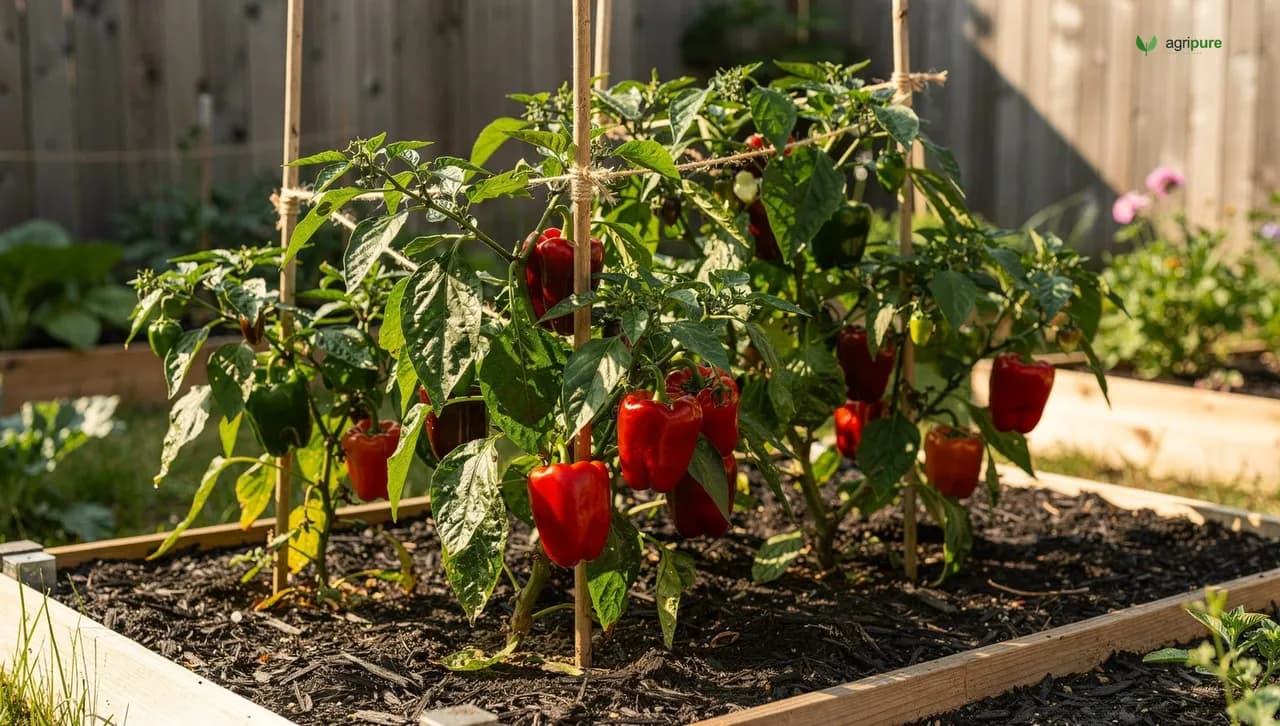
Left on the plant another 2 to 3 weeks, a green bell turns red, yellow, or orange and grows distinctly sweeter, with more vitamin C. The trade-off is plant energy: a pepper ripening on the plant slows the set of new fruit, so picking green keeps the plant productive while picking red maximizes flavor on each fruit.
- Sweet bells: harvest green for crunch and volume, or leave to color up for sweetness; cut, do not pull, to avoid snapping branches.
- Hot peppers: with the exception of jalapenos, let them ripen to their final dark red color on the plant for full heat and flavor.
- End of season: pick everything before the first frost, since cold ruins fruit fast; green peppers will slowly ripen indoors on a counter.
Pick early, pick often. Harvesting the first few fruit promptly signals the plant to keep flowering, often raising total yield over a season that waits for every pepper to fully ripen.
Conclusion
Growing peppers well comes down to respecting their two demands: a long warm start and steady conditions through a long season. Start seed 8 weeks early on bottom heat, wait for 70F soil before planting out, water evenly enough to keep calcium moving, and accept that a hot week or two will pause fruit set. Do that and a single plant will hand you green peppers in midsummer and sweet red ones into fall.
Frequently asked questions
How many weeks before transplanting should I start pepper seeds indoors?
Start pepper seeds indoors about 8 weeks before your last frost date, or 6 to 8 weeks before transplanting. Peppers germinate and grow slowly, so they need the longest indoor lead time of the common warm-season vegetables.
What soil temperature do peppers need before transplanting outside?
Wait until soil temperatures reach about 70F and nighttime lows stay above 50F, usually around 2 weeks after your last frost. Peppers set into cold soil stall and can be overtaken by later transplants in warm ground.
Why are my pepper plants dropping their flowers?
Blossom drop is almost always temperature stress. Peppers set fruit best with nights between 60 and 75F, and they shed flowers when nights stay above about 75F or days exceed 90F. Set usually resumes once temperatures ease.
What causes the brown sunken spots on the bottom of my peppers?
That is blossom-end rot, a calcium-transport problem rather than a soil shortage. It comes from uneven watering that interrupts calcium moving into the fruit. Water deeply and evenly (about 1 to 1.5 inches a week) and mulch to hold steady soil moisture.
Should I pick peppers green or wait for them to turn red?
Both work. Peppers are edible green at full size, usually 70 to 85 days after transplant, and turn red and sweeter if left another 2 to 3 weeks. Picking green keeps the plant setting new fruit; waiting maximizes flavor per pepper.
References
- University of Minnesota Extension — Growing peppers
- University of Georgia Extension — Home Garden Peppers (C1005)
- University of Wisconsin Horticulture — Blossom End Rot
- University of Georgia Extension — Blossom-End Rot and Calcium Nutrition of Pepper and Tomato (C938)
- Tran & Murakami (2015) — High Temperature, Fruit Productivity and Seed-Set of Sweet Pepper