Key takeaways
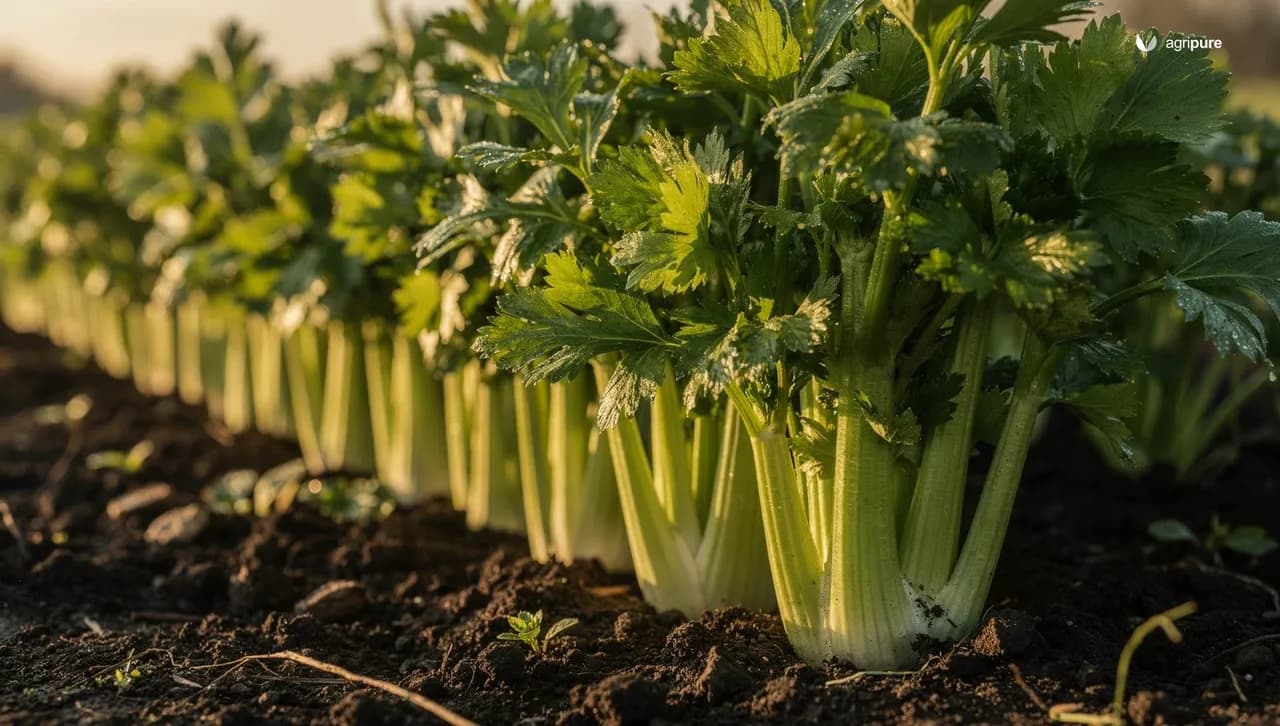
A close-up, eye-level photograph showing multiple stalks of bright green celery with healthy leaves, firmly rooted in dark, moist, organic garden soil. The image captures the texture and freshness of the celery, with a gently blurred garden background.
Growing abundant, tender celery from seed to harvest requires attention to detail and consistent care throughout its long season.
- Celery is a long-season crop that takes roughly 80 to 110 days to mature, so start seed indoors 10 to 12 weeks before your last frost.
- A cold snap below 55 F for 7 days or more makes first-year plants bolt, so set transplants out only after the chill of early spring has passed.
- The plant needs 1 to 2 inches of water every week; any dry spell turns the stalks tough and stringy.
- Celery is a heavy feeder — side-dress nitrogen at 4 and 8 weeks after transplanting to keep ribs growing fast and tender.
- Blanching by mounding soil or wrapping the stalks for the last 2 to 3 weeks yields paler, milder, less bitter celery.
Celery has a reputation as the fussiest thing in the vegetable garden, and most of that comes down to two numbers: a season near 100 days long and a need for water that almost never lets up. Drop a seed in May expecting a quick crop and you will be disappointed; the plant simply does not work on that clock.
What it does reward is planning. Give celery a 10 to 12 week indoor head start, a steady inch or two of water a week, and a bed it can feed from all season, and the fussiness mostly disappears. Here is the full sequence, from a slow indoor sprout to blanched, tender ribs you can cut a few at a time, with the numbers that matter at each stage.
The long clock and the indoor head start
Celery germinates slowly and grows slowly, which is why nearly every grower starts it indoors. Penn State PlantVillage advises sowing seed 10 to 12 weeks before the last spring frost, with seedlings emerging only after 2 to 3 weeks at a warm 60 to 70 F. From there the plant needs most of the summer: Michigan State University Extension puts maturity at 90 to 100 days for the earliest plantings, 80 to 90 days for mid-summer, and 90 to 110 days for anything sown after mid-July.
That long runway is the whole reason for the indoor start. Sowing the tiny seed under lights gives it the 8 weeks MSU says celery needs to reach a transplantable size, so the plant hits the garden already a third of the way through its season. The same patience pays off for other slow, cool-season crops like onions, which also want a long head start before the bed is warm enough.
Sowing the tiny seed
Celery seed is tiny (roughly 2,500 seeds to the gram), so handling it well at the start saves a lot of thinning later.
- Surface-sow shallowly: press seed onto moist mix and barely cover it, since the seed needs light and warmth near 70 F to wake up.
- Keep it damp for the full 2 to 3 weeks of germination — a dome or cover holds the steady moisture the slow sprout demands.
- Grow on cool but bright for 10 to 12 weeks, then harden the seedlings off before they face the open garden.
Start small, transplant once: celery resents being moved, so sow into individual cells rather than a shared flat. A seedling grown in its own cell goes into the ground with its roots intact and skips the week-long sulk that bare-root transplants take.
Young celery seedlings with delicate notched leaves growing in dark potting soil inside a seed tray under bright indoor light.
Why early cold makes celery bolt
The single biggest mistake with celery is rushing it into cold spring ground. Celery is a biennial that means to flower in its second year, but a cold spell in its first season can trick it into bolting early — sending up a tough seed stalk instead of building edible ribs. Michigan State University Extension is specific: celery plants often form seed stalks the first year if exposed to temperatures below 55 F for 7 days or longer.
That is why timing the transplant matters more than the calendar date. Penn State notes the plant’s optimum growth range is a narrow 59 to 70 F, and that a dip below 55 F is reason enough to give young plants a protective cover. Set celery out too early, hit a week of cold nights, and the crop bolts bitter — the same trap that catches a spring sowing of cilantro, only celery wastes a far longer season when it happens.
Wait for the cold to break: hold transplants indoors until nights settle reliably above 55 F, or keep a row cover handy for surprise cold snaps. A few cool nights are fine; it is a sustained week below 55 F that flips the plant into flowering.
Water and feed: where celery is unforgiving
If celery has one non-negotiable rule, it is moisture. The plant is mostly water and has shallow roots, so it cannot ride out a dry spell the way a deep-rooted tomato can. Utah State University Extension states plainly that celery needs at least 1 to 2 inches of water from rainfall or irrigation each week through the whole growing season. Let the bed dry out even once and the stalks turn tough, stringy, and strong-flavored — the classic stringy-celery complaint.
Feeding is the second half of the equation. Celery is a heavy nitrogen user, and USU recommends a side-dressing of nitrogen at a 1/4 cup of 21-0-0 per 10 feet of row at both 4 and 8 weeks after transplanting. Fast, well-fed growth is exactly what keeps the ribs crisp and mild; slow, hungry growth is what makes them woody. Working plenty of compost into the bed first builds the living soil that holds water and feeds steadily between those side-dressings.
Holding moisture between waterings
Hitting 1 to 2 inches a week is easier when the soil holds what you give it.
- Mulch the row with 2 to 3 inches of straw to slow evaporation; a good organic mulch can halve how often you need to water.
- Water deeply, not lightly — a single soaking that wets the top 6 inches beats three shallow sprinkles a week.
- Keep the soil at pH 6.0 to 6.8, the range Penn State gives for celery, so the nitrogen you add is actually available to the roots.
Spacing, varieties, and blanching for milder stalks
Celery wants company close by. Penn State spaces plants 6 to 8 inches apart in rows 2 to 3 feet apart, and that tight in-row spacing is deliberate: neighboring plants shade each other’s lower stalks and help keep them pale and tender. The choice of variety and whether you blanch decides how mild the final ribs taste, so it helps to see the trade-offs side by side.
Approach | Effort | Flavor and color | Best for |
|---|---|---|---|
Green (Pascal) celery, unblanched | Lowest | Deep green, fuller flavor | Most home gardens |
Soil-mounded blanching | Moderate | Pale base, milder | Sweeter eating celery |
Paper or board wrap | Moderate | Pale stalks, less grit | Avoiding soil in the ribs |
Self-blanching variety | Low | Naturally pale | Growers who skip wrapping |
Blanching simply means excluding light from the stalks. Penn State describes covering the stalks with paper or soil to keep them from turning green, and recommends mounding soil up around the ribs starting 2 to 3 weeks before harvest. The result is paler, sweeter, less bitter celery — though many growers happily skip it and eat the fuller-flavored green stalks.
Harvesting a few stalks at a time
Celery does not have to come out of the ground all at once. The plant grows from the center, adding new ribs while the 8 to 12 outer ones mature, so you can harvest it cut-and-come-again — taking the outer stalks as you need them and leaving the plant to keep producing. Penn State notes that cutting the outer petioles is effectively cutting them back naturally, and the heart keeps pushing fresh growth for weeks.
For a single full head, cut the whole plant at the soil line once the ribs reach a usable size, usually after that full 80 to 110 day run. Either way, harvest before a hard freeze: light frost sweetens celery, but a deep freeze ruptures the watery ribs and turns them mushy. The same patient, pick-as-you-go habit works well with leafy crops like lettuce, where outer leaves feed you for weeks before the plant is spent.
Take the outside, leave the heart: snapping off the 3 or 4 oldest outer stalks each week keeps a plant in steady supply far longer than pulling whole heads. The pale inner ribs stay protected and tender under the outer leaves.
A clump of garden celery with soil mounded up around the base of the pale lower stalks to blanch them, dark leafy tops above in afternoon light.
Conclusion
Growing celery is mostly a matter of respecting its two demands — a long season and constant water. Start the seed 10 to 12 weeks early, hold the transplants until nights clear 55 F so the crop does not bolt, keep the bed at 1 to 2 inches of water a week with a nitrogen feed at 4 and 8 weeks, and blanch the last 2 to 3 weeks if you want milder ribs. Do that and a crop with a fussy reputation turns into one of the most rewarding things you cut from the late-season garden.
Frequently asked questions
How long does celery take to grow?
Celery is a long-season crop that takes roughly 80 to 110 days to mature after transplanting, depending on the variety and planting date. Because it also needs 10 to 12 weeks of indoor growth first, the full cycle runs close to half a year from seed.
Why does my celery bolt and go to seed?
Celery bolts when first-year plants are exposed to temperatures below 55 F for 7 days or longer, which tricks the biennial into flowering early. Hold transplants until nights stay reliably above 55 F to avoid a bitter seed stalk.
Why is my celery stringy and tough?
Stringy, tough stalks almost always come from water stress. Celery needs at least 1 to 2 inches of water every week, and any dry spell during the season makes the ribs woody and strong-flavored rather than crisp and mild.
Do I need to blanch celery?
No, blanching is optional. Mounding soil or wrapping paper around the stalks for the last 2 to 3 weeks excludes light and yields paler, milder ribs, but unblanched green celery is perfectly edible and has a fuller flavor.
Can I harvest celery a little at a time?
Yes. Celery grows from the center, so you can cut 3 or 4 outer stalks as you need them and leave the plant to keep producing new ribs for weeks, rather than pulling the whole head at once.
References
- Penn State PlantVillage — Celery: Description, Uses, Propagation
- Michigan State University Extension — Celery: Commercial Vegetable Recommendations
- Utah State University Extension — Celery in the Garden
- Penn State PlantVillage — Celery for Beginners
- UMass Amherst Center for Agriculture — Celery Fact Sheet