Key takeaways

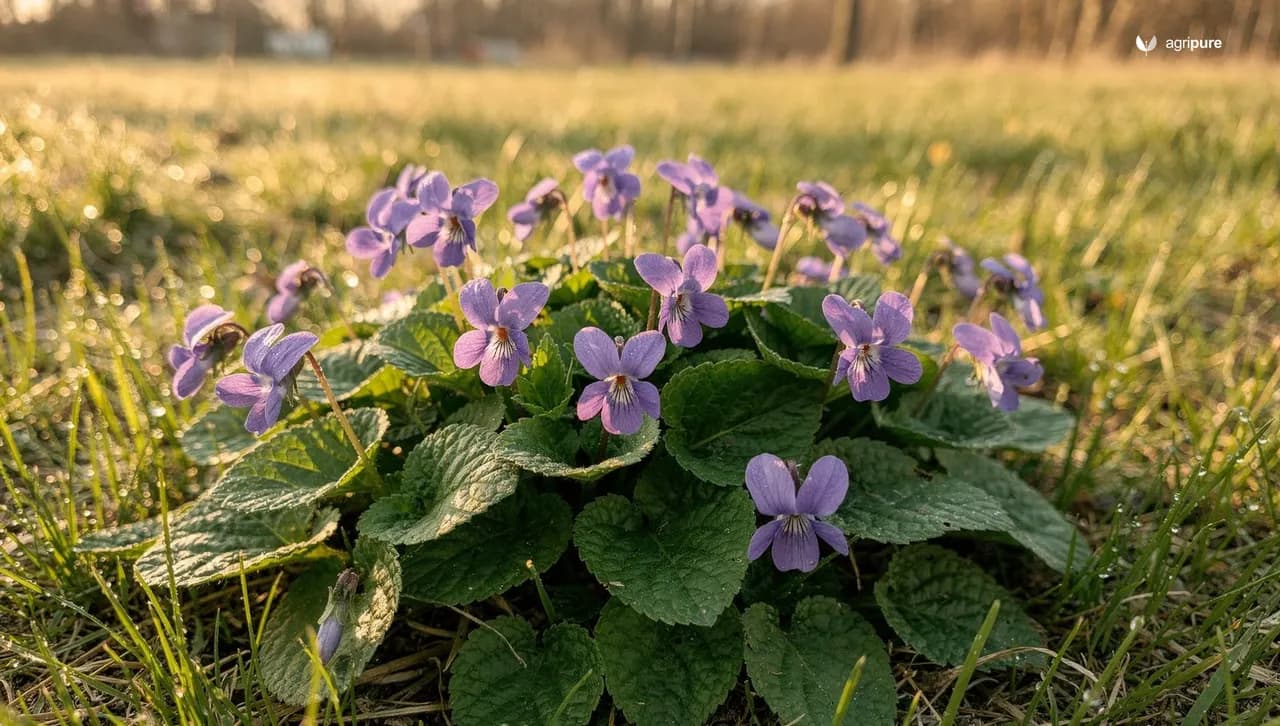
Common blue violets (Viola sororia) are easily identified by their heart-shaped leaves and distinctive five-petal purple flowers, often found as a cheerful early spring groundcover in lawns and gardens.
- Common blue violet (Viola sororia) is a native perennial 3 to 10 inches tall with heart-shaped leaves and five-petal blue-purple flowers.
- The flowers and young leaves are edible; one-half cup of leaves reportedly carries as much vitamin C as three oranges.
- Never eat the roots, and beginners should harvest only the flowers — the leaves have non-edible look-alikes.
- Do not confuse this lawn plant with the houseplant African violet, which is a different genus and not a culinary plant.
- As a lawn weed it spreads by rhizomes and seed; you can either embrace it as groundcover or dig the rhizomes out.
Look down at a spring lawn and the small purple flowers nodding over rounded leaves are almost certainly common blue violet, a native plant that grows in clumps 3 to 10 inches tall. Pick one flower, count 5 petals, and check that the leaf is heart-shaped, and you have made a positive identification of one of the easiest wild edibles to learn.
That same plant is on more than one lawn-weed list, because it spreads by both rhizomes and seed and shrugs off most controls. Here is how to identify Viola sororia with confidence, which parts are safe to eat and which to leave, the 2 look-alikes worth knowing, and whether to manage it as a weed or keep it as groundcover.
How to identify common blue violet
Lead with the flower, because it is the one part that is hard to mistake. University of Minnesota Extension describes the plant as a native perennial groundcover that forms clumps between 3 and 10 inches tall, with leaves that are heart to oval shaped and rounded teeth along the margin, above blue-purple flowers with five petals. Penn State Extension adds the diagnostic detail that 2 of those 5 petals carry small white hairs at the base, a feature you can see with the naked eye.
The Missouri Botanical Garden lists Viola sororia as a Missouri native wildflower 3 to 8 inches tall with wide heart-shaped leaves and large blue-violet flowers, sometimes white with purple veining. Across these sources the picture is consistent, which is exactly what you want in a foraging target: a low rosette of heart-shaped leaves and a 5-petal flower on a bent stalk.
The 4-point field check
Run all 4 checks before you call it. A single matching trait is not enough — wild violet earns its identification when the leaf, the petal count, the color, and the growth habit all line up at once.
- Leaf shape: heart-shaped to oval, with rounded or scalloped teeth, growing in a basal rosette rather than up a tall stem.
- Flower: 5 petals, blue to deep purple, roughly 0.5 to 0.75 inch across, with white hairs at the base of the lower petals.
- Height: a low clump 3 to 10 inches tall, never a shrub or a vine.
- Habit: spreads sideways into a patch by underground stems, which is why you rarely see just one.

Eating the flowers and young leaves
The reason violet is worth keeping in the kitchen is its food value. University of Illinois Extension reports that 0.5 cup of violet leaves contains as much vitamin C as 3 oranges, and that both the flowers and the leaves of common blue violet are edible — but the roots are not. That single line settles most of the safety question: eat the tops, skip the bottom.
The flowers are the easiest harvest and the most forgiving. University of Minnesota Extension notes that violet flowers can garnish salads or flavor vinegar and syrup, and they candy well for cakes. Young leaves are mild and work like any tender green — raw in a spring salad, or wilted into soup where they thicken the broth slightly.
- Flowers: scatter 10 to 20 fresh over a salad, steep in vinegar for a week, or candy them with egg white and superfine sugar.
- Young leaves: pick before the plant flowers heavily, when they are tender; use within a day or 2 like spinach.
- Timing: the best window is the first 3 to 4 weeks of bloom in early spring, before summer heat toughens the leaves.

Harvest clean ground only: skip any patch that may have been sprayed with herbicide or sits within a few feet of a road, since violet leaves hold whatever is on the soil. A backyard no-spray bed is the safest place to forage.
The cautions: roots, quantity, and African violet
Three cautions keep a violet harvest safe, and none of them is complicated. The first of the 3 is the rule already stated: the roots and rhizomes are not for eating. Some yellow-flowered violet species concentrate compounds in the underground parts that can upset your stomach in quantity, so the whole below-ground portion of any wild violet stays in the ground.
The second caution is for beginners specifically. University of Minnesota Extension advises that beginning foragers should only harvest the flowers, because violet leaves are easily confused with other non-edible plants. The flower is the unmistakable part; until you can identify the leaf cold, treat the 5-petal bloom as your sure bet and leave the greens.
Do not eat African violet
The name causes the most dangerous mix-up. The houseplant sold as African violet is in a different genus entirely (Streptocarpus, formerly Saintpaulia) and is not a culinary plant — it is an ornamental grown indoors for its flowers, not something to put in a salad. Wild violet grows outdoors in lawns and woodland edges; African violet lives in a pot on a windowsill. Keep the 2 mentally separate, and never eat a flower off a houseplant just because it shares the word violet.
One-line safety test: if the plant came from a garden center in a 4-inch pot, it is not the wild violet in this guide. Only the outdoor lawn-and-woodland violet with heart-shaped basal leaves is the edible Viola sororia.
Edible parts and safety at a glance
Each part of the plant earns a different verdict, and a single table sorts them faster than a paragraph. This view pairs every part with whether it is edible, how to use it, and the caution that applies — the heart-shaped leaves, the 5-petal flowers, the rhizomes, and the African violet look-alike.
Part | Edible? | Best use | Caution |
|---|---|---|---|
Flowers (5 petals) | Yes | Salads, vinegar, syrup, candied | Beginner-safe; the sure bet |
Young leaves | Yes | Raw or cooked greens, high in vitamin C | Easily confused with look-alikes |
Mature leaves | Yes but tough | Cook into soups to thicken | Bitter and fibrous after bloom |
Roots / rhizomes | No | Leave in the ground | Can upset the stomach in quantity |
African violet (houseplant) | Not for eating | Ornamental only | Different genus; never forage it |
Across all 5 rows, the pattern is simple: tops are food, roots are not, the flower is the beginner’s safe entry point, and anything growing in a pot indoors is off the menu entirely.
Lawn weed or keeper: managing wild violet
The same traits that make violet charming make it persistent. University of Illinois Extension hort answers calls common blue violet an aggressive grower that spreads both by underground stems and by seed. Penn State Extension explains why it is one of the harder lawn weeds to control: the plant forms thick, branching rhizomes that store food and overwinter, and a waxy leaf cuticle blocks much of any spray you put on it.
If you want it gone, hand-pulling alone will not do it. Penn State Extension is direct that removal by hand is not effective unless the rhizomes are excavated from the soil. That means digging a 4 to 6 inch root ball under each clump with a hand tool, not tugging the leaves, which simply snap off and leave the rhizome to resprout. A dense, well-fed lawn slows the spread but rarely clears an established patch on its own.
The case for keeping it
Plenty of growers choose the other path. Illinois Extension’s own writer keeps violets as a groundcover for their wildlife appeal, and in a low-input yard that logic holds: violet shades the soil, feeds early pollinators, and hands you a free spring forage crop in the bargain. In a managed bed it pairs well with other low groundcovers and reduces how much mulch you need to keep weeds down.
- Embrace it in shade gardens, woodland edges, and lawn corners where you want living groundcover over bare dirt.
- Contain it by edging beds and mowing the lawn margin, so it fills the spots you want and stops at the line you draw.
- Remove it only where you need pristine turf, and then by digging rhizomes, repeated over a season or 2.
Foraging it well in your own yard
The cleanest violet patch is one you manage yourself. Because the leaves take up whatever is in the soil, a chemical-free yard is worth more to a forager than any wild stand within 30 feet of a road. Build the soil first, keep the herbicides off, and the violet that volunteers becomes a dependable early-spring harvest you can trust down to the leaf.
Two habits make the harvest reliable year after year. Letting a few clumps go to seed each spring keeps the patch self-renewing, and feeding the ground with compost rather than synthetic spray keeps the leaves clean enough to eat. Growers who already tend living soil usually find violet shows up on its own within a season or 2.
Pick in the morning: flowers are most open and least wilted in the first few hours after the dew dries, so a 15-minute pass at 8 a.m. yields better blooms for vinegar or candying than an afternoon harvest.
Conclusion
Wild violet rewards a grower who leads with identification: 5 petals over a heart-shaped leaf is the positive ID, the flowers and young leaves are food worth more vitamin C than the same weight of orange, and the roots and any African violet houseplant stay off the plate. Whether you treat the patch as a lawn weed to dig out by the rhizome or a free groundcover to embrace, the plant under your feet is one of the most useful 3-inch wildflowers in the yard.
Frequently asked questions
How do I identify a wild violet?
Look for a low clump 3 to 10 inches tall with heart-shaped leaves in a basal rosette and blue-purple flowers that have exactly five petals, two of them with small white hairs at the base. That flower-and-leaf combination is the positive ID for common blue violet.
Are wild violet flowers and leaves edible?
Yes. Both the flowers and the young leaves of common blue violet are edible, and 0.5 cup of leaves reportedly holds as much vitamin C as 3 oranges. The roots and rhizomes are not edible and should always be left in the ground.
Can you eat African violet?
No. The African violet sold as a houseplant is a different genus and is an ornamental, not a culinary plant. Only the outdoor wild violet with heart-shaped basal leaves and five-petal flowers is the edible species described here.
Why is wild violet so hard to kill in a lawn?
It forms thick, branching rhizomes that store food and overwinter, and a waxy leaf cuticle blocks much of any spray. Hand-pulling does not work unless you excavate the rhizomes, so control usually means digging a 4 to 6 inch root ball under each clump.
Should I remove wild violet or keep it?
That depends on the spot. In shade gardens and lawn corners it makes useful groundcover that feeds early pollinators and gives you a spring forage crop, so many growers keep it. Remove it only where you need pristine turf, and then by digging the rhizomes over a season or two.
References
- University of Minnesota Extension — Wild violet
- University of Minnesota Extension — Wild edibles: Common blue violets
- University of Illinois Extension — Embracing the common blue violet
- Penn State Extension — Lawn and Turfgrass Weeds: Wild Violet
- Missouri Botanical Garden — Viola sororia Plant Finder
- University of Illinois Extension — Common Blue Violet (Viola sororia) Hort Answers