Key takeaways
An idyllic, sunlit backyard chicken coop made of natural wood with a green trim, situated in a lush, vibrant green pasture where several healthy hens are foraging. Fresh eggs are visible in a nesting box, and the scene conveys a sense of well-being and sustainable farming.
Building a thriving chicken farm, whether for a backyard flock or a small business, starts with careful planning and attention to detail, from selecting the right breeds to ensuring proper housing and biosecurity.
- Decide the goal before the birds. Eggs, meat, or both pull a farm in different directions — different breeds, different housing, different cash flow, and a different legal path to a sale.
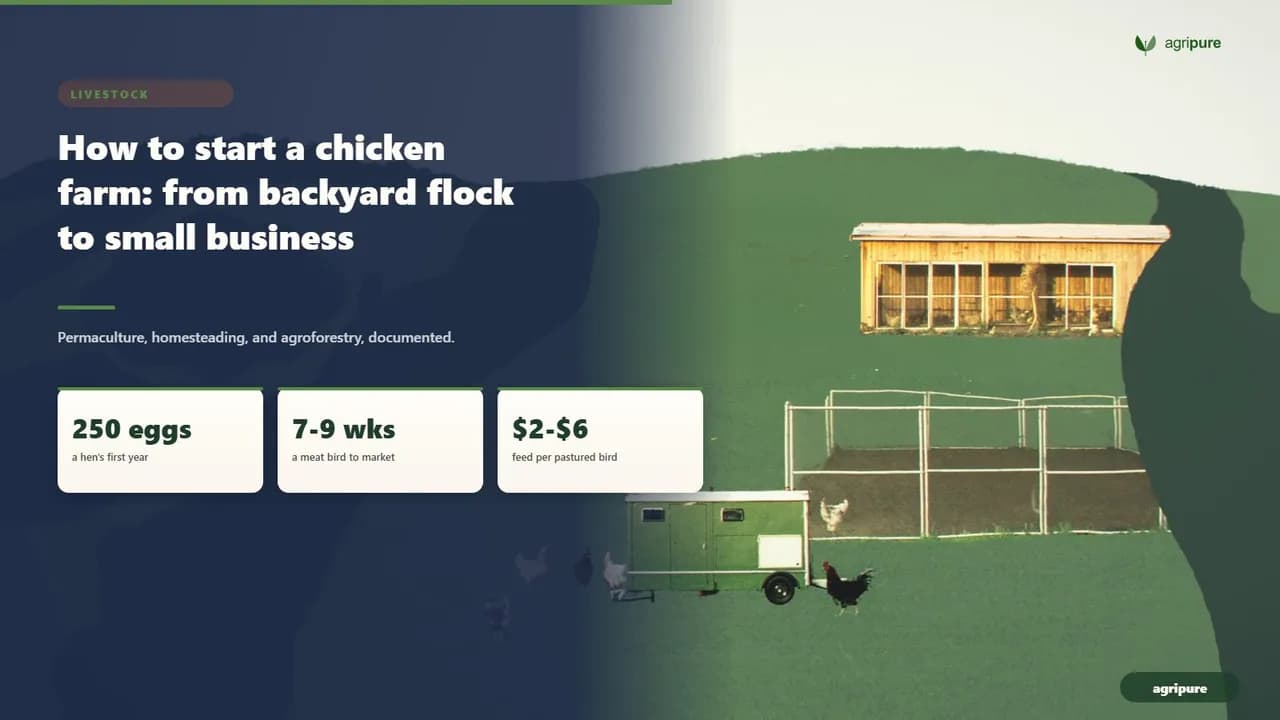
- Scale follows numbers you can verify. A laying hen gives about 250 eggs in her first year and eats 90 to 100 pounds of feed over 13 months; a meat bird reaches 3 to 5 pounds in 7 to 9 weeks on roughly 8 to 9 pounds of feed.
- Clear the land question first. Urban ordinances often cap a backyard flock near five or six hens and ban roosters, so the zoning office comes before the hatchery order.
- Feed is the cost that decides the business. On pasture, feed alone runs about $2 to $6 per meat bird; for eggs, the break-even price per dozen is usually well above the grocery shelf until you reach scale.
- Selling is regulated, and the rules are local. Many states let you sell ungraded eggs under a weekly cap (30 dozen per week in North Carolina) but require refrigeration at 45°F and a labeled carton.
- Most first-year flocks fail on biosecurity and overcrowding, not feed brand. Quarantine new birds 2 to 4 weeks and give layers at least 3 to 4 square feet each indoors.
A chicken farm is a math problem before it is a barn
In 2022 the United States raised enough broilers to put 45.7 billion pounds of chicken on the market, and the USDA projects that climbing to 52.5 billion pounds by 2033. That scale belongs to a handful of vertically integrated companies. Your farm will not look like theirs, and it should not try to. A new grower’s opportunity sits in the gap those companies leave open — fresh eggs from a named flock, pastured meat birds sold at the farm gate, a face the buyer trusts.
Starting a chicken farm is less about chickens than about three decisions made in the right order:
- What you are selling: eggs, meat, or both.
- How many birds that takes: the flock size your goal and your market need.
- Whether the land and the law will let you: zoning, space, and the rules around a sale.
Get those right and the birds are the easy part. Get them wrong and you learn the hard way that a hen who lays 250 eggs a year still eats every single day, laying or not.
This guide walks the path a careful first-year chicken farmer actually takes — from the backyard flock of 4 to 8 birds that proves you can keep them alive, to the small business that turns a profit on eggs or meat. Every number here traces to a university extension service, the USDA, or a SARE field study, because false precision is how new farms lose money. If you are still at the very start, our guide to starting a small laying flock covers the backyard basics this article builds on.
The numbers that frame a small chicken farm, drawn from university extension and SARE data.
Decide the goal and the scale first
Before you price a coop or a single chick, answer one question: are you raising hens for eggs, birds for meat, or running both? The choice sets everything downstream. An egg flock is a slow, steady annuity: birds you keep for 2 or 3 years, daily collection, and a product that is legal to sell almost everywhere with light rules. A meat flock is a sprint: chicks in, birds out in about 8 weeks, a bigger one-time payday but a harder regulatory wall around slaughter and sale.
Eggs and meat reward different temperaments. If you want a routine you can fold into a morning and a product that moves itself, lean toward layers — a hen lays for 2 to 3 productive years. If you would rather run intense 8-week batches a few times a season and you have a plan for processing, meat birds carry a higher ceiling. Many small farms do both, staggering a laying flock against two or three batches of broilers so the cash arrives across the year rather than in one lump.
Map your goal to a flock size
Scale is where ambition meets feed bills. Use these three reference points, drawn from extension budgets, to place yourself.
- Backyard proof of concept: 4 to 8 hens. Enough eggs for a household and a few dozen to give away. It is an apprenticeship that shows whether you like 6 a.m. chores in February, not a business.
- Market-garden sideline: 25 to 100 birds. A laying flock at this size produces real surplus to sell; a pastured-meat batch of this size is a manageable first commercial run.
- Small commercial operation: several hundred to about 1,000 birds per cycle. SARE's pastured-poultry work treats roughly 1,000 birds per season as a sensible starting scale for a serious enterprise: large enough to matter, small enough to learn on.
The jump from a backyard flock to a market sideline is the one most new farmers underestimate. Going from 8 birds to 80 does not multiply the work tenfold, but it does roughly multiply the feed, the manure, the water, and the number of things that can go wrong on a hot afternoon. Start one tier below where you think you can manage and grow into the next.
Five decisions, in order, before a single chick arrives.
Land, zoning, and permits before you buy a single bird
The most expensive mistake a new chicken farmer makes is buying birds before reading the local ordinance. Whether you may keep poultry at all depends on your state, county, and city rules, and those rules vary block to block. In many residential zones the limit on a backyard flock sits around 5 or 6 hens, and roosters are banned outright because they crow throughout the day, not just at dawn.
Call your zoning office and ask for the ordinance in writing. The four questions that matter: how many birds you may keep, whether roosters are allowed, how far the coop must sit from property lines, and whether you need a permit or a neighbor notification. Setback rules (a required distance, often 10 to 25 feet, between the coop and the fence line) are common but not universal, and they reduce how many birds a small lot can legally hold.
When the backyard is not enough
If your goal is a commercial flock of several hundred birds, residential zoning will cap you fast, and you will need agricultural land or a property zoned to allow it. More land also opens better systems. On acreage you can run birds on pasture, rotate them across paddocks, and even fold them into a tree system — grazing livestock under trees keeps the same ground producing eggs, meat, and timber at once. That is a longer game, but it is the direction a land-based chicken farm naturally grows.
Permits scale with ambition too. A handful of hens for personal eggs usually needs nothing. Selling eggs, selling meat, or crossing a few hundred birds can trigger registration with a state agriculture department, and processing meat for sale brings its own inspection rules. Map the legal path to your first sale before you order chicks, not after — the lead time on a permit can run several weeks.
Choosing production breeds that match the job
A chicken is not a chicken when you are selling what it makes. Egg breeds and meat breeds have been selected for opposite traits over more than 60 years, and trying to make one do the other’s job is how margins disappear. Pick the bird for the product.
Rhode Island Red and white Leghorn laying hens foraging on grass beside a wooden coop on a small chicken farm
Commercial laying hybrids like the Rhode Island Red and white Leghorn are bred to convert feed into eggs.
Layers: birds bred to convert feed into eggs
For eggs, the workhorses are commercial sex-linked hybrids — birds bred to lay hard and eat efficiently. Penn State Extension reports these hybrids lay 240 to 280 eggs a year, while many heritage breeds manage only 50 to 100. A White Leghorn or a Rhode Island Red sits at the high end, 250 to 300 eggs in a good first year. Hens begin laying around 18 weeks of age, so a spring chick is paying you back by late summer.
Heritage breeds cost you eggs (often 150 fewer per year) but buy you other things: hardiness, foraging instinct, a story that sells at a farmers market, dual-purpose carcasses when the hen retires. There is no wrong answer, only a tradeoff you should price. If eggs are the business, weigh it carefully against the breed, feed, and yolk realities of laying hens that separate a hen that pays from a pretty one that does not.
Meat birds: the Cornish cross and its alternatives
For meat, the commercial Cornish cross dominates for one reason: speed. University of Minnesota Extension notes these birds reach a 3-to-5-pound market weight in 7 to 9 weeks, converting feed to muscle faster than any heritage bird. That speed is also their flaw — they grow so fast they cannot be kept much past nine weeks without health problems, so the schedule is unforgiving.
Slower-growing alternatives (Freedom Rangers and similar pastured strains) take an extra 2 to 3 weeks and eat more per pound of gain, but they forage, move, and behave like chickens, which matters if you are selling a pasture-raised story. The fast bird wins on cost; the slow bird wins on premium. Your market decides which math you run.
Egg layers vs. meat birds at a glance (figures from university extension)
Trait | Laying hens | Meat birds (Cornish cross) |
|---|---|---|
Time to payback | Begins laying ~18 weeks; kept 2-3 years | Slaughtered at 7-9 weeks |
Output | 240-300 eggs/year (hybrids) | 3-5 lb dressed carcass |
Feed per bird | 90-100 lb over 13 months | 8-9 lb to 8 weeks |
Cash flow | Steady, daily | Lump sum per batch |
Legal path to sell | Light (small-flock egg exemption) | Heavy (inspected processing) |
Housing and infrastructure that scales with the flock
Housing is where the backyard hobby becomes infrastructure. The numbers are not negotiable: crowd birds and you trade saved square footage for disease, feather-picking, and dead stock. Extension guidance is consistent — laying hens need a minimum of 3 to 4 square feet per bird indoors and about 10 square feet per bird outdoors. Penn State puts the indoor floor at 2 square feet for a basic coop; the University of Alaska Fairbanks recommends 2 to 2.5. Build to the higher end and you will rarely regret it.
A mobile chicken tractor and a fixed coop with a fenced run holding broiler chickens on green pasture at a small farm
A fixed coop and run for layers, paired with a mobile tractor for meat birds — two systems on one farm.
A working laying setup needs more than walls: one nest box for every 3 or 4 hens, about 12 inches of roost per bird, predator-proof construction, ventilation that clears ammonia without chilling the flock, and water that will not freeze in winter or cook in summer. The structure is the cheapest insurance you will buy.
Fixed coop, mobile pen, or pasture
These three housing models cover most small chicken farms, and they scale differently.
- Fixed coop and run: simplest, best for a stable laying flock. The ground inside the run wears out, so it needs bedding management and rest.
- Chicken tractor: a bottomless mobile pen moved daily, common for meat birds. UMN Extension recommends raising floor space toward 1 square foot per bird as broilers approach 6 to 10 weeks, and a tractor delivers fresh ground every move.
- Open pasture with mobile shelter: the free-range model, where birds range from a movable house. It is the most land-hungry and the most marketable, and it explains how pastured birds in tractors and rotation operate.
Free-range and pasture systems sell at a premium because the label is real — birds on grass, moved before the ground fouls, at up to 10 square feet per bird outdoors. They also demand more fencing, more predator defense, and more land per bird. Industrial chicken farming chose confinement for a reason: it is cheaper per bird. A small farm wins by selling the opposite, so build the system your buyer is paying for.
Feed, inputs, and the first-year economics
Here is the number that decides whether your chicken farm is a business or an expensive hobby: feed is the largest cost you will carry, routinely 60% to 70% or more of what it costs to put an egg or a pound of meat on the table. Every other line (chicks, bedding, fencing) is a rounding error next to the feed bill over a year. Master feed and you master the economics.
A galvanized hanging feeder full of grain with hens feeding around it inside a coop, layer feed bags stacked nearby
Feed is routinely the majority of the cost of producing an egg or a pound of meat.
The intake figures are steady across sources. A laying hen eats about half a cup of feed a day, totaling 90 to 100 pounds over 13 months, per University of New Hampshire and UAF extension data. A meat bird is hungrier per day but done faster — roughly 5 pounds of feed to reach 6 weeks and 8 to 9 pounds by 8 weeks. On pasture, SARE puts the feed cost at $2 to $6 per bird across its seven-to-eight-week life, because foraging trims the bill.
Running the break-even
Break-even is where romance meets the spreadsheet. Take eggs: a hen eating 100 pounds of feed a year at, say, $0.60 a pound costs $60 to feed, and at 250 eggs (about 21 dozen), that is roughly $2.85 per dozen in feed alone, before you count the coop, the chicks, the bedding, or your time. Add fixed costs and most backyard-scale egg operations only break even at a price well above the grocery shelf. That is why selling eggs profitably usually waits for scale, a premium buyer, or both.
Meat can pencil out faster. A 4-pound dressed bird that costs $6 in feed and a few dollars more in chick, processing, and overhead can sell for a real premium at the farm gate — but only if you have buyers lined up before the chicks arrive. Build an enterprise budget the way extension services teach it: list every cost and every return for one cycle, find your true cost per dozen or per bird, then set a price that clears it. Commercial chicken farming survives on razor margins and volume; a small farm survives on a higher price for a better product. Know which game you are playing.
Selling eggs and meat legally
You can grow the best eggs in the county and still be breaking the law selling them. Egg and meat sales are regulated at the state level, and the rules are specific. Here is the good news for a small egg seller: most of the 50 states carve out a small-flock exemption, frequently for flocks under a few hundred hens. The catch: it has conditions, and they are not optional.
Egg rules turn on volume and channel. North Carolina, a representative example, exempts producers from grading when ungraded sales stay at or below 30 dozen eggs per week and the eggs are sold directly to the consumer. Even under the exemption, the eggs must be held at a refrigerated 45°F or below, and the carton must carry the grade, the size or weight class, the count, and the packer’s name and address. California requires every egg seller to register with the state, with a labeling exemption for flocks of 500 hens or fewer selling direct, and caps a “community food producer” at 15 dozen a month.
The rules tighten as you scale and as you add meat
Read your own state's egg law before you sell a carton: the thresholds, the 45°F refrigeration rule, and the labeling list vary, and crossing from direct-to-consumer into stores or restaurants almost always pulls you into full licensing and grading. Selling meat is a steeper climb: processing birds for sale generally requires inspected facilities, and the limited-volume exemptions that let you process a small number of birds on-farm are narrow and tied to state rules. The pattern holds across the board: the more birds you sell and the further from your own farm gate they travel, the heavier the compliance. Plan the legal path to each sale the way you plan the feed.
First-year mistakes and the biosecurity that prevents them
Most first-year flocks that fail do not fail on breed choice or feed brand. They fail on two things: overcrowding and disease. Both are preventable, and both are cheaper to avoid than to fix.
Overcrowding is the quiet killer. Birds packed below the 3-to-4-square-foot space minimum get stressed, start pecking, stop laying, and pass illness fast. The fix is the floor-space numbers above — honor them and you remove a whole category of problems. Other classic errors: ordering more birds than the coop holds, skimping on predator-proofing until the first raccoon teaches the lesson, and underestimating winter water.
A clean fenced chicken run with a disinfectant footbath at the gate and free-range hens, kept separate from a wild treeline for biosecurity
Biosecurity is mostly routine: clean footwear, a footbath, and distance from wild birds.
Biosecurity is the discipline that keeps a flock alive
Disease is the risk that can erase a flock in a week, and avian influenza has made it sharper. Virginia Cooperative Extension lays out five core practices, and they are simple to follow once they are habit.
- Quarantine new and sick birds. Keep any newly acquired bird separated for two to four weeks before it meets the flock, and isolate sick birds immediately.
- Keep wild birds out. Site feeders and water away from anything that draws wild birds, and do not build decorative ponds into a poultry run.
- Clean what enters the coop. Disinfect shared tools before use, wear dedicated footwear, and wash your hands before and after handling birds.
- Mind cross-contact. Leave a 72-hour gap between visiting other people’s birds and your own, and source stock from clean flocks.
None of this is exotic. It is the unglamorous routine that separates the chicken farmer who is still in business in year 3 from the one who learned biosecurity by losing a flock. The birds reward consistency more than cleverness.
A short history of how the chicken became a farm animal — and where small farms fit now.
The honest version of starting a chicken farm
A chicken farm rewards patience and punishes wishful arithmetic. The birds are forgiving; the feed bill is not. Start with a small flock you can keep alive through a winter, learn what 250 eggs and a 90-pound feed bag feel like in your own hands, and only then scale toward the eggs-or-meat business the numbers will support.
The growers who last are the ones who treated it as a small business from the first chick — who knew their cost per dozen, cleared the zoning and the 45°F egg rule before they sold anything, and built housing for the flock they had rather than the flock they imagined. Do that, and a chicken farm is one of the most honest small enterprises a piece of land can carry. If you want the tools to run the rest of the homestead around it, our shop is a good place to start.
Frequently asked questions
How much money do you need to start a small chicken farm?
It depends entirely on scale and goal. A backyard laying flock of a few hens runs a few hundred dollars for a coop, birds, feeders, and the first feed. A small commercial pastured operation of around 1,000 birds per season needs real investment in mobile housing, fencing, and feed — and SARE’s enterprise budgets are the place to model it before you spend.
Is it cheaper to raise your own eggs than to buy them?
Usually not at backyard scale. Feed alone runs roughly $2 to $3 per dozen for a hen eating 90 to 100 pounds a year, and once you add the coop, chicks, and bedding, the break-even price sits well above the grocery shelf. Home eggs win on freshness, control, and the pleasure of the flock; they rarely win on raw cost until you reach scale or a premium market.
How many chickens do I need to make it a business?
There is no single number, but the tiers help: 25 to 100 birds turns a hobby into a sideline, and several hundred to about 1,000 per cycle is where a serious small enterprise begins. The deciding factor is whether you have buyers and a legal path to the sale, not flock size alone.
Do I need a license to sell eggs from my chickens?
Often you qualify for a small-flock exemption, but the conditions are real. Many states let you sell ungraded eggs directly to consumers under a weekly cap (30 dozen per week in North Carolina), provided the eggs are refrigerated at 45°F and the carton is properly labeled. Some states, like California, require registration regardless. Always check your own state’s egg law first.
What is the most common reason new chicken farms fail?
Overcrowding and disease, not breed or feed choice. Birds kept below the space minimums get stressed and sick, and a single biosecurity lapse can wipe out a flock. Honoring the 3-to-4-square-foot indoor minimum and quarantining new birds for two to four weeks prevents most first-year losses.
References
- USDA Economic Research Service. Poultry & Eggs: Sector at a Glance. 2024.
- USDA Economic Research Service. Long-Term Growth Projected as U.S. Poultry and Egg Sector Recovers. Amber Waves, 2024.
- University of Minnesota Extension. Raising chickens for meat.
- Penn State Extension. Successfully Raising a Small Flock of Laying Chickens.
- Penn State Extension. Small-Scale Egg Production (Organic and Conventional).
- University of New Hampshire Extension. Producing Your Own Eggs.
- University of Alaska Fairbanks Cooperative Extension. Home Laying Flock.
- Poultry Extension. Space Allowances in Housing for Small and Backyard Poultry Flocks.
- Jacob, J. & Anderson, K. Developing Regulations for Keeping Urban Chickens. eXtension Poultry Community.
- NC State Extension. Explaining the North Carolina Egg Law for Producers With Small Flocks.
- California Department of Food and Agriculture egg rules, summarized in Selling Backyard Chicken Eggs in California.
- SARE. Profitable Poultry: Raising Birds on Pasture — Potential for Profit.
- Virginia Cooperative Extension. Biosecurity: Five Steps to Protect Poultry from Avian Influenza (and Other Diseases), APSC-200.
- Animals (MDPI). Data Analytics of Broiler Growth Dynamics and Feed Conversion Ratio of Broilers Raised to 35 d. 2023.