Key takeaways

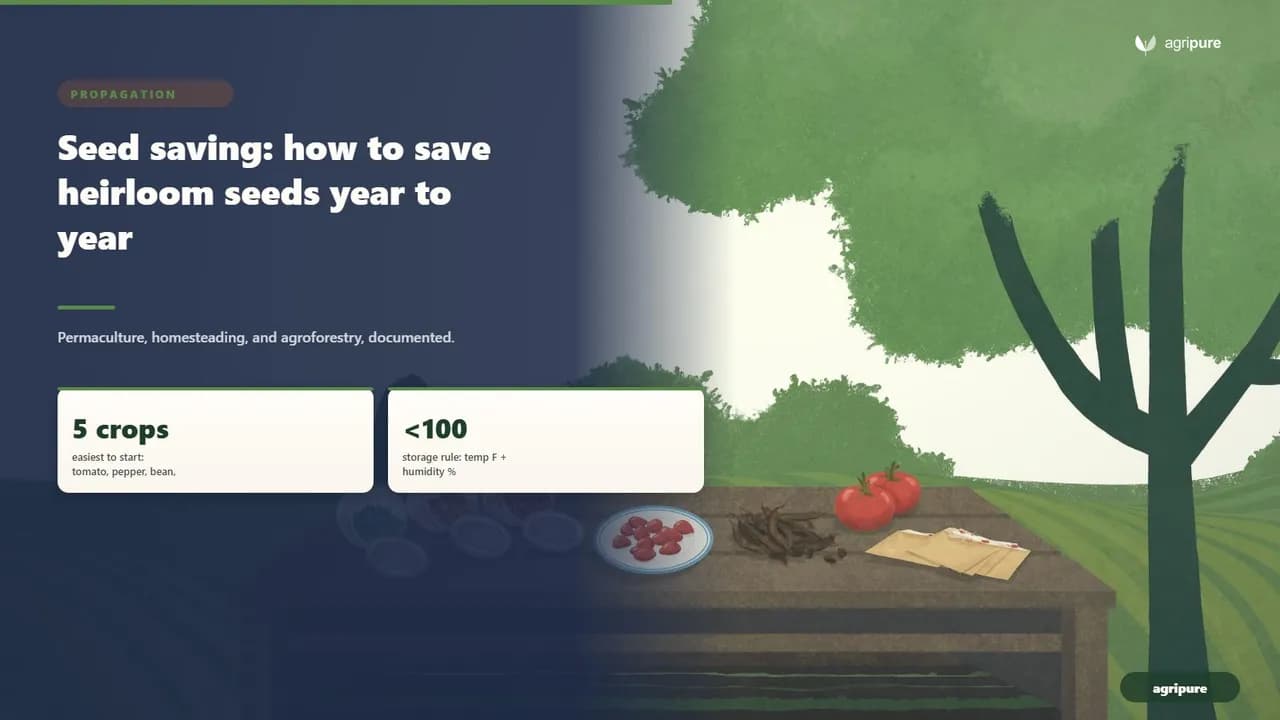
Renewing your garden’s future harvest, one heirloom seed at a time. Saving seeds from open-pollinated varieties like this tomato and these beans ensures a consistent supply year after year.
- One ripe heirloom tomato holds 50 or more seeds, and a single dry bean pod left on the plant carries next spring’s row — seed saving turns a 3-dollar packet you bought once into a supply you renew for free.
- The 1 distinction that decides everything: open-pollinated and heirloom varieties grow true to type, while F1 hybrid seed segregates in the next generation and will not match the parent — so save from open-pollinated plants.
- The 5 easiest crops to start with self-pollinate and need little or no isolation: tomatoes, peppers, beans, peas, and lettuce.
- Out-crossers cross readily, so keep varieties pure by distance, by separating flowering in time, or by bagging and hand-pollinating — squash wants about 1/2 mile, and all of broccoli, cabbage, and kale will cross because they are 1 species.
- Dry-seeded crops dry on the plant and get threshed; wet-seeded tomatoes need a 3-day ferment to strip the gel; then store cool, dry, and dark, where temperature in degrees F plus relative humidity stays under 100.
Pull 1 fully ripe heirloom tomato off the vine in late August and you are holding next year’s whole row — 50-odd seeds wrapped in gel, each one a copy of the plant you chose to keep. The same is true of a bean pod left to rattle dry on the stem, or a lettuce plant allowed to bolt and throw a head of fluff. Saving your own seed is the oldest move in gardening, requiring mostly bookkeeping and patience instead of special skill. The catch is knowing which seed comes true and which does not, which crops cross behind your back, and how to dry and store the harvest so it still sprouts. Onion seed barely lasts 1 year; tomato seed kept cool and dry can stay viable for 4 to 7. This guide walks the whole loop across 6 stages, from picking the right plant to the germination test that tells you whether last year’s jar is still alive. It is the seed-security backbone of any self-reliant or permaculture garden.
Why saving seed earns its jar
Buying a fresh rack of seed packets every February is easy, so the case for saving your own seed has to be honest. The payoff is partly money and mostly something better: a strain of each crop that fits your ground.

The cost is real but small
A seed packet runs 3 to 5 dollars and a single saved tomato gives you more seed than that packet holds, so the arithmetic favors saving over a few seasons. But cost is the weakest argument. Seed is cheap; the value is in what saving does to the plant over time.
Locally adapted seed, season by season
Here is the part that compounds. When you save seed only from the plants that did well in your soil, your climate, and your pest pressure (such as the tomato that set fruit through a hot week, or the bean that shrugged off mildew), you are running a slow selection program. After 5 or 6 seasons of choosing your best plants, the line drifts toward your conditions in a way no national seed company can match. That is the same logic that built every regional heirloom, scaled down to one backyard or a single bed of raised beds.
Preserving heirlooms and keeping the option open
Most heirloom varieties survive only because someone keeps growing them and saving the seed. A variety that drops out of the catalogs is one bad year from gone. Saving seed is also plain self-reliance — a hedge against an empty packet rack, a supply-chain hiccup, or a price spike, with each crop you keep adding a little more seed security to the garden. None of it is dramatic. It is just the difference between renting your garden’s genetics and owning them.
Open-pollinated, heirloom, hybrid, GMO: the one distinction that matters
Before you save a single seed, you have to know what kind of plant you are saving from, because it decides whether the effort works at all. Four labels get thrown around, and only one distinction matters for the home gardener.
Open-pollinated and heirloom: seed that comes true
An open-pollinated variety is genetically stable: as UC ANR puts it, seed produced by an heirloom variety will grow true to type as long as the flowers are pollinated by the same variety. Plant the saved seed and you get the parent again — same flavor, same shape, season after season. Heirloom is just an older subset of open-pollinated; the common rule of thumb is a variety at least 50 years old, passed down through generations. Every variety worth saving for keeps is open-pollinated.
F1 hybrids: seed that does not come true
A hybrid is a deliberate cross between two different parent lines, bred for a specific trait: disease resistance, uniformity, or yield. The first-generation seed you buy, labeled F1, grows into a great plant. But the seed that plant makes is a different story. In UC ANR’s words, the seed saved from hybrids will not grow true to type in the next generation. Save it and the offspring segregate, scrambling the genetic deck and throwing a mix of the grandparents, most of them worse than the hybrid you started with. As the Chicago Botanic Garden notes, start from a hybrid and most seedlings will be different than the parent plant. You can still save hybrid seed as an experiment, but for a reliable harvest, start with an open-pollinated selection.
GMO: not a home-seed problem
GMO is the label that causes the most worry and the least relevance to a backyard. Genetically modified seed is engineered in a lab, and the genetics are patented and sold under contract to commercial growers — it is not on the consumer seed rack, and hybrid is not the same thing as GMO. For the seed you save from your own garden, GMO is simply not a factor. Spend your attention on the open-pollinated-versus-hybrid line instead, because that is the one that determines whether your saved seed is worth planting.
Quick check before you save: look at the original seed packet or plant tag. If it says “F1” or “hybrid,” the saved seed will not come true. If it says “open-pollinated,” “OP,” or “heirloom,” you are clear to save — that one word on the label is the whole decision.
The 5 easiest crops to start with
If this is your first season saving seed, start where the plant does the work for you. The self-pollinating crops fertilize themselves inside a closed flower, so they rarely cross with a neighbor and need little or no isolation. There are 5 of them worth starting on (tomatoes, peppers, beans, peas, and lettuce), and they need inches of separation instead of the 2,600 feet a cross-pollinated crop can demand.

The beginner five
University of Minnesota Extension is blunt about where to begin: tomatoes, peppers, beans and peas are good choices for seed saving, with self-pollinating flowers and seeds that need little or no special treatment before storage. Add lettuce and you have the beginner five:
- Tomatoes: each ripe fruit holds dozens of seeds; flowers self-pollinate, so crossing between varieties is minimal.
- Peppers: both sweet and hot; let the fruit ripen fully to red, yellow, or chocolate before you scrape the seed.
- Beans: snap and dry; leave the pods to dry on the plant and the seed is basically finished for you.
- Peas: same as beans, dried in the pod; among the simplest seed in the garden.
- Lettuce: self-pollinating, though you have to let a plant bolt and flower, which takes patience and bed space.
These five give true-to-type seed with almost no intervention, which is why every seed-saving guide points beginners at them first. Master the loop on a few common beans and a couple of lettuce plants this year, and the harder crops feel routine next year.
Why “self-pollinating” buys you freedom
Because the flower pollinates itself, you are not fighting the bees for control of the cross. As Michigan State University Extension explains, self-pollinated crops only need to be planted far enough apart to keep seed from individual plantings separate during harvest — inches, not miles. You can grow 3 tomato varieties in one bed and still save true seed from each. That single fact is why the beginner five are forgiving, and why the out-crossers in the next section are not.
Managing cross-pollination in the out-crossers
The other half of the garden cross-pollinates (pollen moves between plants on insects or wind), so two varieties grown side by side will mix, and the seed you save becomes an unpredictable cross. To keep a variety pure you control the pollen with one of three tools: distance, time, or a physical barrier.
Know who crosses with whom
The first job is knowing which plants will cross. Some surprise people. As SDSU Extension warns, broccoli, brussels sprouts, cabbage, cauliflower, collards, kale, and kohlrabi will all cross-pollinate because they are varieties of one species, Brassica oleracea. Squash and pumpkins cross within their species groups, while cucumbers are tidy — they cross only with themselves, so you only isolate cucumbers if you grow 2 or more cucumber varieties at once. Corn is wind-pollinated and promiscuous; its pollen can travel a quarter mile or more on the wind.
Crop | How it pollinates | Isolation for pure seed |
|---|---|---|
Tomato, pepper, bean, pea, lettuce | Self-pollinating | None to a few feet |
Cucumber | Insect; crosses only with itself | Only between cucumber varieties (~2,600 ft) |
Squash / pumpkin | Insect; crosses within species group | ~1/2 mile (or bag and hand-pollinate) |
Brassicas (cabbage, kale, broccoli) | Insect; all B. oleracea intercross | Large; cage or grow one at a time |
Corn | Wind; pollen travels 1/4 mile+ | Distance or separate flowering in time |
Isolate by distance
The cleanest method is simple separation. Seed Savers Exchange spans the whole range: from 10 feet for primarily self-pollinating grains up to several miles for cross-pollinating crops such as spinach. For the common out-crossers, the working numbers are large — squash that crosses easily wants about 1/2 mile of isolation for seed saving, and the strict cross-pollinated distances for a seed crop run into the thousands of feet. Most home gardens cannot hit those, which is why distance alone usually is not enough.
Isolate by time, or bag and hand-pollinate
When you lack the acreage, you change tactics. Separating flowering in time works well for corn — stagger plantings so one variety finishes shedding pollen before the next tassels. For insect-pollinated crops, you exclude the insects: SDSU Extension describes the alternative as to net or cage the entire plant to exclude insects, or to bag or tape shut new male and female flowers as they are forming, then hand-pollinate with a small brush the next morning. It is more fuss, but a few bagged squash flowers can give you pure seed in a 30-foot yard.
Harvesting seed by type
Once a plant carries mature seed, how you harvest depends on how the seed is held. Crops fall into two camps (dry-seeded and wet-seeded), and the difference sets the whole process.
Dry-seeded crops: dry, thresh, winnow
Beans, peas, lettuce, and grains hold their seed in pods or heads that dry on the plant. The rule is patience: leave them be. As University of Minnesota Extension advises, allow pea and bean pods to ripen on the plants until they are dry and start to turn brown, with the seeds rattling inside, then strip the pods and spread them out to dry indoors. After that it is two old steps:
- Thresh: crush or crumble the dry pods and heads to break the seed loose. For a handful of bean plants this is just rubbing the pods between your hands over a bowl.
- Winnow: separate the seed from the lightweight chaff. Pour the mix between two containers in front of a fan or a light breeze; the chaff blows aside and the heavier seed drops straight down.
If frost threatens before the pods are fully dry, pull the whole plant and hang it under cover to finish — the seed keeps maturing on the cut stem.

Wet-seeded crops: scoop, ferment, rinse, dry
Tomatoes, cucumbers, squash, and melons carry seed inside wet flesh, so you have to clean it out. For most, you scoop the seed, rinse off the pulp in a sieve, and spread it to dry. Tomatoes get one extra step that matters. That gel around a tomato seed is not just mess — the Chicago Botanic Garden notes it contains chemicals that prevent seed germination, which is why seeds rarely sprout inside the fruit. A short ferment removes it. Scoop the seeds and gel into a jar with a little water, stir once a day, and let it ferment about 3 days until the good seed sinks; fermenting much longer than 3 days can start to lower germination, so do not forget the jar on the counter for a week. Then pour off the floaters and pulp, rinse the sunk seed clean, and dry it on a plate or screen. The same scoop-rinse-dry routine handles cucumber and squash seed, minus the ferment. The reward is durable seed: clean, dry tomato seed stores for years.
Cleaning, drying, and storing seed for the long haul
Most seed-saving failures happen after the harvest, in storage. Seed is alive but dormant, and two things kill it: moisture and heat. Get drying and storage right and viability stretches from one season to several.
Dry it thoroughly first
Before anything goes into a jar, it has to be bone dry, or it molds. Spread cleaned seed in a single layer in a warm, ventilated spot out of direct sun for 1 to 2 weeks. Oregon State University Extension’s easy-saved crops (tomatoes, peppers, beans, peas, eggplant, and lettuce) all just air-dry at room temperature before storage. Seed that bends instead of snapping, or dents under a fingernail, is not dry yet.
Store cool, dark, and airtight
Once dry, the goal is cold, dark, and sealed. Oregon State advises keeping seeds in a labeled container or envelope in a cool, dry place, and for the long haul to place seed packets in a jar, seal the jar tightly, and put it in a refrigerator or freezer. University of Minnesota Extension puts numbers on it: store seeds in tightly sealed glass containers, kept dry and cool, with a temperature between 32 and 41 degrees F ideal. A jar of well-dried seed in the back of the refrigerator is the home gardener’s seed bank.

The temperature-plus-humidity rule
There is a tidy rule of thumb worth memorizing. As Johnny’s Selected Seeds states it, the sum of the temperature in degrees F and percent relative humidity should be less than 100 for good storage — so 40 degrees F at 50% humidity (sum 90) is fine, while a warm, humid 80-degree shelf at 60% (sum 140) is not. Cooler and drier always buys you years. Tossing a packet of silica gel or a tablespoon of powdered milk into the jar as a desiccant keeps the humidity side of that sum low.
How long seed lasts, by crop
Viability varies enormously by crop, and that should shape how much you save and how often. Short-lived seed like onion is barely worth carrying a second year; long-lived seed like tomato can ride out 5 years or more. The table below pulls together the storage-life ranges from Oregon State University Extension and Johnny’s Selected Seeds.
Crop | Typical viability | Group |
|---|---|---|
Onion, corn, parsnip, parsley, pepper | 1–2 years (pepper to ~5) | Short-lived |
Bean, pea, carrot, leek, spinach, broccoli | 2–4 years | Intermediate |
Lettuce | up to 5–6 years | Long-lived |
Cucumber, squash, pumpkin, melon | 3–6 years | Long-lived |
Tomato, eggplant | 4–7 years | Long-lived |
Label everything
Unlabeled seed is half-lost seed. Write the variety and the year on every envelope and jar the moment you fill it, because next March a jar of small tan seeds could be 3 different crops. The year matters as much as the name — it tells you, against the longevity table, whether to trust the seed or test it first.
A 5-minute germination test
Before you waste a whole sowing on dead seed, test it. A germination test takes 10 seeds and 7 days, and it converts the longevity table from a guess into a number for your specific jar.
The paper-towel method
UC ANR lays out the standard test: lay 10 seeds on a moist paper towel, roll it up, place the damp towel in a plastic bag and seal it, and set it somewhere warm around 70 degrees F. At the end of 7 days, unroll the towel and see how many seeds have sprouted. The count out of 10 is your germination percentage — 8 sprouts is 80%.
Read the result
The number tells you what to do, and UC ANR is specific:
- Under 70% (fewer than 7 of 10): you are probably better off getting fresh seed. The line is too weak to rely on.
- 70 to 90%: fine to plant, but sow the seed a little thicker than you normally would to make up for the gaps.
- Above 90%: sow as normal; the seed is strong.
Whatever sprouts in the towel is not wasted — pot up the germinated seedlings into a tray so the test doubles as an early start. A simple seedling tray makes that easy.
Seed libraries, swaps, and keeping the line going
Seed saving turns social fast, and that is where it gets resilient. A variety kept by one gardener is fragile; the same variety shared across 20 gardens is hard to lose.
Seed libraries and swaps
Hundreds of public libraries now run seed libraries — you borrow seed in spring and return a portion of what you save in fall, so the collection renews itself. Seed swaps, often held in late winter, do the same thing person to person. Both move locally adapted, open-pollinated varieties around a community and pull new growers into the loop, and they cost nothing to join.
Pass it on
The honest end of seed saving is that no one keeps a variety alive alone. Grow it, save the best, label it, and hand a pinch to a neighbor or your local swap. That is how a tomato from one grandmother’s garden ends up feeding a whole county 40 years later, passed from hand to hand and bed to bed instead of stored in a vault.
The takeaway
Seed saving is a loop, not a trick, and it runs in 6 plain steps: choose an open-pollinated plant, keep it from crossing, harvest the seed by its type, dry it hard, store it cold and dark, and test it before you trust it. Start with the self-pollinating 5 (tomatoes, peppers, beans, peas, and lettuce), where the plant does the work and crossing is minimal. Save only from your best plants and, after 5 or 6 seasons, you will have a strain shaped to your own ground. Onion seed may quit after 1 year and tomato seed ride out 7, but the jar in your refrigerator is the difference between buying your garden every spring and growing it from itself. Keep a little aside, label it, and give some away; that is the whole craft.
Frequently asked questions
Can you save seeds from store-bought or hybrid vegetables?
You can save the seed, but it may not come true. If the plant is an F1 hybrid (common for supermarket tomatoes and peppers), the saved seed segregates and the offspring will not match the parent. Save seed from open-pollinated or heirloom varieties instead, and you will get the same plant back season after season.
Which vegetable seeds are easiest to save for beginners?
Tomatoes, peppers, beans, peas, and lettuce are the easiest. All self-pollinate, so they rarely cross with other varieties and need little or no isolation, and their seed needs almost no special treatment before storage. Beans and peas are the simplest of all, since the pods dry the seed for you right on the plant.
Why do you have to ferment tomato seeds?
The gel coating around a tomato seed contains chemicals that inhibit germination, which is why seeds do not sprout inside the fruit. Fermenting the seed and gel in a little water for about 3 days breaks down that coating and cleans the seed. Do not ferment much beyond 3 days, because longer fermentation can begin to reduce germination.
How long do saved seeds last?
It depends on the crop. Onion, corn, and parsnip seed are short-lived at roughly 1 to 2 years, while tomato, cucumber, squash, and lettuce can stay viable 4 to 6 years or more when stored well. Storage is the key: keep seed cool, dry, dark, and airtight, ideally where the storage temperature in degrees F plus the relative humidity stays under 100.
How do you test if old seeds are still good?
Run a germination test. Roll 10 seeds in a moist paper towel, seal it in a plastic bag, and keep it warm around 70 degrees F for 7 days, then count how many sprouted. Fewer than 7 of 10 means buy fresh seed; 70 to 90% means sow thicker to compensate; above 90% means sow as normal.
References
- University of Minnesota Extension. “Saving vegetable seeds.” extension.umn.edu
- Oregon State University Extension. “Collecting and storing seeds from your garden.” extension.oregonstate.edu
- South Dakota State University Extension. “Saving Seed of Pumpkins, Squash, Cucumbers, Melons and Gourds.” extension.sdstate.edu
- Seed Savers Exchange. “Isolation Methods.” seedsavers.org
- Michigan State University Extension. “Distance matters when saving seed.” canr.msu.edu
- Chicago Botanic Garden. “Saving Seed for Top-Notch Tomatoes.” chicagobotanic.org
- UC ANR, The Backyard Gardener. “Assessing Seed Viability.” ucanr.edu
- UC ANR, Spill the Beans. “Tomatoes: Heirloom, Open Pollinated or Hybrid?” ucanr.edu
- Johnny’s Selected Seeds. “Seed Viability & Storage Guide.” johnnyseeds.com
- Sow True Seed. “Open-Pollinated, Heirloom, Hybrid, GMO: A Terminology Guide.” sowtrueseed.com
- Ellis, R.H. & Hong, T.D. “Seed longevity – moisture content relationships in hermetic and open storage.” Seed Science and Technology 35(2). doi.org