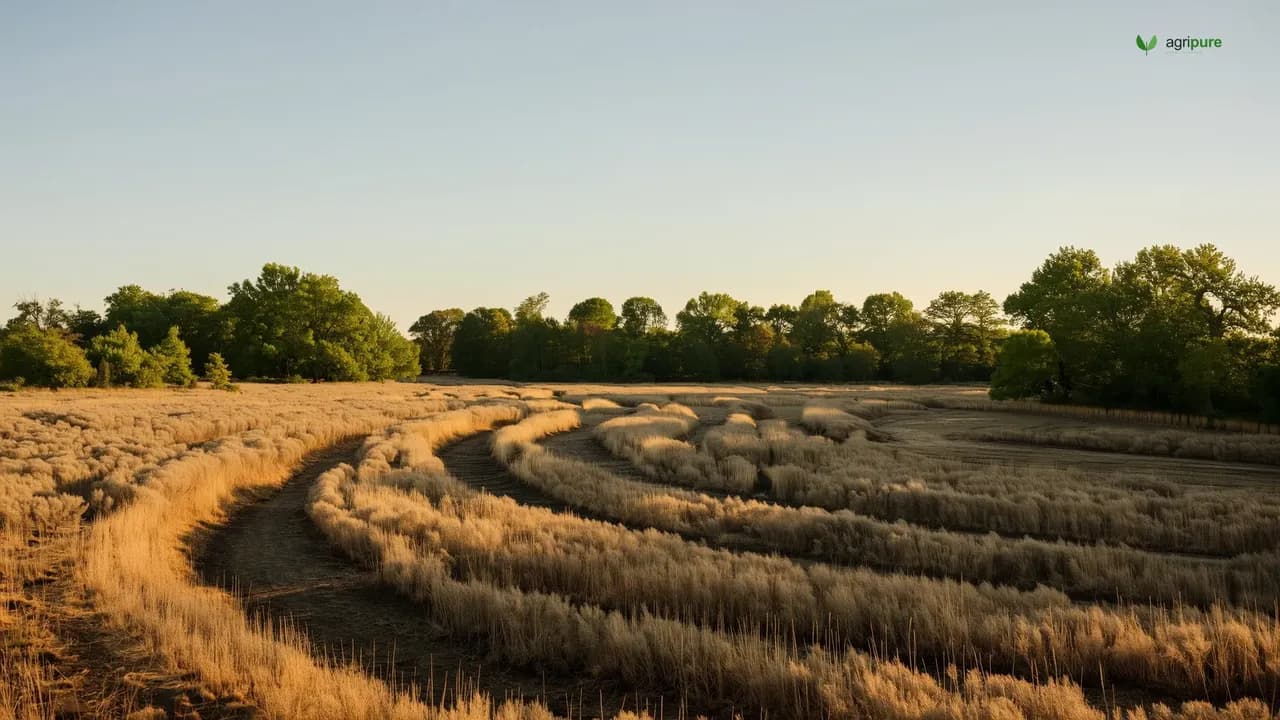
A swale in year one is an earthwork. A swale in year seven is an ecosystem, and the maintenance it needs is the opposite of what year one taught you. The contour ditch you dug to catch and sink rainwater has, if it worked, filled with silt, sprouted a line of thriving trees, and stopped looking like a ditch at all. The instinct to “clean it out” and restore the original profile is exactly the mistake. Year-seven swale maintenance is about reading whether the swale has succeeded into something better — and intervening only where it is genuinely failing.
Related Agripure guides

A successful swale in its seventh year has moved from a simple contour ditch to a self-sustaining ecosystem. The canopy of trees and the organic matter that has built up show it has done its job of harvesting rainwater and building healthy soil, which is why maintenance now means watching rather than clearing.
What a working swale becomes
Geoff Lawton’s swale literature makes the point that a swale is a tree-growing system, not a permanent water feature. Its job is to harvest rainwater, sink it into the soil profile, and grow the trees planted on its mound and in its basin. As those trees mature, their roots and leaf litter stabilise the structure, organic matter accumulates in the basin, and the swale’s water-harvesting function increasingly transfers from the open ditch to the living sponge of root-riddled, high-carbon soil it has created. A swale that has filled with rich sediment and grown a closed line of canopy has not failed — it has graduated. The water it once held in the open it now holds in the ground and the biomass, which is where you wanted it all along.
Source: [1] Lawton, G. — swale design & function (Permaculture Research Institute)Source: [2] Mollison, B. — Permaculture: A Designer’s Manual (1988), earthworks & water harvesting
Sediment: read it before you remove it
Silt accumulation is the maintenance question that most often gets answered wrong. In Pothohar and southern Punjab, where intense seasonal rain carries a heavy sediment load, a swale basin can partly fill within a few years. The reflex is to dig it back out. But that sediment is topsoil the swale captured — exactly its purpose — and if trees are thriving in it, removing it tears their roots and discards the fertility. The rule: only re-cut a swale that is no longer doing its job. If the planted trees are healthy and rain still ponds and sinks rather than overtopping, leave the sediment; the swale is functioning as designed. Re-cut only where silt has filled the basin to the point that water now sheets over the mound and runs off, defeating the structure.
The failure modes that do demand action
Three genuine failures justify intervention by year seven. Overtopping: if a heavy event sends water over the downhill mound rather than holding it, the swale’s capacity has been exceeded, usually by silt filling the basin or by a blocked spillway; clear the designed overflow and, if necessary, lower the basin enough to restore capacity. Channelisation: if water has found a low point and cut a channel through the mound, it is now draining the swale instead of filling it; that breach must be repaired and re-levelled, because a leaking swale concentrates erosion exactly where you wanted infiltration. Basin scouring or silting at the inflow: where runoff enters, check for both erosion (cut a stilling area or add rock) and a silt plug (which can dam and divert flow). These are repairs to specific defects, not a wholesale restoration of the year-one profile.
The year-seven mindset
The shift is from maintaining a structure to stewarding a succession. Walk the swale after the first big rain of the season and watch what the water actually does: where it ponds and sinks, leave it; where it overtops, breaches, or scours, fix that point and only that point. Most year-seven swales need a spillway cleared and a breach or two patched (an afternoon’s work), not the re-excavation the year-one self would have ordered. The swale you dug has become the soil and the trees you wanted. Maintenance now means protecting that graduation, not reversing it.
Source: [1] Lawton, G. — long-term swale behaviour & maintenance (Permaculture Research Institute)Source: [2] FAO — water-harvesting structure maintenance in semi-arid lands
References
- Operation and Maintenance of Wet Swale (Wetland Channel) — Minnesota Pollution Control Agency. Supports that swales naturally accumulate sediment and vegetation, function as vegetated treatment systems, and should be maintained by performance indicators rather than restored to bare ditches.
- Agroforestry in Temperate-Climate Commercial Agriculture — Elementa: Science of the Anthropocene. Supports that integrating trees and shrubs along landscape features improves water management and climate resilience, making a tree-established swale a desirable mature state.
- Land Recovery and Soil Management with Agroforestry Systems — Spanish Journal of Soil Science. Backs the claim that agroforestry strips build soil organic matter and fine sediment, improve infiltration and structure, and reduce runoff and erosion over time.