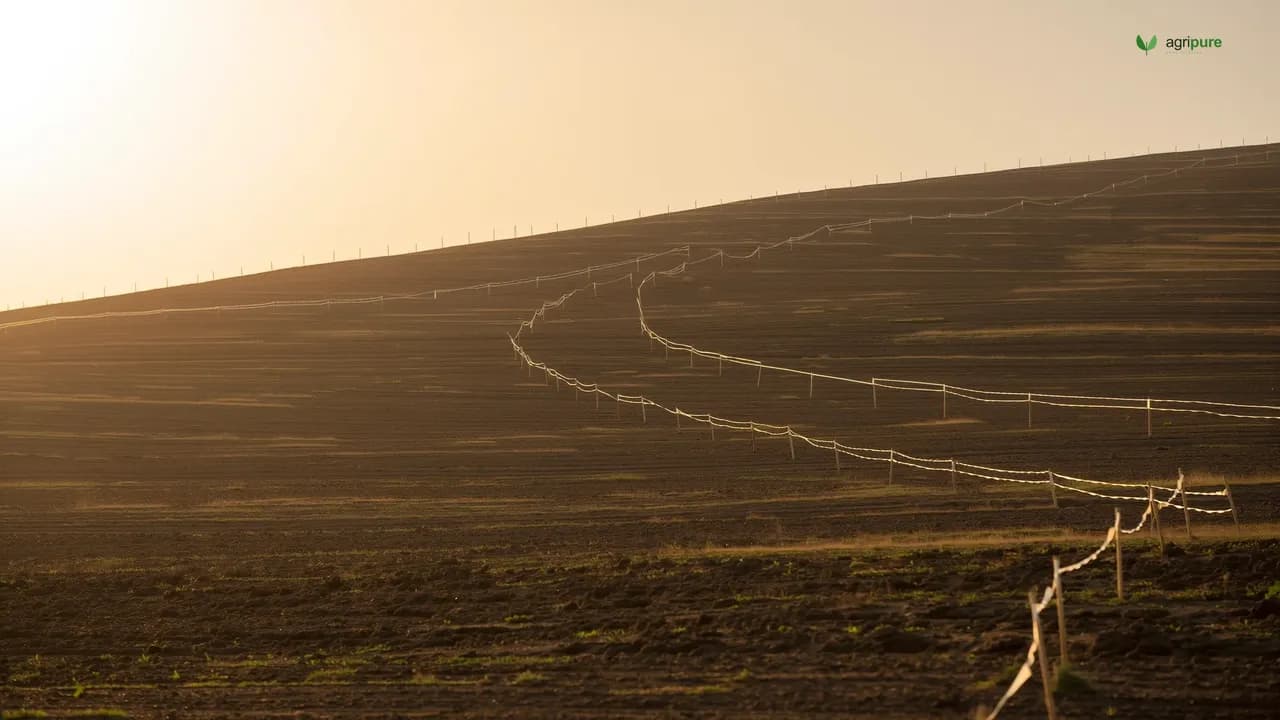
Keyline design has a reputation for being something you do with a bulldozer across a thousand acres. It is not. The idea P. A. Yeomans set out in the 1950s is fundamentally about reading how water moves across land and placing your planting to slow and spread it — and that reading works exactly as well on a quarter-acre as on a cattle station. For a Pakistani smallholder, keyline is not earthmoving. It is a way of seeing the slope you already have, so that every drop of rain or canal water travels a little further across your land before it leaves.
The one concept to understand: the keypoint
Walk any sloping land and you will find that the hillside is not a uniform ramp. It steepens near the top and flattens toward the valley floor, and the place where the steeper upper slope transitions into the gentler lower slope, in the primary valley, the natural water-collecting fold of the land, is the keypoint. Water accelerates above it and slows below it. The keypoint is where Yeomans said the water wants to pause, and therefore where your design should help it pause. Find the keypoint: the line you run level across the slope from it, the keyline, is the reference for everything else, including where to plant, where to mulch, and where to place a swale if you build one.
Finding the keypoint with an A-frame, not a laser
The whole method is accessible with a tool you can build from three sticks. An A-frame level — two legs and a crossbar with a hanging plumb line — finds true level points across a slope; walk it along the hill, marking each point where the plumb hangs centred, and you have traced a contour. To locate the keypoint, walk the primary valley downhill until the slope visibly eases; that transition zone is your keypoint, and the contour you mark through it is the keyline. Stakes, an A-frame, a line level, and a tape are the entire kit. No survey instrument, no power, no contractor.
References
- Permalogica — Yeomans’ Keyline design & Scale of Permanence (https://www.permalogica.com/post/yeomans-keyline-design-and-scale-of-permanence-part-one)
- Agricultural Water Stewardship — Keyline design practice overview (https://agwaterstewards.org/practice/keyline-design/)