Key takeaways
A small flock of hens pecks at the ground in a backyard run, with a clean wooden coop in the background.
Understanding local ordinances and installing predator protection keep a small flock of hens healthy in a backyard run.
- Check the law before you buy a bird. Whether you can keep backyard chickens depends on your state, county, and city, and most urban ordinances cap a flock near five or six hens and ban roosters outright.
- You do not need a rooster. Hens lay eggs without a male in the flock: a rooster only makes the eggs fertile, and the rooster creates the noise neighbors complain about.
- Budget a few hundred dollars to start and feed as the running cost. A representative extension flock budget puts the coop near $500, a fence near $250, and feed at roughly 2 pounds per hen per week: about five pounds of feed for every dozen eggs.
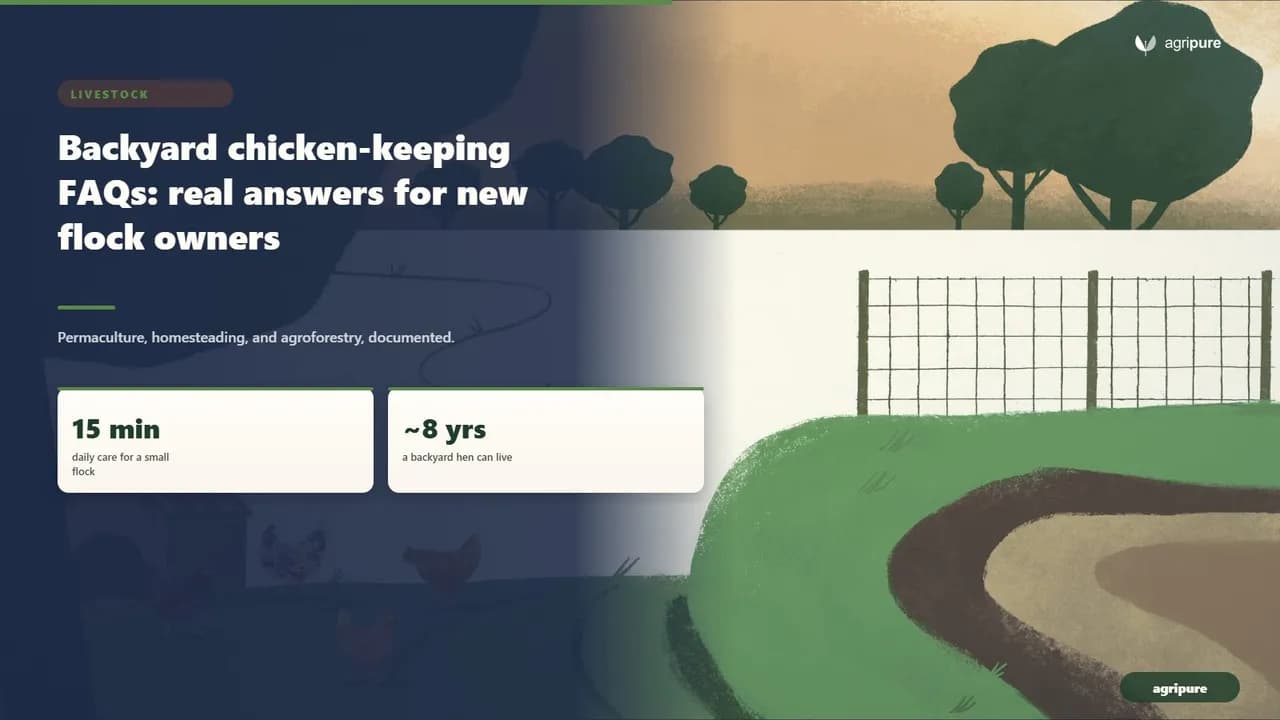
- The daily job is small but daily. A small laying flock takes about 15 minutes a day, every day, including weekends, holidays, and the week you wanted to go on vacation.
- Predators, not disease, kill most backyard birds, and a locked coop with hardware cloth solves most of it. Chicken wire keeps chickens in, not predators out.
- Hens start laying around 18 to 20 weeks, peak in their first two years, and can live 8 years or more, so plan for several years of birds that eat long after they stop laying daily.
Is it even legal to keep chickens in my backyard?
Start here, because this is the question that sends the most new keepers back to the store with an unwanted coop. Whether you can keep backyard chickens at all depends on your state, county, and city ordinances, and those rules change from one town to the next. There is no national rule, and a single lot two streets over might allow a flock of six hens while yours allows none.
In most residential zones the limit sits around five or six hens, and roosters are banned because they crow throughout the day. Many ordinances also impose a setback (a required distance, often around 20 feet, between the coop and a neighbor’s house), and some want a permit or a nod from the people next door. Before you spend a dollar, call your zoning office and ask for the ordinance in writing. Get the four numbers that matter:
- How many birds you may keep.
- Whether roosters are allowed (usually not).
- How far the coop must sit from the property line.
- Whether you need a permit or a neighbor notification.
This is the cheapest 20 minutes you will spend on the whole project, and it is the foundation everything else rests on. If you clear it, our guide to how to start a small laying flock walks the next steps in order.
The numbers that frame backyard chicken keeping, drawn from university extension data.
Do I need a rooster for hens to lay eggs?
No, and this is the single most common misunderstanding new keepers carry. A hen lays eggs on her own schedule whether or not a rooster is anywhere nearby. Penn State Extension states it plainly: roosters are not necessary in a flock for hens to lay eggs. A rooster’s only job is fertilizing eggs, which matters solely if you want to hatch chicks, so a laying flock of six hens needs zero roosters.
There is a second reason to skip him. The crowing that gets people fined and reported is the rooster’s, not the hens’. A rooster crows through the day, while hens cluck softly and only raise a brief alarm call when something startles them. Since most of the towns that allow five or six hens still ban roosters, leaving him out keeps you legal and keeps the peace. Keep hens for eggs; add a rooster only when you deliberately want to raise your own replacements and your ordinance allows it.
How many hens should a beginner start with?
Three to six. That range fits inside almost every urban ordinance, gives a household a steady supply of eggs, and keeps the chores light enough that you learn the rhythm before you scale. A good layer produces roughly six eggs a week, so four hens will hand you about two dozen eggs in seven days: plenty for most families, with a few left over for the neighbors whose goodwill you want.
Resist the urge to start big. Chickens are social, so keep at least three so no bird is alone, but going from a handful to a crowd multiplies the feed, the manure, the water, and everything that can go wrong on a hot afternoon. Each laying hen needs a minimum of 3 to 4 square feet of floor space inside the coop and about 10 square feet outside in the run, so your space caps your flock as firmly as the law does. Start at the low end of what your coop and ordinance allow, and grow into the next tier once you have kept birds alive through a full year.
What does it cost to start a backyard flock, and what does it cost each month?
This is where romance meets the receipt. The startup cost is dominated by housing, and the running cost is dominated by feed. A representative University of Maryland Extension small-flock budget builds its numbers on a coop at about $500 and a poly-wire electric fence at about $250 (roughly $750 in housing setup), plus about $75 for feeders and waterers. Chicks themselves are cheap, around $2 each, so the birds are the smallest line on the page. You can spend far less with a secondhand coop and far more with a boutique one; the budget is a midpoint, not a ceiling.
Where the startup money goes for a small backyard flock, from a University of Maryland Extension budget.
Then comes the feed bill, which never stops. In that same Maryland budget a flock of 25 hens eats about 50 pounds of feed a week (close to 2 pounds per hen per week), and the budget runs at roughly five pounds of feed for every dozen eggs. Translate that to a backyard scale and a small flock costs a modest but real amount each month in feed alone, before bedding and the odd replacement bird.
- One-time startup: coop (~$500), fencing (~$250), feeders and waterers (~$75), and chicks (~$2 each).
- Every month, forever: feed at about 2 pounds per hen per week, plus bedding.
- Occasional: grit, the odd replacement bird, and any vet or parasite treatment.
The honest headline: home eggs rarely beat the grocery shelf on raw cost at this scale. You keep chickens for the freshness, the control over what they eat, and the pleasure of the flock: not to save money on eggs.
Will my yard smell, and will the chickens bother my neighbors?
A few well-kept hens do not stink, and the noise is mostly a myth aimed at the wrong bird. University of Minnesota Extension is direct about it: odor occurs when poultry manure accumulates, a small number of birds will not produce much manure, and routine cleaning of the coop prevents odor issues from arising. A flock of four or five hens is a management problem, not a smell problem. Keep the bedding dry, remove soiled litter, store feed in a sealed container, and the same cleanliness that controls odor also cuts down on flies and keeps rodents from moving in.
A clean wooden backyard coop with dry bedding and a sealed feed bin houses a few hens in a fenced run.
A dry, clean coop with sealed feed storage controls odor, flies, and rodents alike.
Noise breaks down the same way. Hens cluck in a soft tone and only give a loud alarm call when startled, those calls last seconds and end when the threat passes, and chickens are nearly silent overnight. The daytime racket people picture is the rooster’s crow, which is exactly why you are not keeping one. Site the coop the required 20 feet or so from the fence line, hand a carton of eggs over that fence now and then, and your neighbors are far more likely to ask for chickens of their own than to call the city.
How much time do chickens take every day?
Less than you fear on a normal day, more than you would like on the day you want to leave. The University of Maryland flock budget pegs daily care for a small laying flock at about 15 minutes a day. That covers the real routine: let the birds out and check they are healthy, top up feed and water, collect eggs, and lock the coop at dusk against predators. Add a longer session every week or two to muck out bedding and scrub the waterer, and a bigger clean-out a couple of times a year.
The catch is not the length of the job: it is that the job never takes a day off. A home flock of any size requires water, food, and daily care including weekends, vacations, and holidays. Maryland Extension calls it a 24-hour, seven-days-a-week commitment that begins with your first bird. That single sentence is the most important one in this whole article, because it is the reality most people underestimate. Chickens are a low-effort animal but a no-skip one.
What about predators: how do I keep my chickens safe?
Treat this as the primary threat, because predators kill more backyard birds than disease does, and almost every loss traces to a coop that was not properly secure. The list of animals that will eat a chicken is long. eXtension’s predator-management guidance names at least 10 culprits: dogs and coyotes, foxes (especially red foxes), raccoons, weasels, skunks, opossums, rat snakes, hawks including red-tailed, red-shouldered, and Cooper’s, and most commonly the great horned owl. Some hunt by day, some by night, which is why a flock needs protection around the clock.
Predator-proofing in order: the four steps that prevent most backyard losses.
These defenses are not complicated, but all four have to be done right.
- Use hardware cloth, not chicken wire. This is the mistake that costs flocks. Chicken wire keeps chickens in; it does not keep predators out. A least weasel can squeeze through a hole as small as a quarter inch, and raccoons reach through and pull birds apart. Half-inch hardware cloth is the standard.
- Stop the diggers. Foxes and dogs tunnel under a fence. Bury hardware cloth at least 12 inches into the ground, or fold it outward into an apron, around the whole run.
- Cover the run. Hawks and owls drop in from above. For persistent predators, cover the run with welded wire or netting.
- Lock the coop at dusk, every night. Have the flock roost inside a secured structure at night and close and lock every door. Most night raids hit birds that were left out.
Build the run like a fortress once and the daily job shrinks to a 30-second routine: closing one door at dusk. If you would rather move birds across open ground than fence a fixed run, moving birds across pasture in tractors is a different model with its own predator math: bottomless pens that travel, with the flock shut in at night.
How do chickens handle winter: do I need to heat the coop?
Better than most beginners expect, and usually without any added heat. Chickens wear a down coat and run warm (the average body temperature of a chicken is about 106°F), and heavier standard and dual-purpose breeds handle cold especially well. The instinct to install a heat lamp is the one to resist. University of Minnesota Extension warns to use heat lamps with safety in mind because of the fire risk, and a sudden lamp failure on a bitter night can chill a flock that never had the chance to acclimate. A dry, draft-free, well-ventilated coop beats a heated one.
A snow-dusted backyard chicken coop in winter has vents open near the roofline and the run sheltered from wind.
A dry, ventilated coop carries a flock through winter safely without supplemental heating.
The counterintuitive winter rule: ventilate more, not less. A warm, sealed coop traps moisture, and damp air at freezing temperatures is what frostbites combs and wattles. A cold, dry, draft-free coop is safer than a warm, humid one.
The real winter enemy is moisture, not cold. High humidity inside a coop combined with low temperatures causes condensation, and that is what leads to frostbite on combs and wattles. The fix is to let damp air escape near the roofline while keeping drafts off the birds at roost height. UMN does suggest providing supplemental heat only when coop temperatures fall below about 35°F, but for most of the country a sound coop and a flock of cold-hardy birds get through winter on their own. Your one non-negotiable winter chore is water: it freezes, and birds need liquid water daily, so a heated base or a heated fount earns its keep.
When will my hens start laying, and how long will they live?
Plan on a wait, then years of birds. Pullets typically lay their first egg somewhere around 18 to 20 weeks of age: roughly four to five months. Penn State Extension switches birds to a layer ration at 18 weeks, and University of Minnesota Extension puts the onset of lay at about 20 weeks; breed, season, and daylight nudge it either way. A chick brooded in early spring is usually paying you back in eggs by late summer.
A backyard hen’s life, from first egg to retirement, on extension figures.
Production is front-loaded across a long life. Hens peak in their first two years and can keep laying, with a yearly decline, for five to ten years, dropping off each autumn when they molt and regrow feathers. Lifespan outruns laying by a wide margin: chickens in most small flocks live about 8 years, and some reach 12 to 15. So decide early what you will do with a hen who has mostly stopped laying but has years left (keep her as a pet and pest-controller, or cull her), because a flock kept long enough becomes a flock of retirees that still eat every day. For the breed-by-breed picture of how long a hen stays productive, see the breed, feed, and yolk realities of laying hens.
What a beginner can expect, year one and beyond (figures from university extension)
Question | The short answer |
|---|---|
First egg | Around 18 to 20 weeks of age |
Eggs per hen | Roughly 6 a week at peak |
Peak laying | First 2 years, declining yearly |
Lifespan | About 8 years; up to 12 to 15 |
Daily care | About 15 minutes, every day |
Indoor space | 3 to 4 sq ft per hen |
What are the common health problems in a backyard flock?
Most are preventable, and a watchlist of four problems covers the ones you will actually meet.
- External parasites (mites and lice): the most common day-to-day trouble. The northern fowl mite is the single most common external parasite on poultry.
- Marek’s disease: a viral killer of chickens of all ages. Vaccinate day-old chicks at the hatchery.
- Respiratory infections: the most common disease group, seen as sneezing, nasal discharge, and labored breathing.
- A drop in laying: usually not a disease at all but a normal response to age, the autumn molt, or short winter daylight.
The most common of these is external parasites. eXtension notes heavy mite infestations cause anemia, pale combs and wattles, and a drop in egg production. Run your hands through the feathers near the vent every two or three weeks: catching mites early makes them easy to treat.
Disease is the rarer but graver risk. The Merck Veterinary Manual calls Marek’s disease one of the most common killers of chickens of all ages: a herpesvirus spread through airborne feather dander that causes progressive paralysis, and one you can vaccinate day-old chicks against at the hatchery. Respiratory infections are the most common disease group in chickens, showing up as sneezing, nasal discharge, and labored breathing. The discipline that prevents most of it is biosecurity: quarantine any new or sick bird for two to four weeks before it meets the flock, keep your birds away from wild birds and standing water, clean shared tools, and wash your hands before and after handling poultry. None of it is exotic: it is the unglamorous routine that keeps a flock alive.
Who looks after the chickens when I go on vacation?
Someone has to, every single day you are gone: there is no version of this where the birds care for themselves. A flock needs fresh water, feed, egg collection, and a coop locked at dusk whether you are home or not, so plan the coverage before you book the trip. For a two-day weekend, a large hanging feeder and a couple of one-gallon waterers, or an automatic waterer plumbed to a hose, can carry a small flock if a neighbor still closes the coop at night against predators. Water is the one thing you cannot stretch: birds tolerate a thin feed margin far better than a dry waterer on a hot day.
For any trip longer than two days, arrange a sitter and walk them through it in advance. A one-page note covers it:
- Where the feed lives and how much to give.
- How full to fill the waterer, and to check it twice on hot days.
- Where the eggs collect and to take them daily.
- The one job that cannot be skipped: shutting and latching the coop at dusk.
Pay them in eggs or in kind, leave those written instructions, and your flock is as safe while you are away as while you are home. This is simply the daily-care reality stated again: chickens are a no-skip animal, and a vacation plan is part of the 15-minutes-a-day price of keeping them.
The honest version of keeping backyard chickens
Backyard chickens are one of the most rewarding things a small yard can hold, and one of the most consistently underestimated. The work is light (about 15 minutes a day), but it is daily, and it does not pause for weather, weekends, or travel. Clear the ordinance first, skip the rooster, and build the run against predators before you bring birds home, then let a dry coop and a hardy breed handle the winter. Do that, and you get years of fresh eggs, rich compost for the garden, and the daily pleasure of a flock that comes running when you open the gate.
The keepers who succeed know the practical realities: a hen still eats for five or more years after her best laying is done, the coop must be locked every dusk, and a sitter is needed during travel. Backyard chickens reward daily consistency.
Frequently asked questions
Do you need a rooster for backyard hens to lay eggs?
No. Hens lay eggs without a rooster present; a rooster is only needed if you want fertilized eggs to hatch chicks. Penn State Extension states that roosters are not necessary in a flock for hens to lay eggs. Skipping the rooster also keeps you legal in the many towns that ban them for noise.
How many backyard chickens should a beginner start with?
For most households, three to six hens. That fits inside typical urban limits, keeps a family in eggs at roughly six eggs per hen per week, and stays manageable while you learn. Keep at least three, since chickens are social, and let your coop space and local ordinance set the upper limit.
How much does it cost to keep backyard chickens?
Startup is dominated by housing: a University of Maryland Extension budget uses about $500 for a coop, $250 for fencing, and $75 for feeders and waterers, with chicks around $2 each. The ongoing cost is feed, roughly 2 pounds per hen per week and about five pounds of feed per dozen eggs, so home eggs rarely beat the store on raw cost at backyard scale.
Do backyard chickens smell or make a lot of noise?
Not when they are well kept. A few hens produce little manure, and routine coop cleaning prevents odor, flies, and rodents. Hens are quiet: soft clucking and brief alarm calls, and near silence at night. The loud, all-day crowing people picture comes from roosters, which most backyard keepers do not keep.
When do backyard hens start laying eggs?
Most pullets lay their first egg around 18 to 20 weeks of age, roughly four to five months. Penn State Extension moves birds to layer feed at 18 weeks and University of Minnesota Extension puts onset of lay near 20 weeks. Hens peak in their first two years and can lay for several years after, with production declining each year.
References
- Jacob, J. & Anderson, K. Developing Regulations for Keeping Urban Chickens. eXtension Poultry Community.
- Penn State Extension. Successfully Raising a Small Flock of Laying Chickens.
- University of Maryland Extension. Economics of Small Poultry Flocks.
- University of Maryland Extension. Raising Your Home Chicken Flock.
- University of Minnesota Extension. Common concerns with backyard or urban poultry keeping.
- University of Minnesota Extension. Caring for chickens in cold weather.
- University of Minnesota Extension. Raising chickens for eggs.
- University of Minnesota Extension. Raising layer chicks and pullets.
- eXtension Poultry Community. Predator Management for Small and Backyard Poultry Flocks.
- eXtension Poultry Community. External Parasites of Poultry.
- eXtension Poultry Community. Space Allowances in Housing for Small and Backyard Poultry Flocks.
- Merck Veterinary Manual. Common Infectious Diseases in Backyard Poultry.
- Virginia Cooperative Extension. Biosecurity: Five Steps to Protect Poultry from Avian Influenza (and Other Diseases), APSC-200.