Key takeaways
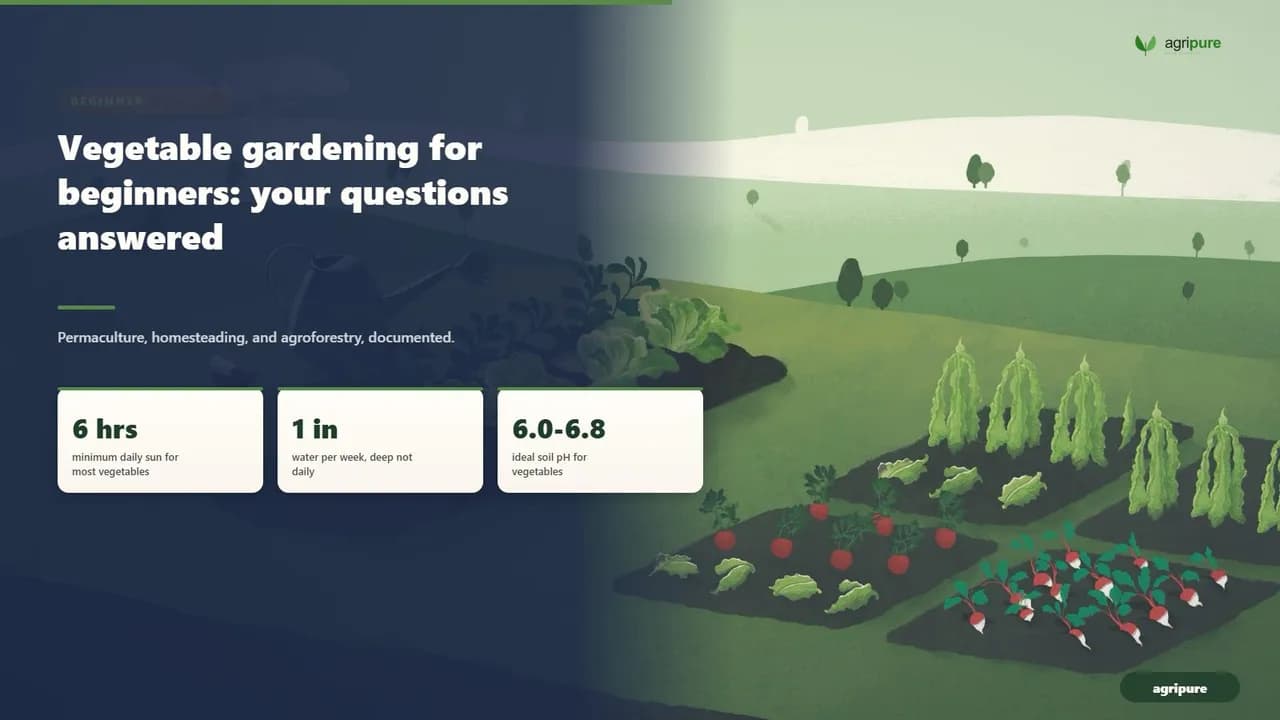
A small raised vegetable garden bed with leafy greens and young tomato plants growing in dark soil.
Starting small makes a first garden manageable. A single bed gives enough space for a mix of vegetables without requiring more maintenance than a beginner can handle.
- Most vegetables want full sun (six or more hours of direct light a day), so pick the sunniest spot you have before anything else. Leafy greens get by on 4 to 5 hours, root crops on 5 to 6, but fruiting crops like tomatoes need 8.
- Start small. A single 4-by-8-foot bed of easy crops beats a sprawling plot you cannot keep up with, and overwatering a garden that is too big is the most common way beginners lose plants.
- Plant cool-season crops (lettuce, peas, radishes, spinach) weeks before your last frost, and warm-season crops (tomatoes, peppers, beans, squash) only after it passes.
- Give the garden about 1 inch of water a week, test your soil once instead of guessing, and follow the spacing on the seed packet; crowding causes more failures than any pest.
- You can regrow green onions, celery, and lettuce from kitchen scraps in a week, but an avocado or citrus pit grown indoors may take 10 to 15 years to fruit, if it fruits at all; grow those as houseplants rather than for food.
A first vegetable garden fails or thrives on 4 decisions made before planting: location, bed size, crop selection, and timing. Get those right and the rest is mostly watering and patience. Get them wrong and you will fight the same battles all summer. This guide answers the questions brand-new growers actually ask, in plain order, with numbers you can act on: how much sun, which crops, what to plant in, when to start, how often to water, how far apart, and why your tomato has flowers but no fruit. Each answer points to a deeper guide when you want to go further, so think of this as the map, not the whole territory. The deeper how-tos for seed starting, companion planting, herbs, and square-foot layouts each get their own article — here we cover the ground every beginner stands on first.
How do I start a vegetable garden from scratch?
The first decision is location, which beginners often miss by planting where it is convenient instead of where the sun falls. Vegetables are sun engines. Penn State Extension defines full sun as 6 or more hours of direct sunlight per day, and notes that most vegetables need 6 or more hours of direct sun each day and would be happy with more. So before you think about soil or seeds, spend a day watching your yard.
Marking out a sunny corner of the yard for a new vegetable bed before planting.
Find the sun first
Watch a candidate spot across a full day and count the hours it gets unobstructed sun. Morning sun plus afternoon shade still counts; the hours do not have to be continuous. Then match the spot to what you want to grow, because the sun budget decides your crop list more than anything else:
- Leafy greens (lettuce, spinach, chard, kale) tolerate the least, about 4 to 5 hours.
- Root crops (carrots, beets, radishes, onions) want 5 to 6 hours.
- Fruiting crops (tomatoes, peppers, cucumbers, zucchini) need at least 8 hours to set a real harvest.
Keep the bed away from the south side of large trees, which cast long shadows in spring and fall and compete for water. A plot that gets 8 hours of sun in June can drop to 4 once a maple leafs out, so judge the spot in the season you will actually garden.
Keep the first garden small
The second decision is size, and here less is genuinely more. A 4-by-8-foot raised bed or a 10-by-10-foot patch of ground is plenty for a first year: enough to grow a real mix of food, small enough to weed in 20 minutes on a Saturday. University of Minnesota guidance for new gardeners is blunt about scale: do not plant more garden than you need, and 1 good soaking a week is enough for most plants. A garden that becomes a chore gets abandoned by July. If you want the most food from the least space, a no-dig bed and tighter intensive layouts stretch a small footprint further than rows ever will.
Should I plant in the ground, a raised bed, or containers?
That sunny footprint settles where the garden goes; the next question is what to plant in. All 3 options (open ground, a raised bed, or containers) grow good vegetables, and the choice depends on your soil, physical comfort, and budget. Each has a clear case.
The honest trade-offs
- In-ground is the cheapest and holds water longest, so it needs the least frequent watering. The catch is your native soil: if it is heavy clay, compacted, or rocky, you are signing up to improve it over several seasons.
- Raised beds let you fill with a known soil mix, warm up earlier in spring, and drain well, which is why they are the default recommendation for beginners on poor ground. They cost more up front and dry out faster than open ground. Our guide on raised beds covers how deep to build (at least 6 inches for greens, 12 inches for tomatoes) and what to fill them with.
- Containers are the right call for a patio, a balcony, or renting. A 5-gallon pot grows one tomato or a clutch of lettuce, but pots dry out fast (sometimes daily in July heat) and need the most attention.
Option | Up-front cost | Watering need | Best for |
|---|---|---|---|
In-ground rows | Lowest | About 1 inch/week | Good existing soil, more space |
Raised bed | Medium to high | Slightly more than in-ground | Poor or compacted soil, easier reach |
Containers | Low to medium | Highest, up to daily in heat | Patios, balconies, renters |
Most first-year gardeners on workable soil do well starting with one raised bed or a short in-ground row, then expanding once they know what their site and schedule can handle.
What are the easiest vegetables for beginners?
The fastest way to quit gardening is to start with the fussy stuff — head cauliflower, melons, anything that needs a long warm season and perfect timing. A better first list is the 5 crops below, all of which forgive mistakes and reward you quickly. Lean on these.
A beginner garden bed planted with radishes, leaf lettuce, bush beans, and zucchini.
Crops that forgive a beginner
- Radishes are the confidence crop. They are, in University of Minnesota Extension’s words, a cool-season, fast-maturing, easy-to-grow vegetable, usually ready to harvest just 3 to 5 weeks after sowing. Nothing teaches you faster.
- Leaf lettuce and salad greens germinate in cool soil, tolerate light shade, and let you cut outer leaves for weeks from one planting.
- Bush beans are warm-season, sown straight into the ground once it warms, and crop heavily with almost no fuss.
- Zucchini and summer squash are so productive that one or two plants feed a household — plant more and you will be leaving bags on neighbors’ porches.
- Tomatoes are the crop everyone wants, and a single transplanted seedling rewards a sunny spot generously. They need the full 8 hours, but they are worth the prime real estate.
A good first-year mix is a row of radishes, a block of leaf lettuce, a few bean plants, 1 zucchini, and a tomato or 2. That covers cool and warm seasons, quick and slow crops, and salad through high summer — without overwhelming you.
When do I plant — and what do frost dates mean?
Timing trips up more beginners than any other single thing, because the answer is not a fixed calendar date — it is your last spring frost. Every region has an average date when overnight freezes stop, and almost all of your planting decisions hang off that 1 date. Look yours up by ZIP code once and write it on the fridge.
Cool-season versus warm-season
Vegetables split into 2 camps, and the split is entirely about cold tolerance. Penn State Extension frames it cleanly: cool-season crops can be planted anytime from several weeks to a couple of months before the last frost date, while warm-season crops require higher soil and air temperatures and are always planted after the last frost date.
- Cool-season crops (lettuce, peas, radishes, spinach, kale, carrots, broccoli) go in early, as soon as the soil can be worked, often 4 to 6 weeks before the last frost. A light frost does not bother them, and some, like kale, taste better for it.
- Warm-season crops (tomatoes, peppers, beans, corn, cucumbers, squash) need warm soil and frost-free weather. A single frost kills a tomato seedling, so there is no prize for rushing them out before the danger passes.
Seeds, transplants, and the avocado question
Some crops are sown directly where they grow; others are started indoors weeks early and transplanted. Radishes, carrots, and beets resent transplanting and must be direct-seeded because their roots are the crop. Tomatoes and peppers, by contrast, need a head start: in cold regions, gardeners sow tomato seed indoors 6 to 8 weeks before the last frost so the plant is big enough to set fruit during the short summer. Onions can be grown from seed, sets, or transplants, and seed gives the widest variety. The details of seed starting (soil temperature, lights, hardening off) belong to a dedicated guide; here, the rule is simple: cool crops out early, warm crops out after frost, root crops sown in place.
How often should I water, and do I need to test the soil?
Watering is where good intentions drown plants. New gardeners tend to water a little every day, which trains shallow roots and, paradoxically, is the leading cause of yellow, sickly plants. The fix is 1 number you can hold onto.
The one-inch rule
A vegetable garden needs about 1 inch of water a week, from rain or hose combined. University of Minnesota Extension puts the frequency by soil type: water once a week on heavier clay soils or loamy soils rich in organic matter, and twice a week on sandy, well-drained soil, giving a half inch each time. When the temperature climbs past 90°F, bump it toward 2 inches. The test for whether to water at all is your finger: if the soil is dry 2 inches below the surface, water; if it is still damp, wait. A cheap soil moisture meter takes the guesswork out for a first season. Water deeply and less often, at the base of the plant rather than over the leaves, and a layer of mulch cuts how often you need to do it at all.
Water at the roots, in the morning: a soaker hose or a watering can aimed at the soil keeps leaves dry, which lowers disease pressure, and morning watering lets foliage dry through the day. Deep and infrequent watering beats shallow and daily watering: it pulls roots downward instead of keeping them at the surface.
Test once, then feed the soil
You do not need to be a soil scientist, but you should test once instead of guessing. A basic soil test from your county Extension lab reports pH and nutrients for around 15 to 20 dollars and tells you what to add. Most vegetables want a pH between 6.0 and 6.8; University of Illinois Extension notes nutrients are most available between 6.5 and 7 and that most horticultural crops do well in the range of 6 to 6.8. If the test calls for it, the fix is usually compost and organic matter rather than a bag of synthetic feed. Building living soil with compost does more for a beginner garden than any fertilizer, because it feeds the soil that feeds the plant.
How far apart do I space plants?
Feeding the plant well is wasted if you crowd it, because spacing is the rule beginners break most. Crowded plants compete for light, water, and air, grow leggy, and trade pest problems back and forth. Seed packet spacing numbers are the difference between a bed that yields well and plants competing with each other.
Spacing for common beginner crops
Rutgers Cooperative Extension’s planting guide gives clear in-row and between-row spacing. A quick reference for the 5 crops a first garden usually holds:
Crop | In the row | Between rows |
|---|---|---|
Leaf / romaine lettuce | 8 in | 15 in |
Carrots | 3 in | 15 in |
Snap bush beans | 4 in | 24 in |
Broccoli | 15 in | 30 in |
Tomatoes | 24 in | 36 in |
The pattern is worth internalizing: small fast crops like carrots and lettuce pack in tight, while big sprawling plants like tomatoes need a 2-foot personal bubble. When you sow seed thicker than this (as many growers do), you have to thin the seedlings back to the spacing, hard as it feels to pull healthy sprouts. Crowded carrots stay pencil-thin; thinned ones size up. If close spacing in a small bed is your goal, an intensive grid plan manages it deliberately instead of by accident.
What are the most common beginner mistakes?
Crowding plants by accident is just 1 of a short list of repeatable errors, and knowing them in advance is half the cure. The 5 below account for the bulk of lost plants, and none of them are about a green thumb. They are about restraint and timing.
The usual five
- Planting too much, too soon. A garden bigger than your time becomes a weed patch by July. Start with one bed.
- Overwatering. Daily sprinkles keep roots shallow and starve them of air; overwatering yellows and rots more beginner plants than drought.
- Ignoring the sun. A bed in 4 hours of light will never ripen a tomato, no matter how well you tend it.
- Skipping the thinning and spacing. Crowded seedlings choke each other; the gardener who thins ruthlessly harvests more.
- Rushing warm crops outdoors. One unexpected frost erases a tray of tomato seedlings set out a week early.
A first-year discipline: plant half of what you think you want, water half as often as you feel like, and give every plant 2 times the room that looks necessary. Beginners almost always err toward too much (too many plants, too much water, too little space), so deliberately leaning the other way lands you closer to right.
Why are my leaves yellow or my plant not fruiting?
Those mistakes spawn the 2 questions that land in every Extension inbox by midsummer: why are the leaves turning yellow, and why is my plant flowering but setting no fruit. Both usually trace to something you can fix, not a plant that is doomed. Read the symptom like a message.
A tomato plant showing yellowing lower leaves and yellow flower clusters during midseason growth.
Yellow leaves
Yellowing has a few common causes, and overwatering tops the list for beginners: soggy soil starves roots of oxygen and the leaves pale and drop. Before reaching for fertilizer, check drainage and back off the hose. Yellowing that climbs from the lower, older leaves can signal a nitrogen shortage, while yellowing tied to a fungal disease usually comes with spots or wilting. The first move is almost always to correct watering and confirm the plant gets its 6-plus hours of sun.
Flowers but no fruit
A tomato or squash covered in blossoms that never become fruit is a classic, and the most common culprit is counterintuitive. Too much nitrogen, as Clemson Cooperative Extension explains, can cause plants to produce primarily leaves and stems — a lush green plant with few flowers. Clemson names 3 more reasons: lack of adequate light is another very common reason that many types of plants do not flower, a plant that is simply too young, or a late freeze that kills the open blossoms. The remedy is usually more sun, less nitrogen, and patience.
When the bottoms rot: blossom end rot
If tomato or squash fruit forms but the bottom turns into a sunken black patch, that is blossom end rot, and it fools many beginners into spraying for a disease. University of Illinois Extension is clear it is not caused by a disease or insects but is a physiological disorder caused by low levels of calcium, driven by uneven soil moisture. The cure is consistency, not a spray: water deeply and evenly once fruit sets, mulch to even out the moisture in the soil, and the next 2 or 3 trusses come in clean.
Can I regrow vegetables from scraps or seeds?
This is a common question from beginners, and the answer is yes, with one caveat for pits and seeds. Some kitchen scraps root in under a week; some seeds are a 10-year science project. Know which is which before you get attached.
Quick wins on the windowsill
- Green onions regrow fastest of all. Keep the white root ends, stand them in a shallow dish of water on a sunny sill, and fresh green tops push up within days; cut and repeat for weeks.
- Celery regrows from the base: University of Illinois Extension’s method is to leave about two inches of celery stalk intact, set it in one inch of water changed daily, and roots and new leaf growth will appear in a few days, ready to move to soil after 2 to 3 weeks.
- Lettuce, bok choy, and cabbage regrow the same way from their cores, and you can sprout fresh greens from the tops of carrots, turnips, and beets.
These 3 will not feed a family, but they are a free, fast lesson in how plants grow, and a good way to practice between seasons.
The avocado and citrus reality check
Now the caveat. Sprouting an avocado pit on toothpicks, or a lemon seed in a pot, makes a handsome houseplant — but as a fruit source it is a long shot. Seed-grown avocados, University of California Cooperative Extension warns, usually do not produce fruit which is true to the parent variety, and all commercially grown avocados are grafted or budded for that reason. Worse, the wait is enormous: a seedling avocado may take 10 to 15 years to bear, against three to five years for a grafted tree. Citrus from seed tells the same story — years to fruit, if ever, and rarely matching the parent. So plant the pit for the glossy leaves and the experiment. Buy a grafted tree when you want avocados or lemons, and treat the windowsill seedling as an ornamental plant.
The takeaway
A successful first vegetable garden depends on a few right decisions made early. Put it where the sun is, 6 hours minimum and 8 for tomatoes. Keep it small enough to enjoy. Plant cool crops before your last frost and warm ones after, give the bed an inch of water a week, test the soil once, and respect the spacing on the packet. When leaves yellow or fruit fails to set, read it as feedback — usually too much water or too much nitrogen, rarely a lost cause. Regrow your green onions for fun, and let the avocado pit be a houseplant. Do that much and you will harvest something real in your first season, which is the only thing that turns a beginner into a gardener.
Frequently asked questions
How do I start a vegetable garden for beginners?
Pick the sunniest spot you have: most vegetables need six or more hours of direct sun, and fruiting crops like tomatoes want eight. Start small, with one 4-by-8-foot bed or a short row, fill it with good soil or compost, and plant a few easy crops. Give it about 1 inch of water a week and follow the spacing on the seed packets.
What are the easiest vegetables to grow for beginners?
Radishes, leaf lettuce, bush beans, zucchini, and tomatoes are the most forgiving. Radishes are ready in just 3 to 5 weeks and build confidence fast; lettuce tolerates light shade; beans and zucchini crop heavily with little fuss. A first-year mix of all five covers both cool and warm seasons.
When should I plant my vegetables?
Everything keys off your average last spring frost date, which you can look up by ZIP code. Cool-season crops like lettuce, peas, and radishes go in 4 to 6 weeks before that date; warm-season crops like tomatoes, peppers, and beans wait until after it passes, since a single frost kills them.
How often should I water a vegetable garden?
Aim for about 1 inch of water per week from rain and hose combined. Water once a week on clay or loamy soils that hold moisture, twice a week on sandy soil, and more in heat above 90°F. Check by feeling the soil 2 inches down: if it is dry, water deeply at the base of the plant rather than sprinkling daily.
Can you really regrow vegetables from scraps?
Yes, for some. Green onions, celery, and lettuce regrow from their bases in a shallow dish of water within days to a couple of weeks, then can move to soil. Avocado and citrus grown from seed are a different story: they may take 10 to 15 years to fruit, if they fruit at all, and rarely match the parent, so grow those as ornamental plants rather than for a harvest.
Why is my tomato plant flowering but not making fruit?
The most common cause is too much nitrogen, which pushes leafy growth at the expense of fruit, so ease off high-nitrogen feed. Too little sun (under 6 hours), a plant that is still too young, or a late frost that killed the blossoms can also be to blame. More sun, less nitrogen, and patience usually fix it.
References
- Penn State Extension. “Planting in Sun or Shade.” extension.psu.edu
- Rutgers NJAES Cooperative Extension. “Planning a Vegetable Garden” (FS129). njaes.rutgers.edu
- University of Minnesota Extension. “Watering the vegetable garden.” extension.umn.edu
- Penn State Extension. “Cool-Season vs. Warm-Season Vegetables.” extension.psu.edu
- University of Minnesota Extension. “Growing radishes in home gardens.” extension.umn.edu
- University of Illinois Extension. “Healthy gardens start with sensible soil testing.” extension.illinois.edu
- University of Minnesota Extension. “Planting the vegetable garden.” extension.umn.edu
- Clemson Cooperative Extension HGIC. “Why Plants Fail to Flower or Fruit.” hgic.clemson.edu
- University of Illinois Extension. “Tomato gardeners beware; blossom end rot can be prevented.” extension.illinois.edu
- University of Illinois Extension. “Kitchen Scrap Gardening: Regrow Your Fruits and Vegetables.” extension.illinois.edu
- University of California Cooperative Extension (Ventura County). “Growing Avocado from Seed.” ucanr.edu
- Glavan, M., Schmutz, U., Williams, S., et al. “The economic performance of urban gardening in three European cities.” Urban Forestry & Urban Greening. doi.org
- Geisel, P. M., & Seaver, D. C. “Food Safety in Your Home Vegetable Garden” (UC ANR Publication 8366). doi.org