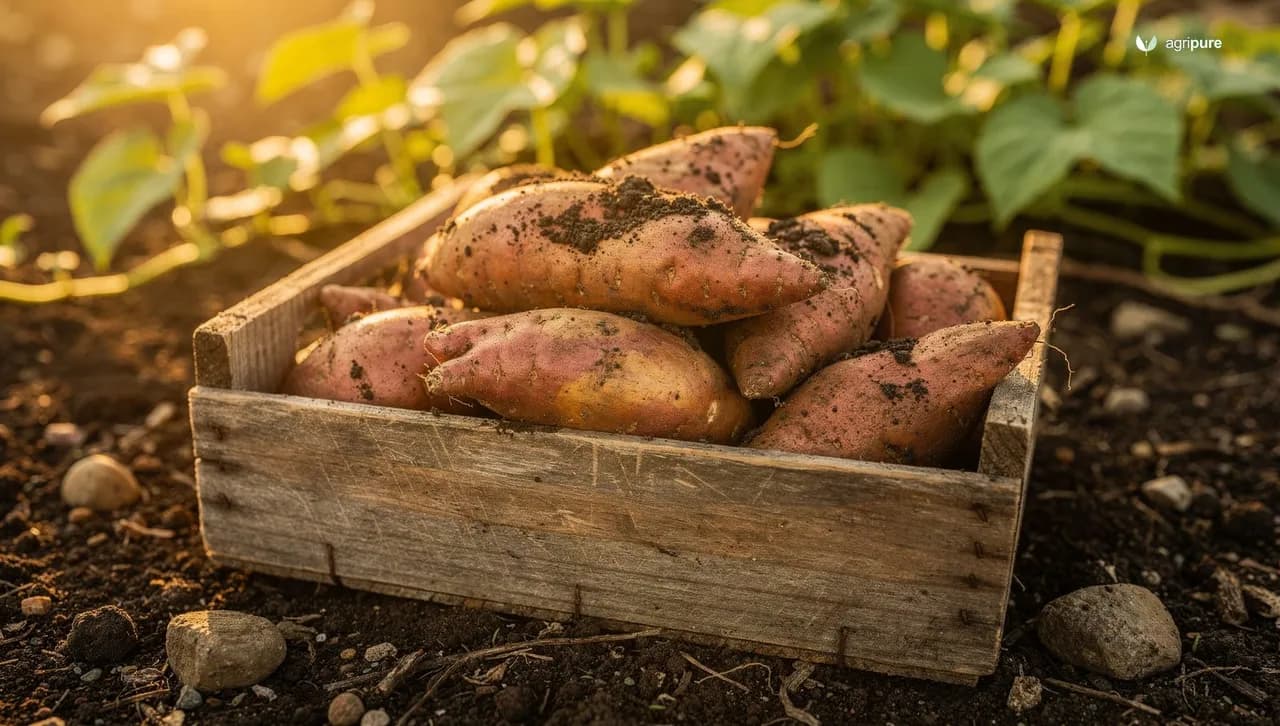
Sweet potatoes require advance planning, starting six weeks before your last frost date with a jar of water and a spare root.
Sweet potatoes are one of the most productive crops a homesteader can plant per square foot of warm-season garden space. A single well-managed 10-foot row yields 15 to 30 pounds of storage roots, and those roots, properly cured and stored, will supply the kitchen for four to six months. The challenge is not growing the plant; it grows aggressively once the soil warms. The challenge is managing the two non-negotiable steps that bookend the season: making your own slips in spring and curing the harvest correctly in fall. Skip either and you lose much of the yield, flavor, and shelf life the plant is capable of.
This guide covers the full arc from root to root: choosing a variety, producing slips, timing and soil preparation, managing the vine through summer, harvesting before frost, and the curing process that converts raw starch into the sweetness the name promises. A container option is included for gardeners working with patios or balconies. Everything here draws from USDA extension research, Clemson University, Penn State, NC State, and University of Maryland Cooperative Extension guidelines.
One clarification before we begin: the roots sold in most North American grocery stores as “yams” are sweet potatoes. True yams (Dioscorea spp.) are a different genus entirely: starchier, drier, and rarely grown in the continental US. Sweet potatoes (*Ipomoea batatas*) produce an edible storage root, not a tuber, and that distinction matters when sourcing certified disease-free planting stock.
Key takeaways
A sweet potato in a clear glass jar sprouts green slips and white roots on a sunlit windowsill at the start of the season.
The journey to abundant sweet potato harvests begins with a single root, suspended in water, patiently awaiting the emergence of vigorous slips.
- Sweet potatoes are grown from slips (rooted shoots pulled from a mother root), not from seed or from grocery-store tubers.
- Start slips indoors four to six weeks before your last frost date; plant out only after soil reaches 65°F.
- Space slips 12 inches apart in rows 3 to 4 feet wide; bury at least two nodes deep to maximize root sites.
- Curing freshly dug roots at 80–85°F and 85–90% humidity for four to seven days heals harvest wounds, sets the skin, and converts starches to sugars.
- Properly cured and stored roots keep three to six months at 55–60°F; never refrigerate them.
- Bush varieties like Vardaman suit containers; a 25-gallon grow bag holds five to six slips.
Choosing a variety
Variety selection determines days to maturity, skin and flesh color, storage life, and disease resistance, and it matters more for sweet potatoes than for most vegetables because regional disease pressure varies sharply. The table below covers the varieties most commonly recommended by extension services across the Southeast, Mid-Atlantic, and North.
Variety | Days to maturity | Flesh / skin | Notes |
|---|---|---|---|
Beauregard | 90–100 | Orange / light rose | Excellent flavor, widely adapted, industry standard |
Covington | 95–110 | Orange / copper-rose | Superior storage (up to 12 months), uniform shape, disease resistant — 90% of NC commercial production |
Georgia Jet | 90–100 | Deep orange / red | Performs well in northern zones; faster maturity |
Vardaman | 100 | Orange / gold | Bush-type; compact vines suit small beds and containers |
Murasaki | 100–120 | White / purple skin | Nutty, less sweet flavor; vigorous vines; drier texture |
Jewel | 120–135 | Orange / copper | High yielding, disease resistant; needs a long season |
Centennial | 100–110 | Orange / copper | Nematode and wireworm resistant — good for problem soils |
For most North American homesteaders, Beauregard or Covington is the starting point: both are adapted across USDA zones 5 through 11 with a long enough season, both have excellent disease packages, and certified slips are easy to source. In the north (zones 4 and 5), reach for Georgia Jet’s 90-day maturity window or start slips early to gain extra time. In small-space gardens, Vardaman’s compact vines stay manageable without constant pruning.
One purchasing note: buy certified disease-free slips from a reputable seed company instead of sprouting a grocery-store root. Commercial sweet potatoes are often treated or from unknown disease history. Certified stock is tested for the viruses and root rots that cut yields dramatically when they establish in your bed.
Making your own slips
Sweet potato halves are suspended in glass jars of water with toothpicks, allowing shoots to emerge from the cut surface.
The water-suspension method is the simplest way to produce slips at home; shoots appear within two weeks in a warm, bright spot.
A slip is a rooted shoot pulled from a mother root. Each seed sweet potato will produce eight to 15 slips over four to six weeks, so a single stored root from last year’s harvest is enough to plant a generous bed. There are two standard methods.
Water-suspension method. Push three or four toothpicks around the equator of a sweet potato, then rest it cut-side down (or whole) in a jar so the bottom third is submerged in water. Keep the jar in a warm, bright window (above 70°F is ideal). Shoots appear in 10 to 14 days. Once each shoot reaches 4 to 6 inches, snap or twist it cleanly off the mother root at the base, place it in a clean jar of cool water, and wait seven to 10 days for roots to develop. Slips with active roots transplant with far less shock than bare-stem cuttings.
Soil-bed method. Fill a shallow tray with two to three inches of moist potting mix or coarse sand. Lay whole sweet potatoes on their sides and cover with an additional inch of mix. Place under grow lights or in a very bright window at 75–80°F. Shoots emerge from the skin in one to two weeks. When each shoot reaches 4 to 6 inches and has developed two or three leaf nodes, snap it off and root it in water as above before transplanting.
Timing is the discipline most first-timers get wrong. Count back six weeks from your anticipated transplant date, which is itself two weeks after your last frost date, once soils have warmed to 65°F. In zone 6, that means starting slips in early to mid-March for a late-May plant-out. In zone 8 and south, April starts work for a mid-May transplant. Start too early and slips become leggy and stressed waiting; start too late and you lose weeks of warm-season growing time the plant needs to fill its roots.
Soil, sun, and spacing
Sweet potatoes prefer full sun: a minimum of six hours daily, eight or more for maximum yield. They are a warm-season tropical crop: every week of full sun the vines capture goes directly into root sugar and size. Do not plant them in any location that shades before 3 p.m.
Soil structure matters more than richness for this crop. Roots that encounter compaction fork, split, or stay small. The ideal is a loose, well-drained loam or sandy loam worked to at least 10 to 12 inches deep. Heavy clay soils benefit from substantial organic matter incorporation: two to three inches of compost tilled in before planting. In wet or clay-heavy sites, raised beds built 8 to 12 inches high reliably outperform in-ground beds because drainage is instant and the loose mix never impedes root expansion.
Soil pH should sit between 5.8 and 6.2. Below 5.5, manganese and aluminum become soluble at concentrations that inhibit root growth. Above 7.0, scurf disease (a fungal skin blemish) becomes significantly more prevalent. Test before planting and amend accordingly: lime raises pH slowly over several months, so test the fall before your target season if possible. For the fertilizer program, apply a low-nitrogen pre-plant fertilizer such as 5-10-10 at around 30 lbs per 1,000 square feet. Too much nitrogen pushes foliage at the expense of root development, a common first-timer mistake.
Planting configuration follows a simple rule: 12 inches between slips in a row, rows 3 to 4 feet apart. The wide row spacing accommodates the vines, which will sprawl 6 to 10 feet in all directions by midsummer. In commercial production, rows of 42 to 44 inches are standard. Plant each slip 3 to 4 inches deep, burying at least two leaf nodes below the soil surface; each buried node is a potential root-initiation site and buried-node count is one of the strongest predictors of total yield. Water in thoroughly after transplanting; establishment is the period of highest stress.
Watering and feeding through summer
The growing season divides into two phases with different water priorities.
Establishment (weeks 1 through 8). Sweet potatoes are most sensitive to drought in the first 50 to 60 days after transplanting, when the storage roots initiate and begin sizing. Deliver at least one inch of water per week during this period, applied to a six-inch depth. Morning watering reduces foliar disease. Drip irrigation is ideal because it keeps water at the root zone and the foliage dry. Do not let the soil dry completely at any point during this window; water stress during root initiation produces a small, forked final harvest.
Vine fill (weeks 8 through harvest). Once the vines are covering the row (typically six to eight weeks after transplanting), sidedress with a modest nitrogen source if growth looks pale or stalled. For sandy soils, a light application of balanced fertilizer (4 lbs of 5-10-10 per 100 feet of row) when vines begin to cover is sufficient. Heavy nitrogen at this stage pushes vine growth, not roots. Reduce irrigation in the final two to three weeks before anticipated harvest; slightly drier conditions help the skin firm up before digging.
The vines need almost no other management in a home garden. Unlike tomatoes or cucumbers, sweet potatoes do not need staking, caging, or regular pruning. The one exception is vines that begin to root at secondary nodes where they touch the soil — some growers lift and redirect these to concentrate energy into the primary root cluster near the original slip. In small beds it is worth doing; in large plantings the return is marginal.
Pests and diseases
Wireworm damage appears as small pinholes and tunnels in the surface of a harvested root.
Wireworm damage appears as pinholes and tunnels in harvested roots; rotate away from grassy cover crops and choose resistant varieties to reduce pressure.
Sweet potatoes are relatively pest-tolerant once established, but a handful of problems cause consistent losses in home gardens.
Wireworms are the primary soilborne pest, the larvae of click beetles, which live in the soil for one to four years. They bore small pinholes into developing roots, creating entry points for secondary rots that spread through stored roots. Wireworm pressure is highest in beds rotated from grass sod or cover-cropped with grasses, so avoid following a grass phase with sweet potatoes. Resistant varieties (Centennial, Covington, and Monaco) reduce damage significantly. There are no effective organic sprays once larvae are in the soil; prevention through rotation and variety selection is the management plan.
Root-knot nematodes cause swellings and deformations on roots in warm-climate gardens, particularly in sandy soils in zones 7 and south. Rotate with corn, which is a poor nematode host, and use resistant varieties such as Centennial or Covington when nematodes have been confirmed in soil tests.
Fusarium root rot and black rot both establish through infected planting material. Buying certified disease-free slips and never replanting from a root that showed any soft rot, dark internal discoloration, or skin lesions eliminates most of this risk. Discard any root showing black rot before curing, and sanitize storage bins with a dilute bleach solution between seasons.
Scurf is a cosmetic fungal blemish on the skin that does not affect eating quality but shortens storage life by compromising the skin barrier. It is worst in alkaline soils (above pH 7.0); keeping pH in the 5.8 to 6.2 range is the primary control. Foliage pests (armyworms, aphids, and whiteflies) appear occasionally but rarely cause meaningful yield loss on established vines. Hand-remove caterpillars; for aphid pressure on young plants, a jet of water or insecticidal soap handles most outbreaks before they establish. Pair your planting with surrounding flowers to support natural predators, as covered in detail in the companion planting guide.
Growing sweet potatoes in containers
Bush-type varieties make sweet potatoes viable on a patio, deck, or balcony where a sprawling in-ground vine would be impractical. The key parameters: container size, drainage, and heat.
Use at least a 25-gallon grow bag or pot; fabric grow bags are preferred because they air-prune roots and drain well. Fill with a well-aerated potting mix instead of garden soil, which compacts in containers. Place the container in the hottest, sunniest position available: south-facing walls that absorb and radiate heat outperform open positions by several degrees, which sweet potatoes convert directly into yield.
Plant five to six slips per 25-gallon container, spaced 10 to 12 inches apart. Water more frequently than in-ground beds, as containers lose moisture faster and the feeder root zone is limited. Check moisture at two to three inches depth every day or two in midsummer heat. Fertilize lightly every three to four weeks with a dilute balanced fertilizer; the restricted root zone depletes nutrients faster than open soil. Pinch long vines to encourage the plant to branch and keep growth manageable on a small patio.
Container harvest follows the same timeline (90 to 120 days), but yields are smaller: a 25-gallon bag typically produces four to eight pounds of roots compared with the 15 to 30 pounds a 10-foot in-ground row delivers. The tradeoff is practicality for space-constrained growers. Cure container roots the same way as field roots; the process is identical. See the square-foot gardening guide for more strategies on maximizing small-space productivity.
Harvesting: timing and technique
Sweet potatoes are ready when approximately 30% of the roots have reached 3.5 inches in diameter; check this by carefully excavating around one or two plants with a digging fork before committing to the full harvest. Most varieties reach this point 90 to 120 days after transplanting; the exact date depends on variety, soil temperature, and accumulated heat units through the season.
The hard deadline is frost. A soil temperature that drops below 55°F damages the roots before they are even dug; an actual frost event kills the vines and triggers decay that spreads into the roots. Watch the 10-day forecast. If frost is incoming and the crop is not fully sized, harvest anyway; a smaller root that has been properly cured is far more useful than a full-sized root damaged by frost.
Harvest technique matters because sweet potato skin is thin and cuts made by a spade will rot during storage. Use a digging fork and work it in at least 12 inches away from the plant crown, pushing it down and under the root cluster instead of stabbing straight down. Lever the roots gently to the surface. Brush off loose soil (do not wash or scrub) and handle each root gently to avoid bruising. Lay the harvest on the soil surface in direct sun for two to three hours if conditions allow, which begins the surface drying process before curing. Any root showing deep cuts, soft spots, or dark internal discoloration should go directly to the kitchen; it will not store.
Curing and storage
Sweet potatoes arranged in a single layer on wooden shelving inside a warm room, curing with gentle ventilation
Curing in a warm, humid space for four to seven days seals harvest cuts and starts the starch-to-sugar conversion that makes the final flavor.
Curing is the step that separates a sweet potato that tastes like a potato from one that tastes like a sweet potato. Three biological processes happen simultaneously during curing:
- Wound healing. A layer of suberin (a cork-like barrier tissue) forms over every cut, scrape, or bruise on the skin within four to seven days at optimal conditions, sealing out the bacteria and fungi that cause storage rot.
- Starch-to-sugar conversion. Enzymes convert starches to simple sugars (sucrose, fructose, and glucose), dramatically improving flavor and the characteristic sweetness. The conversion continues at a slower rate for weeks after curing ends.
- Skin setting. The outer skin hardens and toughens, becoming resistant to mechanical damage during handling and to microbial attack in storage.
Curing conditions: 80–85°F (27–29°C) and 85–95% relative humidity for four to seven days, with gentle air circulation. Penn State Extension specifies this range; NC State’s organic production guide confirms 85°F and 85–90% RH for three to five days at commercial scale. Home gardeners rarely have a controlled curing room, but workable approximations include:
- A bathroom with a space heater and a bowl of hot water to raise humidity
- A greenhouse in late September when daytime temperatures are still high
- The warmest room in the house, lined cardboard box partially closed with a damp cloth over it to hold humidity
- Covered outdoor porch in September in zones 7 and south, where the combination of residual warmth and humidity is often sufficient
If the conditions are imperfect (say, 70–75°F instead of 85°F), extend the curing time to 10 to 14 days. The cure still happens; it just proceeds more slowly. What does not work is cold curing: do not cure below 65°F. Chilling injury at this stage leads to hard, flavorless cores that do not soften in cooking.
After curing, move roots to long-term storage: 55–60°F, 85–90% relative humidity, dark. A basement corner away from the furnace, an insulated garage in mild climates, or a root cellar all work well. Never refrigerate fresh sweet potatoes; temperatures below 50–55°F cause chilling injury (hard centers, off-flavors, accelerated decay). Pack roots in single layers in newspaper-lined wooden boxes or cardboard cartons with ventilation holes; do not pile them tightly. Under proper conditions, Covington and similar varieties keep three to six months, with sugar content continuing to develop for the first six to eight weeks of storage. That is the window (from October harvest to February or March table) when root cellaring at its most useful overlaps with sweet potato storage at its best.
For homesteaders producing more than the household can eat fresh, sweet potatoes also respond well to dehydrating: sliced thin and dried at 130–135°F for eight to 10 hours. More on that approach in the dehydrating guide.
Frequently asked questions
How do you make sweet potato slips at home?
Push three toothpicks around a stored sweet potato and suspend it in a jar of water so the bottom third is submerged. Keep it in a warm, bright window above 70°F. Sprouts appear in 10 to 14 days. Once each shoot reaches 4 to 6 inches, snap it off at the base and place it in a clean jar of water for seven to 10 days until roots form. Slips with developed roots transplant with far less shock.
When do you plant sweet potato slips?
Plant out after your last frost date, once soil temperature has reached 65°F consistently. In zone 5 and 6, that is typically late May to mid-June. In zones 7 and 8, late April to mid-May. Start slips indoors six weeks before your target plant-out date to have rooted transplants ready.
How deep do you plant sweet potato slips?
Plant 3 to 4 inches deep, burying at least two leaf nodes below the soil surface. Each buried node is a potential root-initiation site; deeper planting with more buried nodes generally produces more and larger storage roots.
What is the difference between a sweet potato and a yam?
True yams (Dioscorea spp.) are a different plant genus: starchier, drier-fleshed, and rarely grown in North America. What North American grocery stores label “yams” are almost always orange-fleshed sweet potatoes (Ipomoea batatas). The USDA requires labeling with both names when the word “yam” is used, precisely because of this longstanding confusion.
How long do you cure sweet potatoes?
Four to seven days at 80–85°F and 85–95% relative humidity, with gentle airflow. If your space is cooler (70–75°F), extend to 10 to 14 days. Curing heals harvest cuts, sets the skin, and converts starches to sugars. Never cure below 65°F; cold temperatures cause chilling injury.
Can you grow sweet potatoes in containers?
Yes, in a 25-gallon grow bag or larger. Use a bush variety like Vardaman, plant five to six slips 10 to 12 inches apart, and place the container in full sun against a south-facing wall. Water more frequently than in-ground beds. Expect four to eight pounds per 25-gallon bag versus 15 to 30 pounds per 10-foot in-ground row.
References
- Growing Sweet Potatoes in a Home Garden — University of Maryland Extension
- Sweetpotato Curing and Storage — Penn State Extension
- Sweetpotato — Clemson University Cooperative Extension / Home & Garden Information Center
- Chapter 8: Crop Production Management — Sweetpotatoes — NC State Extension
- Easy Container Vegetables and How to Grow Them — NC State Extension (Onslow County)
- Growing Guide: Sweet Potatoes — University of Georgia Cooperative Extension