Khair (Senegalia catechu) is one of those trees that does the heavy lifting on land nobody else wants. It is the source of catechu (the “cutch” or kattha of South Asian paan and the leather-tanning trade), a strong fuelwood and timber, and a nitrogen-fixing legume that colonises dry, stony riverbanks where most trees give up. But it carries one trait that catches gardeners and growers out: despite its toughness in heat and drought, it is genuinely frost-tender. This guide covers how to grow it, the soils and climate it actually wants, and the hardiness zones where it will survive long term.
What khair is, and why people grow it
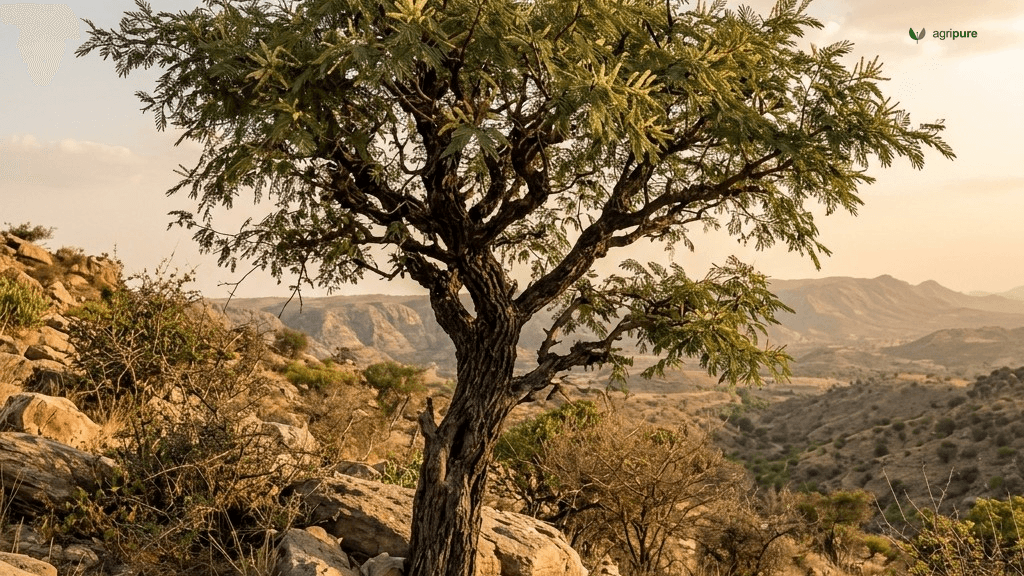
A mature Khair tree in a dry, sun-drenched Indian forest landscape showing delicate feathery leaflets.
A healthy Senegalia catechu (Khair) tree showing typical feathery foliage and thorny stems.
Khair is a small to medium, deciduous, thorny tree in the legume family (Fabaceae), commonly growing up to about 15 m tall (occasionally larger on good sites). Botanically it was long known as Acacia catechu and is still widely sold and listed under that name; it has since been reclassified into the genus Senegalia, so “khair tree” and “acacia catechu” point to the same species. It is native to the drier mixed deciduous forests and savannas of South and Southeast Asia, including the Indian subcontinent (India, Pakistan and Nepal), Myanmar, Thailand and southern China, where it favours the sandy soils of riverbanks and watersheds.
Three things make it worth planting:
- Catechu / cutch extract. Boiling and evaporating the heartwood yields a brittle, astringent extract very rich in tannins (around 25-33%) and catechins. It is used for chewing (kattha in paan), leather tanning, dyeing textiles, and as a traditional remedy for sore throats and digestive complaints.
- Timber and fuel. The heartwood is dense and durable (roughly 880-1,000 kg/m³), used for posts, tool handles and implements, and it makes excellent firewood and charcoal.
- Nitrogen fixation. Like other legumes it forms root nodules with symbiotic bacteria that fix atmospheric nitrogen, gradually lifting the fertility of poor soils for neighbouring plants.
The hardiness story: tough on heat, weak on frost
This is the single most important fact for anyone planting khair outside its native range, and it is surprisingly hard to find spelled out. Khair tolerates a wide warm-season range, comfortably handling temperatures from roughly 10°C up to 40°C, and it shrugs off drought and poor soil. What it does not tolerate is frost. Sustained freezing temperatures will damage or kill it, which is why it is restricted to frost-free or near-frost-free climates.
Translated into the standards international growers use, the AgriPure database records khair as:
System | Rating | What it means |
|---|---|---|
USDA zones | 10-12 | Average annual minimums above about −1°C; essentially frost-free. |
UK / RHS | H1c | Can sit outside in summer once minimums stay above ~10°C, but needs heated glass in winter. Not a plant for open ground in Britain. |
Australia | Tropical, subtropical, arid | Suits the warm, frost-free north and dry interior; not the cool temperate south. |
The practical upshot: in the UK, much of the US mainland, and southern Australia, khair is a heated-greenhouse or large-conservatory subject, not a landscape tree. In its home range and in comparably warm, frost-free climates it is a reliable outdoor pioneer. If your site sees even occasional hard frost, do not plant khair as a permanent tree; pair the role with one of the hardier nitrogen-fixers discussed below.
Soil, water and light
Khair is undemanding about soil, which is much of its appeal on marginal land. It grows on sandy and gravelly alluvium, loams with a range of sand content, and even clay and black cotton soils, from sea level up to around 1,500 m. The non-negotiable is drainage: it is adapted to well-drained riverbank and watershed sites and dislikes waterlogging.
- Light: a strong light-demander. Give it full sun; it will not develop properly in shade.
- Water: drought-hardy once established, surviving on as little as ~500 mm of annual rainfall, though it grows faster where rainfall reaches 1,000-2,000 mm. Treat 500 mm as a floor, not a target.
- Role on site: it behaves as a xerophilous pioneer, often the species that holds dry, stony ground where little else establishes.
How to propagate and plant khair
Khair is grown mainly from seed, but the seed has a hard coat that blocks water and slows or prevents germination unless you break that dormancy.
Seed treatment and sowing
- Scarify: lightly sand or nick the seed coat, or soak the seed in hot water (around 60-80°C) and let it stand for about 24 hours before sowing.
- Sow warm: use a free-draining mix in pots or trays kept at 20-30°C in a bright, sunny spot. Expect germination in roughly 2-3 weeks.
- Establishment options: beyond nursery seedlings, khair can be raised by direct sowing, by planting out stumps (cut-back seedlings with trimmed root and shoot), and it coppices readily, which suits repeated fuelwood harvests.
Early care and the long game
Be patient: establishment growth is slow, and in trials annual diameter increment is modest (on the order of 0.8-1.3 cm per year). Keep young trees weed-free and fully lit, water through the first dry season, and protect them from browsing, because livestock readily lop the foliage for fodder. Rotations reflect the use: fuelwood is typically cut on a 10-15 year cycle, while the heartwood needed for good catechu yield develops best over a much longer span, often cited at around 30 years.
If your site gets frost: pair khair with hardier nitrogen-fixers
Because khair stops at the frost line, the regenerative move on cooler or more variable sites is to keep the same functional roles (nitrogen fixation, fuel, timber, fodder) and fill them with species that push into lower zones. All of the following are legumes or N-fixers and most still want warmth, so check your own winter lows:
- Acacia nilotica (kikar), an arid-zone pioneer for fuel, timber, fodder and nitrogen fixing; rated RHS H2 and USDA 9-12, so slightly more cold-forgiving than khair at the margins.
- Dalbergia sissoo (shisham), a premier timber and fodder legume that also fixes nitrogen, USDA 9-12 / RHS H2, excellent alongside khair on dry alluvial ground.
- Acacia senegal (gum arabic tree), a true desert pioneer (USDA 10-12, H1c) for the hottest, driest sites, adding nitrogen, fodder and fuel.
- Leucaena leucocephala, a fast nitrogen-fixing support tree (USDA 9-11, H1c) for fodder, fuel and mulch; use cautiously as it can be weedy in some regions.
On a dry, frost-free plot, a practical planting is khair as the long-lived heartwood and catechu crop, kikar or shisham as the faster timber and fodder layer, and a leucaena or acacia senegal support stand cut for mulch and nitrogen. The combination builds soil while you wait for the slow-growing khair to mature.
Common problems and how to avoid them
Most failures with khair trace back to two mistakes: cold and wet feet. Knowing what to watch for saves a season.
- Frost damage. Blackened shoot tips, leaf drop and dieback after a cold snap are the classic signs of frost injury on a plant that should never have seen frost. Containerised young trees can be moved under cover before the first frost; in marginal climates, grow khair purely as a glasshouse or conservatory specimen and use a hardier N-fixer outdoors.
- Waterlogging and rot. Because khair is adapted to free-draining riverbank sands, heavy or compacted soil that holds water leads to root problems. On clay, plant on a raised mound or ridge to lift the root crown clear of standing water, and never site it in a hollow that puddles after rain.
- Poor germination. If seed sits without sprouting, the hard seed coat almost certainly was not breached; repeat the hot-water soak or scarification rather than simply waiting longer.
- Browsing pressure. Khair foliage is palatable and livestock will lop it hard. Fence or guard young trees until they are above browse height, or the leader will be repeatedly stripped and the tree will stay stunted.
- Too much shade. As a strong light-demander, khair planted under a canopy or crowded by faster neighbours becomes spindly and weak. Keep it in the open and thin competing growth early.
Frequently asked questions
Is the khair tree frost hardy?
No. Khair tolerates great heat and drought but is frost-tender; prolonged freezing damages or kills it. It is reliable outdoors only in essentially frost-free climates (USDA 10-12, RHS H1c). In cool-winter regions it needs to be grown under heated glass.
Is “acacia catechu” the same as Senegalia catechu?
Yes. The tree was reclassified from Acacia catechu into the genus Senegalia, so both names refer to the same khair tree. Older nursery listings and many search results still use the acacia name.
How long does khair take to be useful?
It is slow to establish. Coppiced fuelwood is generally taken on a 10-15 year rotation, while the dense heartwood that yields good catechu develops best over roughly 30 years.