A jar of August peaches opened in January is not nostalgia — it is food security you put up yourself, one tested step at a time.
Peaches are one of the most forgiving fruits to can. They are naturally acidic enough for a simple boiling-water bath, they pack beautifully in halves or slices, and the USDA’s tested procedure has been refined across decades of food-safety research at the National Center for Home Food Preservation (NCHFP). Follow the process, and the results last up to 18 months on the shelf — firm, golden, and tasting of the orchard they came from.
This guide covers everything from choosing the right variety to sealing the last jar: syrup options (including unsweetened packs), the case for hot packing over raw packing, a step-by-step process you can follow the first time without guessing, and a full altitude-adjustment table so the times are right wherever you live. Safety notes are grounded in USDA and NCHFP guidance throughout — because peaches done right are not just delicious, they are shelf-stable and genuinely safe.
Before you fire up the canner, it is worth connecting canning to the broader pantry. Peaches sit alongside home canning’s general principles, share shelf space with dehydrated fruit, and complement the fermented and pickled vegetables you may already have in rotation. Once you have the water-bath rhythm down here, canning tomatoes and salsa are a short step away.
Key takeaways
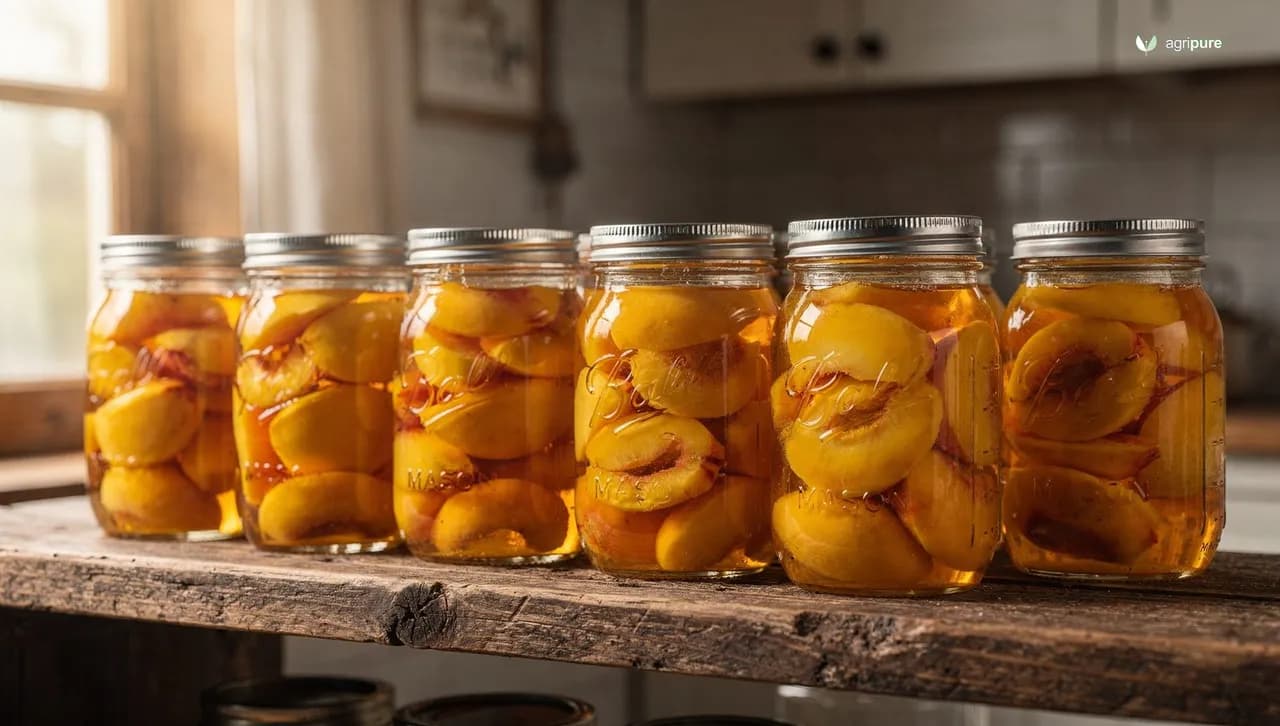
A close-up, warm-toned photograph of five glass jars filled with perfectly preserved golden peach halves, lined up on a simple wooden shelf in a home pantry, evoking a sense of self-sufficiency and abundant harvest.
Transforming August’s bounty into January’s treasure: home-canned peaches offer a taste of summer and reliable food security, preserved safely with time-tested methods.
- Only yellow-flesh peaches are safe to can — white-flesh varieties can exceed pH 4.6 and must be frozen instead, per NCHFP.
- Peaches are a high-acid food (pH below 4.6), so a boiling-water bath canner is sufficient and correct — no pressure canner required.
- Hot packing shrinks the fruit before jarring, reduces floating, and nearly eliminates siphoning; it produces a more consistent finished product than raw packing.
- Five liquid options are USDA-accepted: very light, light, medium, or heavy syrup, or a plain water/juice pack — each produces a different sweetness and calorie level.
- Processing times vary by jar size, pack style, and altitude; at sea level hot-pack pints take 20 minutes and quarts take 25 minutes.
- Properly sealed and stored at 50–70°F in a dark location, home-canned peaches are at peak quality for 12 months and safe beyond 18 months if the seal holds.
Why peaches are safe to water-bath can
The most important decision in home canning is not the recipe — it is the method. That choice rests entirely on acidity. Clostridium botulinum, the bacterium responsible for botulism, cannot grow or produce toxin below a pH of 4.6. Yellow-flesh peaches fall comfortably in the safe zone, typically between pH 3.4 and 4.0, which means a boiling-water bath canner — reaching 212°F at sea level — is enough to process them safely. You do not need a pressure canner for peaches.
The critical exception, and it is non-negotiable: do not can white-flesh peaches. The NCHFP is unambiguous on this point — some white-flesh varieties exceed pH 4.6, placing them in low-acid territory where a water-bath process cannot guarantee safety. If you grow or buy white peaches, freeze them. Yellow peaches only go into the canner.
Beyond the variety rule, follow tested recipes exactly. The USDA’s Complete Guide to Home Canning and the NCHFP’s published procedures are based on laboratory measurements of heat penetration and pathogen destruction across real jar sizes and pack styles. Modifying the recipe — halving the process time, using larger jars than specified, adding extra low-acid vegetables — moves you outside what the science covers. The recipe is not a suggestion; it is the safety margin.
For a deeper primer on the two canning methods and what foods each handles, the water-bath canning guide lays out the high-acid vs. low-acid rule in full.
Choosing and buying peaches for canning
A wooden crate of ripe yellow freestone peaches at a farmers market stand, blushed red and fragrant, ready for canning
Freestone varieties like Redhaven and Cresthaven are the easiest to halve cleanly — the pit lifts out in one move.
Variety selection shapes every stage of canning: how long prep takes, how the halves hold their shape, and how the finished jar tastes. The key split is freestone vs. clingstone.
Freestone peaches — where the flesh separates cleanly from the pit — are almost universally preferred for home canning. Halving is fast, pitting is a single twist, and you lose very little fruit to the knife. Clingstone varieties have flesh that holds to the stone; they are juicier and sweeter, which is why commercial canners favor them, but at home the extra cutting time adds up quickly when you are processing 17 pounds at a stretch.
The best home-canning varieties by name include Redhaven (early season, firm, freestone), Cresthaven (mid-to-late, excellent texture after processing), Elberta (a classic large freestone with strong flavor), Canadian Harmony, and Glohaven. Penn State Extension also recommends Glenglo, Ernie’s Choice, John Boy, Loring, and Sunhigh — all yellow-flesh, all freestone or semi-freestone, all with the firmness needed to hold up in the jar.
Buy or pick ripe, mature fruit. Underripe peaches never fully soften in the jar and can taste flat. Overripe or bruised peaches turn mushy during processing and add off-flavors. The standard test: the fruit gives slightly to thumb pressure, smells like a peach, and shows no green around the stem. For large batches, plan to can within 24 hours of peak ripeness.
Quantity to plan for: the NCHFP’s tested procedure calls for 17.5 pounds of fresh peaches per seven-quart canner load, or 11 pounds per nine-pint load. That accounts for peeling and pitting loss, which typically runs 30–35% of the raw weight.
Equipment and jar prep
You do not need a large collection of specialized equipment, but what you do need must be in good condition. A cracked jar rim, a buckled lid, or a canner that does not maintain a full rolling boil can each undermine a batch that was otherwise perfect.
Essential equipment:
- Boiling-water bath canner (or a deep stockpot with a rack to keep jars off the base) — must be deep enough to cover quart jars by at least one inch of water
- Mason-type canning jars in pint or quart sizes — inspect rims for chips or cracks before every use
- New two-piece lids (bands can be reused; flat lids should be new each season)
- Wide-mouth jars for halves — wide-mouth jars reduce bruising when you fit large halves in
- Jar lifter, canning funnel, headspace measuring tool, bubble remover or plastic spatula
- Ascorbic acid solution (1 teaspoon pure powdered ascorbic acid per gallon of cold water, or six 500-mg vitamin C tablets dissolved per gallon) to hold peeled fruit while you work
Wash jars in hot soapy water and rinse well, or run them through the dishwasher. Keep jars hot until filling — a cold jar cracked by hot fruit is the most common equipment loss in a canning session. The canner itself can double as a jar warmer: stand filled-but-unsealed jars in the hot (not boiling) water while you fill the rest. Warm lids in hot water — not boiling — for about 10 minutes before placing them on the jars.
Syrup, juice, and water: choosing your pack liquid
One of the most useful decisions you make before canning peaches is the pack liquid. Five options are USDA-accepted, and they span the range from lightly sweetened to zero added sugar.
Liquid type | Sugar % | Water (for 9-pint load) | Sugar (for 9-pint load) | Best for |
|---|---|---|---|---|
Very light syrup | 10% | 6.5 cups | 0.75 cup | Sweet ripe varieties; minimal added calories |
Light syrup | 20% | 5.75 cups | 1.5 cups | Moderately sweet, everyday use |
Medium syrup | 30% | 5.25 cups | 2.25 cups | Standard orchard flavor; tart varieties |
Heavy syrup | 40% | 5 cups | 3.25 cups | Very tart or firm clingstone peaches |
Juice or water pack | 0% | As needed | None | Low-sugar diets; let the fruit flavor shine |
The NCHFP specifically recommends very light or light syrup to keep added calories low, and notes that apple juice or white grape juice make excellent substitutes for syrup — they add a subtle sweetness without refined sugar. Plain water works too, though the finished product will taste more muted.
Bring your chosen syrup or liquid to a simmer before you need it. For hot pack (the preferred method), you will be simmering the peaches in this liquid directly. For raw pack, it goes in hot over the uncooked fruit. Either way, a cold liquid poured over fruit creates thermal shock and is never correct.
The syrup does not affect the safety of the finished product — the acid content of the peaches themselves provides that. Sweetness is purely a flavor and texture decision.
Step-by-step: hot pack peaches for the water-bath canner
A large pot of blanching peaches in boiling water beside a bowl of ice water, with a slotted spoon ready to transfer them for skin removal
The boiling-water blanch loosens peach skins in 30–60 seconds — any longer and the flesh starts to soften before it reaches the jar.
Hot packing is the NCHFP-preferred method for peaches. Heating the fruit before jarring drives trapped air out of the tissue, shrinks the fruit to a consistent size, and dramatically reduces both floating and siphoning — two of the most common problems with raw-packed peaches. Follow these steps in order.
1. Fill the canner and heat the water. Fill the canner about halfway and bring it to a simmer (not a boil yet) while you work through the rest of the steps. Place a rack in the bottom to keep jars off direct heat.
2. Prepare the ascorbic acid soak. Mix 1 teaspoon of pure powdered ascorbic acid (or six 500-mg vitamin C tablets, crushed and dissolved) into one gallon of cold water in a large bowl. Peeled peaches go straight into this solution — they can sit up to 20 minutes without significant softening.
3. Blanch and peel. Working in batches of five or six peaches, lower them into a large pot of briskly boiling water for 30–60 seconds, just until the skin at the stem end begins to split. Transfer immediately to a bowl of ice water. When cool enough to handle, slip the skins off with your fingers — they peel cleanly with almost no pressure. If skins resist, the blanch was too short; add 15 seconds next batch.
4. Halve and pit. Cut each peach along the natural seam all the way around the pit. Twist the halves apart. For freestone varieties the pit lifts out cleanly; for semi-freestone types, use a spoon or melon baller to scoop it out. Slice into quarters or eighths if preferred. Place immediately into the ascorbic acid solution.
5. Simmer the fruit. Drain the peaches and place them in a large saucepan with your prepared syrup, juice, or water. Bring to a full boil, then reduce heat and simmer for two to five minutes. The fruit will begin to soften slightly and will turn a deeper golden-orange.
6. Fill the jars. Using a canning funnel, pack hot peach halves into hot jars cut-side down — this minimizes air pockets and makes a tidier pack. Ladle in hot syrup to cover, leaving exactly 1/2 inch of headspace. Too little headspace and the lid may buckle; too much and the jar may not seal. Run a plastic spatula or bubble remover around the inside edge of the jar to release trapped air. Re-check and adjust headspace.
7. Wipe rims and seal. Wipe each jar rim with a clean damp cloth — any peach juice or syrup on the sealing surface can prevent a vacuum seal. Place a warmed flat lid on each jar, then screw the band on fingertip-tight (snug but not cranked down).
8. Process in the boiling-water canner. Lower jars into the simmering canner using a jar lifter. Bring the water to a full rolling boil, then start your timer. Process according to the altitude table below. Maintain a steady boil throughout — if the boil drops to a simmer, bring it back up and do not count that time.
9. Remove and cool. When processing is complete, turn off the heat, remove the lid, and let jars sit in the canner for five minutes before lifting them out. Place jars upright on a towel-covered counter, leaving at least one inch of space between them. Do not tilt or invert. Let cool undisturbed for 24 hours.
10. Test the seals. After 24 hours, press the center of each flat lid. A properly sealed lid will be concave and will not flex. Remove the band and try to lift the lid with your fingertips — a good seal holds firm. Any jar that fails the test goes into the refrigerator and gets eaten first.
Processing times and altitude adjustment
The times below are directly from the NCHFP’s tested procedure for yellow-flesh peaches in a boiling-water canner. Do not substitute approximate times from memory — use this table every session.
Pack style | Jar size | 0–1,000 ft | 1,001–3,000 ft | 3,001–6,000 ft | Above 6,000 ft |
|---|---|---|---|---|---|
Hot pack | Pints | 20 min | 25 min | 30 min | 35 min |
Hot pack | Quarts | 25 min | 30 min | 35 min | 40 min |
Raw pack | Pints | 25 min | 30 min | 35 min | 40 min |
Raw pack | Quarts | 30 min | 35 min | 40 min | 45 min |
Altitude matters because water boils at a lower temperature as elevation increases — as low as 200°F above 8,000 feet, versus 212°F at sea level. At that reduced temperature, the heat penetration that destroys potential spoilage organisms is slower, so additional time compensates. If you live above 1,000 feet and process at sea-level times, you are under-processing. Look up your elevation if you are unsure — the USGS topographic maps and most weather apps provide it.
If you prefer a pressure canner (some canners process everything under pressure as a personal system), the NCHFP also publishes times for that method: six minutes at 10 PSI for a dial-gauge canner across all styles and jar sizes, with adjustments above 2,000 feet. For most home canners, the water-bath method is simpler and equally safe for peaches.
Preventing browning and other quality problems
Rows of open pint jars with fresh yellow peach halves soaking in a clear ascorbic acid solution in a large glass bowl, preventing discoloration
The ascorbic acid soak is a five-minute prep step that separates golden finished jars from brown ones.
The most common quality complaint in home-canned peaches — brownish color in the jar or on the cut surfaces — is nearly always caused by skipping or rushing the anti-browning step. It does not affect safety, but it does affect palatability and appearance.
The solution is straightforward. Keep peeled and cut peaches submerged in an ascorbic acid soak — 3 grams (1 level teaspoon of pure powdered ascorbic acid, or six 500-mg vitamin C tablets dissolved) per gallon of cold water — at all times during preparation. Commercial blends like Fruit-Fresh contain ascorbic acid mixed with citric acid and work equally well; follow the package directions for concentration.
Do not use plain lemon juice as a substitute for the ascorbic acid solution here. It is inconsistent in concentration and can affect flavor unpredictably at the quantities needed. Use it as a finishing touch if you like the flavor, but not as your primary anti-browning measure.
Beyond browning, a few other quality issues have simple root causes:
- Floating fruit. The most common outcome of raw packing. Air trapped in raw fruit tissue causes the pieces to rise as the jar cools. Hot packing cooks out most of that air before jarring. If you raw pack, accept some floating — it is cosmetic, not a safety issue.
- Siphoning (liquid loss during processing). Usually caused by too little headspace, temperature swings during processing (the boil dropping and surging), or jars packed too tightly. Maintain a steady boil and measure headspace precisely at 1/2 inch. Jars that siphon heavily may not seal; refrigerate and use those first.
- Seal failure. Check three things: jar rim cleanliness (any syrup residue = no seal), lid condition (new lids each season), and band tightness (fingertip-tight, not torqued). A jar that won’t seal after 24 hours goes to the fridge.
- Mushy texture. Overripe peaches, over-simmering during hot pack, or extended processing time. Use firm-ripe fruit and limit the hot-pack simmer to two to five minutes.
Storage, shelf life, and what to do with the jar
Properly sealed and stored, home-canned peaches hold at peak quality for 12 months and remain safe well beyond 18 months as long as the vacuum seal is intact. Store them in a dark, dry location at 50–70°F. Avoid the garage in climates with temperature swings — heat accelerates color and flavor loss, and freeze-thaw cycles stress the lids.
Before opening any jar, check the lid. It should still be concave and should not flex when pressed. When you open the jar, there should be an audible pop or hiss as the vacuum releases. Any jar with a bulging lid, unexpected pressure, or off odors goes in the trash — do not taste-test a suspect jar. This is standard food-safety practice for all home-canned goods, not specific to peaches.
Once opened, transfer unused peaches to a covered container in the refrigerator and use within five to seven days. The syrup, by the way, is worth saving — it makes an excellent base for salad dressings, cocktail syrups, and marinades, and a single cup stirred into yogurt or oatmeal is a genuinely good breakfast.
If the pantry is feeling full, the root-cellaring and dehydrating guides cover alternative long-term strategies for the same fruit. Root cellaring works well for whole stone fruits in some climates, and dehydrating peaches into rings or leather requires zero jars and lasts even longer. For fermented options, fermenting and pickling covers the acidification approach — though peaches are more commonly canned than fermented in North American homestead traditions.
The takeaway
Canning peaches rewards precision and punishes improvisation — but the precision is simple, and the process is forgiving once you understand why each step exists. Use yellow-flesh freestone varieties, keep the fruit in ascorbic acid while you work, hot-pack into hot jars, measure your headspace, and process for the time that matches your altitude and jar size. Do those five things and you will pull golden, firm, shelf-stable jars out of the canner every time.
The NCHFP and USDA’s tested guidelines are not bureaucratic caution — they are the result of actual heat penetration studies in actual jars at actual altitudes. Working within them means your preserved peaches carry a safety margin that no amount of “we always did it this way” can match. Use the table, use tested recipes, and enjoy the results through every month that follows the season.
Frequently asked questions
Can you water-bath can white peaches?
No. Some white-flesh peach varieties exceed pH 4.6, which means a boiling-water bath cannot guarantee their safety. The NCHFP explicitly states not to use the peach canning process for white-flesh peaches. Freeze white peaches instead.
What is the difference between hot pack and raw pack for peaches?
Hot pack means you simmer the peaches in your liquid for two to five minutes before filling the jars with the hot fruit and liquid. Raw pack fills the jars with uncooked fruit, then adds hot liquid. Hot pack is recommended because it drives out trapped air, reduces floating, and nearly eliminates siphoning. Raw pack is faster but produces a less consistent finished product.
Do I need to add sugar to can peaches safely?
No. Sugar is not a safety requirement for canning peaches — the peach’s natural acidity provides that. You can pack peaches in plain water, apple juice, or white grape juice and process with the same times as a syrup pack. Sugar affects flavor and helps peaches hold their color and texture, but it is entirely optional.
Why did my canned peaches float to the top of the jar?
Floating is almost always caused by raw packing, which leaves air trapped in the fruit tissue. As the jar cools after processing, the air expands and the fruit rises. It is cosmetic, not a safety issue. Hot packing prevents it by cooking the air out before jarring.
How long do home-canned peaches last?
At peak quality, 12 months. They remain safe beyond 18 months if the vacuum seal stays intact and storage conditions are stable (50–70°F, dark, dry). Once the seal fails or the lid shows any bulging, discard the jar without tasting.
References
- Peaches — Halved or Sliced — National Center for Home Food Preservation (NCHFP / UGA)
- Preparing and Using Syrups for Canning Fruit — National Center for Home Food Preservation (NCHFP / UGA)
- Maintaining Color and Flavor in Canned Food — National Center for Home Food Preservation (NCHFP / UGA)
- Ensuring Safe Canned Foods — National Center for Home Food Preservation (NCHFP / UGA)
- Perfect Canned Peaches — Penn State Extension
- How to Can Peaches — South Dakota State University Extension
- Altitude Adjustments for Home Canning — South Dakota State University Extension
- Why is pH important when canning food at home? — USDA