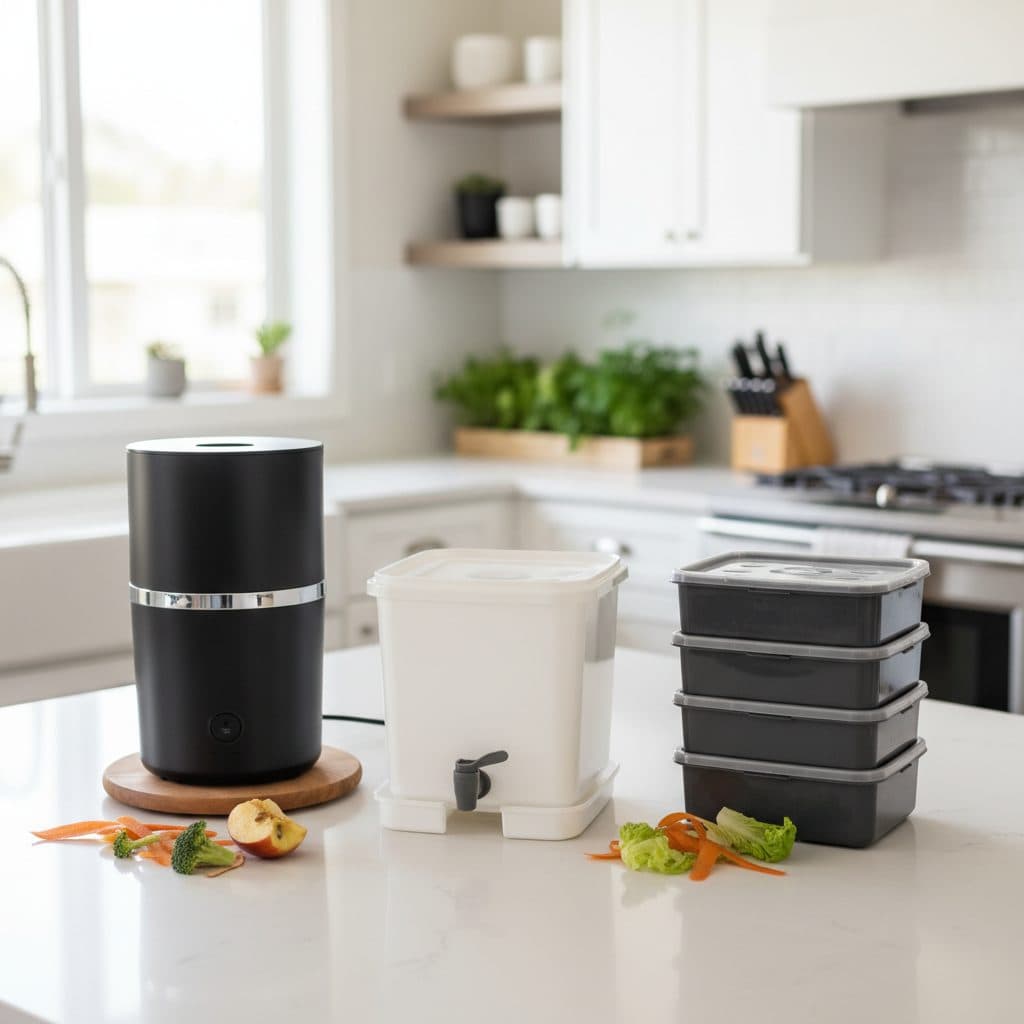
Key takeaways
- Bokashi composting ferments food scraps, including meat and dairy, into a pre-compost material within 10-14 days.
- Vermicomposting uses red wiggler worms to break down fruit and vegetable scraps, producing nutrient-rich castings in 2-3 months.
- Electric composters rapidly dehydrate and grind food waste, reducing volume by up to 90% in 3-8 hours.
- Choosing a system depends on your waste type, desired speed, space, and tolerance for maintenance.
- All three methods significantly divert organic waste from landfills, improving soil health when the finished product is used.
- Regular monitoring of moisture and temperature is needed for successful composting, regardless of the method.
Quick answer: Indoor composting systems like bokashi, vermicomposting, and electric composters can significantly reduce household organic waste by converting food scraps into valuable soil amendments. These methods offer solutions for various waste types, speeds, and space constraints.
For many growers across the United States, from a small apartment in Brooklyn, New York, to a suburban home in Phoenix, Arizona, managing organic waste indoors can be a challenge. The average American household generates about 1,500 pounds of waste annually, with food scraps making up roughly 22% of that total. Diverting a fraction of this material from landfills reduces methane emissions and creates soil amendments for gardens, houseplants, or container farms.
Indoor composting offers a practical solution, turning kitchen waste into nutrient-rich material without requiring a large outdoor space. This article compares three popular indoor composting systems (bokashi, vermicomposting, and electric composters) to help you choose the best fit for your home and growing needs, potentially reducing your household’s organic waste by 30% or more, based on data from typical California residences [6].
Bokashi composting: fermentation for all food scraps
Bokashi composting, originating from Japan, relies on anaerobic fermentation rather than traditional decomposition. It uses anaerobic microorganisms, typically a mix of lactic acid bacteria, yeasts, and photosynthetic bacteria, to ferment food waste in an airtight container. This method stands out because it can handle nearly all types of food scraps, including meat, dairy, and cooked foods, which are generally avoided in other composting systems due to potential odor and pest issues. The process usually takes 10-14 days to complete the fermentation stage, after which the fermented material, or ‘bokashi pre-compost’, needs further breakdown.
how bokashi works
To start, you layer food scraps with bokashi bran (a carrier material like wheat bran inoculated with beneficial microbes) in a sealed bucket. Each layer of food waste is pressed down to remove air, and then sprinkled with bran. A typical 5-gallon bokashi bucket can hold several weeks’ worth of scraps for a two-person household. The microbes begin to ferment the organic matter, breaking it down into simpler compounds and producing a liquid byproduct, often called ‘bokashi tea’ or ‘compost tea.’ This liquid, which can be drained every few days, is highly acidic with a pH often between 3.5 and 4.0, and can be diluted 1:100 with water to fertilize plants or poured down drains to help keep them clear.
- Can process all food types, including meat and dairy.
- Produces a nutrient-rich ‘bokashi tea’ liquid fertilizer.
- Requires an airtight container and bokashi bran.
- Fermentation takes about 10-14 days.
- Reduces food waste volume by approximately 20-30% during fermentation [2].
After fermentation, the pre-compost is still recognizable as food waste and needs to be buried in a garden, added to a traditional compost pile, or mixed with soil in a container for another 2-4 weeks to fully decompose. Research indicates that optimizing drying temperatures for bokashi bran can improve its microbial activity and speed up the fermentation process by a few days [5]. The resulting soil amendment significantly improves soil structure and nutrient availability, making it a valuable addition to any growing operation, whether in a USDA zone 7 garden or a small indoor grow tent. Many growers find that using fermented soybean meal can further boost soil fertility when combined with bokashi-amended soil.
Vermicomposting: nature’s small engineers
Vermicomposting, or worm composting, harnesses the power of specific worm species, primarily red wigglers (Eisenia fetida), to break down organic matter. These worms consume food scraps and excrete nutrient-rich castings, which are an excellent soil amendment. This system is particularly well-suited for fruit and vegetable scraps, coffee grounds, and shredded paper, but generally avoids meat, dairy, and oily foods that can attract pests and create foul odors. A well-maintained worm bin, typically 10-20 gallons in volume, can process 1-2 pounds of scraps per week, making it ideal for smaller households.
setting up a worm bin
A basic worm bin consists of several stacked trays or a single container with drainage holes. The bedding, usually shredded newspaper, cardboard, or coconut coir, provides a habitat for the worms and helps maintain moisture. Worms thrive in temperatures between 55°F and 77°F, making indoor environments like a kitchen corner or a basement ideal, even in colder climates like USDA zone 5. Introducing about one pound of red wigglers to a 10-gallon bin is a good starting point. They reproduce quickly, doubling their population in about 90 days under optimal conditions.
- Best for fruit, vegetable scraps, and paper.
- Produces high-quality worm castings for soil enrichment.
- Requires specific worm species (red wigglers).
- Takes 2-3 months to produce usable castings.
- Reduces food waste volume by up to 50% through consumption and decomposition.
Feeding the worms involves burying small amounts of appropriate food scraps beneath the bedding. Do not overfeed, as uneaten food can rot and create anaerobic conditions. Maintaining moisture levels similar to a damp sponge is essential; a soil moisture meter can be useful for this. The finished product, worm castings, can be harvested every 2-3 months and used directly in gardens or potted plants. These castings are rich in beneficial microbes and plant-available nutrients, often containing 5-11 times more nitrogen, phosphorus, and potassium than regular garden soil [1].
Electric composters: speed and convenience
Electric composters, sometimes called food recyclers, offer a fast and convenient way to reduce food waste volume indoors. These appliances don’t truly ‘compost’ in the biological sense, but rather dehydrate, grind, and aerate food scraps, transforming them into a dry, sterile, and significantly reduced material. This process typically takes 3-8 hours, depending on the model and the type of food waste. They are designed for ease of use, often fitting on a kitchen countertop, and can handle a wide range of food scraps, including small bones and cooked foods, similar to bokashi.
how electric composters work
The core mechanism involves a heating element that dries the food waste, often reaching temperatures up to 200°F, and an agitator that grinds it into a fine, uniform material. This significantly reduces the volume of food waste, often by 80-90%. The resulting material is not finished compost but a nutrient-dense amendment that can be added directly to garden soil, mixed into potting mixes, or further composted in an outdoor pile. While it lacks the microbial diversity of biologically active compost, it still contributes organic matter and nutrients to the soil. Many units have activated carbon filters to minimize odors during operation, making them suitable for apartments or small homes in areas like downtown Chicago.
- Processes food waste rapidly, typically in 3-8 hours.
- Reduces food waste volume by 80-90%.
- Can handle a wide variety of food scraps, including small bones.
- Produces a dry, sterile, soil amendment, not biologically active compost.
- Requires electricity to operate, consuming about 0.7-1.5 kWh per cycle.
One major advantage is the speed and convenience; you can process a day’s worth of scraps overnight. However, they do require electricity, with a typical cycle consuming about 0.7 to 1.5 kilowatt-hours, which might add a few dollars to a monthly utility bill. The output material, while not ‘living’ compost, is excellent for improving soil texture and providing slow-release nutrients. For instance, mixing one part of this material with five parts of garden soil can significantly boost plant vigor in a USDA zone 6 vegetable patch. For those interested in monitoring soil conditions, a 3-in-1 soil meter can help assess the pH and moisture of soil amended with this material.
Choosing the right indoor compost system for your home
Deciding which indoor composting system is best for your situation depends on several factors: the types of food scraps you generate, how quickly you want results, your budget, and your tolerance for maintenance. Each system offers distinct advantages and disadvantages, making one a better fit than another for different households, whether you’re in a small apartment in Seattle, Washington, or a larger home in rural Iowa.
key considerations for selection
If you produce a lot of varied food waste, including meat and dairy, and don’t mind an extra step of burying the fermented material, bokashi is a strong contender. It’s relatively inexpensive to start, with buckets costing $30-$70, and requires ongoing purchases of bokashi bran. The fermentation process is quick, often 10-14 days, but the final decomposition takes longer. Vermicomposting is ideal for households with mostly fruit and vegetable scraps, and those who appreciate a hands-on approach with living organisms. Initial costs are similar to bokashi, around $50-$100 for a bin and worms. The process is slower, yielding castings in 2-3 months, but the output is a highly prized soil amendment. For those prioritizing speed and convenience, and who don’t mind the electricity usage, an electric composter (ranging from $200-$500) is a good choice. It rapidly reduces waste volume, making it easy to manage, but the output needs further microbial activation if you desire true compost.
- Consider the types of food waste you generate daily.
- Evaluate the desired speed of waste processing and output readiness.
- Factor in the initial cost and ongoing operational expenses.
- Assess available space and aesthetic preferences for an indoor unit.
- Determine your comfort level with maintenance and handling organic materials.
For example, a family in Orlando, Florida, with a large volume of diverse food scraps might find an electric composter the most convenient, processing 1-2 gallons of waste daily. Conversely, a gardener in Portland, Oregon, focused on enriching their raised beds with biologically active material might prefer vermicomposting or bokashi for its superior soil-building properties. Understanding each system's typical processing times and output characteristics helps you make an informed decision for your composting goals and space. For more general information on turning waste into fertilizer, consider reading our article on composting.
Comparison of Indoor Composting Systems
Feature | Bokashi Composting | Vermicomposting | Electric Composter |
|---|---|---|---|
Food Scraps Handled | All food types, including meat, dairy, cooked foods | Fruit, vegetables, coffee grounds, paper (no meat/dairy/oils) | All food types, including small bones, cooked foods |
Processing Time | 10-14 days (fermentation) + 2-4 weeks (decomposition) | 2-3 months for castings | 3-8 hours per cycle |
Output Type | Fermented pre-compost & liquid ‘tea’ | Nutrient-rich worm castings | Dry, sterile, reduced organic matter |
Odor Potential | Sour, pickled smell (if anaerobic); minimal if done right | Earthy smell; foul if overfed or too wet | Minimal (carbon filters); slight cooked food smell |
Volume Reduction | 20-30% during fermentation | Up to 50% | 80-90% |
Cost (Initial) | $30 – $70 (bucket, bran) | $50 – $100 (bin, worms) | $200 – $500 (appliance) |
Ongoing Costs | Bokashi bran | Bedding, occasional worm food | Electricity, filter replacement |
Best For | All food waste, quick fermentation, small spaces | Vegetable scraps, high-quality soil amendment, hands-on growers | Speed, convenience, volume reduction, wide waste types |
Waste Reduction: A typical US household can divert 22% of its annual waste, or about 330 pounds, through indoor composting [6].
Bokashi Acidity: Bokashi ‘tea’ has a pH of 3.5-4.0 and should be diluted 1:100 before applying to plants to avoid acid burn.
Worm Bin Temperature: Red wigglers thrive best in temperatures between 55°F and 77°F, producing optimal castings in 2-3 months.
Frequently asked questions
Can I put meat and dairy in my indoor composter?
Yes, bokashi composting and electric composters can safely process meat and dairy products without significant odor issues. Vermicomposting, however, is not suitable for these items as they can attract pests and create foul smells in a worm bin, potentially harming the worm colony over time.
How long does it take to get usable compost from these systems?
Bokashi produces fermented pre-compost in 10-14 days, which then needs another 2-4 weeks to fully decompose in soil. Vermicomposting yields nutrient-rich worm castings in 2-3 months. Electric composters produce a dry, reduced material in 3-8 hours, which is ready for immediate soil amendment but isn’t biologically active compost.
Do indoor composters smell?
When managed correctly, odors are minimal. Bokashi can have a slight sour, pickled smell, but it should not be unpleasant. A healthy worm bin smells earthy; strong odors indicate an issue like overfeeding or too much moisture. Electric composters typically use carbon filters to neutralize odors, sometimes emitting a faint cooked food smell during operation.
What can I do with the finished product?
The output from all three systems can be used to enrich garden soil, improve potting mixes for houseplants, or supplement raised beds. Bokashi pre-compost needs to be buried, while worm castings and electric composter output can be mixed directly into soil at a ratio of one part compost to five parts soil, improving nutrient availability for plants.
Are there any ongoing costs associated with these systems?
Yes, bokashi requires regular purchases of bokashi bran, typically a few dollars per month. Vermicomposting needs bedding materials like shredded paper or coconut coir, and occasionally more worms if populations decline. Electric composters consume electricity, usually 0.7-1.5 kWh per cycle, and may require replacement carbon filters every 3-6 months.
Can indoor composting help reduce my household’s carbon footprint?
Absolutely. Diverting food waste from landfills, where it decomposes anaerobically and produces methane (a potent greenhouse gas), significantly reduces your carbon footprint. A single household can prevent hundreds of pounds of organic waste from entering landfills annually, contributing to a healthier environment and more fertile soil.
References
- Aanzet Kennisprogramma Circulair Terreinbeheer : Landbouwkundig relevante eigenschappen van maaisel, bokashi en compost (2020). Aanzet Kennisprogramma Circulair Terreinbeheer : Landbouwkundig relevante eigenschappen van maaisel, bokashi en compost.
- Producing Bokashi Compost from Vegetable and Fruit Wastes and Characteristics of Compost (2025). Producing Bokashi Compost from Vegetable and Fruit Wastes and Characteristics of Compost.
- Design and Validation of a Wireless System for Bokashi Compost Monitoring (2026). Design and Validation of a Wireless System for Bokashi Compost Monitoring.
- The Significance of Bokashi Compost Obtained from Beneficial Microorganisms on Sustainability and Waste Disposal (2022). The Significance of Bokashi Compost Obtained from Beneficial Microorganisms on Sustainability and Waste Disposal.
- Enhancing Bokashi Compost via Optimal Drying Temperatures (2025). Enhancing Bokashi Compost via Optimal Drying Temperatures.
- USDA Natural Resources Conservation Service (2024). USDA Natural Resources Conservation Service.