Key takeaways
A bowl of fermented chicken feed sits on a wooden table beside a metal feeder in a poultry yard.
Fermenting chicken feed improves digestibility and makes each bag go further, lowering feed expenses on homesteads and small farms.
- Fermenting feed is the cheapest reliable win. Soak your usual feed in dechlorinated water for 2 to 3 days until it smells like sourdough, and the same bag goes further: one on-farm trial found hens needed about 174 g of feed per egg on fermented feed versus 196 g on dry.
- Fermentation works through the gut, not magic. Lactic acid bacteria drop the feed pH from roughly 6.5 to about 4.2, which improves digestibility and crowds out pathogens, but it can also degrade some lysine, so it is a tune-up, not a transformation.
- A genuinely complete homemade ration is hard to hit. A laying hen needs at least 14% protein and 2.5% to 3.5% calcium in a balanced mix of energy, amino acids, vitamins, and minerals; grains alone are low in minerals, and wrong proportions cause weak shells, soft bones, and feather picking.
- Scratch grains are a treat, not a diet. They are low in protein and high in energy, so keep them to about 10% of the diet: what birds clean up in 15 to 20 minutes, fed after the complete feed.
- Sprouting is for winter greens, not extra calories. Grains lose dry matter and 8% to 15% of their energy as they sprout, so fodder is a convenience and a tonic: not a way to grow more feed than you started with.
The real reason homesteaders ferment and mix their own feed
Feed is the single largest cost in keeping poultry, and that is true whether you run 3 hens or a pastured flock of 300. The Western SARE-funded Foothills Farm study in Sedro-Woolley, Washington put the problem plainly: small and mid-scale producers, many of them buying higher-priced organic feed, need ways to cut waste and squeeze more eggs from every pound. Two old kitchen tricks keep coming up (fermenting the feed and mixing your own ration), and both deserve an honest look before you commit a season to them.
The appeal is obvious. A 50-pound bag of organic layer mash is not cheap, and watching hens bill it onto the ground stings. Fermentation promises to stretch that bag; a homemade ration promises control over what goes in. Both can pay off. Both also carry a real risk of doing harm if you treat folk wisdom as nutrition science. The honest version of this topic names the wins and the failure modes in the same breath.
Two practices, two different problems
This guide separates the two practices because they solve different problems. Fermentation changes how well birds use a feed you already trust, often trimming 10% or more off the feed needed per egg. A do-it-yourself ration changes the feed itself: that is where most backyard flocks quietly go wrong, because hitting at least 14% protein and the right minerals by hand is harder than it looks. We will cover the method, the numbers behind the savings, the hard part of balancing a homemade mix, and where scratch grains and sprouted fodder genuinely fit. If you are still deciding on breed and overall setup, the companion piece on raising chickens for premium eggs covers the flock-level economics this feeding guide assumes.
How to ferment chicken feed, step by step
Fermenting feed is the most forgiving project in the chicken yard, which is why it is the right place to start. You are not inventing anything: you are soaking grain and letting wild lactic acid bacteria do what they do in sourdough and sauerkraut. The whole method takes 2 to 3 days and no special equipment, and it follows guidance published by NC State Extension’s poultry program.
The whole method is soak, wait, and feed out: five steps, no special equipment.
The five-step method
- Use a clean, food-grade bucket, filled only halfway to leave room for the mash to expand and bubble.
- Add your normal feed, then pour dechlorinated water over it until the water covers the feed by 1 to 2 inches. Chlorine from municipal tap water can stall the culture, so let tap water sit out overnight or use filtered water.
- Cover loosely with a towel or a lid that lets gas escape but keeps insects and debris out. This is a wet, low-oxygen ferment, not a sealed jar.
- Leave it at room temperature, ideally 60 to 75 degrees Fahrenheit, for 2 to 3 days. Stir it once a day and top up the water if the grain has drunk it all and poked above the surface.
- Feed it out within a day, scooping only what the flock will finish, and start the next batch on a rolling schedule so something is always ready.
Reading a good ferment versus a bad one
The signs are easy to learn with your nose and eyes within the first 2 or 3 batches. A healthy ferment smells sour and yeasty, like sourdough, throws small bubbles on the surface, and turns mildly tangy. Behind those signals, the pH falls from about 6.5 to around 4.2 as the bacteria produce lactic acid: that acidity is the whole point, because it preserves the mash and discourages spoilage organisms.
Spoilage looks and smells wrong, and you should trust that instinct. Mold, a rotten or putrid smell, or milky-white deposits mean the batch is ruined: discard it rather than risk it. A common beginner question is how long fermented chicken feed is good for: treat each batch as a 1-day food once you start feeding it, and keep the bucket culture going only as long as it stays sour and clean rather than rotten. When in doubt, dump it and start over; the ingredients are cheap and a sick flock is not.
Good ferment versus spoiled batch
Signal | Healthy ferment | Throw it out |
|---|---|---|
Smell | Sour, yeasty, like sourdough | Rotten, putrid, or off |
Surface | Small bubbles, slightly fizzy | Fuzzy mold or milky-white film |
pH | Falls from about 6.5 to near 4.2 | Stays high; never turns sour |
Timing | Ready in 2 to 3 days at room temperature | Left sitting until it sours past tangy |
What a batch looks like day by day, from soak to ready to discard.
What fermentation does and what it saves
That sour, clean ferment does real work on the flock, but here is where honesty matters, because the internet promises feed savings that range from trivial to absurd. The mechanism is real and well documented; the size of the payoff depends on your birds and your management. Fermentation does 3 things worth paying for, and the trials below put numbers on each one.
A food-grade bucket holds soaking grain mash mid-fermentation, with bubbles visible on the surface of the wet feed.
Mid-ferment: the bubbles and a sour smell are the culture doing its work.
Better digestibility and a healthier gut
As lactic acid bacteria multiply, they lower the feed’s pH and pre-digest some of the starches and anti-nutrients. A peer-reviewed laying-hen trial published in the journal Animals in 2021 measured the feed pH dropping from 6.27 in the dry diet to roughly 4.9 in the fermented diet, with higher Lactobacillus counts, lower phytic acid, and an improved feed conversion ratio that fell from about 2.19 to near 2.0. Lower phytic acid matters because phytate locks up minerals; fermentation’s microbial phytase can eliminate a large share of it, with reviews in Frontiers in Nutrition reporting 60% to 80% phytate reduction in cereal grains, freeing calcium, iron, and zinc the bird can actually absorb.
The gut effects are the other half, and they show up in the manure as much as the bird. NC State Extension notes that fermented feed encourages beneficial bacteria that can crowd out pathogens such as Salmonella and Campylobacter. A separate study in the Journal of Animal and Feed Sciences found that feeding a fermented product lowered faecal pH and raised lactic acid bacteria counts while reducing Enterobacteriaceae across all 3 inclusion levels tested: the kind of shift that supports a more resilient digestive system.
The feed-savings numbers, with the caveats attached
This is the claim people most want quantified, so here are 2 sets of real figures rather than a vague promise.
What controlled and on-farm trials actually measured for fermented feed.
- In a controlled trial reported in British Poultry Science in 2009, hens on fermented feed showed better feed conversion than hens on dry mash (2.28 versus 2.53 g of feed dry matter per gram of egg mass), and ate less, about 110 versus 125 g of dry matter a day.
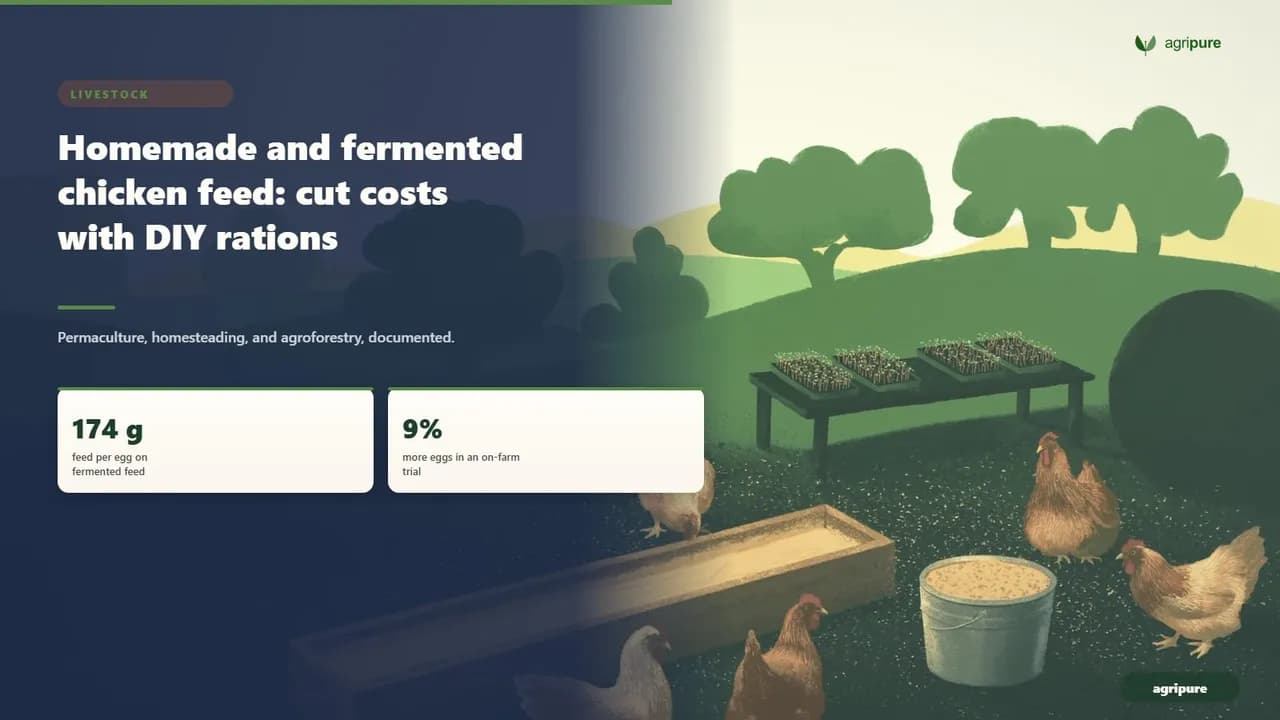
- The on-farm Foothills Farm study, the first rigorous quantitative on-farm data of its kind, found that hens on a fermented diet laid 9% more eggs over the year than hens on a dry diet, while needing roughly 174 g of feed per egg against 196 g for the dry-fed birds.
Now the caveat that keeps you honest. The same on-farm study found that a merely hydrated diet (feed wetted just before serving, not fermented) laid 11% fewer eggs than the dry control. Adding water is not the same as fermenting; if you skip the multi-day culture, you can make things worse. And the Journal of Animal and Feed Sciences trial found no change in egg production or feed conversion at any of its inclusion levels, a reminder that results vary with the feed, the strains, and the flock. Fermentation reliably improves gut health and usually improves feed efficiency, but it is not a guaranteed egg machine.
Is the labor worth it?
The Foothills economic model is the clearest answer available. It found the fermented-feed system was the most profitable of the 3, with net revenue of $5,124 against $4,717 for the dry system: driven by the extra eggs, not by cheaper feed. Total feed cost was only slightly lower under fermentation ($3,245 versus $3,293), and labor cost was higher because wet feed takes more time to prepare and carry. The win was real but modest, and it came with extra daily work: exactly the tradeoff a homesteader should weigh rather than assume.
Building a homemade ration without starving your hens
That is a tradeoff you can weigh and manage. Mixing your own feed is a bigger commitment than fermenting, and it is where good intentions most often produce unbalanced diets. A pile of grains is not a chicken feed, even if it hits the right 16% on a protein label. Understanding why is the difference between thriving birds and a slow nutritional shortfall you only notice when shells thin and feathers fray.
A bowl of mixed chicken ration contains whole grains, cracked corn, field peas, sunflower seeds, and crushed oyster shell.
A homemade ration: easy to assemble, hard to balance without a real recipe.
The four things a laying ration must hit
A complete layer ration balances 4 things: energy, protein with the right amino acids, vitamins, and minerals. The targets are specific, not approximate:
- Protein: at least 14% for a laying hen, and many keepers run 16% to 18% to keep production steady. Protein quality matters as much as quantity, because hens need particular amino acids like lysine and methionine that grains are short on.
- Calcium: laying mashes typically carry 2.5% to 3.5% calcium because a hen pulls a remarkable amount of it into every shell. Growing pullets need far less, so a one-size mix can harm young birds.
- Energy: carbohydrates from grains do the heavy lifting here, which is the easy part of any homemade mix.
- Vitamins and trace minerals: the quiet, decisive part. Grains are low in minerals, which is exactly why commercial feeds add a mineral and vitamin premix.
Why complete nutrition is hard to hit at home
The trouble is that the easy nutrients are easy and the hard ones are invisible. Extension guidance on home feed formulation is blunt about the risk: a grain-and-legume mix is not a complete feed without the right amount of age-specific vitamins and minerals, and if the grains are not in the proper proportions, the feed can carry too much or too little protein, fat, or fiber. Improper proportions of calcium, phosphorus, vitamin D, and vitamin E can cause weak shells and bones, and too little protein below that 14% floor shows up as small or missing eggs and as feather picking.
Mix feed using a tested recipe and a mineral supplement instead of guessing proportions with unmeasured scoops. If you want plant-protein and energy sources to build around, field peas, sunflower seeds, and maize are the 3 workhorses of most homemade mixes, and a separate dish of crushed oyster shell or limestone lets hens self-regulate the calcium a shell demands. For anyone just starting a small laying flock, buying a balanced complete feed for the first year while you learn the birds is the lower-risk path.
When DIY makes sense, and when it does not
DIY rations pay off when you have 4 things in place: a reliable local grain source, a scale, a written formula, and the discipline to add the vitamin and mineral premix every batch. They make sense if certified-organic feed is priced out of reach and you can source organic grain cheaper, or if you simply want to know every ingredient. They do not make sense as a casual shortcut. A commercial layer feed is formulated by nutritionists to put every nutrient in proportion, and matching that at home is genuine work. If the choice is between a careful homemade ration and a sloppy one, the bag wins every time.
Field note: the cheap-feed trap. The cheapest feed is worthless if it quietly costs you eggs. A ration that saves 10% on cost but drops laying by 15% is a loss dressed as a saving. Weigh the eggs, not just the bag.
The honest role of scratch grains
That same balance a homemade ration works to hit can be undermined by scratch grains. Scratch grains cause frequent problems in backyard feeding because they look like whole food but act like candy. Chicken scratch feed is a cracked-grain mix (corn, wheat, barley, oats) that is low in protein and high in energy. Birds prefer it, but left to choose, a hen will fill up on corn and skip the 16% ration she needs.
Treat, not staple
The rule from poultry extension specialists is simple and worth following to the letter. Feed scratch in the afternoon, after the birds have filled up on their complete feed, and offer only as much as they can finish in 15 to 20 minutes. When scratch is fed alongside a complete feed, it dilutes the carefully balanced nutrition in that feed: every mouthful of corn is a mouthful of layer ration not eaten. A flock living mainly on scratch slides toward the same protein shortfall that wrecks a careless homemade mix: thin shells, sparse laying, and ragged molts.
Used the right way, scratch earns its keep at roughly a tenth of the diet. It drives natural foraging and scratching behavior, gives you a tool to lure birds back into the run, and a modest handful of cracked corn on a frigid night gives a hen extra energy to burn overnight. The discipline is keeping it near that 10% and never letting it become the meal.
Sprouting grains and fodder for winter greens
Those same discipline-and-doubt rules carry straight into the last project on the list. Sprouted grain and hydroponic fodder are the prettiest project here and the most oversold. A tray of bright green sprouted barley in February looks like free feed. The dry-matter math says otherwise, and it is worth understanding before you build a fodder rack.
Trays of sprouted barley fodder form a dense root mat grown indoors for winter chicken greens.
Sprouted fodder: a fine winter green, but not more calories than the seed held.
What sprouting does and does not do
When a grain germinates over 6 to 8 days, enzymes convert some starch into simpler sugars and the seed greens up, which is why sprouts are palatable and a welcome bit of fresh forage when the ground is frozen. But germination also burns energy. As NDSU Extension explains, grain loses dry matter during sprouting as heat, carbon dioxide, and moisture are given off, and the energy value per kernel falls; in one dataset, wheat sprouted to increasing degrees retained 92.5%, then 87.2%, then 85.6% of its original energy. Crude protein barely moves: one sample shifted only from 12.32% to 13.16%, a concentration effect rather than new protein appearing.
The takeaway is that you do not end up with more feed than you started with. Sprouting trades a little dry matter and energy for fresh greens, enzymes, and palatability: a genuine wintertime tonic and a morale boost for confined birds, not a way to multiply your grain. NDSU’s overall verdict is reassuring on quality, noting that the feeding value of sprouted grain is not reduced substantially across most feeding trials; just do not expect it to stretch a feed budget. If you want one grain to start with for sprouting, barley is the classic fodder choice because it sprouts fast and clean.
A note on safety
Wet sprouting trays are a mold risk if they sit longer than about a week or stay too warm, and moldy grain can sicken a flock. Rinse trays well, keep them moving on a short cycle, and toss any tray that smells off or shows fuzz: the same discard-when-in-doubt rule that governs a fermentation bucket. A clean, fast 6-to-8-day cycle is the difference between a tonic and a hazard.
Bringing it together on your homestead
That tonic-or-hazard line runs through every method here, which is why the smart play for most flocks is layered, not all-or-nothing, resting on 4 habits. Start with a complete feed you trust, ferment it to stretch the bag and steady the gut, treat scratch as an afternoon treat, and use sprouted fodder for winter greens rather than as a calorie source. That combination captures the real, documented gains (roughly 9% more eggs in one on-farm trial, a healthier digestive tract, and happier foraging) without gambling your hens’ health on an unbalanced homemade mix.
If you do want to build your own ration, do it deliberately: a written formula, a scale, a vitamin and mineral premix every batch, and free-choice calcium to hit that 2.5% to 3.5% on the side. Homesteading rewards people who measure. The same instinct that makes you weigh your harvest should make you weigh your feed, because thin shells and slow laying are expensive lessons. For a grain worth keeping in rotation across rations and sprouting trays alike, our profile on oats is a practical place to plan your next order.
Frequently asked questions
How do you ferment chicken feed?
Put your normal feed in a clean, food-grade bucket filled halfway, cover it with dechlorinated water by 1 to 2 inches, and cover the bucket loosely so gas escapes. Leave it at 60 to 75 degrees Fahrenheit for 2 to 3 days, stirring daily, until it smells sour like sourdough and shows small bubbles. Feed out a day’s worth at a time and keep a rolling schedule of batches.
How long is fermented chicken feed good for?
Treat each serving as a 1-day food: scoop only what your flock will finish in a day and remove leftovers promptly so they do not spoil or draw pests. The bucket culture itself can keep going for several days to a week as long as it stays sour and clean; if it smells rotten, grows mold, or shows milky-white deposits, throw the whole batch out.
Does fermenting feed really save money?
Usually, but modestly. Controlled and on-farm trials show fermented feed improves feed efficiency (birds in one on-farm study needed about 174 g of feed per egg versus 196 g on dry feed), and can raise egg numbers around 9%. The savings come mostly from extra eggs rather than cheaper feed, and they cost extra daily labor, so the net win is real but not dramatic.
Can I feed my chickens only homemade feed?
You can, but only if the mix is genuinely complete. A laying hen needs at least 14% protein and 2.5% to 3.5% calcium, plus balanced energy, vitamins, and trace minerals; grains alone are low in minerals. Without a vitamin and mineral premix and a real recipe, a homemade-only diet risks weak shells, soft bones, and feather picking, so most keepers blend homemade grain with a balanced base or supplement.
How much scratch grain is safe to feed?
Keep scratch to roughly 10% of the diet: about what birds can clean up in 15 to 20 minutes, fed in the afternoon after they have eaten their complete feed. Scratch is low in protein and high in energy, so making it the main meal dilutes the balanced nutrition hens need and can thin shells and slow laying.
Is sprouted fodder more nutritious than plain grain?
Not really in calories. Sprouting converts some starch to sugars and adds fresh greens and enzymes, but the grain loses dry matter and 8% to 15% of its energy in the process, and crude protein barely changes. Fodder is a worthwhile source of winter greens and palatability for confined birds, not a way to grow more feed than you planted.
References
- Mwangi, S. Fermenting Poultry Feed: Simple Steps to Healthier Birds and Higher Yields. NC State Extension, Prestage Department of Poultry Science.
- Engberg, R. M., Hammershoj, M., & Johansen, N. F. (2009). Fermented feed for laying hens: effects on egg production, egg quality, plumage condition and composition and activity of the intestinal microflora. British Poultry Science, 50(2).
- Steinman, M., & Brouwer, L. The Foothills Farm Fermented Feed Study. Western SARE Farmer-Rancher project final report.
- Guo, W., et al. (2021). Effects of Different Fermented Feeds on Production Performance, Cecal Microorganisms, and Intestinal Immunity of Laying Hens. Animals, 11(10):2799.
- Loh, T. C., Law, F. L., Foo, H. L., Goh, Y. M., & Zulkifli, I. (2007). Effects of feeding a fermented product on egg production, faecal microflora and faecal pH in laying hens. Journal of Animal and Feed Sciences, 16(3).
- Jacob, J. Feeding Chickens for Egg Production in Small and Backyard Flocks. University of Kentucky, Poultry Extension.
- Jacob, J. Basic Poultry Nutrition. University of Kentucky, Poultry Extension.
- Hoppe, K., & Tobin, C. (2023). Feeding Value of Sprouted Grains (AS647). North Dakota State University Extension.
- Enhancing iron and zinc bioavailability in maize through phytate reduction: the impact of fermentation alone and in combination with soaking and germination (2024). Frontiers in Nutrition.