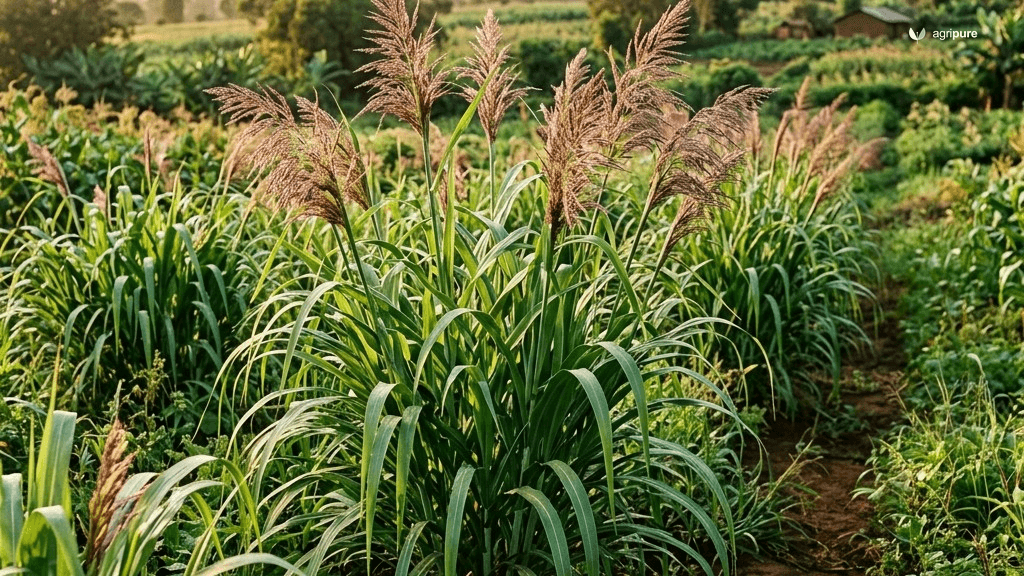
Napier grass (also called elephant grass) is one of the most productive forage plants on earth, throwing down 2-6 metre canes and roughly 30-40 tonnes of dry matter per hectare a year under good conditions. That headline yield is exactly why growers in cooler regions keep searching for it, and keep getting let down by vague advice. The honest answer is hardiness-bound: napier is a tropical perennial, and whether it lives or dies in your garden comes down to one number on a thermometer.
This guide settles the question with a clear hardiness key: USDA zones 9-12, a frost-free site in the UK, and the Australian tropical-to-subtropical band. Below that, napier is not a perennial at all. We will explain exactly where the frost line falls, how to grow it as a cut-back annual or under cover where winters bite, and which zone-matched fodder grasses actually overwinter where napier cannot.
The short answer: napier grass is USDA 9-12, frost-free, AU tropical/subtropical
Lush clumps of mature Napier Grass canes standing tall in a sunny tropical field.
Vigorous Napier grass (elephant grass) plantation with heavy biomass growth.
Napier Grass (Pennisetum purpureum, now reclassified as Cenchrus purpureus) is a true tropical perennial. It performs best where mean temperatures sit between about 25 and 40°C, slows sharply below 15°C, and effectively stops growing around 10°C. It has no meaningful winter dormancy to fall back on.
Here is how that translates across the three hardiness systems international growers actually use:
System | Rating for napier grass | What it means |
|---|---|---|
USDA zones | 9-12 | Reliable as a perennial only where winter minimums stay above roughly -6°C (zone 9b and warmer) |
UK (practical hardiness) | Tender / frost-free | Will not survive an outdoor UK winter; needs a frost-free site kept above about 1-5°C (broadly RHS H2 territory) |
Australia | Tropical & subtropical | Thrives across Queensland, the NT Top End and frost-free coastal NSW; struggles inland and in cool-temperate zones |
If you are in USDA 9 or warmer, a frost-free UK situation, or tropical/subtropical Australia, you can grow napier as a perennial. If you are colder, read on, because the plant does not simply tolerate a bit less heat. It dies.
Where exactly is the frost line?
Napier’s above-ground growth is highly frost-sensitive, and a frost kills the leafy tops outright. For borderline growers, what matters is what happens underground: the crown and rhizomes survive as long as the soil itself does not freeze. If the ground stays unfrozen, the plant re-shoots from the base once warm, moist conditions return in spring.
Field testing in the southern United States puts real numbers on the edge. Napier plantings have survived brief lows of around -6°C and -8°C, while stands exposed to roughly -17°C did not recover. That maps cleanly onto the zone rating:
- USDA 10-12 (frost-free): Grows year-round as a vigorous perennial. No special winter care.
- USDA 9 (light, occasional frost): Tops get burned off in cold snaps, but mulched crowns usually regrow. Treat it as a cut-back perennial, hilling soil or straw over the base.
- USDA 8 and colder: Soil freezes deeply enough to kill the rhizomes. Napier will not survive the winter outdoors and must be grown as an annual or under cover.
At high altitude the same logic applies even within the tropics. Napier grows from sea level to over 2,000 m, but near the top of that range, where morning frosts occur, regrowth after cutting slows and plants can be lost to cold.
Growing napier as a cut-back annual or under cover
You can still get a season of biomass from napier in cooler zones; you just cannot expect it to return on its own. Two approaches work.
1. The summer annual approach (USDA 7-8)
Napier propagates readily from stem cuttings and crown divisions rather than seed. In spring, once all frost risk has passed and the soil has warmed past 15°C, plant rooted cuttings or canes. Through a hot summer it will put on rapid growth and give you several cut-and-carry harvests for fodder or mulch. The first hard autumn frost ends the stand. Lift a few crowns before then, overwinter them in a frost-free shed or greenhouse, and replant next spring to avoid buying material every year.
2. The under-cover / container approach (UK and cool-temperate)
In the UK and similar cool-temperate climates, the only way to keep a napier plant alive over winter is to keep it frost-free. Grow it in a large container that can be moved into a heated greenhouse, polytunnel or conservatory before the first frost, keeping it above about 5°C and on the dry side while dormant. It is a demanding houseguest for a fodder grass, which is exactly why most cool-climate growers are better served by a hardier substitute.
Zone-matched fodder grasses for colder growers
If napier will not overwinter where you are, choose a forage grass keyed to your actual zone. These four are all in the AgriPure database, with hardiness that reaches well below napier’s floor.
Grass | USDA | Hardiness | Best for |
|---|---|---|---|
7-11 | Most cold-hardy here | The hardiest swap; tough perennial pasture and erosion cover | |
8-11 | Light frost only | Non-invasive clumping grass for slope stabilisation, mulch and windbreak | |
9-12 | Frost-sensitive | Drought-hardy perennial fodder and windbreak in arid/subtropical zones | |
Annual* | Frost-sensitive | Fast summer-annual fodder you resow each year, like napier’s annual cousin |
*Pearl millet is grown almost everywhere as a frost-sensitive summer annual rather than a perennial; it winterkills but produces a full forage crop in a single warm season, so it suits a wide range of zones as a resown crop.
A few notes on matching the plant to your situation:
- Coldest sites (USDA 7-8): Bermuda grass is your most reliable perennial pasture grass and the closest thing to a set-and-forget option. It also carries a long history of traditional medicinal use alongside its forage value.
- You wanted napier for biomass on a slope: Vetiver gives you the deep-rooted, clump-forming structure for soil holding and windbreaks without napier’s weedy spread, and is hardier into zone 8.
- You wanted napier’s cut-and-carry productivity: Treat pearl millet as the annual stand-in. As a close relative in the same group, it delivers a tall, leafy summer forage crop you simply resow each year.
- Dry, hot summers: Blue panic grass shares napier’s zone ceiling but is far better adapted to arid and subtropical conditions, doubling as fodder and a living windbreak.
Why competitors get this wrong
Most napier articles quote a single USDA range and stop. What confuses people is that napier’s perennial range and its growable range are two different things. As a perennial it is genuinely a zone 9-12 plant. But because it strikes so easily from cuttings and grows explosively in heat, it can be grown as a one-season annual much further north, just as maize or sorghum are. The trap is assuming a summer of vigorous growth means the plant is hardy. It is not. Come the first hard frost, an unprotected crown in frozen ground is gone. Keying the plant to its frost-free requirement, rather than a lone USDA number, makes the distinction obvious and stops cool-climate growers wasting a season.
Frequently asked questions
Will napier grass come back after a frost?
It depends on what froze. A frost that kills only the leafy tops is survivable: the plant re-shoots from its crown and rhizomes once warmth returns, provided the soil did not freeze. If the ground freezes hard enough to reach the rhizomes (typically USDA 8 and colder, or sustained lows around -17°C), the whole plant dies and will not return.
Can I grow napier grass in the UK?
Only with protection. It cannot survive an outdoor UK winter. Grow it in a container that overwinters frost-free in a greenhouse or conservatory above about 5°C, or treat it as a single-season annual planted out after the last frost. For a low-effort UK fodder or mulch grass, a hardier option keyed to your zone is the more practical choice.
What is the most cold-hardy alternative to napier grass?
Bermuda grass (Cynodon dactylon), hardy to USDA 7-11, is the toughest forage grass in this comparison and the best perennial substitute for growers below zone 9. For a tall, annual cut-and-carry crop in the napier mould, pearl millet resown each spring is the closest match.
Sources
- Plants For A Future — Pennisetum purpureum (Napier grass / Elephant grass): hardiness and temperature requirements
- Feedipedia — Elephant grass (Pennisetum purpureum): climate, frost response and forage yields
- Wikipedia — Cenchrus purpureus: frost kills tops, rhizome survival, growth temperatures and elevation range
- Royal Horticultural Society — Pennisetum purpureum (elephant grass): cultivation and tender status
- University of Florida IFAS Extension — Pearl Millet (Pennisetum glaucum): summer-annual forage management