Key takeaways
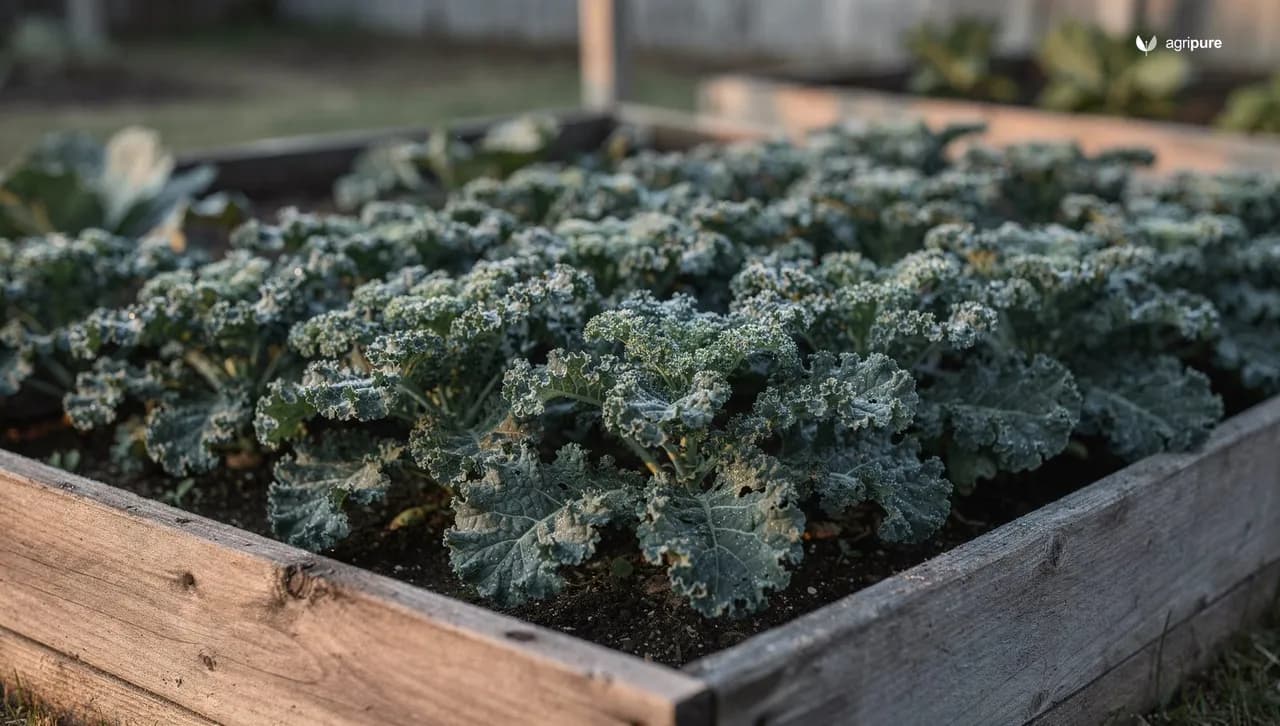
Dewy curly kale plants in an organic garden bed during a cool autumn morning, with light frost clinging to the deep green leaves.
Kale’s remarkable cold hardiness allows it to thrive in cooler temperatures, making it an ideal crop for both spring and fall harvests, often turning sweeter after a light frost.
- Kale matures in 45 to 65 days and survives cold down to about 20 F, so it earns both a spring and a fall season.
- Sow in spring as soon as soil is workable, and direct-seed the fall crop about three months before your first frost date.
- Harvest the outer leaves bottom-up and leave the growing crown, and a single plant feeds you for months.
- Watch for imported cabbage worms and cabbage aphids, and a floating row cover excludes both before they start.
- A light frost converts starch to sugar, so the leaves turn sweeter exactly when most crops are finished.
Kale is the crop that rewards you for planting on either edge of the season. Get seed in cool spring soil and you cut leaves within 50 days; sow again in midsummer and the plants ride straight through the first hard frosts, growing slower but turning sweeter every cold week. A tomato gives you one season — kale gives you two, plus a few weeks of winter most gardens go without.
That cold-hardiness is the whole reason kale belongs in any cool-climate garden. Once you plan around the spring and fall windows, harvest the outer leaves bottom-up, and keep cabbage worms and aphids off the new growth, kale becomes one of the most forgiving 60-day crops you can grow. Here is the full seed-to-harvest picture.
Why kale is a cool-season crop
Kale evolved for cool weather, and its tolerances show it. University of Minnesota Extension reports that the plant takes 45 to 65 days to mature (about as long as a bush snap bean) and that it can survive cold down to about 20 F while continuing to grow when temperatures stay cool. That single pairing, a fast 2-month maturity and real frost-hardiness, is what lets kale work at both ends of the calendar.
The germination end is just as flexible. Clemson Cooperative Extension notes that kale seed sprouts across a wide 40 to 85 F soil range, so you are not waiting on warm ground the way you would for a pepper. West Virginia University Extension puts germination at two to three weeks after sowing, and notes the plant grows best below 65 F and tolerates cool weather far better than heat. On a deep-summer afternoon kale sulks; in October it thrives.
The 40 F germination floor
Cool soil slows germination but rarely stops it. The practical rule is to sow as soon as the bed reaches about 40 F and stays workable, then expect seedlings in 2 to 3 weeks rather than the 5 to 7 days you would get in warm soil. Growing kale tracks closely with how you start other cool-season greens — both go in the ground weeks before tender crops.
- Spring soil near 40 F: sow direct or set transplants; expect slow but reliable germination.
- Soil at 65 to 75 F: fastest sprouting, ideal for starting fall transplants in trays in midsummer.
- Soil above 85 F: germination drops off and seedlings bolt-prone; shade the bed or wait for the fall window.
Spring and fall planting windows
That same cool-season biology gives kale two distinct sowing windows, and the fall one is usually the better crop. University of Minnesota Extension says to sow in spring as soon as the soil is workable for an early-summer cut, then direct-seed again about 3 months before the average frost date for a fall crop. The spring planting races the heat; the fall planting grows into cooling weather that the plant actually prefers.
The timing rewards a little arithmetic. Clemson Extension’s South Carolina chart plants kale from mid-March in spring and from early August in fall, while West Virginia Extension direct-seeds in early April for spring — proof that the right date shifts by weeks between a Zone 5 and a Zone 7 garden. Work backward from your two frost dates rather than a fixed calendar date. A raised bed warms a few days faster in spring and drains better in fall, which widens both windows.
Reading your frost dates
Both crops in the cabbage family live or die by frost-date math, so count back from your 2 local dates rather than copying a calendar from another zone.
- Spring: sow or transplant as soon as soil hits 40 F, usually 3 to 5 weeks before the last frost.
- Fall: count back about 3 months from the first-frost date, since the soil is warm and germination is fast.
- Overwinter: a late sowing that stays small can survive winter under cover for an early spring cut.
Start fall kale in trays: midsummer soil can top 85 F, where germination stalls. Sowing into 24 to 32 cell trays in light shade gives even sprouting, then set the transplants out once they are 3 inches tall.
Young kale seedlings with their first true leaves growing in a black cell-tray of dark potting mix on a wooden bench in soft morning light.
Spacing, sowing depth, and transplanting
Once that sowing date is set, spacing is the next call, and kale is planted shallow and spaced by what you want to harvest. Clemson Extension recommends sowing seed 1/4 to 1/2 inch deep and spacing plants 12 to 18 inches apart for full-size heads of leaves. University of Minnesota Extension transplants seedlings eight inches apart in rows 18 inches apart, or as close as four inches apart in the row if you only want baby leaves. The tighter you plant, the smaller and more tender the leaf.
How you start the plant shapes the spacing too. Direct seeding suits the fall crop, while spring kale is easier as transplants set out after the worst cold passes. A reliable cell tray gives you even, controllable germination, and setting out 3-inch transplants skips the slowest, most vulnerable weeks in the open bed.
- Baby-leaf beds: sow thick and thin to 4 inches; cut whole at 30 days for salad-size leaves.
- Full-size plants: space 12 to 18 inches; harvest outer leaves over months from a standing plant.
- Row spacing: keep rows 18 inches apart so air moves through and leaves dry fast after rain.
A field comparison of kale-growing choices
Those spacing and timing decisions interact, and each one (when you sow, how you space, and how you harvest) carries a trade-off. This table sorts the 5 main choices by what they cost you and what they buy.
Choice | Timing | Spacing | Best for |
|---|---|---|---|
Spring transplants | 3-5 weeks before last frost | 8 in apart | An early-summer cut before heat |
Spring direct seed | Soil at 40 F | 12-18 in (thinned) | Full-size plants, low cost |
Baby-leaf sowing | Any cool window | 4 in apart | Salad leaves in 30 days |
Fall direct seed | ~3 months before first frost | 12-18 in | Sweet, frost-kissed leaves |
Overwinter under cover | Late fall, kept small | 12-18 in | Earliest spring harvest |
Across all 5 choices, spring plantings race the heat, fall plantings ride the cold into sweeter leaves, and a baby-leaf bed is the fastest of the lot at roughly 30 days.
Cabbage worms, aphids, and row cover
Healthy leaves are exactly what the 2 main kale pests come for, and both are easiest to stop before they arrive. The imported cabbage worm hatches from eggs laid by a small white butterfly and, as University of Illinois Extension describes, the larvae begin feeding on the underside of leaves, chewing ragged holes within days. Illinois Extension calls the simplest control plain: exclude the moths with a floating row cover, and where worms are already present, Bacillus thuringiensis (Bt) kills only caterpillars but must be reapplied about once a week.
The second pest is the cabbage aphid. Utah State University Extension notes these form dense colonies on the undersides of leaves of kale and related cole crops, and that 4 natural enemies (lady beetles, lacewings, syrphid flies, and parasitic wasps) do much of the suppression for you. A row cover keeps winged aphids off in the first place, and a strong jet of water knocks down a colony in seconds when one slips under it.
Why a row cover earns its keep
University of New Hampshire Extension describes a floating row cover as a barrier that excludes insects outright: 5 brassica pests, from cabbage maggots and cutworms to flea beetles, cabbage loopers, and cabbage worms, all stay off. Because kale never needs pollinating, you can leave the cover on the whole season. Interplanting marigolds nearby supports the predators that mop up any aphids that get under it.
Cover at transplant, not after damage: set the row cover the day you plant, before the white butterflies find the bed. Once eggs are on the leaf undersides, the cover traps the pest in with the crop.
Harvesting bottom-up and letting frost sweeten the leaves
A clean, pest-free plant under that cover is worth more if you harvest it right, and how you cut kale decides how long one plant lasts over its 45 to 65 days. University of Minnesota Extension says to harvest single leaves as soon as they reach a usable size, using the cut-and-come-again approach. Pick the outer leaves bottom-up and leave the central growing point, and the plant keeps pushing new leaves from the crown for months. West Virginia Extension notes baby greens are ready about 30 days from seeding, with full leaves at 55 to 75 days depending on variety.
The best is saved for last. Clemson Extension reports that kale leaves are hardy to 20 F and that flavor improves after the first frost: a light freeze sweetens the leaves and darkens them. That is not folklore: peer-reviewed work by Megías-Pérez and colleagues in Food Research International traced how kale’s low-molecular-weight carbohydrates shift as the plant acclimates to cold, the starch-to-sugar conversion that makes a frosted leaf taste milder than a summer one. The cold most crops fear is the season kale waits for. Building a few inches of mulch over the roots carries plants through harder freezes, much the way you would leave root crops in the ground under cover.
Cut-and-come-again, step by step
- Start at usable size: begin picking once outer leaves are 6 to 8 inches, well before the plant is full.
- Take the bottom ring: harvest the oldest, lowest leaves and leave the inner crown to regrow.
- Cut, do not strip: snap or snip 3 to 5 leaves per plant at a time so the growing point keeps producing.
- Wait for frost: after the first light freeze, the leaves turn noticeably sweeter; that is the cut to plan for.
A gardener's basket of freshly cut curly kale leaves resting on dark soil beside a row of kale plants under a light morning frost.
Conclusion
That frost-sweet cut is the payoff for using both ends of the season the plant was built for. Sow into cool spring soil for an early cut, direct-seed again about 3 months before your first frost, space by whether you want baby leaves at 30 days or full plants at 55 to 75, and keep a row cover over the bed so cabbage worms and aphids never get started. Then let the first frost do the last job for you: at 20 F the leaves turn sweet as they hold through the cold.
Frequently asked questions
How long does kale take to grow?
Kale matures in about 45 to 65 days, and you can cut baby greens roughly 30 days after sowing. Full-size leaves take 55 to 75 days depending on the variety, but the plant keeps producing for months once it starts.
How cold can kale tolerate?
Kale leaves are hardy to about 20 F and the plant keeps growing through the first fall frosts. A light freeze improves the flavor by converting starch to sugar, so frosted leaves taste sweeter than summer ones.
When should I plant kale in spring and fall?
Sow or transplant in spring as soon as the soil is workable, around 40 F. For a fall crop, direct-seed about three months before your average first frost date so the plants size up as the weather cools.
How do I harvest kale so it keeps producing?
Use the cut-and-come-again method: pick the outer, lowest leaves bottom-up and leave the central growing point intact. Taking 3 to 5 leaves per plant at a time lets the crown push new growth for several months.
How do I keep cabbage worms and aphids off kale?
Cover the bed with a floating row cover at transplant time to exclude the white butterflies and winged aphids. For worms already present, Bacillus thuringiensis (Bt) applied about once a week works, and 4 natural enemies including lady beetles suppress aphid colonies.
References
- University of Minnesota Extension — Growing collards and kale in home gardens
- University of Minnesota Extension — Planting vegetables in midsummer for fall harvest
- West Virginia University Extension — Growing Kale in West Virginia
- Clemson Cooperative Extension — Kale Is a Headless Cabbage
- Clemson Cooperative Extension — Planning a Garden (planting dates)
- Megías-Pérez et al., Food Research International (2020) — Carbohydrates in Kale During Cold Acclimation
- Utah State University Extension — Cabbage Aphid
- University of Illinois Extension — Cabbageworms
- University of New Hampshire Extension — Using Row Covers in the Garden