“Plant it this spring, eat it next decade: asparagus is the only vegetable that rewards you more the longer you leave it alone.”
Asparagus is unlike any other vegetable you will grow. You dig the bed once, plant crowns once, and then, if you follow the rules, you harvest fresh spears every spring for 15 to 20 years without replanting. That is the perennial bargain. The catch is that asparagus asks for patience first: two full seasons of not touching it before you take a single spear. Most gardeners who skip those patience years end up with a weak bed that collapses within five. The ones who wait end up with a living perennial bed that becomes one of the most productive square-footage investments on the property.
This guide covers everything from choosing crowns over seed to building the bed, managing the patience years, and eventually harvesting six to eight weeks of spring spears each year. It is rooted in Cooperative Extension research, so the numbers given here hold up across regions.
Asparagus pairs naturally with a permaculture approach: a permanent planting that requires minimal intervention once established, produces reliably, and builds root-system depth year over year. It earns its place at the edge of any raised bed garden or along a permanent fence line, anywhere the bed will not be turned over each fall.
Key takeaways
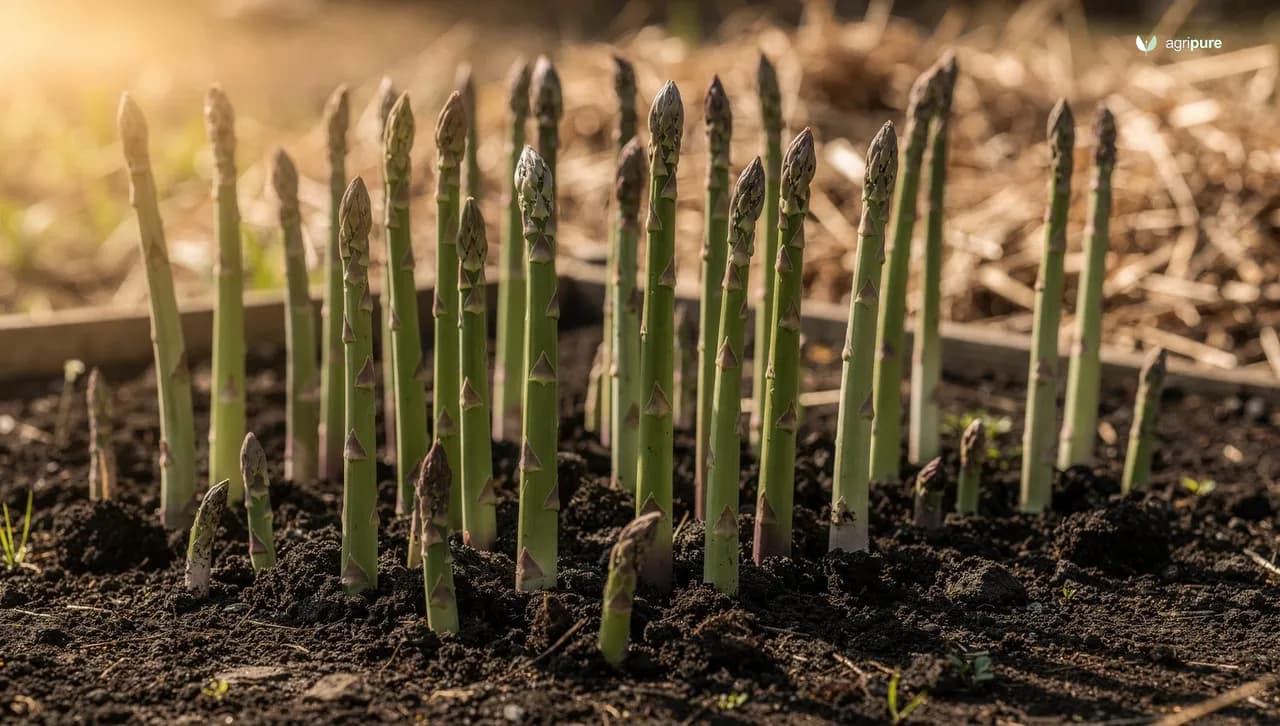
Bright green asparagus spears emerge from fertile soil in an established perennial bed in early spring.
Patience yields perennial rewards: An established asparagus patch produces up to two decades of harvests from a single planting.
- Start with one-year-old crowns, not seed; crowns cut one full patience year off the timeline and give you a first light harvest in year two.
- The patience rule is non-negotiable: no harvest in year one, a short one- to two-week harvest in year two, and full six- to eight-week seasons from year three or four onward.
- Prepare the bed deeply: a 12-inch-deep trench packed with compost feeds a root system that can reach 10 to 15 feet down over a decade.
- Soil pH between 6.5 and 7.0 is the single most important site requirement; correct it before you plant.
- Choose all-male hybrid varieties (Jersey Knight, Millennium) for two to three times the yield of older open-pollinated types.
- Cut ferns down only after they have fully turned brown; their photosynthesis from July through October is what recharges the crowns for next spring.
Crowns vs. seed: why most gardeners should skip seed entirely
Asparagus can be started from seed or from crowns (dormant, one-year-old root systems that look like a fleshy, tentacled mass about the size of a splayed hand). The difference in timelines is a full year, and that gap matters when patience is already the hardest part of growing asparagus.
Crowns planted in spring typically allow a very light first harvest in the second spring (one to two weeks of cutting). Full harvest seasons of six to eight weeks begin in year three. Seed-started asparagus, by contrast, cannot be harvested at all in the first two seasons, and the light-harvest phase pushes to year three, with full production delayed until year four or five. For a home gardener putting in 25 to 50 crowns, seed offers little advantage except price.
Starting method | First light harvest | Full harvest season begins | Cost per plant |
|---|---|---|---|
One-year crowns | Spring of year 2 | Spring of year 3–4 | $1–$3 per crown |
Seed (germinate indoors) | Spring of year 3 | Spring of year 4–5 | Pennies per seed |
Buy crowns from a reputable nursery or extension-affiliated seed company and inspect them before planting: healthy crowns are firm, not shriveled, with plentiful fleshy storage roots radiating from the central bud cluster. Avoid crowns that are two or more years old; they rarely establish as reliably as one-year stock.
Choosing the right variety
Variety selection matters more with asparagus than with most vegetables because you are committing for 20 years. The old-fashioned open-pollinated Mary Washington is still widely sold, but modern all-male hybrid varieties outperform it substantially: University of Minnesota Extension and North Dakota State University Extension both note that all-male hybrids produce two to three times as many spears per plant as older types, because they put no energy into seed production.
Asparagus variety crowns on a potting bench show the fleshy roots and central bud of Jersey Knight, Millennium, and Purple Passion crowns.
One-year crowns at planting time are firm, fleshy, and ready to establish a root system that will last two decades.
The leading choices by region:
- Jersey Knight — the most widely recommended all-male hybrid. Resistant to crown rot, rust, and Fusarium wilt. Produces thick spears and adapts to most of the continental United States.
- Millennium — bred for performance across a wide range of soil types, including heavier clay soils that trip up other varieties. Shows intermediate resistance to rust. Highly productive in northern regions.
- Purple Passion — open-pollinated, produces anthocyanin-rich purple spears that are noticeably sweeter than green types. The purple color fades when cooked; eat raw or blanch briefly. Requires one additional year to reach full production compared with the Jersey hybrids.
- Mary Washington — the heirloom standard, still cold-hardy and reliable, but lower-yielding. A reasonable pick if seed saving matters to you and you are willing to accept lighter crops.
In very cold climates (hardiness zones 3 and 4), check with your state extension service; the Jersey series can be vulnerable in soils that drop below -30°F, while Millennium and Mary Washington handle hard winters better.
Site prep and bed building
Bed preparation is the single step that most directly determines how productive your asparagus will be a decade from now. You cannot go back and amend the soil after the crowns are in place, so do it right before planting.
Asparagus needs full sun (a minimum of eight hours of direct sun per day). It is a tall plant once it ferns out, reaching five to six feet, so site the bed where it will not shade other crops. The bed should be permanent: choose a location along a fence line, at the northern or eastern edge of the garden, or as a dedicated border planting. Do not put asparagus in the middle of an annual bed you will be turning each fall.
Good drainage is essential, as asparagus roots are susceptible to crown rot in waterlogged soils. Raised beds work extremely well for asparagus because they guarantee the drainage the crop needs. If your native soil is heavy clay, building a raised bed 10 to 12 inches tall is a better investment than fighting the drainage problem in the ground.
Soil pH should land between 6.5 and 7.0. University of Minnesota Extension notes that holding pH at or above 7.0 also reduces the incidence of Fusarium crown rot, the fungal disease most responsible for asparagus bed decline. Test the soil before you dig; lime or wood ash raises pH, elemental sulfur lowers it. Correct the pH at least several weeks before planting so it has time to equilibrate.
The bed-preparation sequence, step by step:
- Mark the row or bed. Space rows at least four to five feet apart, as the mature fern canopy needs that width.
- Dig a trench 6 to 12 inches deep. Use the shallower depth in clay and the deeper depth in loose, sandy soil. University of New Hampshire Extension specifies 8 inches deep and 10 inches wide as a reliable middle ground for most soils.
- Work in compost, aged manure, or other organic matter thoroughly into the trench bottom. The root system can eventually reach 10 to 15 feet deep; feed it now while you can reach the upper layers.
- Before planting, broadcast 2.5 pounds of a balanced fertilizer such as 10-10-10 per 100 square feet of bed, or the equivalent in organic fertilizer, and incorporate it 10 to 12 inches deep.
Planting crowns: the right depth and spacing
Place asparagus crowns in the prepared trench, spreading the roots evenly with the bud cluster pointing up, surrounded by compost-enriched soil.
Crowns go in bud-side up, roots spread evenly, initially covered by just two inches of soil; the trench fills gradually as the season progresses.
Plant asparagus crowns three to four weeks before the last expected frost date in your area. The soil should be workable but does not need to be fully warm; asparagus spears begin emerging when soil temperature reaches 40°F, so an early start is appropriate.
Place crowns in the bottom of the prepared trench, bud-cluster facing up, roots spread evenly outward like the spokes of a wheel. Space crowns 12 to 18 inches apart along the row; University of Maryland Extension uses 18 inches as the standard in-row spacing for home gardens. Cover the crowns with just two to three inches of soil at planting time. Do not fill the trench all at once.
As the young shoots grow through the first summer, gradually add more soil back into the trench, two to three inches at a time, until the trench is level with the surrounding soil by late summer. The tops of the crowns should end up about six inches below the final soil surface. This gradual backfilling prevents burying the emerging shoots and gives the crowns a chance to establish before they are fully underground.
Space rows four to five feet apart; the fern canopy that develops in summer is large, and crowded rows compete for light and air circulation, increasing disease pressure.
Water gently after planting and keep the bed consistently moist through the first growing season. University of Minnesota Extension recommends at least one inch of water per week; sandy soils may need watering more than once weekly during dry spells. Once established (by the end of year two), the deep root system makes asparagus one of the more drought-tolerant vegetables in the garden.
The patience years: why the do-not-harvest rule exists
This is the part of asparagus growing where most mistakes happen. The temptation to cut a few spears in year one is understandable, as the plants look capable of it by June. Do not do it.
Every spear you harvest is energy that does not go into the crown. Asparagus crowns grow by accumulating carbohydrate reserves in their fleshy storage roots. Those reserves are what power the following year’s spear production. The fern foliage that develops after spears are left to grow is the solar panel: it photosynthesizes from July through October and loads the crown for next spring. Cut the fern prematurely (or harvest too heavily in the early years) and you draw down the reserves faster than they replenish. The result is a bed that produces thin, spindly spears and then fails within five to seven years instead of lasting 20.
Oregon State University Extension’s guidance is direct on this point: the patience years are the investment that makes the permanent bed possible.
The harvest schedule by year:
- Year 1 (planting year): No harvest at all. Let every spear grow into full fern. The crowns are establishing their root system.
- Year 2: Harvest sparingly for one to two weeks only. Cut spears that reach six to eight inches; leave the rest to fern out. Stop cutting after two weeks regardless of how many spears are emerging.
- Year 3: Harvest for two to three weeks. The bed is still building; restrain yourself.
- Year 4 and beyond: Full harvest seasons of six to eight weeks, typically from early May through late June in most of the northern United States. University of Maryland Extension puts the eventual yield at three to four pounds per 10-foot row per season.
After harvest season ends each year, even in year four and beyond, stop cutting and let every remaining spear fern out. Cut the ferns down to ground level only after they have turned completely brown and brittle in late fall. Removing green ferns early repeats the same mistake as harvesting too long: it starves the crown.
Feeding, watering, and annual maintenance
An established asparagus bed needs fertilization every year to maintain vigor. Apply a balanced fertilizer (2.5 pounds of 10-10-10 per 100 square feet, or its organic equivalent) in early spring just as the first spears begin to emerge. A second application of nitrogen after harvest season ends helps the fern foliage grow vigorously through the summer. University of Minnesota Extension notes that asparagus is a heavy potassium consumer; a soil test every three to four years will tell you if potassium is being depleted and needs supplementing.
Topdress with two to three inches of compost each fall after cutting the ferns. This maintains organic matter, suppresses weeds, and feeds the soil biology that supports the root system. Weed control is especially important in years one and two: asparagus roots do not compete well with established weeds in their early seasons. Hand-pull weeds carefully: asparagus roots spread wide, and aggressive cultivation near the crowns damages them.
An established bed in most of the eastern United States and Pacific Northwest needs no irrigation beyond rainfall. The roots can reach 10 feet deep in well-prepared soil. In arid regions (southwestern and interior western states), provide one inch of water per week during the growing season. Deep, infrequent watering is better than shallow daily watering; frequent light irrigation keeps the surface moist, which encourages foliar disease.
Common pests and diseases
An asparagus beetle on a young green spear shows the metallic blue-black body with yellow spots against fern foliage in the background.
The common asparagus beetle is the primary insect pest: metallic blue-black with yellow spots on adults, dark slug-like larvae on ferns.
Asparagus has a short list of serious pests and diseases, and most are manageable with the right practices.
Asparagus beetles are the primary insect pest. Two species appear in North American gardens: the common asparagus beetle (Crioceris asparagi), metallic blue-black with yellow-orange spots, and the spotted asparagus beetle (C. duodecimpunctata), red-orange with 12 black spots. Adults emerge as spears push up in spring and feed on tender tips. Larvae (dark, slug-like, about a half-inch long) feed on the ferns through summer. University of New Hampshire Extension’s most effective management advice is behavioral: harvest all spears at every picking during harvest season (clean harvest leaves no tips for adults to feed on), and remove and compost all dead fern material in fall to eliminate overwintering sites. For heavy infestations, hand-pick adults and larvae, or apply neem oil or spinosad as a last resort.
Asparagus rust (Puccinia asparagi) produces orange-brown pustules on ferns in mid- to late summer. Modern hybrid varieties like Jersey Knight and Millennium have good rust resistance. The best cultural control is cutting and removing fern debris after it dies back, as the fungus overwinters in dead plant tissue. Avoid wetting foliage during irrigation.
Fusarium crown and root rot is the disease most responsible for early bed death. It is a soil-borne fungus that attacks the crown and storage roots, causing the bed to produce progressively weaker spears over time. Prevention is the only reliable strategy: plant resistant varieties (Jersey Knight, Millennium), maintain soil pH at or above 6.5, and never replant asparagus in a bed that has had asparagus before; the pathogen persists in the soil for years.
Frost on emerging spears: a late frost can kill or deform tips that are already above ground. If a hard frost is forecast after spears have emerged, cover the bed with row cover or straw overnight. Damaged spears will not recover their texture, but the crown is safe underground; new spears will follow.
Harvesting, storing, and using your spears
Harvest asparagus when spears reach six to eight inches tall and the tips are still tightly closed. At peak season in warm weather, spears can grow up to two inches per day; you may need to check the bed every other day to catch them before the tips open into fern fronds. Once the tip begins to feather out, the texture becomes stringy and the flavor fades.
Cut or snap spears at or just below soil level. Snapping (bending the spear until it breaks naturally) is a kitchen technique that separates the tender top from the woody base, but it wastes some edible stem. Cutting with a sharp knife at ground level wastes nothing and is the better practice in the garden. Keep a bucket of cold water nearby and drop cut spears in immediately to slow respiration.
Fresh asparagus quality deteriorates faster than almost any other vegetable. Penn State Extension recommends processing or refrigerating immediately. The best short-term method: stand the bunch upright in one to two inches of cold water in the refrigerator, cover the tips loosely with a plastic bag, and use within three to five days. Quality at the stove at day seven is noticeably lower than at day two. For longer storage, blanch spears for two to three minutes, chill in ice water, pat dry, and freeze in a single layer before transferring to an airtight bag. Frozen asparagus holds well for six to eight months.
Asparagus is a low-acid vegetable and must be pressure-canned if you want shelf-stable jars: water-bath canning is not safe. Most home growers freeze it instead.
To connect asparagus with the rest of the garden’s perennial and companion ecosystem, plant good neighbors at the bed edge: tomatoes and basil are classic companions that tolerate the asparagus fern shade in midsummer. Keep the asparagus bed out of heavy weed competition by laying a thick layer of straw mulch along the row after the ferns are fully open.
If you are new to growing vegetables from scratch, asparagus pairs well with the broader seed-starting workflow for the rest of the annual garden; you will be starting tomatoes, peppers, and squash under lights while your asparagus bed builds its root system in the garden. Both take patience. Both pay off.
Container and small-space growing
Asparagus is not an ideal container plant: the root system can reach 10 to 15 feet deep in the ground, and no container comes close to that depth. That said, half-barrel planters (at least 18 to 24 inches deep) can support two to three crowns and produce a small harvest starting in year three. The trade-off is that container asparagus needs more frequent watering and fertilizing, and the bed may run out of vigor by year eight or ten rather than lasting 20 years.
In small gardens, the better small-space strategy is a narrow dedicated raised bed (even two feet wide and eight feet long) built along a fence or wall. Eight to ten crowns spaced 18 inches apart in an 8-foot row will produce three to four pounds of spears per season at maturity, which is plenty for a household that eats asparagus through the spring.
For gardeners exploring square-foot garden layouts, note that asparagus does not fit neatly into the annual-turnover model: dedicate a permanent strip at one end of the garden rather than trying to rotate it through the main bed.
Frequently asked questions
How long does it take to harvest asparagus after planting?
With one-year crowns, expect a light one- to two-week harvest in spring of year two. Full harvest seasons of six to eight weeks begin in year three to four. Seed-grown asparagus takes one additional year at each stage. The patience investment is real, but the bed then produces reliably for 15 to 20 years.
Crowns or seed: which is better for a home garden?
Crowns, almost always. One-year crowns save a full year compared with seed, cost only $1 to $3 each, and establish reliably. Seed makes sense only if you are planting a very large bed where cost per plant matters significantly, or if you want to maintain a specific open-pollinated variety.
Can I harvest any asparagus in year one?
No. Year-one harvesting weakens the crown’s carbohydrate reserves and leads to a short-lived, unproductive bed. Let every spear grow into full fern in year one. The restraint in years one and two is what makes 20-year productivity possible.
When should I cut asparagus ferns down?
Only after the ferns have turned completely brown in late fall, typically after the first hard frosts. Green ferns are photosynthesizing and loading the crown with reserves for the following spring. Cutting them early is the same mistake as harvesting too long.
What is the best asparagus variety for a home garden?
Jersey Knight is the most widely recommended: all-male (no seed production), resistant to major diseases, and two to three times more productive than Mary Washington. Millennium is the better pick in heavy clay soils or in very cold northern regions. Purple Passion is a good choice if sweetness and novelty matter; budget one extra year for it to reach full production.
References
- Growing asparagus in home gardens — University of Minnesota Extension
- Growing asparagus takes patience but rewards gardeners for years — Oregon State University Extension Service
- Growing Asparagus in a Home Garden — University of Maryland Extension
- Growing Vegetables: Asparagus — University of New Hampshire Cooperative Extension
- Nutrient management in asparagus — University of Minnesota Extension
- Millennium Is The New Leader in Asparagus — North Dakota State University Extension
- Preparing and Preserving Asparagus — Penn State Extension