Key takeaways

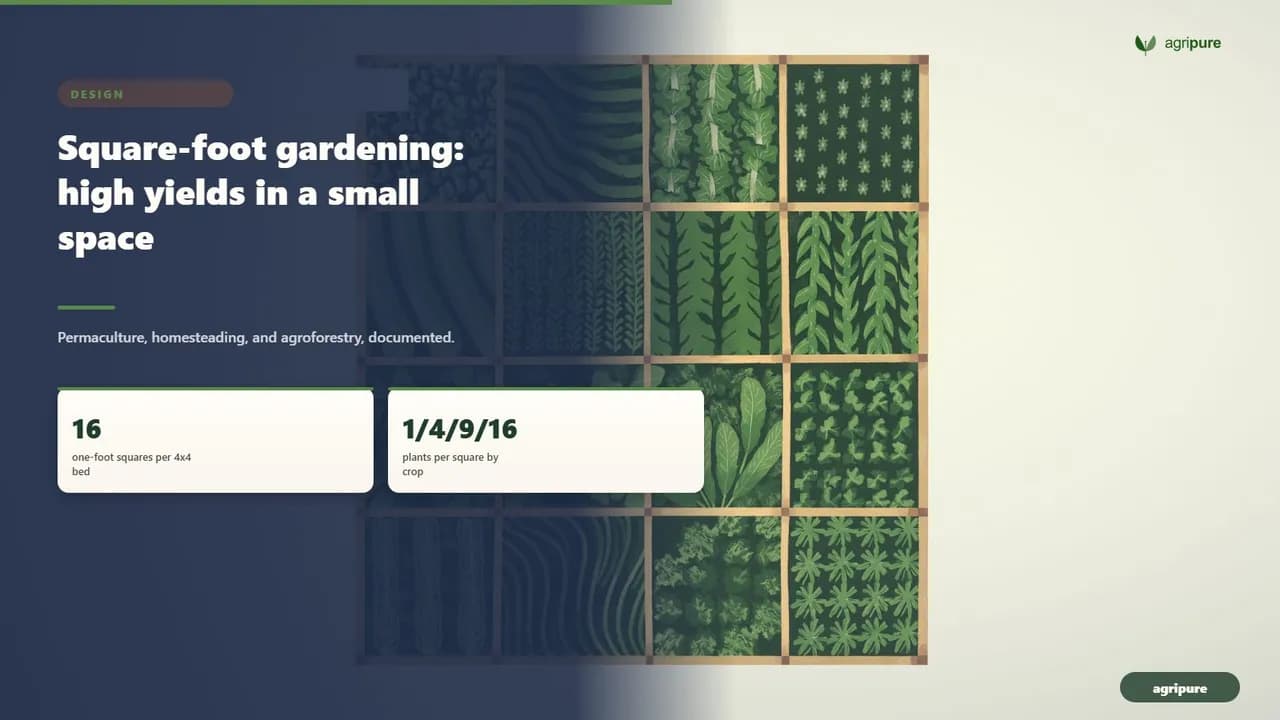
Maximize your harvest in minimal space: This square-foot garden exemplifies Mel Bartholomew’s efficient grid method, allowing for diverse crops like tomatoes, lettuce, spinach, and carrots to thrive in a compact 4×4-foot raised bed. A perfect solution for urban gardeners and beginners aiming for high yields.
- Square-foot gardening is Mel Bartholomew’s grid method: a compact raised bed, usually 4 by 4 feet and about 6 inches deep, split by a physical grid into 16 one-foot squares you plant and harvest one square at a time.
- The bed is filled with Mel’s Mix — roughly equal thirds of blended compost, peat moss or coconut coir, and coarse vermiculite — an 8-cubic-foot batch per 4-by-4 box.
- Spacing runs off a simple chart: 1 plant per square for big crops like tomatoes and broccoli, 4 for lettuce and chard, 9 for spinach and beets, and 16 for carrots and radishes.
- It suits beginners and small spaces because there are no rows to thin, the close spacing shades out weeds, and each square is a self-contained, re-plantable unit.
- It is a poor fit for sprawling, space-hungry crops — sweet corn needs a wind-pollinated block, and winter squash wants 30 to 48 inches — and the startup soil cost is its honest downside.
Drop a 4-by-4-foot box on a patio, fill it with about 8 cubic feet of soil mix, and you have room for 16 separate one-foot squares — enough to keep a single person in salad, herbs, and a steady trickle of vegetables through the season. That is square-foot gardening, the grid method Mel Bartholomew popularized in 1981 to replace the long, half-empty rows most beginners inherit from farm-scale advice. Instead of a 30-foot row of carrots you thin and weed for weeks, you sow 16 carrots in one square, 4 heads of lettuce in the next, and a single caged tomato in a third. This guide walks the whole system — the bed, the soil, the planting-density chart that does the real work, and the honest places where the method falls short — so you can build one raised bed that earns its 16 square feet.
What square-foot gardening actually is
Square-foot gardening is an intensive growing system that, in Michigan State University Extension’s words, provides lots of tasty vegetables from a small space. The whole idea is to take a small, defined area and subdivide it so tightly that almost no ground sits bare. A standard bed is 4 feet on a side, which gives you 16 square feet of growing space and, critically, lets you reach the center from any edge without stepping on the soil. You never compact the bed, so the roots never fight packed dirt.
The grid: 16 squares, not a sketch
The feature that names the method is the grid: a physical lattice laid across the top of the bed that divides it into 16 one-foot squares. This is not a suggestion drawn on paper. As University of Illinois Extension describes it, after adding the soil you add a grid with 16 squares out of string or wooden stakes. Thin wood lath, old blinds, or taut string all work. That grid matters because it forces the discipline that makes the system productive — you plant by the square, not by the handful, and every square gets its own crop and its own count.
3 reasons beginners take to it
3 things make square-foot gardening forgiving for a first-year grower, and each one removes a classic beginner mistake:
- No row thinning. You place a known number of plants per square — 1, 4, 9, or 16 — so you never sow a dense row and agonize over pulling healthy seedlings later.
- Built-in weed control. Close, even spacing closes the canopy fast, and a shaded soil surface sprouts far fewer weeds than the bare gaps between conventional rows.
- Small, legible scale. A single 16-square bed is easy to water, easy to watch, and cheap to replace if a season goes wrong, which lowers the stakes of learning.
Build the bed: 4 by 4 feet, 6 inches deep
The physical build is deliberately simple, and you can finish one in an afternoon with hand tools. A classic box is 4 feet by 4 feet, framed from 2-by-6 lumber. West Virginia University Extension spells out the standard: a box or frame made from 2-by-6 untreated boards, where the constructed 4-by-4 frame results in 16 square feet of garden space.

Why 6 inches is usually enough
Depth surprises people who assume deeper is always better. A 2-by-6 board gives you roughly 6 inches of soil, and that is the point. Illinois Extension notes the bed can be built out of four-foot, two-by-six-inch untreated boards as most vegetable roots do not exceed six inches. For salad greens, roots, alliums, and most annual vegetables, 6 inches of good mix is plenty. A shallow profile is also what makes Mel’s Mix affordable — you are filling 8 cubic feet, not 16.
Where to put it and how to grid it
Siting and gridding take only a few decisions, but they set up the whole season:
- Sun. Put the bed where it gets at least 6 to 8 hours of direct sun; most fruiting vegetables stall below that.
- Reach. Keep it to a 4-foot width so you can tend every square from the edge. Go longer if you want — an 8-by-4 bed gives 32 squares — but never wider.
- Grid. Once filled, lay the 16-square grid in string or lath so the divisions are visible every time you plant. A raised bed without the grid is just a small raised bed, not a square-foot garden.
If you have read our guide to raised bed gardening, think of the square-foot box as a raised bed with 1 extra rule — the grid — and a specific recipe for the 8 cubic feet that go inside it.
Mix the soil: Mel’s Mix in equal thirds
The soil is the part most beginners get wrong, because square-foot gardening does not use garden dirt at all. It uses a soilless blend Bartholomew called Mel’s Mix, built from three ingredients in equal parts. WVU Extension gives the formula directly: the planting soil should be an 8-cubic-foot mix with one-third peat moss, one-third compost, and one-third vermiculite for each 4-by-4 garden. Each 4-by-4 box swallows about 8 cubic feet, which is the math behind the recipe.

What each of the 3 thirds does
Each of the 3 components earns its place, and skipping one shows up fast in the bed:
- Compost (one-third) is the fertility. Bartholomew’s instruction is to blend several different composts rather than one, so the mix draws nutrients and microbes from varied sources. This is the living-soil engine of the bed, the same principle behind building living soil in any organic system.
- Peat moss or coconut coir (one-third) is the sponge that holds moisture against the roots. Many growers now swap the peat third for coir; Oregon State University Extension calls coconut coir a popular, lower-cost, and more sustainable alternative to peat moss that holds moisture well and wets more easily than peat.
- Coarse vermiculite (one-third) is the aerator. It keeps the blend loose and open so roots breathe and water drains instead of pooling in a shallow 6-inch box.
A note on cost
Here is the honest part of the soil story. That first batch of Mel’s Mix is the single biggest expense in the whole system. Buying compost, a compressed bale of peat or coir, and a couple of large bags of coarse vermiculite to fill 8 cubic feet can cost more than the lumber for the box. The trade is that you mix it once: in following seasons you only top up the compost third as each square is replanted, so the steep cost is a one-time entry fee, not an annual bill.
Mix it once, top it up forever: blend a full 8 cubic feet for the first fill, then keep a small bag of finished compost on hand. Each time you clear a square, work a trowel of compost into that one square before replanting. You will rarely buy peat or vermiculite again — only the compost third gets used up.
The planting-density chart: how many plants per square
This is the heart of the method and the reason most people search for it. Instead of memorizing row spacing, you ask one question per crop — how many of these fit in a one-foot square — and the answer is almost always 1, 4, 9, or 16. University of Maine Extension states the rule plainly: for each square foot, you will plant either 1, 4, 9, or 16 plants. The number comes straight from the plant’s normal spacing, divided into a 12-inch square.
The logic behind 1, 4, 9, and 16
The four counts map directly to conventional spacing, so the chart is not arbitrary — it is just division into a 12-inch square. WVU Extension lays out the whole ladder: a plant that requires 12 inches of space, such as tomatoes or broccoli, gets one per square; a 6-inch crop such as lettuce or chard gets four; a 4-inch crop such as onions or beets gets nine; and small 3-inch crops such as radishes and carrots get 16. A 12-inch crop is 1, a 6-inch crop is a 2-by-2, a 4-inch crop is a 3-by-3, and a 3-inch crop is a 4-by-4.
Per-square counts for 13 common crops
Clemson Cooperative Extension publishes a sample planting guide with per-square numbers for the crops most home gardeners actually grow. The 13-row table below collects the standard counts; use it as your master chart.
Crop | Plants per square | Spacing logic |
|---|---|---|
Tomato (caged) | 1 | 12-inch crop, one per square |
Pepper | 1 | 12-inch crop, one per square |
Broccoli | 1 | 12-inch crop, one per square |
Cabbage | 1 | 12-inch crop, one per square |
Leaf lettuce | 4 | 6-inch spacing, 2 by 2 |
Swiss chard | 4 | 6-inch spacing, 2 by 2 |
Strawberry | 4 | 12-inch in-row, 2 by 2 |
Bush beans | 9 | 4-inch spacing, 3 by 3 |
Beets | 9 | 4-inch spacing, 3 by 3 |
Spinach | 9 | 4-inch spacing, 3 by 3 |
Bulb onions | 9 to 16 | 3 to 4-inch spacing |
Carrots | 16 | 3-inch spacing, 4 by 4 |
Radishes | 16 | 3-inch spacing, 4 by 4 |
A few specifics worth pinning down from the Clemson guide: head lettuce is 1 per square while leaf lettuce is 4; bush beans, beets, and spinach all land at 9; and the fast little roots — carrots and radishes — top the chart at 16. Strawberries fit 4 to a square, since Utah State University Extension spaces everbearing and day-neutral plants 12 to 15 inches apart in the row, and 12 inches gives a clean 2-by-2.
Spacing, succession, and vertical supports: 3 habits
The chart gets you planted; 3 working habits keep the bed full all season. Square-foot gardening is not a plant-once system — its productivity comes from how aggressively you reuse each square. A hand trowel does most of the work, since you plant and replant one 12-inch square at a time.

Replant the square the moment it clears
The single most productive habit is immediate succession. Illinois Extension puts it simply: once the vegetable has been harvested, it is ready for another crop. A square of spring radishes pulled in 4 weeks becomes a square of bush beans; a finished head of lettuce becomes 16 carrots. Because each square is its own small unit with its own count, you replant one 12-inch square at a time without disturbing its neighbors — a far lighter task than re-sowing a whole row.
Go vertical for vining crops
Sprawl is the enemy of a 4-by-4 bed, so vining crops climb instead of crawling. Maine Extension’s advice is to grow plants vertically when possible, noting that vine crops such as cucumber, squash, or even melons can be trained to a trellis rather than allowing them to sprawl across the ground. Two placement rules keep a trellis from wrecking the rest of the bed:
- Build it at planting time. Illinois Extension warns to build in a trellis system at the time of planting so the plant does not get away from you — retrofitting a trellis over an established vine 6 weeks later tears roots.
- Put it on the north edge. Clemson advises placing the trellis at the north side of the raised bed so the tall crop does not shade the shorter squares in front of it.
Don’t crowd past the chart
It is tempting to squeeze in 1 more plant, but the counts exist for a reason. The numbers already assume mature size and airflow; overplanting a square trades a few extra seedlings for crowding, poor air circulation, and disease. Plant the chart number, not 1 more, and let each square fill out the way the spacing intends.
The honest case against it: 3 real weaknesses
A good method is one you can also criticize accurately, and square-foot gardening has 3 real weaknesses. None of them sink the system, but pretending they do not exist sets beginners up for disappointment. The 3 are sprawling crops, startup cost, and watering.

Sprawling and wind-pollinated crops don’t fit
The clearest failure is big, space-hungry crops. Sweet corn is the textbook case: it is wind-pollinated, and Iowa State University Extension is explicit that to insure good pollination and ear development you plant several short rows or blocks rather than 1 or 2 long rows. A single 4-by-4 bed cannot hold the block of plants corn needs to pollinate, so ears come in patchy and half-filled. Winter squash and melons are the other misfit: Utah State University Extension spaces winter squash 30 to 48 inches apart and summer squash 24 to 30 inches apart, which is one plant sprawling across two to four entire squares. You can grow a compact, trellised variety, but a full-size winter squash will eat the bed.
The startup soil cost is real
Money is the second honest knock. Filling 8 cubic feet with bought compost, peat or coir, and vermiculite is the most expensive part of the build — often more than the wood. Gardeners who already make compost, or who are filling a long permaculture bed, sometimes find the Mel’s Mix recipe pricier per square foot than amending native soil. The mix is excellent; it is not cheap on day one.
Watering needs attention
Watering, the third trade-off, follows from the first two virtues. A shallow 6-inch bed of fast-draining, peat-and-vermiculite mix packed with closely spaced plants dries out faster than deep garden soil. In a hot Midwestern July, a square-foot bed may need water daily. The high planting density that gives you the yield also raises the demand, so the method rewards consistent watering and punishes neglect more than a deep, mulched row would.
How it compares to rows and standard raised beds
Square-foot gardening is 1 of 3 common ways to lay out a vegetable garden, and the right pick depends on your space and what you grow. The differences come down to spacing philosophy and footprint.
Versus conventional rows
Row gardening spaces single plants in long lines with wide walkways between, which made sense for hoes and tractors but wastes space in a backyard. Maine Extension makes the contrast directly: when gardening in a small space, there is little need for spacing plants in rows, so planting can be more efficient. A square-foot bed packs the same crops into a fraction of the ground because it deletes the walkways and plants in two dimensions instead of one. The row method still wins for genuinely large or mechanized plots, and for the sprawling crops — corn, field pumpkins — that a 4-by-4 box cannot hold.
Versus a standard raised bed
A square-foot garden is a raised bed, so the comparison is narrower. The 2 differences are the grid and the recipe:
- A standard raised bed can be any depth and is often filled with amended native soil or a bulk garden blend; a square-foot bed is the shallow 6-inch box filled specifically with equal-thirds Mel’s Mix.
- A standard bed is usually planted by eye or by row; a square-foot bed is planted strictly by the 16-square grid and the 1/4/9/16 chart.
In practice, square-foot gardening is the most beginner-proof of the 3: the grid and chart turn a blank bed into a paint-by-numbers plan, which is exactly why it spread.
The takeaway
Square-foot gardening works because it removes decisions. Build one 4-by-4 box about 6 inches deep, fill it with 8 cubic feet of equal-thirds Mel’s Mix, lay a grid of 16 squares, and plant each square by the chart — 1 tomato, 4 lettuces, 9 beets, 16 carrots. Replant every square the day it clears, send the vines up a north-side trellis, and keep the shallow bed watered. Skip the corn and the full-size squash, and budget for that first batch of soil. Do that and a single 16-square bed will out-produce a row plot many times its size — not by magic, but because every square foot is working at once.
Frequently asked questions
What is square-foot gardening?
Square-foot gardening is an intensive method, developed by Mel Bartholomew, that divides a small raised bed — typically 4 by 4 feet and about 6 inches deep — into a grid of 16 one-foot squares. You plant each square with a set number of plants (1, 4, 9, or 16 depending on the crop) and replant it as soon as it is harvested, so a small bed stays continuously productive.
What is Mel’s Mix made of?
Mel’s Mix is a soilless blend of three ingredients in equal parts: one-third blended compost, one-third peat moss or coconut coir, and one-third coarse vermiculite. A standard 4-by-4 bed needs about 8 cubic feet of mix. The compost feeds the plants, the peat or coir holds moisture, and the vermiculite keeps the blend loose and well-drained.
How many plants go in each square foot?
It depends on the crop’s spacing: 1 plant for 12-inch crops like tomatoes, peppers, and broccoli; 4 for 6-inch crops like lettuce and chard; 9 for 4-inch crops like spinach and beets; and 16 for 3-inch crops like carrots and radishes. The count is just the plant’s normal spacing divided into a one-foot square.
Can you grow corn or squash in a square-foot garden?
Not well. Sweet corn is wind-pollinated and needs a block of several short rows to pollinate, which a single 4-by-4 bed cannot provide, so ears come in poorly filled. Winter squash and melons need 30 to 48 inches per plant and will sprawl across the whole bed. Compact, trellised varieties can work, but full-size sprawling crops belong in a larger plot.
Is square-foot gardening worth the cost?
The main expense is the first batch of Mel’s Mix, which can cost more than the lumber for the box. After that you only top up the compost third each season, so the high cost is a one-time entry fee. For beginners and small spaces, the payoff is a weed-light, high-yield bed that is easy to manage, which most growers find well worth the upfront spend.
References
- West Virginia University Extension. “Square Foot Gardening.” extension.wvu.edu
- Clemson Cooperative Extension, Home & Garden Information Center. “Small-Scale Gardening (Square Foot Gardening).” hgic.clemson.edu
- University of Illinois Extension. “Square Foot Gardening” (Flowers, Fruits, and Frass). extension.illinois.edu
- Michigan State University Extension. “Square foot gardening: a formula for successful intensive gardening.” canr.msu.edu
- University of Maine Cooperative Extension. “Bulletin #2761, Gardening in Small Spaces.” extension.umaine.edu
- Iowa State University Extension and Outreach. “What is the correct way to plant sweet corn in the home garden?” extension.iastate.edu
- Utah State University Extension. “Strawberries in the Garden.” extension.usu.edu
- Oregon State University Extension Service. “Coir is sustainable alternative to peat moss in the garden.” extension.oregonstate.edu
- Utah State University Extension. “Cucumber, Melon, Pumpkin & Squash: Planting, Spacing & Thinning.” extension.usu.edu