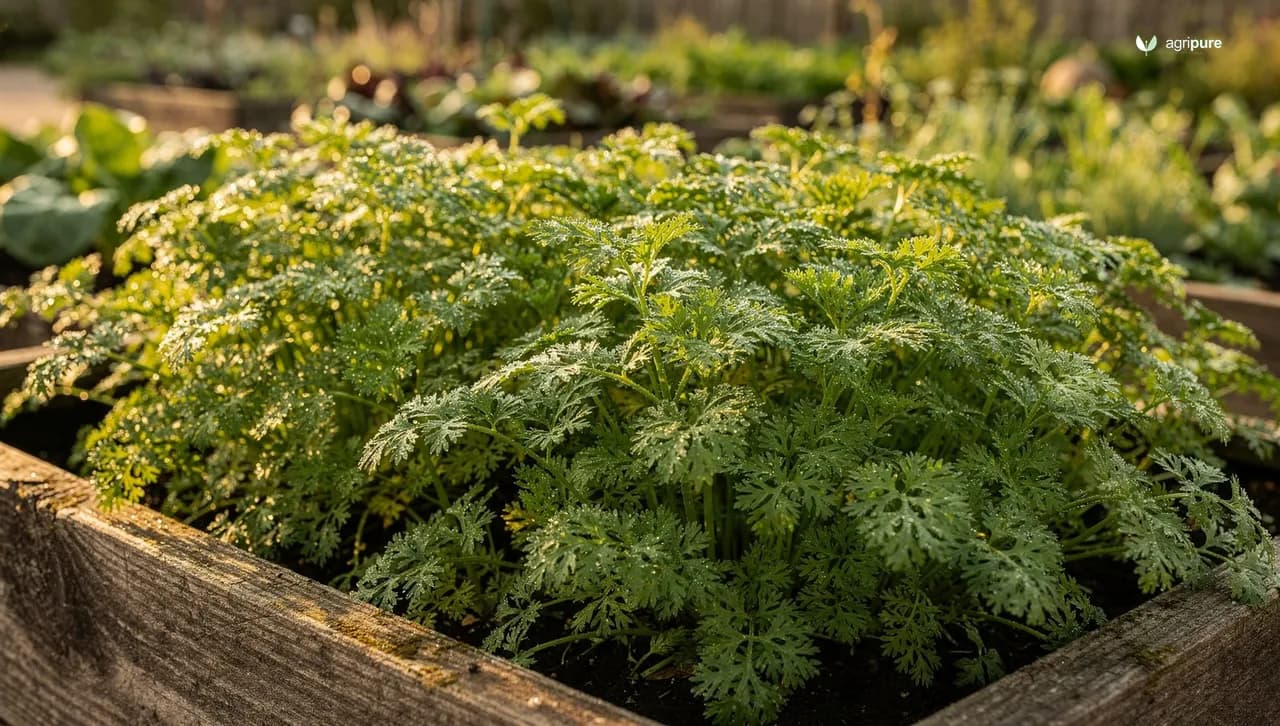
Cilantro is a season-aware herb: work with its clock and you will never run short of leaves.
Cilantro is one of the most-used herbs in the world and one of the most misunderstood to grow. Home gardeners sow a packet in May, watch the plants bolt to flower within a month, and conclude the herb is fickle. It is not. Cilantro is a cool-season annual that reads day length and soil temperature like a calendar; once you understand what it is reading, you can stay a step ahead of it all season.
This guide covers everything from choosing the slowest-to-bolt varieties to the math of succession sowing, indoor growing under lights, and harvesting both leaves and coriander seed from the same plants. The common questions (“growing cilantro indoors,” “why does cilantro bolt,” “cilantro vs coriander”) are each answered in their own section below.
Whether you are a balcony gardener in Minnesota or a market gardener in the Pacific Northwest, the approach is the same: short windows, staggered plantings, and the right variety in each slot.
Key takeaways
Non-bolting cilantro plants grow in a partially shaded raised garden bed, showing broad green leaves in cool-season conditions.
Cultivating cilantro successfully means understanding its seasonal preferences. By providing cool, shaded conditions and selecting slow-bolting varieties, gardeners can enjoy a prolonged harvest of fresh, aromatic leaves.
- Cilantro is a facultative long-day plant: bolting accelerates once days exceed 12–14 hours and soil temps climb past 75°F (24°C). Cool seasons and shaded afternoon spots buy extra time.
- Choose slow-bolt varieties: ‘Calypso’ is three weeks slower to bolt than the standard ‘Santo’; ‘Leisure’ is ready in 28–40 days and handles heat better than most.
- Succession sow every two to three weeks through spring and again in late summer. One patch lasts; three patches overlapping last all season.
- Direct seed only: cilantro’s long taproot resents transplanting. Sow 1/2 inch deep, thin to eight inches apart for leaf harvest.
- Cilantro and coriander are the same plant: the leaves are cilantro, the dried seeds are coriander. A late-summer sowing timed to bolt on purpose gives you a coriander seed harvest.
- Indoor growing is viable with 12–16 hours of LED or fluorescent light; pot depth matters more than pot width, so use at least eight inches of depth.
Variety selection: the first and most important decision
Most bolt problems start at the seed rack, not in the bed. Standard cilantro varieties like old-strain ‘Santo’ can go from leaf to flower in three to four weeks when the mercury rises, but that is not the only choice. Penn State Extension and UC Master Gardeners both identify a clear tier of slow-bolt cultivars that extend the leaf window significantly.
Seed packets of slow-bolt cilantro varieties including Calypso and Leisure sit alongside fresh-cut cilantro leaves on a wooden table.
Choosing a slow-bolt variety like ‘Calypso’ or ‘Leisure’ adds two to three weeks of leaf production before flowering begins.
Here is how the main cultivars compare:
Variety | Days to leaf harvest | Bolt resistance | Notes |
|---|---|---|---|
Calypso | 50–55 | Highest | Three weeks slower to bolt than ‘Santo’; best for summer windows |
Slow Bolt | 50 | High | The most widely available slow-bolt type; reliable in zones 4–8 |
Leisure | 28–40 | High | Fastest to harvestable size; tolerates heat better than standard types |
Santo | 45–50 | Medium | Dark leaves, uniform flavor; the benchmark for bolting comparisons |
Confetti | 50 | Medium | Fern-like cut leaf; good for baby-leaf garnishes and containers |
Delfino | 50 | Medium | Feathery leaves; strong flavor; good for seed saving (coriander) |
Moroccan | 45 | Medium-low | Grown primarily for coriander seed; let it bolt deliberately |
The rule of thumb from Utah State University Extension: for leaf production, choose slow-bolting cultivars like ‘Slow Bolt’ or ‘Leisure.’ For coriander seed, varieties like ‘Moroccan’ or ‘Delfino’ that bolt readily produce heavier seed heads and more aromatic dried coriander.
Variety choice interacts with timing: a slow-bolt variety planted in cool weather outperforms a standard variety in every slot. Use both levers together: slow-bolt variety + cool-season timing.
Starting from seed: timing, zones, and the taproot rule
Cilantro is almost always direct-seeded, and for good reason. Its long taproot — the same root prized in Thai cooking — makes transplanting risky. Disturb it during transplant and the plant checks growth, then bolts immediately. Oregon State University Extension notes that the taproot makes transplanting difficult, so direct seeding is the standard method.
Sow seeds 1/2 inch deep. Fresh cilantro “seeds” are two seeds fused inside a husk; crack the husk lightly between your palms before sowing to improve germination speed. Soil temperature drives germination timing: seeds emerge in seven to 10 days at 65–70°F (18–21°C) and can germinate at 55°F, but the window closes fast above 75°F.
Planting windows by USDA zone
- Zones 3–5: Start as soon as soil works in spring (late March to April). A fall window opens in late July to early August. Cilantro tolerates light frost, so it can carry into October.
- Zones 6–7: Late February to mid-April for spring; late August to mid-September for fall. The summer gap (June–July) is when heat makes leaf production nearly impossible.
- Zones 8–10: February to early March for spring; September to October for fall; in mild-winter regions, cilantro can overwinter as a cool-season annual.
Two planting windows exist in almost every zone (spring and fall) with a summer gap that heat makes impractical for leaves. That gap is when you deliberately sow for coriander, which needs the bolt to produce seed.
Soil, sun, and spacing
Cilantro is not demanding, but three things matter: drainage, coolness, and spacing.
Soil should be well-draining and moderately fertile. Before planting, work two to four inches of compost into the top four to six inches: this improves drainage in clay and moisture-holding in sand, and gives the taproot something to push through. Soil pH around 6.5 suits cilantro well; it does not need rich soil and requires low nitrogen. Excess nitrogen pushes soft growth that bolts faster and is more susceptible to powdery mildew. Phosphorus and potassium support the plant more than nitrogen does.
Full sun is ideal in spring and fall. In mid-summer plantings at the zone edge of viability, an east-facing spot with afternoon shade from a fence or taller crop can add one to two weeks of leaf life by keeping soil temperatures two to four degrees cooler. Position cilantro on the north side of trellised tomatoes or bean rows in a companion planting scheme; the dappled shade is useful without cutting light below the four-hour minimum.
Spacing governs both yield and bolt speed. For leaf production:
- Thin seedlings to eight inches apart in rows 18–24 inches apart (Oregon State Extension standard).
- For seed (coriander) production, thin to eight to 10 inches so plants can develop full seed heads without crowding.
- In dense-sowing salad-cut style (harvesting at two to three inches), space seeds two inches apart and cut the whole flat before thinning is even needed.
Close spacing in a raised bed also creates a mild microclimate effect: plants shade each other’s roots slightly and lose less moisture to evaporation, which is a practical small bolt-delay for a hot week.
Succession sowing: the real answer to “why does my cilantro keep bolting”
No single planting of cilantro (even ‘Calypso’) lasts all season. The reliable approach is succession sowing, which is simpler than most gardeners realize.
Three staggered rows of cilantro at different growth stages show young seedlings, harvestable plants, and a bolting plant with white flowers.
Staggered succession rows at two to three week intervals keep a continuous harvest window open across the season.
The principle: sow a small batch (a one-foot row or a six-inch pot) every two to three weeks through the cool-season window. As one batch bolts, the next is at peak leaf. You never run dry, and you never need to grow a large patch that all peaks and bolts at once.
Practically, this looks like:
- Week one: sow batch A (six plants)
- Week three: sow batch B
- Week five: sow batch C
- Week six: begin harvesting batch A
- Week eight: batch A bolts; batch B at peak; begin harvesting
- Week ten: batch B bolts; batch C at peak; sow batch D if fall window permits
This is the same logic behind succession seed starting for lettuce and salad greens. Small, frequent sowings beat large, infrequent ones every time for herbs that bolt.
UC Master Gardeners of Santa Clara County put the interval at every two to three weeks; Penn State Extension says every two to four weeks. The cooler your climate, the longer you can stretch the interval. In a hot zone-9 spring, two weeks is the tighter, safer number.
Watering and feeding
Irregular watering is the second most common bolt trigger after heat, and it is the one fully within your control. When cilantro stresses from drought, it interprets the stress as end-of-season and accelerates reproduction. Consistent soil moisture signals the plant that conditions are stable and leaf growth is still the right strategy.
Water when the top inch of soil is dry. In a raised bed or container, that typically means every two to three days in warm weather, every four to five days in cool spring or fall. Mulching around the plants with two inches of straw helps hold moisture and keeps the soil surface two to four degrees cooler, providing a buffer in late spring.
Feeding is minimal. Cilantro in compost-amended soil needs little or no supplemental fertilizer. If you feed at all, use a balanced slow-release organic blend, and do not apply high-nitrogen fertilizers. NC State University’s crop guide is explicit: avoid excess nitrogen. It pushes soft growth, raises aphid pressure, and accelerates bolting. If leaves are pale and growth is slow, a single dilute liquid feed of a balanced fertilizer (something like 5-5-5) is enough.
Overhead watering raises the risk of powdery mildew and bacterial leaf spot. Water at the base of plants or use drip irrigation where possible. If you must water overhead, do it in the morning so foliage dries before nightfall.
Common pests and diseases
Cilantro is generally low-maintenance but has a short list of recurring problems, most of which are manageable with basic garden hygiene.
Aphids (willow-carrot aphid) are the most common pest. They cluster on tender new growth, excreting honeydew that leads to sooty mold. Inspect the undersides of leaves weekly. Management: spray infested leaves with a strong jet of water; apply insecticidal soap if populations persist. When cilantro flowers, its flat white umbel blooms attract beneficial insects (lacewings, parasitoid wasps, and hoverflies) that prey on aphid colonies in neighboring crops. This is one reason the cilantro–tomato pairing in companion planting schemes is useful.
Powdery mildew (Erysiphe heraclei) appears as a white powdery coating on leaves and stems. It is most common in humid conditions with poor airflow, or when plants are crowded. Management: space plants properly; water at the base; remove affected leaves promptly. Sulfur-based fungicide applied early is effective; avoid copper-based fungicides on edible herbs near harvest.
Damping-off (Pythium, Rhizoctonia) rots seeds and collapses seedlings at the soil line. Prevention is better than cure: use well-draining soil or potting mix, avoid overwatering at germination, and do not sow in cold, waterlogged ground.
Cutworms sever seedlings at the soil line overnight. A cardboard or plastic collar pressed one inch into the soil around each seedling stem stops them. Hand-pick by flashlight if the problem is acute.
Root-knot nematodes cause galls on roots and stunted, wilting plants. Soil solarization in summer between crop cycles reduces populations; crop rotation with non-host plants (brassicas are poor hosts) helps long-term.
Container and indoor growing
Cilantro is well suited to containers, provided two conditions are met: adequate pot depth and adequate light. The taproot needs at least eight inches of depth: a shallow salad bowl will work for a cut of baby leaves, but mature plants in pots under eight inches deep bolt faster because their roots hit the bottom and experience a stress signal.
Cilantro grows in a deep terracotta pot on a sunny apartment windowsill under a grow light.
Deep pots (at least eight inches) and supplemental LED lighting make year-round indoor cilantro practical even in cold climates.
For outdoor containers, use a pot at least 12 inches wide and eight to 10 inches deep. Unglazed terracotta is useful in hot weather: it breathes and prevents the soil from overheating, which matters for bolt delay. Fill with a well-draining potting mix containing perlite or coarse sand, and blend in a handful of compost before planting. Drainage holes are non-negotiable.
For indoor growing, light is the limiting factor. UC Master Gardeners are specific: cilantro needs at least six hours of bright direct window light, or 12 to 16 hours of supplemental cool white fluorescent or LED light at a height of four to six inches above the leaf canopy. A south-facing window in winter may fall below the six-hour threshold in zones north of 45°N; in those cases, supplemental lighting is needed to produce harvestable leaves.
Succession sow in pots exactly as you would outdoors. A windowsill with three four-inch pots at two-week offsets will keep cuttings available nearly year-round, with no garden space needed. Keep indoor plants away from heat vents, which dry and warm the air and accelerate bolting faster than outdoor heat.
Harvest, ripening, and storing: leaves and coriander seed
Cilantro and coriander are the same plant, Coriandrum sativum, at different life stages: a plant that has bolted becomes a coriander seed crop in progress.
Harvesting leaves
Begin harvesting once plants reach four to six inches tall. Penn State Extension recommends cutting one-third of the plant at ground level each time, which removes the most mature growth and encourages fresh lateral shoots. Do not cut more than a third at once; plants that are overharvested skip regrowth and bolt directly.
Harvest in the morning after dew evaporates; leaves hold more volatile oils and are crispest then. Pinch off any flower buds as they appear; catching them early extends the leaf window by one to two weeks even on a non-slow-bolt variety. Once a stem flowers, the leaves on that stem become smaller and less flavorful, but new vegetative shoots often continue from the base.
For storage, wrap cleaned, dried leaves loosely in a barely damp paper towel, place in a container or bag, and refrigerate for up to one week. Cilantro does not dry well: the aromatic compounds responsible for its flavor are highly volatile and mostly disappear in a food dehydrator. Freezing flat on a baking sheet, then storing in a zip bag, preserves more flavor for cooking applications where texture matters less.
Harvesting coriander seed
For seed harvest, shift your mindset entirely: you want the plant to bolt. A late-June or early-July sowing in most zones will bolt predictably in summer heat, producing seed heads by August or September. Use a lower bolt-resistance variety like ‘Moroccan’ or ‘Delfino’ for heavier seed heads.
Allow seed heads to turn brown and begin to dry on the plant; NC State gives this as two to three weeks after flowering. Cut the entire stem just as the heads start to brown but before seeds drop. Place cut stems upside-down in a paper bag and hang in a dry, ventilated space. Seeds will dry and fall into the bag over one to two weeks. Whole dried coriander seeds keep for two to three years in an airtight jar away from light.
Self-sowing is a useful bonus: let a few seed heads shatter naturally in the bed, and cilantro will self-seed when temperatures drop in autumn, giving you a free fall planting. This pairs naturally with a light mulch layer that holds moisture for the germinating seeds without burying them too deep.
The roots can also be used. In Thai cooking, cilantro roots ground with garlic and white pepper form the base of many curry pastes. Roots are most aromatic when dug in autumn as the plant completes its life cycle. This is a no-waste harvest from a plant that many gardeners discard after bolting.
Frequently asked questions
Why does my cilantro keep bolting?
Cilantro bolts in response to two triggers: rising soil temperature above 75°F and lengthening days past 12–14 hours. It is a facultative long-day plant, meaning warm, long summer days send it into flower regardless of what you do. The answers are to plant in the correct cool-season window (spring and fall), choose slow-bolt varieties like ‘Calypso,’ shade roots from afternoon heat, keep soil moist, and succession sow every two to three weeks so there is always a younger patch waiting when the current one flowers.
What is the difference between cilantro and coriander?
They are the same plant: Coriandrum sativum. Cilantro is the common North American name for the fresh leaves (and stems). Coriander refers to the dried seeds, which have a completely different flavor profile: warm, citrusy, slightly nutty, with none of the “soapy” character some people detect in fresh leaves. The roots are a third usable part, prized in Southeast Asian cooking.
Can I grow cilantro indoors?
Yes, with adequate light. Cilantro needs at least six hours of bright direct sun from a south-facing window, or 12 to 16 hours of LED or cool fluorescent grow light set four to six inches above the canopy. Use a pot at least eight inches deep, as the taproot needs the depth. Succession sow in small pots every two to three weeks for a continuous supply. Keep pots away from heat vents, which dry the air and trigger bolting.
How do I harvest coriander seeds from cilantro?
Let the plant bolt and flower, then allow seed heads to turn brown on the plant. Cut stems when the heads are brown but before seeds start dropping, about two to three weeks after flowering ends. Hang the stems upside-down in a paper bag in a dry, ventilated space. Seeds drop into the bag as they dry over one to two weeks. Store whole coriander seeds in an airtight container away from light for up to two to three years.
What is the best cilantro variety to grow?
‘Calypso’ is the slowest to bolt of commonly available varieties, three weeks slower than ‘Santo.’ ‘Leisure’ is the fastest to reach harvestable size at 28–40 days and handles heat better than most. Both are good defaults. For coriander seed, choose ‘Moroccan’ or ‘Delfino,’ which bolt readily and produce heavy seed heads.
References
- Cilantro, a Unique Culinary Herb — Penn State Extension
- Cilantro/Coriander in the Garden — Utah State University Extension
- How to grow cilantro for leaves — or coriander seeds — Oregon State University Extension Service
- Cilantro and Coriander — UC Master Gardeners of Santa Clara County, University of California Agriculture and Natural Resources
- Coriander (Cilantro) — Diseases and Pests — PlantVillage, Penn State University
- Cilantro Crop Guide — NC State University, Plants for Human Health Institute