“Carrots are soil critics: give them a deep, loose bed free of stones and they will grow straight and sweet; give them anything else and they will twist to tell you so.”
Carrots are one of those crops that look simple on the seed packet and deceptively tricky in the ground. The good news is that nearly every problem (forked roots, spindly tops, bitter flavor) traces back to a handful of fixable causes: compacted or stony soil, skipping the thinning step, or letting moisture swing between flood and drought. Get those three things right and carrots reward you with little fuss across spring, summer, and fall.
This guide walks through the full season: choosing a variety matched to your soil type, preparing the bed, sowing and thinning, watering and feeding, managing the main pests, growing a crop in containers if you have no deep ground, and storing the harvest in sand so it keeps for months. Every number and timeline below comes from university Cooperative Extension and the Royal Horticultural Society rather than gardening folklore.
Carrots also slot naturally into the wider kitchen garden. They pair well with onions and leeks as companion plants, thrive in the deep, improved soil of a raised bed, and benefit from the loose, living structure that a good organic soil program builds over time.
Key takeaways
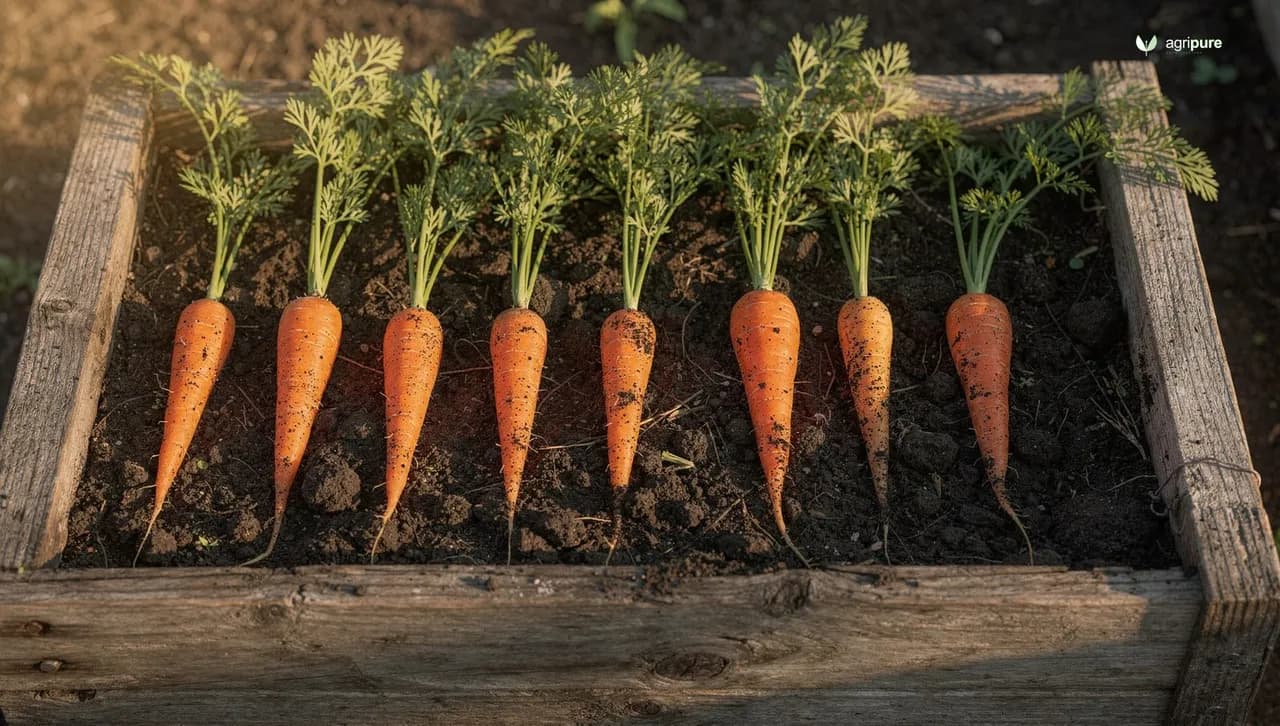
Dark, crumbly, stone-free soil in a raised bed prepared for carrot planting, with a straight carrot emerging from the ground.
Straight carrots require deep soil preparation. Loosen the soil to at least 12 inches deep and remove all stones and debris to prevent forked roots and encourage uniform growth.
- Prepare soil to at least 12 inches deep and remove every stone; compaction and obstacles are the primary cause of forked roots.
- Never use fresh manure; it causes branching and hairy roots. Use well-rotted compost only, no more than 1 inch per 100 sq ft.
- Thin ruthlessly to two to three inches apart when seedlings reach two inches tall; cut, never pull.
- Sow every two to three weeks from early spring through midsummer for a continuous harvest across the season.
- Harvest 65–100 days from sowing (variety-dependent) and store topped roots in moist sand at 32°F for up to five months.
- Short-rooted Chantenay, Nantes, or Paris Market types grow well in containers at least 12 inches deep.
Choosing a variety: matching root type to your soil
Carrot varieties are classified by root shape and length, and choosing the right type for your soil is the single most practical decision you will make before sowing. University of Illinois Extension identifies five main groups:
- Imperator: the long, tapered carrot seen in supermarkets, reaching 8–10 inches. Needs deep, loose, sandy soil and at least 12 inches of prepared depth. Poor choice for clay or stony ground.
- Danvers: up to seven inches, conical with a broad shoulder. More tolerant of heavier soils than Imperator, stores well, and has good disease resistance.
- Nantes: six to seven inches, nearly cylindrical with a blunt tip, widely regarded as the best-flavored type for fresh eating. Performs in lighter soils and is a reliable pick for raised beds.
- Chantenay: four and a half to five and a half inches, wide-shouldered and conical. The go-to for heavier, clay-prone soils where a long root would fork. Also good for the first sowing of the year when soil is still cold.
- Miniature / Paris Market / Oxheart: two to three inches, nearly round. The only type suited to containers and thin or stony soils. Harvest young as baby carrots.
Type | Length | Best for | Days to maturity |
|---|---|---|---|
Imperator | 8–10 in | Deep, loose, sandy soil | 75–90 days |
Danvers | Up to 7 in | Medium soils; good storage | 70–80 days |
Nantes | 6–7 in | Raised beds; fresh eating | 65–75 days |
Chantenay | 4.5–5.5 in | Heavy or clay soils | 65–75 days |
Paris Market | 2–3 in | Containers; stony ground | 60–70 days |
For resistance to carrot fly (the most damaging pest in many regions), the RHS recommends the variety ‘Flyaway’, which has been bred with partial resistance. Sowing after mid-May also sidesteps the first generation of the pest without any chemical input.
Five carrot types laid side by side show Imperator, Danvers, Nantes, Chantenay, and Paris Market shapes and sizes.
Left to right: Imperator, Danvers, Nantes, Chantenay, and Paris Market, each shaped by the soil it grows best in.
Soil preparation and bed setup
Carrots are more sensitive to soil structure than almost any other vegetable. A root growing downward through loose soil forms a straight tap; a root that hits a stone, a clod, a compressed layer, or a knot of uncomposted organic matter does something else: it forks, spirals, or stunts. The prep investment here returns straight in the harvest.
Work the bed to a depth of at least 12 inches for Chantenay and Nantes types, and to a full 8–9 inches loosening plus 12 inches of friable depth for Imperator. Remove every stone you find. If your native soil is clay or heavily compacted, a raised bed filled with a sandy loam blend is the most practical fix; it eliminates the compaction problem entirely and gives you control over drainage.
The target soil pH is 6.0–7.0 (slightly acidic to neutral), per University of Minnesota Extension. Amend with well-rotted compost (no more than 1 inch per 100 square feet, per USU Extension) and work it in thoroughly. Do not use fresh or partially composted manure: it contains excess nitrogen, which promotes top growth and causes the hairy, branched roots you are trying to avoid. If you apply a balanced fertilizer at planting, keep the nitrogen fraction modest. Carrots need potassium and phosphorus more than they need nitrogen once the seedling stage is past.
Sowing, germination, and thinning
Carrot seed is slow. The University of Illinois Extension puts it plainly: germination is “notoriously slow, often taking up to three weeks.” That gap between sowing and the first green thread appearing is where most gardeners lose patience and either overwater or assume failure. The seed is fine. Keep the soil surface consistently moist without letting it become soggy, and wait.
Sow seeds 1/4 inch deep in spring (or 1/2–3/4 inch deep in summer, when the surface dries faster). Space rows 12–18 inches apart. One classic trick: sow a few radish seeds in the same row. Radishes germinate in five to seven days, mark the row clearly, and are harvested well before the carrots need the space.
The minimum soil temperature for germination is 45°F; germination is fastest and most uniform between 55°F and 75°F. Do not rush the first sowing into cold, wet soil; a late April or early May sowing into warming ground often catches up to a too-early March sowing in the same calendar week.
Thinning: the step most gardeners skip
Thinning is not optional. Crowded seedlings produce twisted, forked roots that twine around each other below the surface. University of Illinois Extension advises thinning when seedlings are about two inches tall, to approximately two to three inches apart in the row. University of Maryland Extension recommends cutting rather than pulling to avoid disturbing the roots of the seedlings you are keeping. A pair of small scissors at soil level is the right tool. It is an unglamorous 20-minute job that determines whether your harvest is straight or knotted.
For succession planting (the best way to avoid a glut and extend the harvest), sow a new short row every two to three weeks from early spring through midsummer. UTahState Extension recommends continuing until about ten weeks before your first average frost date, giving the late sowings enough time to mature before cold sets in. In most of USDA Hardiness Zones 4–7, that window runs from early April through late July.
Watering and feeding
Carrots need about one inch of water per week from rain or irrigation, per University of Minnesota Extension. The key word is consistent. Letting the bed dry out and then saturating it causes two problems: flavor loss (dry stress triggers bitterness and toughening of the root) and splitting (a sudden water surge after drought cracks the root longitudinally). Sandy soils may need watering twice a week; heavier soils typically need watering once a week deeply.
The RHS notes that in-ground carrots are relatively drought-tolerant once established; in a damp climate, a thorough watering every two weeks during dry spells is often enough. Container-grown carrots are a different case: pots dry quickly and need daily checking, particularly in warm weather.
Reduce irrigation in the final two to three weeks before harvest. This concentrates sugars in the root and reduces the risk of splitting. Fall crops left in the ground until the first light frost often develop sweeter flavor, as cold triggers starch-to-sugar conversion in the root.
On fertilizer: a side-dressing of balanced fertilizer (something like 5-10-10) mid-season is helpful on poor soils. On well-amended beds, additional feeding is rarely needed. Avoid high-nitrogen feeds at any point, because they push leaf growth and suppress root development.
Thin young carrot seedlings with scissors in a raised bed, cutting rather than pulling to avoid disturbing neighboring roots.
Cut thinnings at soil level rather than pulling them. Pulling disturbs the roots of neighboring seedlings, the ones you want to keep.
Common pests and diseases
Carrots face a short but serious list of threats. Knowing which to watch for saves the harvest.
Carrot fly (carrot rust fly)
The most damaging pest in most of North America and the UK, per both the RHS and the Pacific Northwest Pest Management Handbooks. Carrot fly (Psila rosae) lays eggs near the base of the plant; the larvae burrow into the root, causing rust-colored tunnels, decay, and, in bad cases, total root loss. There is no effective organic spray once larvae are inside the root.
Prevention is the management strategy. Three approaches work reliably:
- Insect-proof mesh or row cover: the RHS recommends covering the entire crop from sowing to harvest. Even a fine net with no gaps keeps adults from reaching the soil to lay eggs.
- Timing: the first adult flight typically occurs in late April to May, the second in August. Sowing after mid-May in most regions avoids the first generation; harvesting before late August avoids the second.
- Resistant varieties: ‘Flyaway’ (UK) and some Nantes selections carry partial resistance; they do not eliminate the risk but significantly reduce it.
Aster yellows
A phytoplasma disease spread by leafhoppers. Infected plants produce hairy, stunted, bitter roots that look normal from above until harvest. There is no cure once a plant is infected. Control leafhoppers with row covers early in the season; remove and destroy infected plants immediately. University of Minnesota Extension notes that aster yellows is a periodic problem across the Midwest and upper plains.
Alternaria leaf blight
The most damaging foliar disease, caused by the fungus Alternaria dauci. Dark brown to black lesions appear along leaf margins, edged with yellow. Lesions can coalesce, killing whole leaves and, in severe cases, causing taproot decay. The Pacific Northwest Pest Management Handbooks recommend crop rotation, certified disease-free seed, and avoiding overhead irrigation to reduce leaf-surface wetness. Do not compost affected tops.
Wireworms and cutworms
Both tunnel into roots or sever seedlings at the base. They are most problematic in newly broken ground. A year of crop rotation, with the carrot bed moved away from where it was last season, breaks the cycle. Row covers limit cutworm moth access for egg-laying.
Growing carrots in containers
Carrots are one of the few root vegetables that work well in containers, provided you choose the right variety and use a deep enough pot. Short-rooted types are the only practical choice: Chantenay (4.5–5.5 inches), Nantes (6–7 inches in a deep pot), and Paris Market or Oxheart types (2–3 inches) all perform well in pots, per University of Maryland Extension and the RHS.
The container must be at least 12 inches deep for Chantenay and Nantes types; Paris Market can manage in 8–10 inches. Use a loose, sandy potting mix; standard potting soil is usually too dense and retains too much moisture. Fill the container to within an inch of the top, sow seeds 1/4 inch deep, and thin to two to three inches apart once seedlings reach two inches tall.
Container carrots need more attentive watering than in-ground crops. Check moisture daily in warm weather and water when the top inch of compost feels dry. Drainage holes are not optional: waterlogged compost causes root rot and forking. A balcony or patio facing south or west, getting six or more hours of sun, will grow a respectable crop from a single deep planter or a window box wide enough to space the seedlings properly. This approach fits naturally with square-foot gardening, where compact root types are planned into each block.
Round Paris Market carrots harvested from a deep pot on a sunny patio, with clean roots beside the container.
Paris Market carrots are the container gardener’s answer: round-rooted, short enough for most pots, and ready in 60–70 days.
Harvesting, curing, and storing in sand
Most carrot varieties are ready 65–100 days from sowing, depending on type; University of Maryland Extension puts the fresh-eating window at 65–75 days, while USU Extension extends this to 100 days for larger storage types. The simplest harvest indicator is shoulder diameter: pull a test root when the top of the carrot at soil level reaches about 3/4 to 1 inch across. Roots held past the 1-inch mark become woody and lose sweetness.
To harvest without snapping the tops off at the shoulder (a common problem in compacted soils), loosen the soil six inches out from the row with a garden fork before pulling. Push the fork straight down, lever back gently, and the roots slide free.
In-ground winter storage
Carrots can stay in the ground through winter in Zones 5 and warmer, provided you mulch the row with 6–8 inches of straw or shredded leaves before the soil freezes. The insulation keeps the ground from locking up so you can pull roots as needed through January or February. The cold itself improves flavor. University of Maryland Extension confirms this approach: “fall crops can be harvested throughout winter if mulched before the ground freezes.”
Sand storage
For indoor storage across several months, the classic method is moist sand in a box or crate in a cool cellar. Remove the green tops immediately after harvest, as leaving them on draws moisture out of the root. Layer the topped carrots in the box without touching each other, alternating with slightly damp sand (or sawdust or peat substitute). Store at 32°F and 90–95% relative humidity. USU Extension reports 2–4 weeks at 32°F in a refrigerator, or several months in a cool, moist cellar using this sand method.
One critical note: keep carrots away from apples, pears, and other ethylene-producing fruit. Ethylene gas diffuses through stored produce and causes carrots to become bitter within weeks, explaining disappointing flavor in stored roots. A dedicated root-cellar section or a separate cool closet away from fruit stores solves it.
Carrots also freeze well: blanch peeled, sliced roots in boiling water for two to three minutes, chill in ice water, drain, and pack into freezer bags. They hold quality for 10–12 months. For longer-term preservation, carrots are a low-acid vegetable and must be pressure-canned, never water-bath canned. See the home canning guide for times and pressures by altitude.
Troubleshooting: why carrots fork, go hairy, or taste bitter
Most carrot problems have a cause you can trace and fix before the next sowing. Here are the most common, drawn from the sources above:
Problem | Most likely cause | Fix for next sowing |
|---|---|---|
Forked or branched roots | Stones, clods, compaction, or fresh manure in the soil | Remove stones; prepare to 12 in deep; use well-rotted compost only |
Hairy roots | Fresh manure, aster yellows, or carrot fly damage | Use only aged compost; control leafhoppers; cover against carrot fly |
Bitter flavor | Drought stress during growth, or ethylene from stored fruit nearby | Keep moisture consistent; separate storage from apples/pears |
Green-shouldered tops | Root crown exposed above soil and greened by light | Hill soil or mulch lightly over exposed shoulders as roots size up |
Cracked/split roots | Dry period followed by heavy irrigation | Water consistently; reduce irrigation in final weeks |
Short, stubby roots in expected variety | Soil not deep or loose enough for the variety | Switch to a shorter type (Chantenay, Paris Market) or raise a deeper bed |
Poor germination | Soil too cold, surface too dry, or seed buried too deep | Wait for 55°F soil; keep surface moist; sow at 1/4 in depth |
The single best investment for better carrots is time spent on bed preparation: loosening, stone-removing, and using well-rotted organic matter. The difference between a handful of forked roots and a row of straight, sweet ones is almost always made before the first seed goes in the ground. Pair that with a good mulch layer between rows to hold moisture and suppress weeds, and you are most of the way there.
For gardeners who are new to direct-sowing root vegetables (carrots are one of the few crops that cannot be transplanted), the seed-starting for beginners guide covers the direct-seeding basics in more depth, and the herb garden guide includes succession-sowing advice that applies equally well to carrot rows.
Frequently asked questions
Why are my carrots forked?
Forking is almost always a soil problem. Stones, soil clods, compaction, or uncomposted (fresh) manure force the growing tap root to split. Prepare the bed to 12 inches deep, remove all stones, and use only well-rotted compost (never fresh manure) and most forking disappears.
How far apart do I thin carrots?
Thin to two to three inches apart when seedlings are about two inches tall. Cut the seedlings at soil level with small scissors rather than pulling, which disturbs the roots of the plants you want to keep. Skipping thinning is the most common reason carrot roots twist and crowd each other.
Can you grow carrots in containers?
Yes, if you choose the right variety. Short-rooted Chantenay, Nantes, and Paris Market/Oxheart types all work in containers at least 12 inches deep. Use a loose, sandy potting mix and check moisture daily. Long types like Imperator need deep, open ground.
When should I harvest carrots?
Most varieties are ready 65–100 days from sowing. Pull a test root when the shoulder reaches about 3/4 to 1 inch in diameter. Carrots left past 1 inch become woody. Fall crops left in the ground through light frosts develop sweeter flavor, as cold converts starch to sugar in the root.
How do I store carrots for several months?
Remove the green tops immediately after harvest. Store topped roots in layers of slightly moist sand in a box at 32°F and 90–95% relative humidity. A cool cellar works well; a second refrigerator is a practical alternative. Keep carrots away from apples and pears: the ethylene gas those fruits emit makes carrots bitter over time. Stored this way, carrots hold quality for up to four to five months.
References
- Growing Carrots and Parsnips in Home Gardens — University of Minnesota Extension
- Carrots in the Garden — How to Grow Carrots — Utah State University Extension
- Growing Carrots in a Home Garden — University of Maryland Extension
- How to Grow Carrots | Good Growing — University of Illinois Extension
- How to Grow Carrots — Royal Horticultural Society
- Carrot (Daucus carota) — Alternaria Leaf Blight — Pacific Northwest Pest Management Handbooks (Oregon State University)
- 9 Causes of Deformed Carrots: How to Identify and Prevent Them — Gardener’s Path