Key takeaways
Vibrant orange carrots partially visible in dark, rich soil, growing in an organic garden bed next to a cluster of upright, green chive plants, illustrating beneficial companion planting.
Strategic companion planting, such as pairing carrots with chives, can deter pests like the carrot rust fly, protecting your harvest and promoting a healthier garden ecosystem.
- The onion family earns its spot by scent: in trials, carrot rust fly damage was lower in carrot rows sitting next to onion rows.
- Onions only mask the carrot’s odor while they are young and leafy; once they bulb, the cover fades, so stagger plantings.
- Tomatoes throw light afternoon shade that suits carrots in heat, and fast radishes mark the row 3 weeks before carrots even sprout.
- Skip dill, parsnips, and celery next to carrots: they are all in the same family and feed the same rust fly.
- Scattering a few marigolds does almost nothing for nematodes; the research shows that takes a dense, full-season planting.
Carrots take as long as 3 weeks to germinate, so for most of that time the row is bare soil with nothing to defend it. That slow start is exactly why pairing matters: the right neighbor covers the gap, confuses a pest, or shades the bed, while the wrong one quietly invites the one fly that ruins a carrot harvest.
The headline pairing of carrots and onions is real, but it works for a reason most charts skip, and only under 1 narrow condition. Extension and chemical-ecology research explains how 4 useful companions (onions, chives, tomatoes, and low greens) function around carrots, and why dill, parsnips, and scattered marigolds tend to backfire.
Why onions and chives belong next to carrots
The carrot rust fly, Psila rosae, finds carrots by smell. Females are drawn to host plant odor and lay up to 40 eggs near the base of the row, and larvae mine the roots. The onion family interferes with that search. In a Journal of Chemical Ecology study, the fly’s distribution relative to wind direction changed when onion odor was combined with carrot odor: the sulfur volatiles muddle the scent trail the fly is following.
That carries into the field. A Finnish intercropping trial reported that carrot fly damage was lower in carrot rows next to onion rows than in rows next to other carrots. The effect is masking rather than repelling, and it fades within 3 to 4 weeks as the onion bulbs, leaving a limited window of protection.
Plant young, and keep replanting
The cover comes from leafy onion, chive, garlic, and leek tops, which means timing is everything. There are 3 ways to keep the scent screen up across the season:
- Interplant alliums while leafy: the disruption is strongest when onions are young, so the masking weakens once a bulb forms.
- Use chives as a permanent edge: clumping chives stay leafy for months and re-grow after cutting, unlike a bulbing onion.
- Stagger sowings: slot a fresh round of onion sets every 3 to 4 weeks so something pungent is always alongside the carrots.
Masking, not magic: field trials show a modest reduction rather than total immunity. In a bad rust fly year, pair alliums with a floating row cover over the carrots; that physical barrier stops the fly when scent masking is insufficient.
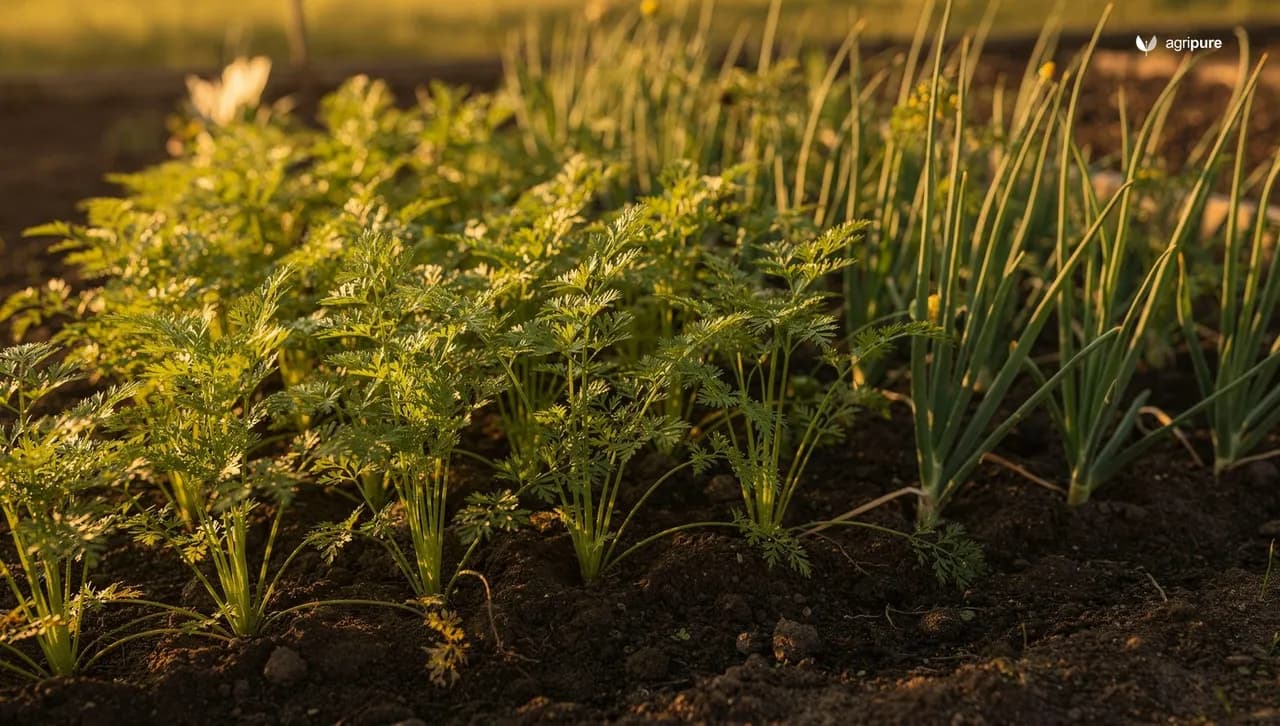
Rows of feathery green carrot tops growing alongside upright green onion and chive foliage in dark garden soil in morning light.
Tomatoes, radishes, and low greens as living mulch
Beyond the rust fly, good carrot neighbors solve light, space, and time. Tomatoes are the classic overstory: a staked tomato casts light afternoon shade that keeps carrot shoulders from baking in midsummer, while its roots run deeper than a carrot’s, so the two rarely fight for the same water. Give each plant its room and the pairing trades a little carrot vigor for cooler soil during the hottest 6 to 8 weeks of the year.
Low, fast greens serve a different purpose. Radishes sprout in 5 to 7 days, so sowing a few in the carrot row marks where to weed 2 to 3 weeks before the carrots emerge. University of Maryland Extension recommends harvesting radishes before they crowd the carrot roots. **Lettuce and other shallow-rooted greens** act as a living mulch, shading the soil surface to conserve moisture and suppress weed germination.
- Radish as a marker: ready in roughly 25 to 30 days, pulled long before carrots size up.
- Lettuce as ground cover: shades soil between widely spaced carrot rows, then comes out as carrots fill in.
- Tomato as shade: 1 tall plant per few feet of row, trimmed low enough to let morning sun through.
A raised vegetable bed with young carrot seedlings and lettuce growing beneath a staked tomato plant that casts light afternoon shade over the dark soil.
The neighbors that backfire
The mistakes cluster in 1 plant family. Carrots are an umbellifer (family Apiaceae), and so are dill, fennel, parsnip, celery, parsley, and chervil. Utah State University Extension lists carrot rust fly hosts as carrots plus celery, celeriac, chervil, parsnips, and parsley. Planting those beside carrots provides an additional food source for the pest instead of breaking its life cycle.
Dill draws a particular warning. It cross-attracts the same umbellifer pests, can stunt nearby carrots once it bolts past 2 feet tall, and its flowers feed the very insects you are trying to confuse with onions. The fix is distance and family awareness.
- Keep umbellifers apart: dill, fennel, and parsnips belong in a different bed at least 3 to 4 feet from the carrot row.
- Rotate, do not repeat: following carrots with parsnips in the same soil keeps rust fly larvae fed across seasons.
- Mind the marigold myth: a few scattered plants are not a nematode shield, as the next section explains.
Same family, same pests: if a plant has the carrot’s lacy, hollow-stemmed, umbrella-flower look, treat it as a rust fly host and give it its own corner of the garden, at least a bed away from the carrots.
A field comparison of carrot companions
Each candidate does one job well and may do another badly. This table sorts the common carrot neighbors by what they actually deliver and the catch that comes with each.
Companion | What it does | The catch | Verdict |
|---|---|---|---|
Onions and chives | Mask carrot scent from rust fly | Only while young and leafy | Plant — stagger sowings |
Leeks and garlic | Same allium scent cover | Slow to leaf out from cloves | Plant — as an edging |
Tomatoes | Light afternoon shade in heat | Heavy feeder if crowded | Plant — give spacing |
Radishes | Mark rows, ready in 25 to 30 days | Crowd carrots if left in | Plant — harvest early |
Lettuce and low greens | Living mulch, shades soil | Competes if too close | Plant — between rows |
Dill and fennel | Attract beneficial insects | Cross-attract umbellifer pests | Avoid — different bed |
Parsnips and celery | None for carrots | Share the carrot rust fly | Avoid — rotate apart |
Read top to bottom, the pattern is simple: alliums and low greens help, tomatoes help if spaced, and anything in the carrot’s own family backfires by feeding the same pest.
Spacing and intercropping that works
Companion planting only pays off if the carrots themselves have room. University of Maryland Extension advises sowing in wide rows and thinning to 1 to 2 inches apart, with carrots maturing in 65 to 75 days from seed. University of Minnesota Extension puts the spacing a touch wider, every 2 to 4 inches, and notes seed can take as long as 3 weeks to germinate. Crowd them and you get forked, stunted roots no companion can fix.
Intercropping works by layering plants according to root depth and top growth. Carrots root straight down 8 to 12 inches, alliums sit shallow and upright beside them, lettuce covers the surface between rows, and a tomato plant rises above, creating 4 layers that share garden space efficiently. Start slower transplants like onions and tomatoes 3 to 4 weeks ahead so they are leafy when carrots sprout, and use raised beds for the stone-free soil depth carrots need to grow straight.
Where marigolds fit, and where they don’t
Marigold is the most over-promised carrot companion. The science is real but specific: University of Florida IFAS Extension reports that marigold roots release alpha-terthienyl and can suppress 14 genera of plant-parasitic nematodes, with root-knot nematodes among the most affected. The catch is dosage.
- It needs density: good nematode control takes a thick, near-solid marigold planting at under 7 inches between plants, not 1 plant every few feet.
- Intercropping falls short: the same extension is blunt that interplanting marigold with other crops to cut nematodes does not appear to be effective.
- Use it as a rotation: grow marigold as a full-season cover the year before carrots in nematode-prone soil, then plant carrots into the cleaned bed.
Putting a carrot guild together
A practical carrot bed combines 4 roles. Run carrots down the center at 1 to 2 inch spacing, edge the bed with leafy onions or chives for scent masking, drop a few radishes in the row as living markers, and let lettuce fill gaps as a ground cover, optionally adding 1 staked tomato on the sunny side for light shade. Keep every umbellifer out of the bed entirely.
The sequence matters as much as the map. Sow onions and start tomatoes 3 to 4 weeks ahead so they are pungent and leafy before the carrots emerge, then refresh the alliums through the season as earlier ones bulb up. Done that way, the guild covers the carrots’ slow 3-week start, screens their scent during the rust fly’s active window, and keeps the soil shaded and weed-free while the roots size up.
One bed, one family rule: allow only a single umbellifer per bed (the carrots). Every dill, parsnip, and celery plant located elsewhere provides one fewer host for overwintering rust flies.
Conclusion
Good carrot companions are less about a lucky chart and more about understanding 1 pest and 3 needs. Leafy onions and chives mask the scent the carrot rust fly hunts by — but only while young, so keep replanting. Tomatoes, radishes, and lettuce handle shade, spacing, and weeds. And the surest way to invite trouble is to crowd the carrot row with its own relatives, so keep dill, parsnips, and celery a bed away.
Frequently asked questions
What should you not plant near carrots?
Keep the other 5 common umbellifers — dill, fennel, parsnip, celery, and parsley — out of the carrot bed. They share the carrot rust fly as a pest, so planting them together feeds the same insect instead of breaking its cycle, and dill can also stunt nearby carrots once it bolts.
Why are onions a good companion for carrots?
Onions and other alliums release sulfur volatiles that mask the carrot’s scent, which is how the carrot rust fly locates the row and lays up to 40 eggs. In trials, carrot fly damage was lower in carrot rows next to onion rows, though the cover works best while the onions are young and leafy.
Do marigolds really protect carrots?
Only at high density. Marigold roots release alpha-terthienyl, which can suppress 14 genera of plant-parasitic nematodes, but a few scattered plants do little. Extension research finds that interplanting marigold to reduce nematodes is not effective; it works as a dense, full-season cover crop instead.
Can you plant carrots and tomatoes together?
Yes, with spacing. A staked tomato gives carrots light afternoon shade during the hottest 6 to 8 weeks of summer and roots deeper than they do, so the two rarely compete for water. Just give each plant room, since a crowded tomato is a heavy feeder that can outcompete the carrots.
How far apart should carrots be spaced?
Thin carrots to 1 to 2 inches apart, or up to 2 to 4 inches for larger roots, in wide rows. Carrots mature in 65 to 75 days and can take as long as 3 weeks to germinate, so crowding leads to forked, stunted roots that no companion plant can correct.
References
- Utah State University Extension — Carrot Rust Fly
- Nottingham, Journal of Chemical Ecology (1987) — Nonhost-Plant Odors and Carrot Rust Fly
- Varis, Agricultural and Food Science (1991) — Intercropping Carrots and Onions
- University of Minnesota Extension — Growing Carrots and Parsnips
- University of Maryland Extension — Growing Carrots in a Home Garden
- University of Florida IFAS Extension — Marigolds for Nematode Management