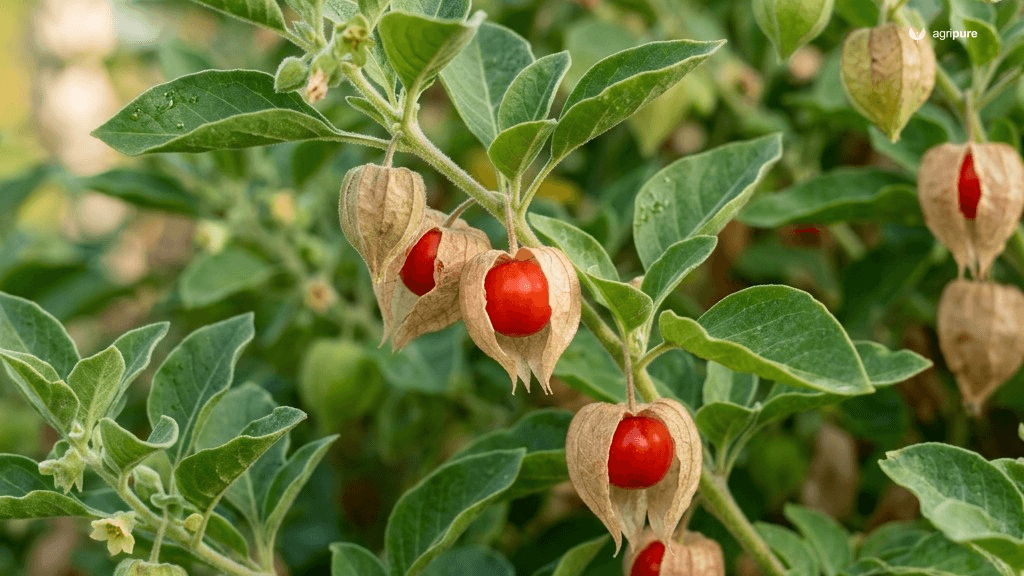
The ashwagandha plant (Withania somnifera) is one of the most sought-after medicinal crops a home grower can raise, yet most guides skip the single fact that decides success or failure: it is a warmth-loving subtropical shrub that simply will not survive a cold winter. Whether you harvest fat, milky-white roots or watch your seedlings rot depends almost entirely on getting the timing right for your climate. This guide gives you the sowing-to-root-harvest calendar for the US, the UK and Australia, anchored to the same hardiness data professional growers use.
Know your plant: a tender perennial that most of us grow as an annual
A potted ashwagandha plant displays small green leaves and clusters of orange-red berries.
Withania somnifera (ashwagandha) can be grown in a terracotta container for root harvesting.
Native to the dry subtropics of India, the Middle East and parts of Africa, ashwagandha is technically a short-lived perennial shrub reaching about 60–120 cm (2–4 ft). But its hardiness is the headline. In US terms it survives outdoors as a perennial only in the mild end of the range: roughly USDA zones 8–11, and growers commonly carry it through winter in zones 8–10 (some report success in sheltered, free-draining zone 7 spots). In the UK it carries an RHS H2 rating, “tender,” meaning it needs a minimum of 1–5°C and glasshouse protection except in genuinely frost-free pockets. In Australia it suits the subtropical, arid and warm-temperate zones. The common thread: even a light frost burns the foliage, and a hard frost kills the top growth outright.
The roots bulk up in a single warm growing season of about 150–180 days, so gardeners in cold zones do not need the plant to overwinter. Growing it as a warm-season annual, or in a pot moved under cover, allows you to lift the roots before the first frost. This approach makes growing ashwagandha practical across varied climates.
The growing conditions ashwagandha needs
This is a dryland plant, and the most common way to kill it is kindness with the watering can.
- Sun: Six or more hours of direct sun daily; it will not grow in shade. In cooler climates, give it the hottest, brightest spot you have.
- Soil: Free-draining, sandy to sandy-loam, neutral to slightly alkaline. Heavy clay or soggy ground causes taproot rot. In pots, blend roughly three parts cactus/succulent mix to one part compost.
- Water: Let the soil dry between waterings. Established plants are drought-tolerant; waterlogging is fatal.
- Warmth: Seeds germinate well across a 20–30°C soil-temperature band, with around 25°C a reliable sweet spot. Germination slows sharply as soil cools, so don’t sow into cold ground.
- Spacing: About 50–60 cm (roughly 2 ft) between plants for airflow and root development.
Like its fellow dryland medicinals aloe vera (USDA 9–12, RHS H1c) and warmth-demanding turmeric (USDA 8–11, RHS H2), ashwagandha rewards lean, gritty conditions and punishes a heavy, wet root zone.
From seed to germination
Sow seed shallowly: press it 0.5–1 cm into warm, moist (not wet) seed-starting mix and cover lightly. With bottom heat around 22–25°C, the first seedlings usually appear within about two weeks; cooler conditions stretch this out and reduce the strike rate. Seed viability drops with age, so sow fresh and sow generously. Transplant seedlings out when they are roughly 35–40 days old and all frost risk has passed, once nights stay reliably above about 12–15°C.
Zone-by-zone sowing and harvest calendar
The same 150–180-day clock applies everywhere; only the start date moves. Count backwards from your first expected autumn frost (or forward from your last spring frost) to find your window.
Region / zone | Start seed | Plant out | Harvest roots | How to grow it |
|---|---|---|---|---|
US zones 8–11 | Indoors late winter, or direct-sow after last frost | Spring, after frost | Late summer to autumn (150–180 days) | In-ground; often perennial in zones 9–10 |
US zones 6–7 | Indoors 8–10 weeks before last frost | Late spring | Early autumn, before first frost | Warm-season annual; lift roots before frost |
US zone 5 and colder | Indoors 8–10 weeks before last frost | Early summer (use black plastic/raised beds for heat) | Autumn, before frost | Annual or large pot moved under cover |
UK (most regions, H2) | Indoors Feb–March on a warm windowsill or heated propagator | Late May–June into greenhouse/polytunnel or large pot | Sept–Oct, before cold sets in | Annual under glass or in 3–5 gal pots |
AU subtropical / arid | After nights stay above ~15°C | Spring | Autumn (~5 months) | In-ground perennial in frost-free spots |
AU cool-temperate (e.g. Tas.) | Spring under cover | After last frost | Autumn, before frost | Annual, or pot kept above 12°C in winter |
United States
In zones 8 and warmer, you can direct-sow once the soil warms, and in zones 9–10 plants often persist for a second year, yielding heavier roots. From zone 7 downward, start indoors 8–10 weeks before your last spring frost, harden off, and transplant into the warmest bed you have. Cold-zone growers (5 and below) benefit from raised beds, black plastic mulch, or simply growing in a dark container that warms quickly.
United Kingdom
Treat ashwagandha as a glasshouse annual. Sow in February or March under heat, then move plants into a greenhouse, polytunnel, or a 3–5 gallon pot in your sunniest spot from late May. You will still reach the plant’s full size and harvest milky taproots in autumn; the plant simply behaves as an annual. Pot culture is genuinely one of ashwagandha’s strengths, making it forgiving for growers without protected ground.
Australia
In subtropical, arid and warm-temperate gardens, sow in spring once nights hold above roughly 15°C and grow it in the ground as a perennial where frost is absent. In cool-temperate regions such as Tasmania, treat it as an annual or keep potted plants above 12°C under cover through winter for a head start the following season.
Harvesting and curing the roots
Ashwagandha tells you when it is ready: lower leaves yellow and dry, and the berries inside their papery husks ripen to red-orange and begin to dry, usually 150–180 days (about five to six months) from sowing. To harvest, water the day before to soften the soil, then loosen widely with a fork and lever out the whole taproot to avoid snapping it. Wash thoroughly, trim fine rootlets, and slice thick roots lengthwise into pencil-thick pieces so they dry evenly. Dry slowly by air-drying in shade with good airflow, or dehydrating at 35–40°C (95–105°F) for 12–24 hours, until the pieces snap cleanly when bent. Store the dried root whole in an airtight jar away from light and grind to powder only as needed.
If a frost threatens before the berries ripen in a cold-zone garden, lift the roots anyway: the harvest is the root, so unripe fruit is no reason to wait. Collect a few ripe berries when you can for next season’s seed; ashwagandha self-seeds readily in warm climates.
Common problems
- Yellowing, mushy roots: overwatering or heavy soil. Improve drainage and water less.
- Leggy, weak plants: not enough sun, or started too early indoors without strong light.
- Poor germination: soil too cool or seed too old. Use bottom heat and fresh seed.
- Frost damage: lift roots at the first frost warning, even if slightly early.
Frequently asked questions
Can I grow ashwagandha indoors or in a pot year-round?
Yes, it is one of the better medicinal herbs for container culture. A 3–5 gallon pot with gritty, free-draining mix in your sunniest window or under grow lights works well, and pots let cool-climate growers move plants under cover before frost. This is the standard approach across the UK and cooler parts of the US and Australia.
Do I have to grow it from seed, or can I buy a plant?
Ashwagandha is almost always grown from seed because it germinates readily and develops its harvestable taproot in a single season. Seed also lets you time sowing precisely to your frost dates, which matters far more for this crop than for hardier herbs.
How is it different from other medicinal herbs I might grow alongside it?
Ashwagandha is a dryland plant that wants heat and lean, dry soil. That sets it apart from moisture-loving medicinals such as water hyssop (brahmi) or the tropical, tender holy basil (tulsi) (USDA 10–11, RHS H1b). Group ashwagandha with sun-baked, drought-tolerant species instead of herbs that like consistently damp ground.
Sources
- North Carolina Extension Gardener Plant Toolbox — Withania somnifera (hardiness, light, soil)
- Practical Self Reliance — How to Grow Ashwagandha (Care, Hardiness Zones & Harvest)
- Germination behaviour of seeds of Withania somnifera (L.) Dunal — PMC, US National Library of Medicine
- Royal Horticultural Society (RHS) — Plant Hardiness Ratings
- Aussie Green Thumb — How to Grow Ashwagandha in Australia
- National Medicinal Plants Board (India) — Ashwagandha (Withania somnifera) cultivation