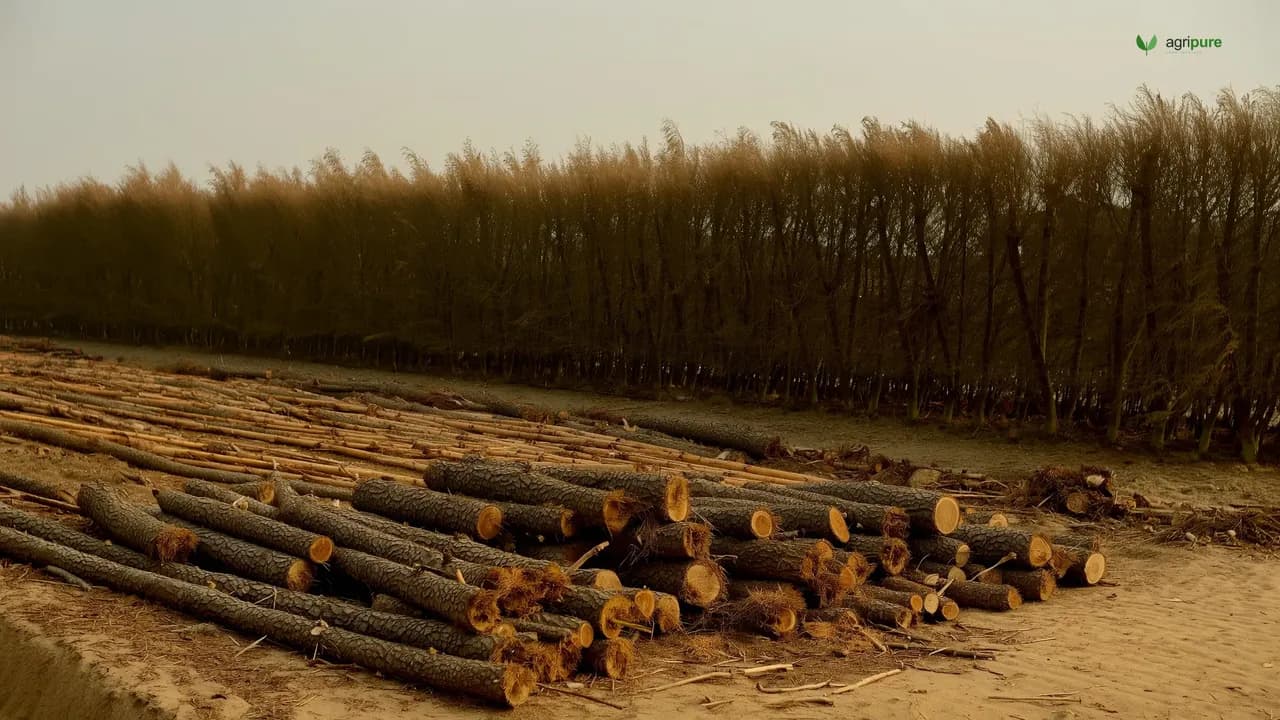
Leucaena is not a crop you harvest. It is a pump you operate. Leucaena leucocephala — ipil-ipil, river tamarind — exists in a syntropic system to convert sunlight and atmospheric nitrogen into biomass faster than almost any other tree available to a Pakistani grower, and then to surrender that biomass to the soil on a schedule you control. The tool that operates the pump is a pruning blade, and the discipline is Ernst Götsch’s chop-and-drop: cut hard, cut often, drop everything in place. Done right, a leucaena hedgerow will mulch a young orchard into fertility within three seasons.
Related Agripure guides

Implementing Ernst Götsch’s chop-and-drop method: Leucaena hedgerows are regularly pruned to deposit nutrient-rich biomass directly onto the soil, rapidly building fertility in a young orchard.
Why leucaena, and how fast it actually grows
Leucaena’s appeal is its growth rate under coppicing. Cut to a low stump, it regenerates vigorously from the base, and a well-managed stand coppiced two to three times a year produces large volumes of nitrogen-rich leaf and fine stem — a green manure with a carbon-to-nitrogen ratio low enough to break down quickly and feed the soil rather than tie up its nitrogen. Its deep taproot mines nutrients and moisture from below the reach of the shallow-rooted crops it shelters, and as a legume it fixes its own nitrogen, so the biomass it gives away costs the soil nothing to produce.
The chop-and-drop protocol, applied to dry Punjab
Götsch’s Brazilian protocol prescribes frequent, hard cutting timed to the system’s growth pulses — cut when the canopy threatens to over-shade the crop below, drop the material as a surface mulch, and let the decomposition release a nutrient flush that the main crop’s roots are waiting to catch. The principle transfers to Punjab; the timing must be adjusted for a drier, more seasonal climate. The two reliable cutting windows are the onset of the monsoon, when moisture guarantees fast regrowth and fast mulch breakdown, and the end of the hot season, when a heavy mulch layer protects the soil through the worst of the heat.
Cut low (50 to 100 cm) to force basal regrowth rather than a tall, woody framework. Coppicing every 4 to 6 months keeps the material young, leafy, and nitrogen-rich; let the interval stretch and you get more wood, less leaf, and a slower-breaking mulch. In a hedgerow alley-cropping layout, the cut material goes straight onto the alley where the food crops grow. There is no carting, no composting step, no delay: the soil surface is the compost heap.
The tool spec that matters
Leucaena stems at a 4–6 month coppice cycle are finger-to-thumb thick — well within the range of a sharp bypass pruner for the smaller material and a bypass lopper for anything approaching wrist diameter. The economics of chop-and-drop reward a blade that holds an edge through hundreds of cuts per session: a forged carbon-steel bypass pruner and a telescopic bypass lopper between them handle a smallholder’s entire hedgerow without a saw. Keep the blades sharp; a crushing cut on green leucaena tears the bark and slows regrowth, while a clean slice heals and re-shoots fast.
The mimosine caveat for livestock
If the biomass is destined for animals rather than the soil, leucaena carries a real constraint: its leaves contain mimosine, a toxic amino acid that, fed in excess, causes hair loss, poor growth, and thyroid problems in ruminants. Used as fodder it must be a supplement, not a staple — a widely cited safe ceiling is keeping leucaena below roughly a third of the ruminant diet, ideally alongside the rumen microbes that detoxify mimosine. As mulch, mimosine is a non-issue and even a mild bonus: it suppresses some weeds as the leaf breaks down. The simplest rule for a smallholder is to default leucaena to the soil and treat any fodder use as the careful exception.
Operated as a biomass pump on a disciplined cut-and-drop cycle, a single leucaena hedgerow will lift the organic matter of the alley beside it season after season — the cheapest fertility a dry Punjab field can buy, paid for in nothing but the swing of a sharp blade.
References
- Frontiers in Agronomy (2022) — leucaena biomass & coppice management (https://www.frontiersin.org/journals/agronomy/articles/10.3389/fagro.2022.890992/full)
- Feedipedia (INRAE/CIRAD/FAO) — Leucaena leucocephala nutritive profile & mimosine (https://www.feedipedia.org/node/282)
- Feedipedia — mimosine content & safe ruminant inclusion rates for leucaena (https://www.feedipedia.org/node/282)
- Götsch, E. — chop-and-drop and biomass management in syntropic systems (collected papers)