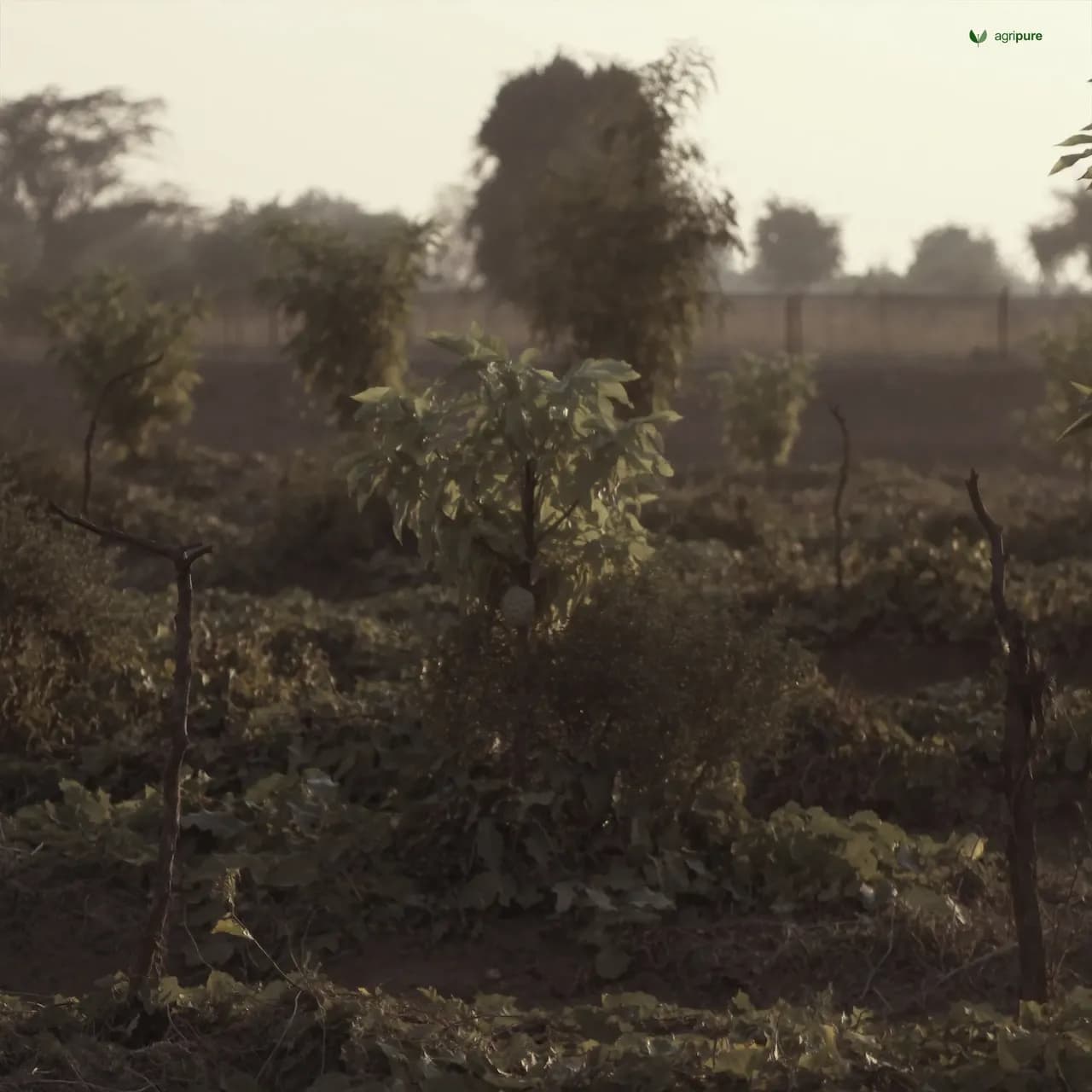
Most growers know the custard apple primarily as a fruit. In a syntropic planting, Annona squamosa (sharifa in the bazaar) earns its place as a functional nurse plant. It is a chaperone: a small, patient, partial-shade tree that holds the middle of a young system together while the climax canopy above it is still a decade from closing. It bears in year three, tolerates the heat and drought that kill more delicate understorey crops, and asks for almost nothing once established. If the pioneer legumes are the soil-builders and the mango is the destination, the custard apple is the chaperone that keeps the guild company along the way.
What a chaperone species actually does
Ernst Götsch’s term for the species that occupy a system between its pioneer and climax phases is deliberately social. A chaperone is a productive, medium-lived tree that accompanies the planting through its initial years, shading the soil, drawing the farmer back for harvest, and vacating space as the canopy matures. Custard apple fits the brief almost exactly. It reaches only 3–5 metres, casts light dappled shade instead of dense shadow, and its shallow, non-aggressive root system competes little with the deeper-rooting mango or guava it sits beneath.
That tolerance of partial shade is the quality that matters most. A full-sun-demanding fruit tree planted into a young guild either bakes in the open or sulks under early canopy. Annona squamosa does neither: it fruits acceptably at roughly 30–40 percent shade, which is precisely the light environment of a three-to-seven-year-old syntropic system before the climax trees close overhead.
Bearing age, and why grafting changes the maths
A seed-grown custard apple in Punjab or Sindh conditions typically flowers in its third year and carries a usable crop by year four. A grafted tree on established rootstock compresses that to the second or third season. The difference is not trivial in a planting designed around cash flow: a grafted chaperone returns fruit money while the climax trees are still pure cost.
The trade-off is propagation difficulty. Annona squamosa is notoriously awkward to graft: softwood cleft and side-veneer grafts succeed at far lower rates than mango, and the scion’s pithy wood bruises easily. Most Pakistani nursery stock is therefore seedling-raised, which is cheaper and produces a hardier, if slower and more variable, tree. For a smallholder building a guild on a budget, seedling custard apple is the honest choice; for a grower who needs early income from a specific cultivar, grafted stock justifies its cost. A single-bevel grafting knife and a few rolls of grafting tape are the only specialist tools the second route requires.
Placing it in a multi-strata guild
The custard apple occupies the secondary layer, below the eventual mango, citrus, or guava canopy and above the herbaceous turmeric-and-ginger ground layer. Spacing is forgiving because the tree stays small: 4–5 metres between custard apples leaves room for a climax tree on a wider grid to mature through and above them. As the canopy closes in years eight to twelve, the custard apples that find themselves too shaded can be pruned hard or removed; they have already paid for themselves several harvests over. That graceful exit is exactly what a chaperone is for.
Pair it with nitrogen-fixing pioneers (sesbania, pigeon pea, leucaena) for the first three years, and the custard apple inherits a soil already improving. Its own leaf litter is modest but useful, and its flowers draw the pollinators (chiefly nitidulid beetles) that a monoculture orchard never attracts. The result is a layer that feeds the household, enriches the soil, and supports biodiversity, providing the returns of a well-chosen chaperone.
The honest limitations
Custard apple is frost-tender; a hard Pothohar winter will check or kill young trees, which is why it belongs to the warmer Punjab plains and the Sindh coast instead of the northern dryland. Its fruit is fragile and short-shelf-life, a farm-gate and local-market crop instead of an export line. And its yields are moderate, not spectacular. None of these are faults in a chaperone; they are the reasons it stays in place and lets the climax canopy take over. Plant it for what it is: the patient teacher of the secondary stage.
References
- Plants for a Future — Annona squamosa database (https://pfaf.org/user/Plant.aspx?LatinName=Annona+squamosa)
- eFloras — Flora of Pakistan, Annona squamosa (http://www.efloras.org/florataxon.aspx?flora_id=5&taxon_id=200008509)
- Growables — Annona squamosa culture & propagation notes (https://www.growables.org/information/TropicalFruit/annonasquamosa.htm)
- Götsch, E. — syntropic-agriculture principles on succession and chaperone species (collected papers)