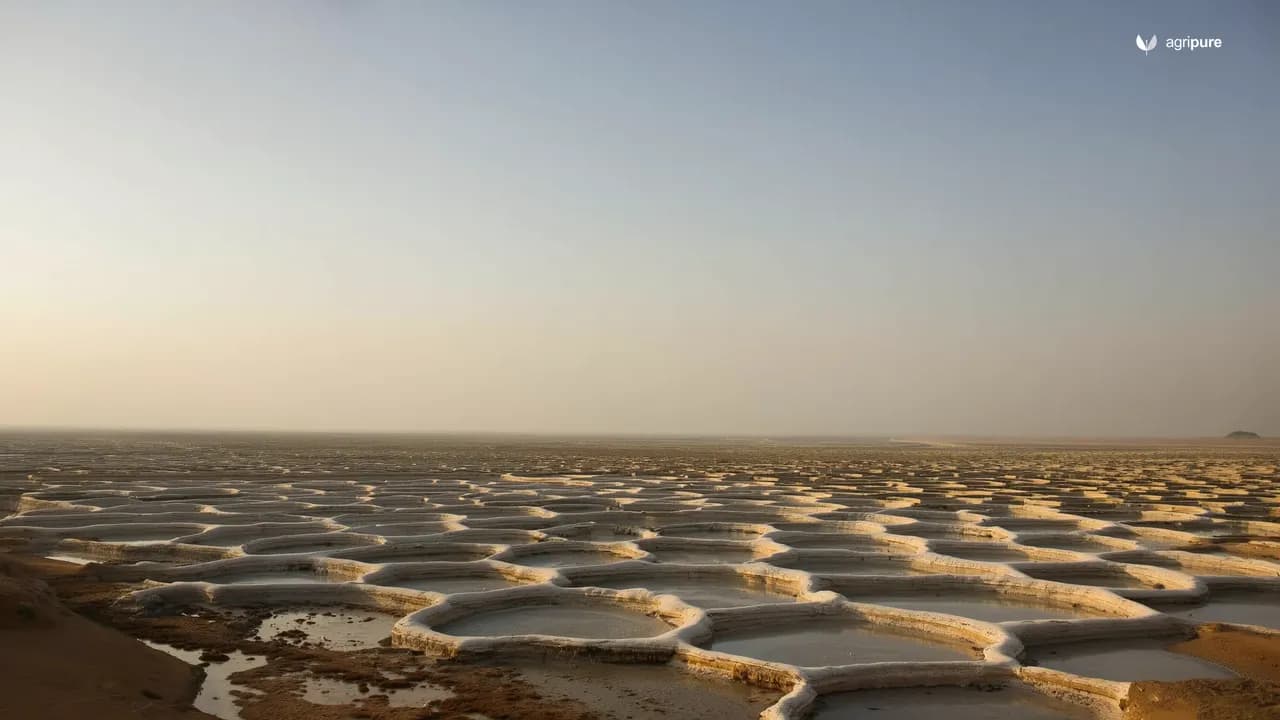
On the Sindh coast, salt is the first thing a planting must survive and the last thing most planting guides take seriously. Beyond about 8 dS/m of soil salinity, the fruit trees and vegetables a farmer actually wants will not establish — they germinate, struggle, and die in the saline pulse that follows every irrigation. The answer is not to fight the salt directly but to send pioneers in first: salt-tolerant species that grow in conditions the climax crops cannot, lower the salinity in their root zone over seasons, and hand the farmer a planted soil instead of a salt flat. This is what the pioneer stage is for on saline ground.
Related Agripure guides

Pioneer species like these hardy plants on the Sindh coast play a large part in reclaiming saline land. By thriving in conditions where other crops cannot, they naturally reduce soil salinity over time, preparing the ground for more sensitive and productive climax crops.
Read the salinity before you plant anything
Salinity is measured as electrical conductivity (EC) in deciSiemens per metre. The bands that matter for planting decisions are roughly: moderate at 4–8 dS/m, where tolerant crops struggle but tough pioneers thrive; high at 8–16 dS/m, where only specialist halophytes and the hardiest pioneers survive; and severe above 16 dS/m, where the first job is drainage and leaching, not planting. A cheap EC meter and a soil-water sample tell you which band you are in — and that single number should drive every species choice that follows.
The pioneers that work at 8 dS/m and above
Sesbania species are the workhorses. Trial evidence consistently shows Sesbania tolerating moderate-to-high salinity while producing heavy nitrogen-rich biomass. It grows where the crop won’t, fixes nitrogen, and its deep roots and copious leaf litter begin the slow biological desalination of the topsoil. Prosopis cineraria (kandi), the indigenous desert tree of lower Sindh, anchors the high-salinity, low-water end: deep-rooted, nitrogen-fixing, and genuinely drought- and salt-hardy, it is the tree that will hold a site too harsh for anything softer. For the most degraded saline flats, fodder halophytes such as Atriplex species are the recognised rehabilitation pioneers: they pull salt into their tissue and tolerate EC levels that kill ordinary plants outright.
The sequence that turns a salt flat into an orchard
The mistake is planting the destination crop first. The working sequence on Sindh coastal salinity is staged. Year one to two: establish the salt-tolerant pioneers — sesbania for biomass and nitrogen, prosopis or atriplex for the harshest patches — and mulch heavily; the goal is living root and shade, which slow surface evaporation and the capillary rise that concentrates salt at the top. Year two to three: as the pioneers lower root-zone salinity and lift organic matter, the EC reading should fall a band; re-test before progressing. Year three onward: introduce moderately salt-tolerant secondary species, then finally the climax fruit trees once the soil sits reliably in the band they can take. Skip the staging and the salt wins; respect it and the same flat that killed your first mango will carry your fifth.
Drainage underwrites everything
No pioneer can outrun a rising saline water table. Where the table is shallow, leaching salt down simply brings it back up; the rehabilitation only holds if excess water has somewhere to go. On the worst sites, pioneer planting must run alongside drainage — open field drains or the regional network — so the salt the pioneers and leaching push down actually leaves the root zone for good. Get the drainage and the pioneers right together, and the salt becomes a stage the land passes through rather than the verdict it stays at.
References
- FAO — salt-affected soils & crop salt-tolerance thresholds (EC bands) (https://www.fao.org/4/y4263e/y4263e0e.htm)
- Texas Water Resources — managing soil salinity (EC classification & leaching) (https://twon.tamu.edu/wp-content/uploads/sites/3/2021/06/Salinity-Pub-March-2014-1.pdf)
- Asian Journal of Plant Sciences (2020) — salt-tolerance evaluation of pioneer species (https://docsdrive.com/pdfs/ansinet/ajps/2020/300-312.pdf)
- ICBA / RAMSAP — Sesbania sesban genotype salt-tolerance & biomass yield (https://ramsap.biosaline.org/publications/evaluation-some-sesbania-sesban-genotypes-their-salt-tolerance-biomass-yield-nutrient)
- USDA ARS — halophyte & salt-tolerant species for saline-soil reclamation (https://www.ars.usda.gov/ARSUserFiles/20360500/pdf_pubs/P2246.pdf)
- PMC — salinity tolerance mechanisms in pioneer leguminous trees (https://pmc.ncbi.nlm.nih.gov/articles/PMC4423721/)
- PCRWR / Sindh Agriculture University Tandojam — coastal saline-soil rehabilitation protocols (institutional reference)