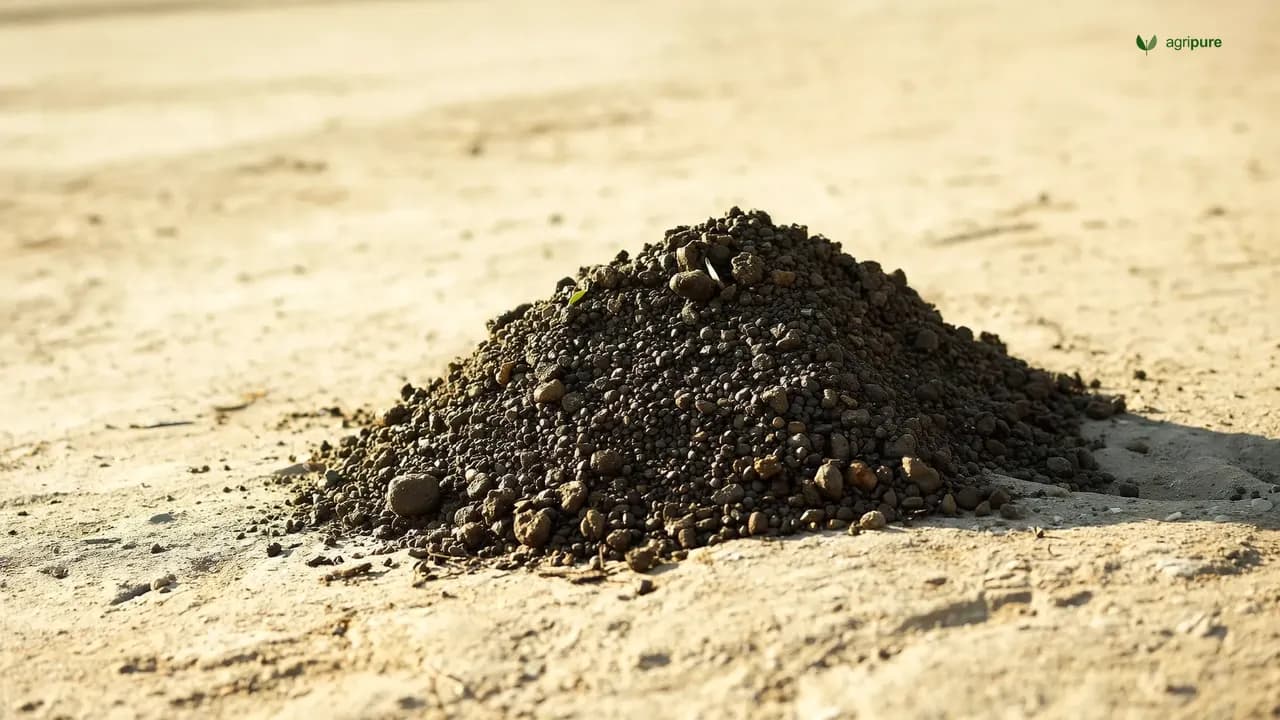
A soil-organic-carbon number arrives looking like a verdict. It is not. It is a starting line. Most Pakistani farmland tests low — commonly 0.2 to 0.6 percent organic carbon on the alluvial plains, against the roughly 0.86 percent that provincial labs already call “low” — and the temptation is to read that figure as a sentence rather than a measurement. The grower who understands what the number means, how fast it can move, and which test produced it, stops losing their nerve and starts using it as the single best progress meter a farm has.
Related Agripure guides

Understanding your soil’s organic carbon levels is the first step toward improving its health and productivity. These numbers are a starting line, not a final verdict.
What “low” actually means here
Pakistani soils are carbon-poor for structural reasons: hot summers that burn through organic matter fast, decades of intensive tillage, residue removal and burning, and bare fallows that expose the soil to oxidation. Vertisols, Inceptisols, and the Aridisols of the drier zones all sit at the low end of the global range. So the first thing to understand about a 0.4 percent reading is that it is normal for the context — not a personal failure, and not a permanent state. It is the baseline from which the only direction that matters is up.
Source: [1] PARC National Reference Soil Lab / Soil Survey of Pakistan — SOC baselines for Pakistani soil orders (institutional reference)Source: [2] FAO — World Reference Base for Soil Resources; soil-organic-carbon assessment
How fast carbon can actually move
The second nerve-steadying fact: organic carbon responds. Under conservation agriculture and agroforestry (continuous cover, minimal tillage, root-in-ground year round, biomass returned rather than removed), soils build carbon measurably within a few seasons, not generations. The gains are incremental and the early years are the steepest, because degraded soil has the most room to recover. Christine Jones’s work on the biological carbon pathway explains the mechanism: living roots and their mycorrhizal partners pump liquid carbon from photosynthesis directly into the soil, where it is stabilised. That is why the single most powerful carbon-building act is keeping something green and rooted growing as much of the year as possible. A syntropic system, with its stacked layers and chop-and-drop biomass, is essentially a carbon-building machine for exactly this reason.
Walkley-Black versus dry combustion: which number you’re holding
Two labs can hand you two different carbon figures for the same soil, and knowing why prevents needless panic. The Walkley-Black wet-oxidation method is the long-standing standard in Pakistani provincial soil-testing labs; it is cheap and widely available but tends to under-recover total carbon, often capturing only a portion of it, so results are typically corrected by a factor. Dry combustion is the more complete, more modern method, measuring total organic carbon directly, and usually returns a somewhat higher figure. The practical lesson for a farmer is simple: compare like with like. Track your soil over time using the same lab and the same method, because the trend — is my carbon rising? — matters far more than the absolute number, and a method switch can manufacture an apparent jump or drop that means nothing.
Using the number, not fearing it
Treat the SOC test as an annual or biennial progress report on the one thing that underwrites everything else: water-holding capacity, nutrient availability, structure, resilience. Take samples the same way, from the same depth, at the same time of year, with the same lab. Watch the trend. A planting that is working will show the line climbing, slowly at first then steadily, and that climbing line is the most honest evidence you have that the system is succeeding. The number was never a verdict. It is the scoreboard, and on a well-designed agroforest, the score goes up.
Source: [1] Jones, C. — liquid-carbon pathway & soil-carbon building (Amazing Carbon)Source: [2] Walkley & Black method vs. dry-combustion total organic carbon — soil-testing methodology (institutional reference)
References
- Soil Organic Carbon: A Foundational Indicator of Soil Health — University of Missouri Extension. Defines SOC as the carbon fraction of organic matter, commonly expressed as a percentage of soil weight, and a management-responsive indicator of soil fertility.
- A global meta-analysis of soil organic carbon in the Anthropocene — Nature Communications. Shows that converting land to cropland causes major SOC losses and that SOC can be restored through management, including introducing trees and adding organic carbon.
- Soil organic carbon sequestration in temperate agroforestry systems: a meta-analysis — Agriculture, Ecosystems & Environment. Finds agroforestry has a significant positive effect on SOC, with alley cropping, shelterbelts, and hedgerows raising stocks in topsoil and subsoil.
- Soil organic carbon sequestration in agroforestry systems: a review — Agroforestry Systems. Reviews evidence that 30–300 Mg C ha⁻¹ can be stored in agroforestry soils to 1 m depth, so small percentage shifts reflect real stock change.
- Soil Organic Carbon: The Hidden Potential — Food and Agriculture Organization of the United Nations (FAO). Establishes that SOC is dynamic and that management can turn soils into either a net source or a net sink of greenhouse gases.
- A new, simple method for analysing soil carbon — World Agroforestry (ICRAF). Describes accessible field and lab methods for measuring soil carbon, supporting the article’s framing of SOC tests as practical for tree-based farms.