Walk across any central Punjab field in June and the evidence is right under your feet. Dig six inches and you find pale grey soil: crumbly, almost powdery, with organic matter so low it barely colours your hand. PARC and provincial soil-testing labs classify most of these alluvial plains at 0.2–0.6 percent soil organic carbon. That is well below the 0.86 percent threshold those labs call “low.” Before you spend money on a mango, citrus, or guava orchard, that soil needs to change. Twelve weeks of Sesbania bispinosa is the cheapest way to begin.
Related agripure guides

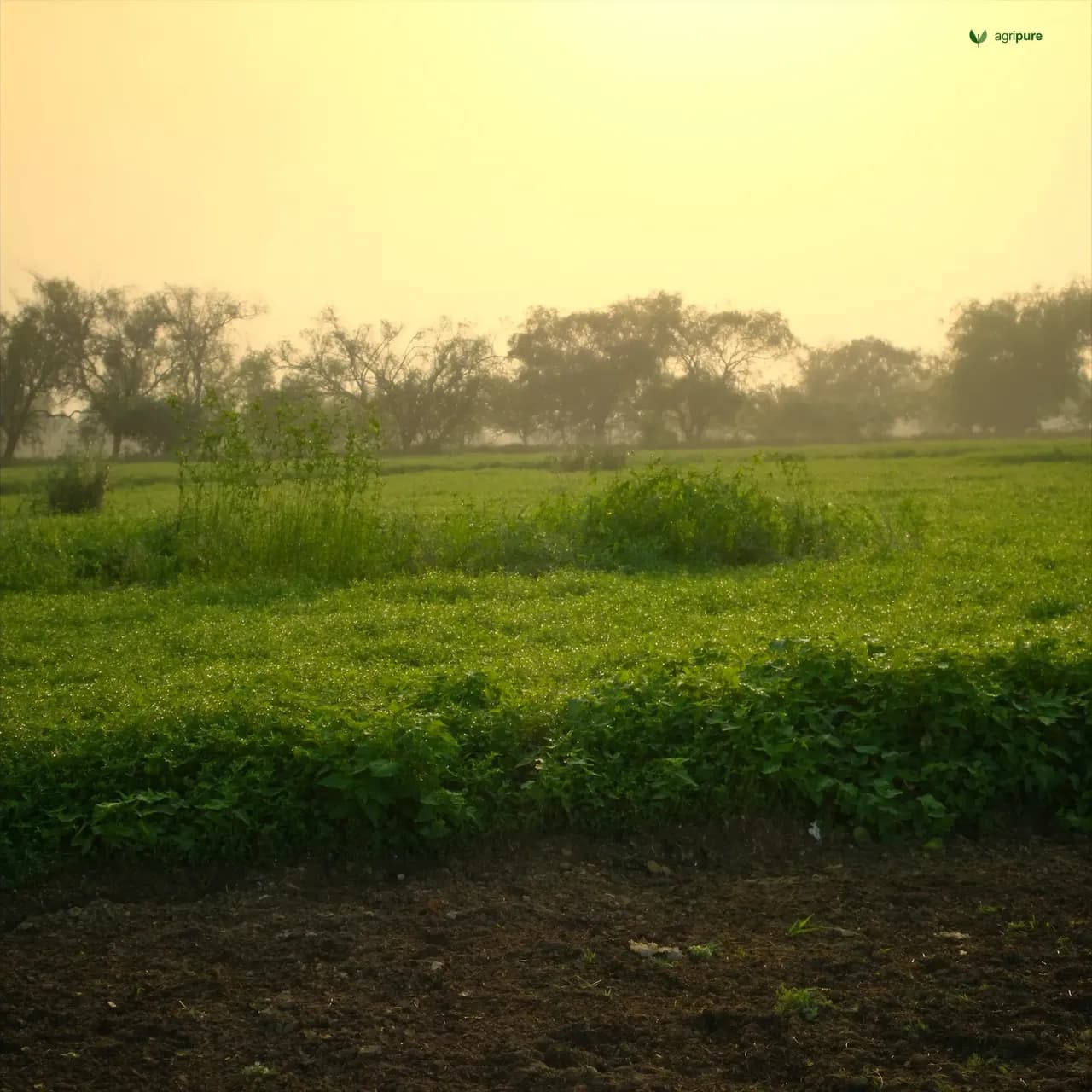
In central Punjab, many fields suffer from critically low soil organic carbon. This pale, crumbly soil, easily sifted by hand, is a clear indicator of the nutrient depletion that a crop like Sesbania bispinosa can help reverse.
What sesbania actually does to your soil
Sesbania bispinosa (called dhaincha locally) is a warm-season annual legume that fixes atmospheric nitrogen through root nodules. Under Faisalabad and similar central-Punjab field conditions, research on its biomass production and tissue nitrogen concentrations consistently implies more than 150–200 kg of fixed nitrogen per hectare in a ten-to-twelve-week growing window. A conservative band used in Pakistan extension work puts a single green-manure cycle at roughly 150–250 kg N per hectare. FAO puts the annual potential, under optimal symbiotic conditions, at 542 kg N per hectare per year.
That nitrogen figure is only half the story. Sesbania grows fast, often reaching two metres in ten weeks on bare, low-fertility soil. When you plough it in at flowering, that green mass decomposes into humus. Humus feeds the microbial community, improves water-holding capacity, and loosens the compacted structure that characterises Punjab’s intensively cropped fields. A single sesbania cycle will not transform your soil profile, but it will lift organic carbon measurably and give your young fruit-tree roots a far better environment to explore.
The root system matters as much as the above-ground biomass. Sesbania produces a dense, fibrous root network that penetrates hard soil layers — a common problem in Punjab fields that have been tractor-ploughed to the same depth for decades, creating a compacted layer at around 20–25 cm. Those sesbania roots channel water downward, and when they decompose they leave macropores that subsequent tree roots will follow. This physical improvement to soil structure is harder to measure than a nitrogen number, but farmers who have used dhaincha before orchard planting consistently report that their first-year trees show less transplant stress and deeper early root establishment.
What PARC and the Punjab Agriculture Department say
Neither PARC nor the Punjab Agriculture Department publishes a single statewide “twelve-week sesbania directive,” but their orchard-establishment bulletins and soil-fertility guidelines make the recommendation clearly. PARC’s soil-fertility guidance for rainfed areas recommends using green-manure legumes such as dhaincha before high-value perennial crops, particularly on degraded soils. The Punjab Agriculture Department’s Extension Wing, in its citrus, guava, and mango planting guides, states that a season of green manure (dhaincha or guar) should be grown and ploughed in at flowering before orchard establishment on barani and light-textured soils.
The timing matters. Ploughing at flowering (roughly fifty to sixty days after sowing) is the critical step. At that point the plant is at peak nitrogen content and hasn’t yet set hard seed. Incorporate it too early and you sacrifice biomass; too late and the stems become woody and decompose more slowly. Once ploughed in, allow two to three weeks before transplanting your tree seedlings. That gap lets the green mass start breaking down and prevents the anaerobic conditions that can harm young roots.
We recommend sowing in two passes if you have any doubt about seedbed uniformity. Broadcast half your seed, rake lightly, then broadcast the remaining half at a slight angle to the first pass. This cross-hatching pattern fills gaps and gives you more even canopy closure — which matters for weed suppression during the first three weeks before the sesbania canopy shades the ground. Weed pressure in that window is the most common reason a dhaincha stand underperforms, and it’s easily avoided with a little attention at sowing time.
The pioneer-to-climax logic behind the method
Bill Mollison’s Permaculture: A Designer’s Manual (1988) describes building productive systems by moving through a deliberate succession: pioneer species first, then secondary, then climax. Pioneers are fast-growing, often nitrogen-fixing, and tolerant of disturbed or degraded conditions. Their role is not to produce fruit; it is to repair the habitat so that longer-lived, more demanding species can establish.
Ernst Götsch’s syntropic agroforestry work applies the same logic to food production. He plants aggressive pioneer legumes densely, prunes and chops them repeatedly, and uses their biomass to fertilise and protect the slower, higher-value trees growing alongside them. Each pruning is a pulse of fertility. The system accelerates its own succession.
Sesbania in Punjab plays the pioneer role exactly. It tolerates sandy-loam soils with very low organic matter — the kind of starting condition that would stress a young mango. It closes the canopy quickly, suppresses weeds, and fixes nitrogen even on soils that are structurally poor. When you incorporate it and plant your fruit trees, you are doing in twelve weeks what Götsch does over several seasons of chop-and-drop: delivering the first pulse of fertility that moves the system from near-bare soil toward a functioning young orchard.
The soil you’re starting from: baseline numbers
Central Punjab’s cultivated alluvial fields consistently test below 1 percent soil organic carbon in national and provincial surveys. FAO’s Harmonized World Soil Database places much of the Punjab plains at 0.3–0.8 percent SOC in the top thirty centimetres. PARC and the Punjab Soil Fertility Survey confirm the same range: most barani and intensively cropped irrigated fields run between 0.2 and 0.6 percent.
These numbers have practical consequences. A soil at 0.3 percent SOC holds water poorly, has a weak microbial community, and offers little buffer against fertiliser leaching. A young fruit tree on that soil needs expensive irrigation and constant feeding. Raise SOC to 0.6 or 0.7 percent and you start to see measurable improvements in water-holding capacity, cation exchange capacity, and root penetration depth. One sesbania cycle will not get you there alone, but it starts the trajectory — and it does so at a fraction of the cost of synthetic nitrogen.
How to read your starting point before you sow
Before you commit to a sesbania rotation, take a baseline reading of your soil’s pH and moisture profile. Sesbania nodulates best between pH 5.5 and 7.5. If your soil is alkaline (as many central Punjab fields are, running pH 7.8 to 8.2), nodulation can be suppressed. A four-in-one soil meter measuring pH, moisture, light, and temperature lets you check conditions at the planting site in two minutes. Take readings at three or four spots across the field, at 10 cm and 25 cm depth, before broadcasting your seed.
If pH is above 7.8, consider a light dose of sulfur or acidifying fertiliser three to four weeks before sowing, then re-test. Do not broadcast sesbania onto waterlogged soil: it tolerates brief flooding but grows poorly in standing water for its first two weeks. Prepare a firm seedbed, broadcast at 25–30 kg per hectare, and cover lightly. No irrigation is required if you sow just before the monsoon; in rabi-timing trials or irrigated plots, one irrigation at germination and one at branching stage are sufficient.
What to do this week
If you plan to plant fruit trees this winter (November through January), your sesbania window opens now. The crop needs ten to twelve weeks to reach flowering and maximum nitrogen accumulation. Sow in the first or second week of August, and you hit the incorporation window in late October or early November. That gives you the two-to-three-week decomposition period before your trees go in the ground.
Three concrete steps for this week: first, collect soil samples from your planting site and run a pH and moisture check. Second, identify your seed source: government-subsidised dhaincha seed is available through provincial agriculture offices, or through commercial suppliers stocking legume seed mixes. Third, mark out your furrow rows and calculate your seed requirement at 25–30 kg per hectare.
Keep a simple record as you go. Note the sowing date, the seed rate, and your pre-sowing pH reading. Photograph the crop at three weeks, six weeks, and at incorporation. These records are useful when you assess your orchard’s first-year performance and want to understand what contributed to it. The investment is modest: the cost of dhaincha seed and one or two tractor passes. The return, 150 or more kilograms of fixed nitrogen plus a measurably improved root zone, will feed your orchard for years without a single bag of urea.
References
- Jilani G. et al. 1996 — “Effect of nitrogen on the growth of Sesbania bispinosa. Pakistan Journal of Botany 28(1).” (http://www.pakbs.org/pjbot/PDFs/28(1)/PJB28(1)12.pdf)
- World Agroforestry Centre 2002 — “Sesbania species fix large quantities of atmospheric nitrogen via root-nodule symbiosis, with FAO citing up to 542 kg N/ha/yr under optimal conditions.” (https://apps.worldagroforestry.org/treedb/AFTPDFS/Sesbania_sesban.PDF)
- Soil & Environment Society of Pakistan — “Green-manure legumes improve nitrogen availability and organic matter in Punjab soils ahead of high-value crop establishment.” (https://www.se.org.pk/File-Download.aspx?archivedpaperid=578)
- World Agroforestry Centre 2002 — “Sesbania species are adapted to low-fertility soils and can substantially raise soil organic matter when used as a green manure.” (https://apps.worldagroforestry.org/treedb/AFTPDFS/Sesbania_sesban.PDF)
- Jilani G. et al. 1996 — “Sesbania bispinosa growth and nitrogen uptake was studied under Faisalabad conditions, confirming high biomass and N-fixation potential on Punjab-type soils.” (http://www.pakbs.org/pjbot/PDFs/28(1)/PJB28(1)12.pdf)