Key takeaways
Close-up of a black soldier fly composting bin showing numerous creamy-white larvae actively breaking down fruit and vegetable scraps, with a few chickens blurred in the background, suggesting their role as protein feed.
Revolutionize your food waste management and feed your flock simultaneously. This innovative black soldier fly composting system efficiently converts kitchen scraps into nutrient-rich larvae for poultry and valuable frass for your garden.
- Black soldier fly larvae are a saprophytic insect that eats food scraps, manure, and farm waste, so the bin runs on what a homestead already throws out.
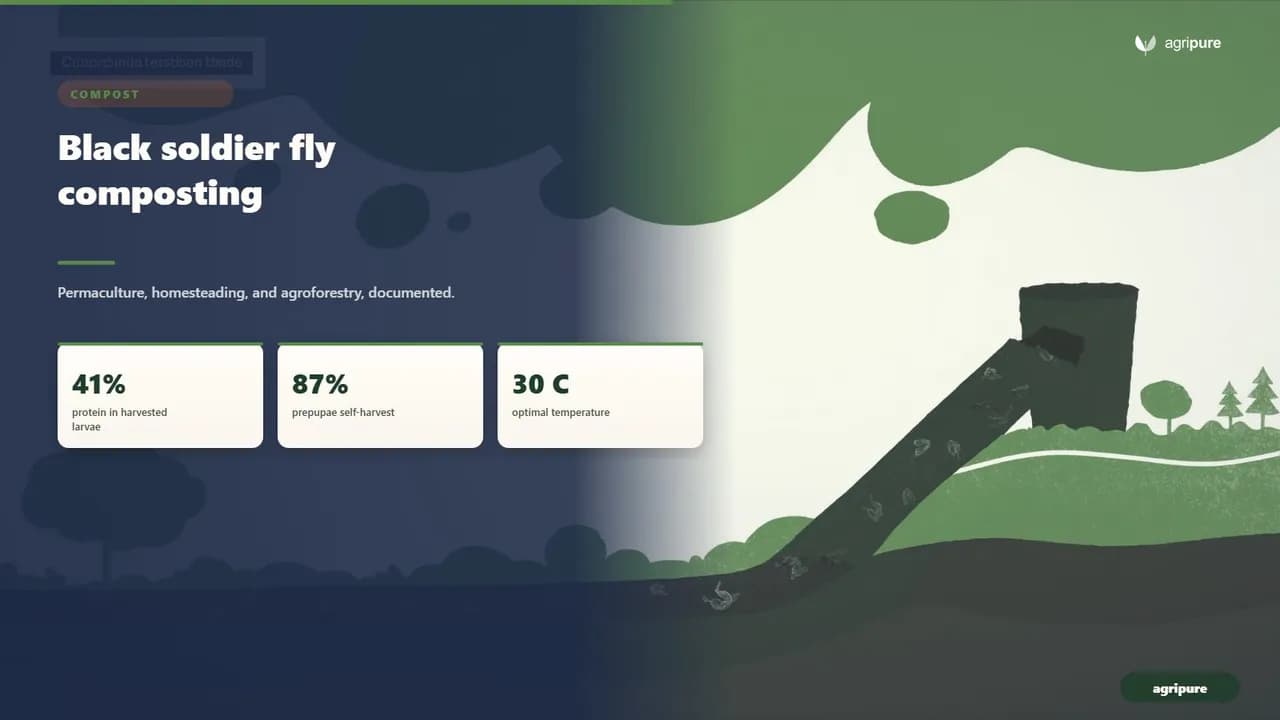
- Harvested larvae average about 41% crude protein and 35% fat on a dry basis, which is why a backyard flock treats them as a feed, not just compost.
- The bin self-harvests: at the prepupal stage the larvae crawl up and out to pupate, and a sloped ramp drops them into a bucket — one trial caught 87% of prepupae this way.
- They thrive at 30 C (86 F); development stalls below about 12 C and fails above roughly 40 C, so the system is seasonal across most of North America.
- The leftover frass is a nitrogen- and chitin-rich soil amendment, the second yield alongside the larvae.
- The US FDA backed dried larvae as a poultry feed ingredient in 2018, so feeding them to laying hens is on solid regulatory ground.
A conventional compost heap gives you one thing back: compost. A black soldier fly bin gives you two — dark, nitrogen-rich frass for the beds and a daily bucket of fat, protein-dense larvae the chickens will mob you for. The engine is the larva of Hermetia illucens, a saprophytic insect that, per a 2022 review in the journal Animals, “primarily feeds on organic wastes such as plant residues, animal manure, and waste, food waste, agricultural byproducts, or straw.” Point that appetite at your kitchen scraps and you get a self-running protein factory. This guide covers how the larvae work, how to build a bin that harvests itself, what to feed them, the protein numbers that make them worth the trouble, and the temperature limits that make it a seasonal system. If you want the aerobic-pile basics first, start with a conventional aerobic compost pile; this is the insect-driven cousin.
How the larvae turn waste into feed
The whole system rides on one fast-moving life stage. Black soldier fly larvae are voracious and quick: in a controlled feeding-rate study, larvae fed food waste at the optimal rate hit a peak prepupal weight of 12.73 g per replicate in just 12 days, with mortality under 1%. That speed is the selling point over worms — a bin can turn a day’s scraps into larval biomass inside 2 weeks rather than the months a cold heap needs.
A close view of a dense mass of pale black soldier fly larvae working through dark, moist kitchen scraps and coffee grounds in a composting tray
What you feed them sets the pace. That same research found that feeding rate, not just quantity, drives efficiency: for food waste the highest waste reduction index, 4.43, came at 0.50 g per larva per day — overfeed and the bin turns anaerobic and reeks, underfeed and growth stalls. For a backyard bin the lesson is to match the feed to the colony: add scraps at the rate the larvae actually clear them, not all at once.
Two yields: larvae and frass
Two products come out the far end, which is the real efficiency of the system. The larvae are the headline yield, but the residue — the frass — is a fine, dark, nitrogen-rich castings material that goes onto beds like any finished amendment. Because composition tracks diet across the 216 to 655 g/kg protein range the review reports (it notes “the content of fat and ash fed from vegetable waste, chicken feed and kitchen waste varies greatly”), a bin fed clean kitchen scraps yields richer larvae than one fed manure alone.
Building a self-harvesting bin
The clever part of a black soldier fly system is that you barely harvest it — the larvae do. Near the end of larval life, around day 12 when they reach prepupal weight, they enter the prepupal stage, stop feeding, darken, and instinctively crawl up and out of the wet substrate to find a dry place to pupate. A study of this behavior in the journal Insects attributes the migration to prepupae “driven by the instinct of locating an adequately safe area to pupate.” Build a ramp they can climb and they walk straight into a collection bucket.
A homemade black soldier fly bin built from a plastic tote with an angled internal ramp rising from the scrap chamber to a drainage spout emptying into a catch bucket
Why the ramp sorts the harvest for you
The self-harvest is also a sorting mechanism: only the mature, ready-to-leave prepupae make the climb. In the same study’s high-moisture treatment, the migration ramp delivered 87% of prepupae to the collection area but only 4% of younger instars — so the bucket fills with finished, fat-rich larvae while the young stock stays behind to keep eating. That self-selection is what makes the harvest nearly labor-free and keeps the breeding population in the bin.
A workable bin has 4 parts: a scrap chamber with a drainage floor (the residue is wet), a ramp angled gently up the wall, a lip or chute at the top, and a catch bucket below the exit. Commercial units sell for real money, but the design is simple enough to cut from a 20-gallon plastic tote. Keep the residue moist but not flooded — the migration study tied the 87% collection rate to its high-moisture treatment, so a bin that drains well harvests better.
What to feed them, and what to keep out
Black soldier fly larvae are far less fussy than worms. A red-wiggler bin chokes on all 3 of meat, dairy, and citrus; a black soldier fly bin handles them, because the larvae are saprophytes built to process exactly the high-fat, high-protein waste — recall those 353.2 g/kg average fat figures — that putrefies in other systems. That broad diet is the practical advantage: it takes the kitchen waste compost piles tell you to avoid.
Still, a backyard bin runs best on the scraps the colony can clear without souring — recall the 0.50 g per larva per day that maximized waste reduction. Use this as a starting split:
Feed freely | In moderation | Keep out |
|---|---|---|
Fruit and vegetable scraps | Meat and fish trimmings | Large bones |
Spent grains, bread, coffee grounds | Dairy and cheese | Anything chemically treated |
Soft garden waste, overripe produce | Oily or greasy leftovers | Woody, fibrous stems |
Manure (for a feedstock-only bin) | Salty cooked food | Persistent pesticides / herbicides |
Diet decides what you can feed back, and the 216-to-655 g/kg protein spread proves it. If you plan to feed the larvae to laying hens, raise them on clean food scraps rather than manure. The review is explicit that substrate changes the animal: larvae “on cow dung grow at a much slower rate of individual size than on poultry feed,” and a manure diet also raises contamination questions for anything destined for the egg basket. Manure-fed bins are best aimed at the compost and frass, not the flock.
Larvae as flock feed: the protein numbers
This is where a black soldier fly bin stops being a compost gadget and starts paying for itself. Harvested larvae are genuinely feed-grade. The Animals review puts average crude protein at 414.7 g/kg — roughly 41% protein on a dry basis — across a range of 216 to 655 g/kg depending on diet. For comparison, that lands them in the same neighborhood as the fishmeal and soybean meal that anchor commercial rations.
A handful of harvested dried black soldier fly larvae being offered to brown laying hens pecking eagerly at the ground
Fat and minerals round out the case. Full-fat larvae average 353.2 g/kg fat — about 35% — which makes them an energy-dense treat, and calcium “is the most abundant” mineral at 1.2 to 35.7 g/kg, useful for laying hens building eggshells. The catch is balance: at 35% fat, larvae are a supplement, not a complete ration. Treat them as a protein-and-energy top-up to a balanced base — it helps to know what is already in your chicken feed before you start swapping in handfuls of larvae, the same way a food forest planted for chickens supplements rather than replaces the feeder.
Feeding them is also legal and documented. The regulatory door opened in 2018: per Poultry Extension, “in September 2018 the US Food and Drug Administration (FDA) recommended an amendment to the Association of American Feed Control Officials (AAFCO) ingredient definition of dried black soldier fly larvae to include feeding to poultry.” So a backyard keeper offering self-harvested larvae to the hens is on the same ground commercial feed mills now are.
Temperature and climate limits
Here is the honest constraint that the homestead blogs skip: black soldier fly composting is a warm-season system across most of North America. The larvae are a warm-climate insect, and a PLOS ONE study of their thermal requirements pins the optimum developmental range at 31.3 to 36.0 C — roughly 88 to 97 F — with population growth “most favourable at 30-degree celsius.”
The edges of that window are hard. That same study sets the lower developmental threshold for larvae at about 11.7 to 12.3 C — below roughly 12 C (54 F) they essentially stop developing — and puts the thermal maximum between 37.2 and 44.0 C, beyond which development fails. Immature stages are also “highly susceptible to freezing,” so an outdoor bin does not overwinter in a cold-winter zone. In practice that means a bin runs from late spring through early autumn in USDA zones 5-7, longer in the South, and needs a heated indoor space to hold a colony through a northern winter. Plan the season honestly rather than fighting the thermometer.
The takeaway
Black soldier fly composting earns its place by doing two jobs at once. It clears the hard-to-compost waste — meat, dairy, citrus, oily scraps — that a worm bin or cold pile can’t, and it converts that waste into larvae running about 41% protein and 35% fat, a feed-grade supplement the FDA has backed for poultry since 2018. Give the prepupae a ramp and the bin harvests itself, leaving you a bucket of larvae and a tray of nitrogen-rich frass. The one real limit is heat: build the colony for the warm season, keep it near 30 C, and bring it indoors or shut it down before the first hard freeze. Run it that way and a few totes turn your kitchen waste into eggs.
Frequently asked questions
How fast do black soldier fly larvae compost food waste?
Fast — a colony processes scraps in roughly 2 weeks rather than the months a cold pile needs. In a controlled study, larvae fed food waste at the optimal rate reached a peak prepupal weight of 12.73 g per replicate in 12 days with mortality under 1%. Feeding rate matters: the best waste reduction came at about 0.50 g per larva per day, so match the feed to the colony rather than dumping it all at once.
How does a self-harvesting black soldier fly bin work?
At the prepupal stage the larvae stop feeding and crawl up and out of the wet substrate to find a dry place to pupate. A ramp angled up the bin wall to a catch bucket exploits that instinct: in one trial the migration ramp delivered 87% of prepupae to the collection area but only 4% of younger larvae, so the bucket fills with mature, fat-rich larvae while the young stock keeps eating.
What can you feed black soldier fly larvae, and what should you avoid?
They are saprophytes and far less fussy than worms — they handle meat, fish, dairy, citrus, and oily scraps that other compost systems reject, alongside fruit and vegetable waste, spent grains, and coffee grounds. Keep out large bones, woody fibrous stems, salty or chemically treated food, and anything carrying persistent pesticides. If you’ll feed the larvae to hens, raise them on clean food scraps rather than manure.
How much protein do black soldier fly larvae have as chicken feed?
Harvested larvae average about 414.7 g/kg crude protein — roughly 41% on a dry basis — and around 353.2 g/kg fat, about 35%, plus calcium as their most abundant mineral. That protein is comparable to fishmeal and soybean meal, but the high fat means larvae are a supplement, not a complete ration. The FDA backed dried black soldier fly larvae as a poultry feed ingredient in 2018.
What temperature do black soldier fly larvae need?
They are a warm-climate insect. Development is fastest in the 31.3 to 36.0 C range (about 88 to 97 F) and population growth is most favourable near 30 C. Below roughly 12 C the larvae essentially stop developing, and development fails above about 40 C. Immature stages are highly susceptible to freezing, so the bin runs in the warm season and needs a heated indoor space to survive a cold-winter region.
Is the leftover frass useful?
Yes. The residue left after the larvae finish is a fine, dark, nitrogen-rich frass that goes onto garden beds like any finished compost or castings. It is the second yield from the bin alongside the larvae, which is part of why a black soldier fly system can be more productive per bin than a worm bin or a cold heap.
References
- Lu, S. et al. “Nutritional Composition of Black Soldier Fly Larvae (Hermetia illucens L.) and Its Potential Uses as Alternative Protein Sources in Animal Diets: A Review.” Animals. pmc.ncbi.nlm.nih.gov
- Chia, S.Y. et al. “Threshold temperatures and thermal requirements of black soldier fly Hermetia illucens: Implications for mass production.” PLOS ONE. pmc.ncbi.nlm.nih.gov
- Parodi, A. et al. “Do It by Yourself: Larval Locomotion in the Black Soldier Fly Hermetia illucens, with a Novel Self-Harvesting Method to Separate Prepupae.” Insects. pmc.ncbi.nlm.nih.gov
- Lim, J.W. et al. “Effect of Feeding Rate on Growth Performance and Waste Reduction Efficiency of Black Soldier Fly Larvae (Diptera: Stratiomyidae).” pmc.ncbi.nlm.nih.gov
- Poultry Extension (eXtension). “Use of Black Soldier Fly Larvae in Poultry Diets.” poultry.extension.org