Key takeaways
Chickens thrive in well-structured food forest environments that encourage natural foraging and offset feed costs.
- Realistic feed-offset from forage is roughly 5 to 20% of a chicken's diet; the rest is grain. (Silvopasture for chickens extension materials.)
- Virginia Tech APSC-198 found even ~30% canopy cover increased outdoor range use: from ~1% of birds outside on open pasture to ~5% on wooded silvopasture.
- A 2023 silvopasture trial (PMC10035879) on plots with 32% canopy cover found 5-15% of birds showed footpad dermatitis (lower than open pasture) and reduced fearfulness on the tonic-immobility test.
- Plant a mulberry-elderberry-comfrey-white-clover layer system in zones 4-9 in North America; avoid rhubarb leaves (oxalic acid), nightshade fruit, and foxglove. (Use sterile ‘Bocking 14’ Russian comfrey to prevent invasive seeding, and apply strictly as chop-and-drop mulch or external liquid fertilizer; never consume comfrey internally due to hepatotoxic pyrrolizidine alkaloids.)
- Rotate paddocks on a 14 to 28-day cycle to break parasite life cycles and let pasture regrow above 4 inches.
- This article stays narrowly on chicken-specific food-forest design; for general silvopasture see livestock-in-the-mature-canopy, and for the seven-layer model see seven-layer-food-forest-in-pakistan.
A food forest designed around chickens differs from one planted for human harvest. The species matrix is different, the layout is paddock-first, and success is measured in feed cost offset and bird welfare rather than fruit yield per acre. This guide is for North American homesteaders in roughly USDA zones 4 to 9 who keep chickens and want a perennial paddock system to reduce feed costs and pasture wear. It focuses on species, layout, rotation, and feed-offset numbers without covering general silvopasture theory or mixed-livestock canopy systems. For husbandry baselines, see our raising pastured chickens guide, and for flock nutrition, see raising chickens for eggs.
The realistic feed-offset target
Before designing anything, set the goal honestly. Extension materials on silvopasture for chickens are consistent: chickens can get 5 to 20% of their diet from forage, and the rest is grain. Meat birds (broilers) sit at the bottom of that range; foraging breeds on a well-designed perennial paddock can reach the top of it. Anyone selling a ‘free feed’ food-forest design is selling a story.
Bird type | Forage % of diet (realistic) | Why |
|---|---|---|
Heritage layer (Plymouth Rock, Orpington) | 10 – 20% | Strong foraging instinct, longer outdoor time |
Production layer (sex-link, Leghorn) | 5 – 15% | Bred for feed conversion, less foraging |
Fast-growing broiler (Cornish Cross) | <5% | Poor foragers, short outdoor windows |
Slow-growing meat (Freedom Rangers) | 8 – 15% | Better foragers than Cornish, still mostly grain |
What this means in dollars: for a 6-bird heritage layer flock eating ~3 lb of feed per bird per week, a 15% offset is roughly 14 lb of feed saved per week, or about USD 12 – 20 / month on a soy-free whole-grain ration at 2026 prices. It is worth doing over the trees' 30+ year lifespan, though it will not eliminate feed costs entirely.
Species that feed chickens
The species choice for a chicken food forest is narrower than a human food forest for two reasons: chickens cannot eat most of the canopy fruit until it falls (so dropping trees beat climbing trees), and a lot of textbook food-forest plants are toxic to poultry. The list below sticks to species with documented chicken use in North American temperate climates.
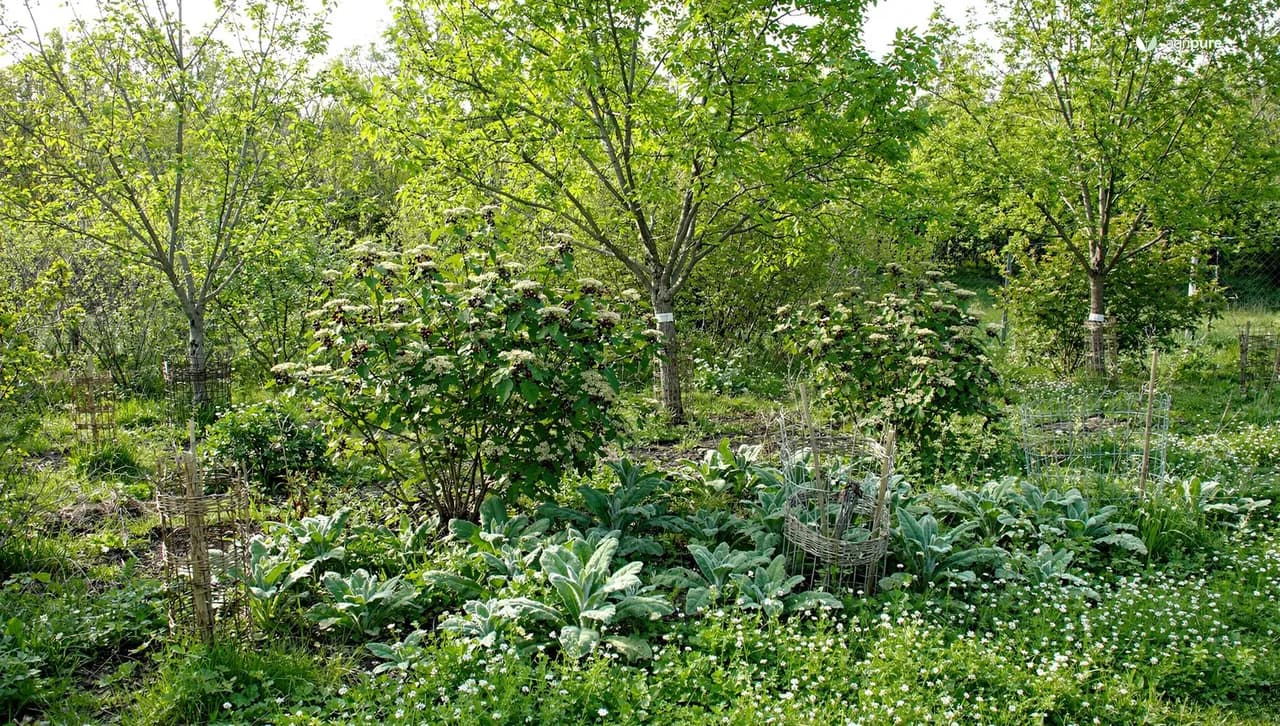
Mulberry, elderberry, and black locust over comfrey and white clover - a chicken food-forest layer system on a small homestead, no birds visible
Layer | Top picks (zones 4-9) | What it gives the flock |
|---|---|---|
Canopy (drop fruit) | Mulberry (Morus alba, M. rubra), persimmon, hawthorn | Fall fruit drop, shade, perch |
Sub-canopy | Mulberry, serviceberry, Siberian pea shrub (avoid black locust, Robinia pseudoacacia, as its seeds, bark, and leaves contain toxalbumins poisonous to poultry) (Siberian pea shrub, Caragana arborescens, self-seeds freely and is listed as an invasive concern in parts of the upper Midwest and prairie woodland edges.) | Drop berries, leaf forage, N-fixation |
Shrub | Currants, gooseberries, sea buckthorn (Sea buckthorn is dioecious—requiring both male and female plants for fruit—and spreads vigorously by root suckers unless contained with a root barrier.) | Drop fruit, ground cover |
Herbaceous | Comfrey, plantain, dandelion, sorrel (small amounts) | Leaf forage, mineral pump |
Ground cover | White clover, Dutch clover, chickweed, lamb’s quarters | Continuous leaf forage + N-fix |
Root + insect | Jerusalem artichoke (tuber), comfrey roots for insects | Insect habitat under mulch |
The mulberry case: mulberry is the single highest-value species in a temperate chicken food forest. The trees drop fruit for 4 – 6 weeks in early summer in zones 5 – 8, the leaves are a high-protein forage, and the trees coppice. Plant 2 – 3 mulberries per 6-bird flock and rotate the paddock under them when fruit is dropping.
Plants to keep out of the paddock
The toxic-plant list matters because chickens will sample most things at least once. A well-fed flock with options usually avoids the worst plants, but a hungry one will not. The shortlist below covers the plants most likely to appear in a North American food-forest design that chickens should not have access to.
Plant | Toxin | Severity | Note |
|---|---|---|---|
Rhubarb leaves | Oxalic acid | High | Stalks fine for humans; leaves cause kidney damage in poultry |
Nightshade family unripe fruit (potato, tomato) | Solanine | High | Ripe tomato fruit OK in small amounts |
Foxglove (Digitalis) | Digitalis glycosides | Lethal | Cardiac toxin; keep out entirely |
Yew (Taxus) | Taxine alkaloids | Lethal | Common hedge; remove from poultry zones |
Pokeweed | Phytolaccatoxin | High | Mature berries and roots; chickens often avoid |
Oak acorns in quantity | Tannins | Moderate | Occasional foraging fine; acorn mast year may overload |
A practical rule: if your food forest already contains foxglove, yew, or established rhubarb, fence the chicken paddock around them or remove them before letting the flock in. Chickens are good at avoiding bitter plants when full; they are bad at it when their grain feeder is empty.
Paddock layout and rotation
A working chicken food forest is multiple paddocks under one canopy. Single-paddock designs fail the same way single-pen pasture fails: the ground gets nuked, parasite pressure climbs, and the perennials never recover from the scratching. The standard pattern is a 3 to 4-paddock rotation under a mixed canopy, with the flock spending 5 – 7 days in each before moving on.
Layout element | Rule of thumb | Why |
|---|---|---|
Paddocks per flock | 3 – 4 | Lets ground rest 14 – 28 days between visits |
Time per paddock | 5 – 7 days | Long enough to harvest forage, short enough to prevent overgraze |
Canopy cover target | 30 – 40% | Virginia Tech APSC-198 found ~30% canopy increased outdoor range use significantly |
Tree protection | 1.2 m woven wire cylinder, mulch ring | Young trees get girdled by scratching in 1 – 2 seasons |
Flock density | Max 100 birds / acre on long rotation | Higher density needs shorter visits, longer rest |
The 32% canopy benchmark: the 2023 silvopasture trial (PMC10035879) used plots with 32% canopy cover and found broilers there had lower footpad dermatitis (5 – 15% of birds affected vs higher on open pasture) and reduced fear responses on the tonic-immobility test. Both outcomes track with chickens’ jungle-fowl ancestry preferring overhead cover.
Seven layers, adapted for poultry
The classic 7-layer food forest model needs three substitutions to work for chickens. The standard layers are designed for human harvest from below or above, and a few of them create more problems than benefits when birds live in them year-round.
Standard layer | Adapted for chickens | Why the swap |
|---|---|---|
Canopy: tall fruit and nut | Drop-fruit canopy: mulberry, persimmon, hawthorn | Chickens cannot pick fruit at height |
Sub-canopy: dwarf fruit | Sub-canopy + N-fixers: black locust, Siberian pea shrub | N-fixation supports forage growth under canopy |
Shrub: berries | Same: currants, gooseberries, sea buckthorn | Chickens eat dropped berries; thorny shrubs limit damage |
Herbaceous: kitchen herbs | Forage herbs: comfrey, plantain, dandelion | Comfrey produces 4 – 6 cuts a year |
Ground cover: edible greens | Continuous clover + chickweed mix | Re-seeds itself under scratching pressure |
Vine: kiwi, grape | Skip or fence out | Chickens climb / damage; ground-level vines a tripping hazard |
Root: edible roots | Jerusalem artichoke + comfrey roots | Below paddock disturbance depth |
What this does not replace
One honest qualifier: a food forest paddock does not eliminate the grain ration, and trying to push past the 5 – 20% forage share starves the flock or grinds the perennials to dust. It also does not replace coop design, predator protection, or the husbandry decisions that determine whether the flock survives. If a paragraph of this guide is starting to feel like husbandry advice, this is the cross-reference to pull:
You are asking about | Where to read |
|---|---|
Daily coop care, predator protection, basic husbandry | raising-pastured-chickens |
General silvopasture and mixed livestock canopy | livestock-in-the-mature-canopy |
Seven-layer food-forest fundamentals (human harvest) | seven-layer-food-forest-in-pakistan |
Breed selection + premium feed + cost / dozen | raising-chickens-for-eggs |
The honest closing math: a mature 3-paddock chicken food forest on 0.25 acre might cut a 6-bird heritage layer flock’s feed cost by 10 – 15%, improve the omega-3 profile of the eggs, and give the trees decades of fertility from manure deposition. The trees take 3 – 7 years to start producing usable drop fruit. Plant now; the offset compounds.
The takeaway
A chicken food forest is a long-term investment in perennials that yields animal welfare, soil health, and a modest 10 – 20% feed offset without eliminating the feed bill. The species that do the work in North American zones 4 – 9 are mulberry, elderberry, black locust, comfrey, and white clover. Layout is 3 – 4 paddocks under 30 – 40% canopy cover, rotated every 5 – 7 days, with young trees fenced from the flock. Keep rhubarb leaves, foxglove, yew, and nightshade fruit out of the design. For the husbandry side, the pastured-chickens guide covers what this article deliberately does not; for the canopy theory, livestock in the mature canopy and the seven-layer food forest piece. For the egg-economics side, raising chickens for eggs.
Frequently asked questions
Can a food forest replace chicken feed?
No. Realistic forage share of a chicken's diet, per silvopasture extension materials, is 5 – 20%: heritage layers at the high end, fast-growing broilers under 5%. The rest is grain. A well-designed perennial paddock cuts feed cost by roughly 10 – 20% for a heritage layer flock and improves the egg’s omega-3 and carotenoid profile, but it does not eliminate the feed bill.
What’s the single most valuable tree for a chicken food forest?
Mulberry, in most temperate North American zones. Mulberries drop fruit for 4 – 6 weeks in early summer (zones 5 – 8), the leaves are high-protein forage, and the trees coppice well. Plant 2 – 3 per 6-bird flock and rotate the paddock under them during fruit drop. Persimmon and hawthorn are useful secondary canopies for the same drop-fruit reason.
Which food-forest plants are toxic to chickens?
The shortlist: rhubarb leaves (oxalic acid), all nightshade family unripe fruit and foliage (solanine), foxglove (cardiac glycosides), yew (taxine alkaloids), and pokeweed berries and roots. Oak acorns in mast quantity can also be a problem. Chickens usually avoid bitter plants when fed; a hungry flock will not. Fence or remove these from any paddock.
How should I rotate the paddocks?
3 – 4 paddocks under a shared canopy, with the flock spending 5 – 7 days in each before moving. That gives every paddock 14 – 28 days of rest, long enough for forage to regrow above 4 inches and short enough to break the cycle of most poultry parasites. Higher flock density needs shorter visits and longer rest. Tree-protection cylinders (woven wire, ~1.2 m tall) are mandatory in the first 2 – 3 seasons.
How much canopy cover is right?
30 – 40% is the working range. Virginia Tech APSC-198 found even ~30% canopy cover meaningfully increased outdoor range use, from roughly 1% of flocks roaming on open pasture to ~5% on wooded silvopasture. The 2023 trial (PMC10035879) used 32% canopy and found broilers there had lower footpad dermatitis and reduced fearfulness on the tonic-immobility test. Heavier shade than 40% starts to reduce understory forage.
How long until the paddock starts producing?
Mulberry begins useful fruit drop in years 3 – 5 from a 1-gallon nursery whip; elderberry in years 2 – 3; black locust adds nitrogen fixation from year 1 and meaningful coppice biomass by year 4. Plan on 3 – 7 years to start seeing the feed-offset side of the math. The compensation is that the system runs for 30 – 50 years once established.
References
- Booth, B.J. et al. “Silvopasture Systems for Broiler Chickens: Ranging Behavior and Range Use.” Virginia Tech Extension APSC-198. pubs.ext.vt.edu
- Stadig, L.M. et al. (2023). “Effect of silvopasture system on fearfulness and leg health in fast-growing broiler chickens.” Poultry Science, PMC10035879. pmc.ncbi.nlm.nih.gov
- SARE LS20-332. “Silvopasture for Poultry Production with Outdoor Access: Impact on animal welfare, economic, and environmental parameters.” projects.sare.org
- Penn State Extension. “Small-scale egg production (organic and non-organic).” extension.psu.edu
- University of Minnesota Extension. “Raising chickens for eggs.” extension.umn.edu