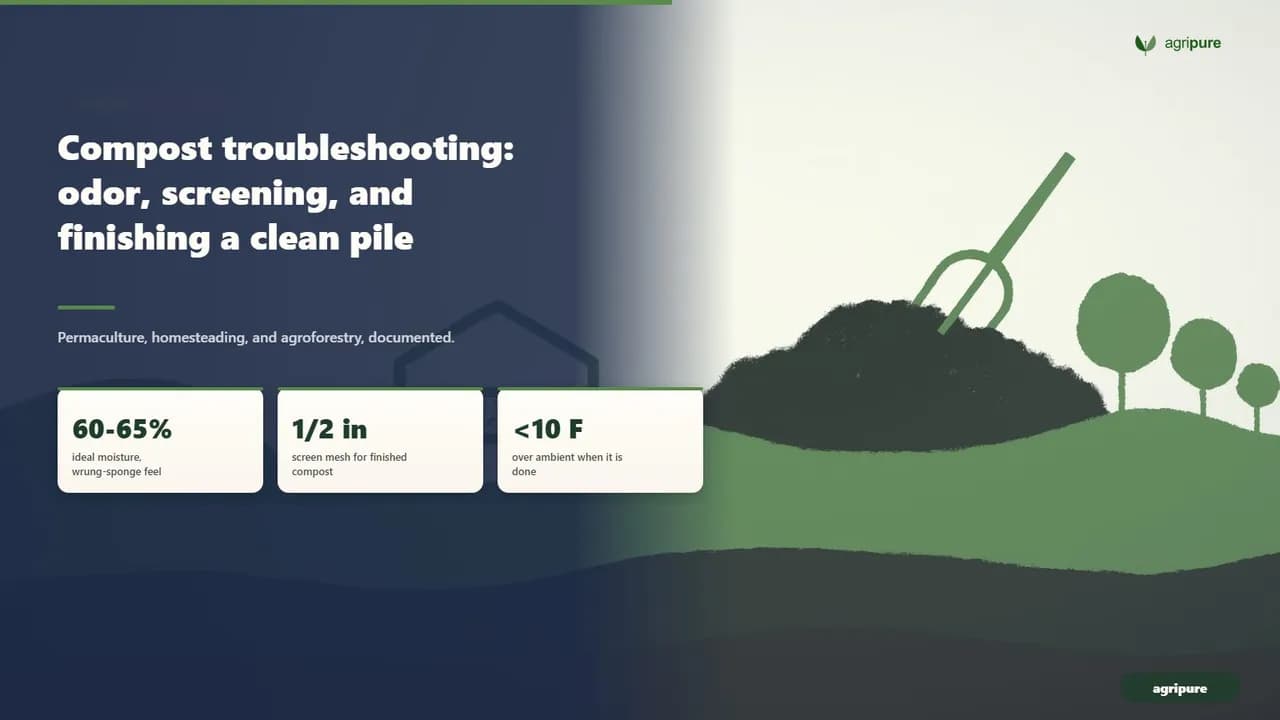
Key takeaways
Close-up of hands wearing gardening gloves, sifting through a dark, rich, and crumbly compost pile in a wooden bin. The compost displays an ideal earthy texture, and a faint wisp of vapor indicates warmth. A small, clean hand trowel is visible on the bin's edge, with blurred garden foliage in the background under soft daylight. The image highlights the perfect consistency and appearance of finished, healthy compost.
A healthy compost pile should be consistently dark, crumbly, and emit a pleasant earthy aroma, signaling active decomposition and a successful process. Maintaining proper moisture and aeration is crucial to prevent common odor issues and achieve this ideal consistency.
- A healthy pile smells earthy, not sulfurous; any sharp odor is a diagnosable problem, not a reason to give up.
- Two smells, two causes: rotten eggs or sour means too wet and anaerobic; sharp ammonia means too much nitrogen (a low carbon-to-nitrogen ratio).
- Most odors share one fix – turn the pile to add air and mix in dry, coarse browns like straw, dry leaves, sawdust, or shredded paper.
- Keep moisture around 60 to 65%, damp like a wrung-out sponge; above that, oxygen cannot move and the pile turns anaerobic.
- Screen finished compost through a half-inch hardware-cloth frame and toss the oversize chunks back in to finish.
- Compost is done when it is dark, crumbly, earthy-smelling, and less than 10 F warmer than the surrounding air; confirm with a radish-seed germination test.
- A compost filter sock – a mesh tube of compost – puts coarse or surplus compost to work filtering runoff, then gets raked into the soil afterward.
A compost pile that works smells like a forest floor – earthy, faintly sweet, nothing you would step back from. So when a bin starts to reek, the instinct is to assume composting itself is the problem. It is not. A bad smell is the most useful diagnostic a pile gives you: the specific odor names the specific fault, and almost every one of the 5 common faults is corrected in an afternoon with a fork and a bale of straw. This guide walks the 2 odor families and their fixes, then takes the pile through to the finish line – screening the crumbly part out from the chunks, knowing when it is truly done, and one use for coarse or surplus compost that most home growers never consider: a filter sock. If you are still building your first pile, start with the fundamentals of building a compost pile; this piece is about fixing one that has gone sideways and finishing one that has gone right.
Why a compost bin smells
Start with the reassurance: a properly built pile barely smells at all. Oregon State Extension puts the baseline plainly – healthy compost “smells earthy, not sulfurous.” The aerobic microbes doing the work are quiet, odorless decomposers, happiest at a moisture around 60 to 65% with air moving freely. Smell only shows up when those microbes are shut out, and the kind of smell tells you which way the pile failed. There are really just 2 odor families, and they point in opposite directions.
A dark, wet, compacted compost pile being opened with a garden fork, slightly slumped and dense, with drier brown straw at the edges, no people
Rotten eggs or sour: the pile is suffocating
A rotten-egg, sour, or putrid smell means the pile has gone anaerobic – the aerobic microbes ran out of oxygen and anaerobic ones took over. Cornell’s composting program notes that anaerobic odors are “most notoriously the reduced sulfur compounds” – hydrogen sulfide is the one that smells like rotten eggs. This happens when a pile creeps past about 65% moisture or packs down so air cannot move through it. Oregon State pins the cause on “low oxygen and excess moisture” – 2 conditions that almost always travel together.
Sharp ammonia: too much nitrogen
A sharp ammonia smell is the opposite problem – not too little air, but too much nitrogen. Cornell singles it out: “ammonia is the most common odor that can be formed aerobically as well as anaerobically.” When the carbon-to-nitrogen ratio drops well below the balanced 30:1 a pile wants – think a heap of nothing but grass clippings or kitchen scraps – the surplus nitrogen gasses off as ammonia. NC State lists the rancid, vinegar, or rotten-egg pile as “too wet or not enough air or too much nitrogen,” the 3 faults that cover nearly every smelly bin.
Quick read: sniff before you fix. Rotten eggs / sour = too wet, no air – the pile needs to dry out and breathe. Ammonia = too much nitrogen – the pile needs carbon. Both are corrected the same afternoon; the difference is mostly how much dry brown material you add and whether you also need to loosen the pile.
Fixing each odor, fast
The good news is that 1 motion fixes most of it: turn the pile. Turning forks air back in, breaks up the soggy anaerobic pockets, and lets you blend in dry material as you go. The University of Illinois Extension’s entire prescription for a bad-smelling pile is 6 words: “turn it, add dry material if the pile is too wet.” What you add, and how much, depends on which of the 2 smells you diagnosed.
Smell | Cause | The fix |
|---|---|---|
Rotten eggs / sulfur | Anaerobic – too wet, compacted, no air | Turn the pile; mix in coarse dry browns (straw, wood chips) to open it up |
Sour / vinegar | Going anaerobic, excess moisture | Add dry, bulky material; turn to dry it out and re-aerate |
Sharp ammonia | Too much nitrogen, C:N too low | Mix in carbon – dry leaves, straw, sawdust, shredded paper |
Musty / damp | Slightly too moist, slow air | Add a dry bulking agent; turn |
No smell but cold | Stalled – often too dry or too small | Moisten to a wrung-sponge feel; add nitrogen and mass |
The moisture number that prevents most of it
Almost every odor traces back to water. Oregon State gives the target that keeps a pile aerobic: “about 60%-65% moisture – damp like a wrung-out sponge.” Past roughly two-thirds water by weight, the spaces between particles fill with liquid instead of air and the pile suffocates. The field test needs no meter: grab a handful and squeeze. A few drops is right; a trickle is too wet and headed for trouble; bone dry and crumbly with no give is too dry to heat. The browns you add to fix a smell do double duty here – straw, shredded leaves, and wood chips soak up excess water while they open the pile to air.
Why coarse browns beat fine ones for a fix: sawdust adds carbon but packs down; straw and wood chips add carbon and structure, propping the pile open so air keeps moving after you walk away. For a stinking, slumped pile, reach for the coarsest dry material you have first. For the underlying recipe that keeps a pile from smelling in the first place, our browns-to-greens recipe for a hot pile covers the carbon-to-nitrogen balance in depth.
Screening finished compost
Once a pile is mostly broken down, it is rarely uniform. You get dark, crumbly finished compost shot through with stragglers – twigs, corn cobs, an avocado pit, a clump that never quite went. Screening separates the 2 streams so the finished part goes to the garden and the rest goes back to cook. It is the 1 step that turns a rough heap into a clean, even soil amendment you can spread or pot with.
A homemade compost screen of half-inch hardware cloth in a simple wood frame resting across a wheelbarrow, dark sifted compost below and coarse chunks held on top, no people
The tool is about as simple as garden tools get. NC State Extension describes it in one line: “a simple screen can be made with half-inch mesh hardware cloth and a wood frame.” Build a shallow box the width of your wheelbarrow, staple 1/2-inch hardware cloth across the bottom, and set it on top of the barrow. Shovel compost on and shake; the fine stuff falls through and the oversize pieces ride on top, which – again per NC State – get “added back into the compost pile.” Nothing is wasted: the chunks carry live microbes and become inoculant for the next batch.
Mesh size | Output texture | Best for |
|---|---|---|
1/2 inch | Coarse, all-purpose | Garden beds, mulch, top-dressing, filter socks |
1/4 inch | Fine, even | Seed-starting blends, lawn top-dressing, potting mixes |
3/8 inch | Medium | A middle ground for general garden use |
Screen on a dry day. Damp compost clogs the mesh and balls up instead of falling through. If the pile is still wet enough to smell, fix the moisture first – then let it dry to a crumbly feel before you screen. Wet compost is also heavier to lift and far more tiring to shake through a frame.
Is the compost actually finished?
Screening tidies the texture, but it does not tell you the compost is mature. Unfinished compost dug into a bed can rob nitrogen and even stunt seedlings as it keeps decomposing. 3 cheap checks settle it – look, feel, and a seed test – and none needs a lab or more than 7 days.
NC State Extension gives the field definition: compost is “basically done when the original materials are unrecognizable, the pile temperature is less than 10 degrees warmer than ambient, and it is dark brown or black and smells earthy (not like ammonia or rotten eggs).” That temperature clue is the most reliable one – if a finished-looking pile is still running hot, the microbes are still working and it is not done. A compost thermometer or even a hand pushed into the center tells you in seconds.
The radish test for maturity
To be sure the compost will not harm plants, run the test NC State recommends: “test it on radish seeds to make sure it does not prevent germination or damage the plants.” Sow a few radish seeds in a pot of the finished compost and a few in plain potting mix as a control. Radishes sprout in 3 to 7 days, so within a week you have your answer. If the compost-grown seeds germinate and grow as well as the control, the compost is mature and safe. If they lag, fail, or come up deformed, the compost is still immature – give it a few more weeks to cure and test again. Once it passes, it is ready to dig into beds for building soil organic matter with finished compost.
Putting a compost filter sock to work
Here is the use almost no backyard composter thinks of. When you screen a pile, the 1 stream nobody wants is the coarse rejects, and a productive system often makes more compost than the beds can take. Both are perfect for a compost filter sock – a tool the erosion-control trade has used for 20-plus years and home growers can borrow.
The US EPA defines it cleanly: a compost filter sock is “a mesh tube filled with compost that is placed perpendicular to sheet flow runoff to control erosion and retain sediment.” Lay one across a slope or at the bottom of a bare bed and rainwater filters through the compost while soil stays put. A real advantage for a home site: “no trenching is required during installation,” so a sock can even sit on a driveway as inlet protection for a storm drain. It is silt-fence performance without the digging or the stakes.
Use | Where it helps | Sock fill |
|---|---|---|
Slope erosion control | Bare or newly graded ground after rain | Coarse screened or surplus compost |
Bed / path edging | Keeping mulch and soil from washing off beds | General-purpose compost |
Storm-drain inlet protection | Driveways, hard surfaces – no trenching needed | Coarse compost in UV mesh |
Garden runoff filtering | Downhill edge of a vegetable plot | Surplus finished compost |
The best part – it disappears into the garden. The EPA notes that compost filter berms and socks “can be easily vegetated and incorporated into the landscape when the job is completed, so removal and disposal is unnecessary.” When the sock has done its work, cut the mesh, rake the compost into the soil it was protecting, and it becomes a soil amendment. Coarse rejects that could not go on a seedbed find a second life holding a slope together, then feed it.
The takeaway
A smelly compost bin is not a failure – it is a label. Rotten eggs or sour means too wet and airless: turn it and add coarse dry browns. Sharp ammonia means too much nitrogen: add carbon. Keep moisture near a wrung-out-sponge 60 to 65% and most smells never start. When the pile cools to within 10 F of the air, goes dark and earthy, and passes a radish-seed test, screen it through half-inch hardware cloth and send the chunks back to finish. Then put even the coarse rejects to work in a filter sock before they melt into the soil. A pile that smells right, screens clean, and finishes fully is the whole job – the rest is just spreading it. For the recipe that keeps a pile sweet from day one, the hot-composting method is the companion to this troubleshooting guide.
Frequently asked questions
Why does my compost bin smell so bad?
Because air is being shut out or nitrogen is in excess. A rotten-egg, sour, or putrid smell means the pile has gone anaerobic – too wet and compacted for oxygen to move, so sulfur compounds like hydrogen sulfide form. A sharp ammonia smell is the opposite: too much nitrogen relative to carbon, so the surplus gasses off. A healthy pile, by contrast, smells earthy, not sulfurous.
How do I get rid of compost odor fast?
Turn the pile to add air, then mix in dry, coarse browns – straw, dry leaves, wood chips, or shredded paper. The University of Illinois Extension’s whole fix for a bad-smelling pile is to turn it and add dry material if it is too wet. For an ammonia smell, focus on adding carbon; for a rotten-egg smell, focus on loosening and drying the pile so it can breathe.
How wet should compost be so it doesn’t smell?
About 60 to 65% moisture, which Oregon State Extension describes as damp like a wrung-out sponge. Squeeze a handful: a few drops is right, a trickle is too wet, and bone-dry with no give is too dry to heat. Above roughly two-thirds water by weight, oxygen can no longer move through the pile and it turns anaerobic and smelly.
What size mesh should I use to screen compost?
Half-inch hardware cloth in a simple wood frame is the standard, per NC State Extension – coarse, all-purpose, and fast to shake through. Use quarter-inch mesh for a finer product like seed-starting blends or lawn top-dressing. Screen on a dry day; damp compost clogs the mesh. Oversize chunks that ride on top go back into the pile to finish.
How do I know when compost is finished?
It is done when the original materials are unrecognizable, it is dark brown or black and smells earthy (not like ammonia or rotten eggs), and the pile runs less than 10 degrees Fahrenheit warmer than the surrounding air, per NC State Extension. A finished-looking pile that is still hot is not done. Confirm maturity with a radish-seed germination test before using it on seedlings.
What is a compost filter sock used for?
It is a mesh tube filled with compost, laid perpendicular to runoff to filter sediment and control erosion – the EPA’s definition. It needs no trenching, so it works on slopes, bed edges, and even pavement as storm-drain inlet protection. It is a great home for coarse screened rejects or surplus compost, and afterward the mesh is cut and the compost raked into the soil, so nothing is wasted.
References
- Cornell Composting. “Odor Management.” Cornell Waste Management Institute. compost.css.cornell.edu
- University of Illinois Extension. “Troubleshooting Composting Problems.” extension.illinois.edu
- NC State Extension Gardener Handbook. “2. Composting.” content.ces.ncsu.edu
- Oregon State University Extension Service. “Answers to three common compost problems.” extension.oregonstate.edu
- US EPA Region 5. “What are the Compost BMPs?” archive.epa.gov
- US EPA GreenScapes. “Compost as a Cure-All.” archive.epa.gov