Key takeaways
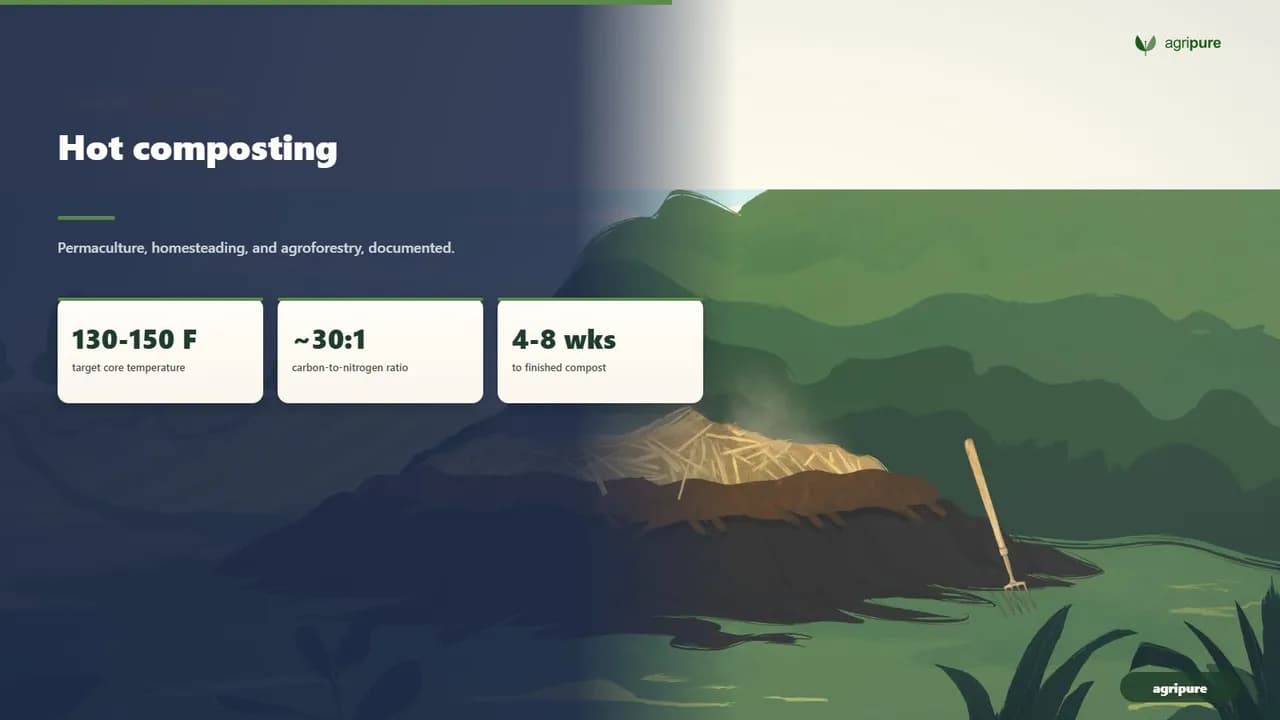
A large, steaming hot compost pile in an organic garden, showing layers of brown and green materials. A compost thermometer is visible, indicating optimal heat, and a pitchfork leans against a nearby wooden fence.
Achieving a thermophilic composting temperature between 130-150°F is key to rapid decomposition and nutrient-rich soil. This optimal heat, often visible as steam, signifies a healthy, active microbial furnace at work, capable of breaking down organic matter in weeks rather than months.
- Hot composting runs the pile core at 130 to 150 F, the thermophilic band where decomposition is fastest and most weed seeds and pathogens die.
- Aim for a carbon-to-nitrogen ratio near 30:1 — in practice about a 2-to-1 mix of browns to greens by volume.
- The pile must be at least 3 ft by 3 ft by 3 ft (about 1 cubic yard); anything smaller will not hold heat.
- Turn the pile weekly, moving the cool outside into the hot center, and keep moisture at a wrung-sponge feel.
- A well-built pile heats within 2 to 3 days, shrinks to about half its volume in a month, then cures for another 4 to 8 weeks.
- Keep the core below about 150 F (65 C); hotter and the microbes doing the work start to die off.
A cold compost pile finishes in 6 months to 2 years. A hot one can be cured and ready in roughly 2 to 3 months, because you are not waiting on the weather — you are running a microbial furnace and feeding it on purpose. The difference comes down to four numbers: the carbon-to-nitrogen ratio of what goes in, the size of the heap, the core temperature it holds, and how often you turn it. Get those right and the pile climbs past 130 F within days. This guide walks the recipe, the temperature window, the turning cadence, and where odd browns like cotton burr fit. If you are new to the basics, start with the basics of building a compost pile; this piece is the thermophilic deep end.
The browns-to-greens recipe
Everything starts with the carbon-to-nitrogen ratio, because that ratio is what decides whether the pile heats or sulks. Cornell’s composting program puts the target plainly: “the ideal C/N ratio for composting is generally considered to be around 30:1.” Carbon is the energy source for the microbes and nitrogen is the protein they build bodies with, and 30 parts carbon to 1 part nitrogen by weight keeps the two in balance.
Miss that 30:1 balance in either direction and you get a specific failure. Too much nitrogen — a ratio well under 30:1 — and “nitrogen will be supplied in excess and will be lost as ammonia gas, causing undesirable odors,” which is why an all-grass-clippings heap reeks. Too much carbon — a ratio far above 30:1, the way a pile of raw wood chips at 100:1 or more behaves — and “there is not sufficient nitrogen for optimal growth of the microbial populations, so the compost will remain relatively cool and degradation will proceed at a slow rate.” A cool, inert pile is almost always too brown.
A compost pile built in alternating layers of brown straw and dry leaves with green kitchen scraps and grass clippings, a garden fork standing in the dark material
You do not weigh anything in a backyard. The working shortcut, from NC State Extension, is “a 2-to-1 mix of browns and greens”; Rodale Institute frames the same idea by layer thickness, advising that “brown layers should be two or three times thicker than green layers.” Browns are the carbon — “leaves, straw, newspaper, and wood chips.” Greens are the nitrogen — “food wastes, grass, coffee grounds.” Because raw materials vary so widely in their own C:N, knowing a few reference values keeps you from guessing blind.
A C:N reference for common materials
The reason 2-to-1 by volume lands near 30:1 by weight is that browns are far more carbon-dense than greens are nitrogen-dense. Cornell’s figures show the spread: leaves and straw sit in the dozens-to-hundreds of parts carbon, while scraps and clippings are down in the teens. Use this as a balancing table — pair a high-carbon brown with a high-nitrogen green and you land in range.
Material | Type | C:N ratio (approx.) |
|---|---|---|
Wood chips / sawdust | Brown | 100-500:1 |
Straw | Brown | 40-100:1 |
Autumn leaves | Brown | 30-80:1 |
Grass clippings | Green | 15-25:1 |
Vegetable scraps | Green | 15-20:1 |
Finished compost (target) | — | 10-15:1 |
Hitting the temperature window
With the mix right, temperature is the gauge that tells you it is working. Decomposition, in Cornell’s words, “occurs most rapidly during the thermophilic stage of composting (40-60 C)” — that is roughly 104 to 140 F where the heat-loving microbes take over from the mesophilic ones. NC State sets the practical target a touch higher: “a pile needs a balance of organic materials, moisture, and oxygen to support microorganisms that will heat the pile to 140 to 150 F.”
Those degrees do real work beyond speed. NC State is specific on the thresholds: “temperatures need to reach over 130 F in the pile to kill most pathogens that are harmful to humans and pets, and over 140 F to destroy most weed seeds.” That is the payoff of going hot rather than cold — a weed-seed-free, sanitized compost you can spread without sowing last year’s weeds back into the bed.
A long-stem dial compost thermometer pushed into the center of a steaming dark compost pile, with faint heat haze rising and brown straw visible
There is an upper limit too. Cornell warns that managers “strive to keep the compost below about 65 C” — roughly 150 F — “because hotter temperatures cause the beneficial microbes to die off,” and that most species “cannot survive at temperatures above 60-65 C.” If your core blows past 150 F, turn the pile to vent the heat. Hotter is not better; 130 to 150 F is the sweet spot, and a $15 long-stem compost thermometer is the only way to know where you are.
Pile size and turning
A hot pile is partly a geometry problem: too small and the heat bleeds out faster than the microbes can make it. University of Minnesota Extension sets the floor — hold the material “in a cylindrical or cubical mass that is about 3 to 5 feet in each direction,” because “smaller sizes do not create enough heat, and larger sizes do not allow enough penetration of air and water.” NC State gives the same minimum a different way: “build a pile 3-feet high and at least 3-feet in diameter so it can become self-insulating to retain heat.” That roughly 1-cubic-yard mass is the smallest heap that reliably cooks.
A garden pitchfork turning a large dark compost pile in a wooden three-bin system, moving outer material into the steaming hot center
Turning is the other half, and it does 2 jobs: it re-oxygenates the microbes and it moves the unfinished outer shell into the hot core. The cadence depends on how hard you want to push. For a genuinely fast finish, NC State advises that “mixing the pile once a week” — about every 7 days — “by moving the material from the outside to the center will hasten the composting process.” A more relaxed hot pile, per Minnesota Extension, gets turned 1 or 2 times a month as the center cools. Either way, turn on temperature, not the calendar — when the core drops below roughly 130 F, it is asking to be turned.
The cycle, start to finish
Put the recipe, the heat, and the turning on a calendar and a hot pile follows a fairly predictable curve over about 8 to 12 weeks. NC State describes the arc: “after the pile is created, it should heat up within a few days and stay hot for several weeks if it is turned weekly. During this time, the pile will shrink and after about a month it may be about half of its original volume. It will take another 4 to 8 weeks for the pile to cure and be ready for use.”
So the honest timeline is 2 to 3 months, not the “14 days” some kits promise. The active hot phase is a few weeks; the cure — where the pile cools, stabilizes, and the C:N falls toward the finished “10-15:1” Cornell cites — is the patient part. Rushing the cure gives you a coarse, still-hungry product. Once it is done, dark and crumbly and earthy, it is ready to feed the garden, whether you dig it into beds for building soil organic matter or top-dress a lawn with the finished compost.
Where cotton burr and other odd browns fit
Most browns are obvious — the 3 staples are leaves, straw, and wood chips, sitting at 30-80:1, 40-100:1, and 100-500:1 respectively. Cotton burr compost is the one that confuses people, partly because of its name. It “is made from the organic waste leftovers after cotton has been harvested,” the burrs and hulls plus “the seeds, stalks, and leaves” left after ginning — what the cotton industry calls gin trash. In the cotton belt it is a cheap, regionally abundant amendment.
Here is the catch: bagged cotton burr compost is usually already finished, not a raw brown. Its value is structural — it “is very coarse, which is helpful for soil aeration and drainage,” so it “will help break up heavy clay soil.” That makes it a soil amendment you “mix into the topsoil before planting” or use as a 1 to 2 inch mulch, more than a feedstock you toss in a hot pile. If you do get raw cotton gin trash, treat it as a coarse, carbon-leaning brown and balance it with greens like any other. One rule covers every unusual input: place it on the C:N spectrum first, then balance, and if a pile ever goes sour on you, our guide to diagnosing a smelly or stalled pile walks the fixes.
The takeaway
Hot composting is just four numbers held together. Mix to about 30:1 carbon-to-nitrogen — roughly 2 parts brown to 1 part green — build the heap to at least 3 ft by 3 ft by 3 ft, drive the core into the 130 to 150 F band, and turn weekly when it cools. Do that and the pile heats in days, halves in a month, and cures in another 4 to 8 weeks into a weed-free, finished compost. Keep a thermometer in it, stay under 150 F, and let the cure finish. The reward is a 2-to-3-month batch instead of a 2-year wait.
Frequently asked questions
How hot should a hot compost pile get?
The core should reach 130 to 150 F. NC State Extension targets 140 to 150 F for fast composting, and notes that over 130 F kills most pathogens while over 140 F destroys most weed seeds. Cornell cautions against going much above 150 F (65 C), because hotter temperatures start to kill the beneficial microbes. A long-stem compost thermometer is the only reliable way to track it.
What is the right carbon-to-nitrogen ratio for hot composting?
Aim for about 30:1 by weight, which Cornell calls the ideal ratio for composting. In practice that is roughly a 2-to-1 mix of browns to greens, or brown layers two to three times thicker than green layers. Too little nitrogen and the pile stays cool; too much and it loses nitrogen as ammonia and smells.
How big does a compost pile need to be to heat up?
At least 3 feet by 3 feet by 3 feet, about 1 cubic yard. University of Minnesota Extension recommends a mass 3 to 5 feet in each direction, because smaller piles do not create enough heat and much larger ones limit air and water flow. NC State frames the minimum as 3 feet high and at least 3 feet in diameter so the pile becomes self-insulating.
How often should I turn a hot compost pile?
Weekly for the fastest finish. NC State Extension says moving material from the outside to the center once a week hastens composting; a more relaxed pile can be turned once or twice a month as the center cools. The best trigger is temperature — when the core drops, turn it to re-oxygenate and reheat.
How long does hot composting take?
Roughly 2 to 3 months. A well-built pile heats within a few days, stays hot for several weeks with weekly turning, and shrinks to about half its volume in a month. It then needs another four to eight weeks to cure before use. The “finished in 14 days” claims skip the cure.
Is cotton burr compost a brown for hot composting?
Not usually. Bagged cotton burr compost is already finished and is best used as a coarse soil amendment that loosens clay and improves drainage, mixed into topsoil or used as mulch. Only raw cotton gin trash behaves like a carbon-rich brown, and you would balance it with greens like any other feedstock.
References
- Cornell Composting. “Compost Chemistry.” compost.css.cornell.edu
- Cornell Composting. “Getting the Right Mix.” compost.css.cornell.edu
- Cornell Composting. “Compost Physics.” compost.css.cornell.edu
- University of Minnesota Extension. “Composting in home gardens.” extension.umn.edu
- NC State Extension Gardener Handbook. “2. Composting.” content.ces.ncsu.edu
- Rodale Institute. “Backyard Composting Basics: A Cheatsheet.” rodaleinstitute.org
- Help Me Compost. “What Is Cotton Burr Compost?” helpmecompost.com