Key takeaways

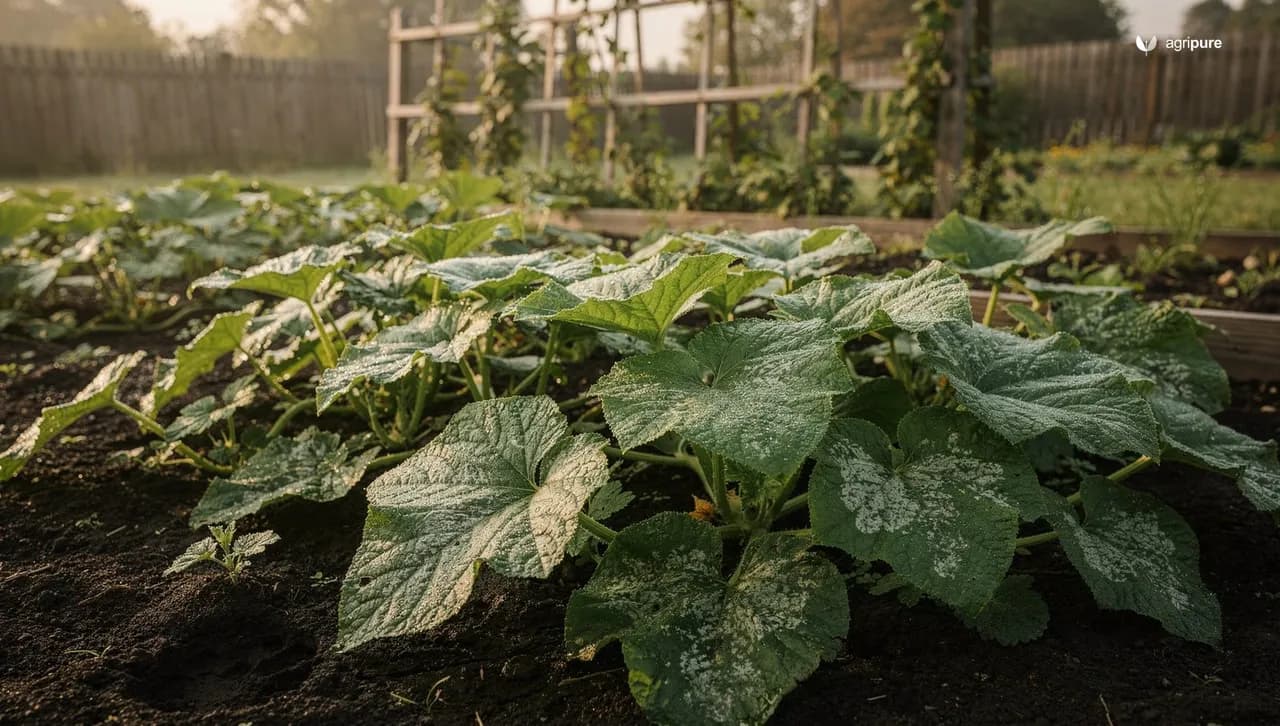
Powdery mildew, characterized by its distinctive white, dust-like appearance, commonly afflicts squash and cucumber leaves, particularly during warm days and humid nights. Effective treatment and prevention require understanding the conditions that favor its spread.
- Powdery mildew is favored by moderate temperatures of 60 to 80°F and shade, and it infects dry leaves — so keeping foliage wet is not the cure.
- A spray of 3 tablespoons potassium bicarbonate (or baking soda) plus 3 tablespoons horticultural oil per gallon improves control when applied at first symptoms.
- Neem oil and horticultural oil clear mild to moderate infections; sulfur prevents new ones but can burn leaves above 90°F.
- Diluted cow’s milk has peer-reviewed backing on zucchini, making it a cheap contact option for home beds.
- The real fix is cultural: full sun, generous spacing, resistant varieties, and less nitrogen stop it from coming back.
Powdery mildew shows up as a white dust on squash, cucumber, and rose leaves, usually when days run warm and nights turn humid. It is favored by moderate temperatures of 60 to 80°F and shade, and unlike most plant diseases it does not need wet foliage to take hold — so spraying water on the leaves makes things worse, not better.
Most home sprays work on contact and have to land on every leaf, top and bottom, because the fungus reproduces fast (a new spore-to-spore cycle can take as little as 48 hours), so reapplication every 7 to 14 days is the rule, not the exception. The treatments that actually move the needle are a short list of 4: potassium bicarbonate, neem oil, sulfur, and milk. The prevention that keeps it from returning matters more than any of them. Here is what the research from UC IPM, Penn State, and Clemson actually shows, and how to stop powdery mildew recurring season after season.
Why powdery mildew appears in the first place
Powdery mildew is the one common garden disease that thrives in dry weather. UC IPM is explicit that moderate temperatures of 60 to 80°F and shade encourage it, and that it does not require moist conditions to grow. Penn State Extension adds the specific trigger: high relative humidity at night paired with low daytime humidity and temperatures around 70 to 80°F. That is why it tends to flare in late summer and early fall, when warm afternoons give way to heavy dew.
The spores ride air currents onto a leaf and germinate without any free water, and Penn State notes a single spore can go from germination to producing new spores in as little as 48 hours. The same source adds that liquid water on the leaf actually inhibits spore germination for most powdery mildews, which is the opposite of how blights and downy mildew behave. Crowded, shaded, over-fed plants are the easiest targets, because soft growth in still, humid air is exactly the microclimate the fungus wants.
The conditions you can change
Three of those drivers are within your control before you ever mix a spray, and sorting all 3 out cuts the pressure by more than half.
- Shade and crowding: plants packed tight hold humidity in the canopy; thinning to full sun and open airflow removes the fungus’s preferred habitat.
- Excess nitrogen: UC IPM warns that too much nitrogen causes lush foliage and shade, feeding fungal growth — so a balanced living soil beats a heavy feed.
- Susceptible plants: squash, cucumber, melon, and grape are repeat offenders, so plant choice sets the baseline risk.
Spot it early: the first colonies look like a few small flour-dusted patches on older, shaded lower leaves. Treating at that stage takes one application; waiting until the whole canopy is white takes a campaign.

The treatments that actually work
Once mildew is visible, contact treatments can stop its spread, but only if you apply them at first symptoms and cover both leaf surfaces. Clemson’s Home and Garden Information Center gives a tested home recipe: 3 tablespoons of horticultural oil plus 3 tablespoons of potassium bicarbonate or baking soda per gallon of water. Potassium bicarbonate is the better of the two salts because it leaves no sodium behind, and the oil both spreads the spray and smothers spores.
UC IPM recommends treating mild to moderate infections with horticultural oil or plant-based oils such as neem oil, and preventing new infection with sulfur products — though sulfur can injure plants once temperatures reach 90°F, so it is a cool-morning tool. The timing rule is non-negotiable: Clemson notes fungicides only work when applied as soon as symptoms are noticed, because none of them cure a leaf that is already fully colonized.
Where milk fits in
Milk is the surprise on the list with real evidence behind it. A peer-reviewed 1999 study in Crop Protection by Bettiol found that diluted cow’s milk gave effective control of zucchini squash powdery mildew under greenhouse conditions. Gardeners typically mix it at roughly 1 part milk to 9 parts water and spray weekly in sun, where the proteins appear to act against the fungus.
Cover both sides: every contact spray (oil, bicarbonate, or milk) only kills what it touches. Spray to the point of runoff on the undersides of leaves too, and repeat every 7 to 14 days while conditions favor the disease.
A field comparison of powdery mildew treatments
Each of these 6 options has a job it does well and a limit worth knowing before you spray. This table sorts the main treatments by how they act and where they fit best.
Treatment | How it acts | Main limit | Best use |
|---|---|---|---|
Potassium bicarbonate + oil | Contact, kills active mildew | Needs full coverage, reapply | Visible early infection |
Baking soda + oil | Contact, raises leaf pH | Sodium can build up over time | Occasional spot treatment |
Neem / horticultural oil | Smothers spores and mycelium | Avoid in heat or full midday sun | Mild to moderate infection |
Sulfur | Protectant, blocks new infection | Burns leaves above 90°F | Cool-morning prevention |
Milk (1:9 dilution) | Contact, protein-based | Weekly reapplication needed | Squash, cucumber, low cost |
Resistant varieties | Genetic, prevents infection | Resistance-breaking races exist | Every new planting |
Across all 6 options, the sprays only manage an infection already underway, the oils and sulfur need care about heat, and resistant varieties are the only line that stops the disease before it starts.
How to stop it coming back
Treating the same plants every year, sometimes 6 or 8 times a season, means you are losing the argument with the fungus. Prevention is where the leverage is, and the Missouri Botanical Garden is direct that buying resistant varieties is the single best strategy for avoiding powdery mildew. Pair that with spacing plants for air circulation, giving them plenty of sun, watering early in the day, and pruning out and destroying diseased tissue rather than composting it.
UC IPM frames the cultural fixes the same way across all 3 levers: grow plants in sunny locations, provide good air circulation by pruning excess foliage and properly spacing plants so the canopy is not crowded, and fertilize moderately so you are not pushing soft, shaded growth. Dense, healthy, well-fed-but-not-overfed plants in moving air are simply a poor host. Note too that resistance-breaking races already exist on cucurbits, so a resistant variety lowers the odds without guaranteeing a clean season.
A simple anti-recurrence routine
The same handful of habits, repeated, shrink the problem to almost nothing within 2 seasons.
- Choose resistant cucumber, squash, and melon at the seed rack — it is the cheapest control you will ever buy.
- Space and prune for airflow so no leaf sits in still, shaded air for long; dense but deliberate planting shades soil without choking the canopy.
- Water at the roots, early, and never wet the foliage at dusk, when nighttime humidity is already the trigger.
- Clear infected debris at season’s end so spores have nowhere to overwinter on susceptible hosts like cucumber and grape.

Conclusion
Powdery mildew treatment is two jobs, not one. When the white dust appears, a potassium bicarbonate or oil spray at first symptoms — or diluted milk on squash — stops it spreading if you cover every leaf and reapply every 7 to 14 days. But the lasting fix is cultural: resistant varieties, full sun, generous spacing, and restrained nitrogen remove the 60 to 80°F shaded, humid microclimate the fungus depends on, so next season you spray far less or not at all.
Frequently asked questions
What is the fastest treatment for powdery mildew?
At first symptoms, spray a mix of 3 tablespoons potassium bicarbonate or baking soda plus 3 tablespoons horticultural oil per gallon of water, covering both leaf surfaces. Neem oil works on mild to moderate infections, and reapplication every 7 to 14 days is usually needed.
Does baking soda kill powdery mildew?
Baking soda (sodium bicarbonate) helps when mixed with horticultural oil at about 3 tablespoons of each per gallon, because it raises leaf-surface pH against the fungus. Potassium bicarbonate does the same job without adding sodium, so it is the better long-term choice.
Does milk really work on powdery mildew?
Yes, with evidence behind it. A 1999 study in Crop Protection found diluted cow’s milk gave effective control of zucchini powdery mildew in the greenhouse. Most gardeners use roughly 1 part milk to 9 parts water, sprayed weekly in sun.
Why does powdery mildew keep coming back?
It returns because the conditions return: shade, crowding, excess nitrogen, and warm days with humid nights at 60 to 80°F. Spores also overwinter on debris and susceptible hosts, so without resistant varieties and better airflow the disease reappears each year.
Will neem oil get rid of powdery mildew?
Neem oil controls mild to moderate powdery mildew by smothering spores, per UC IPM, but it should not be applied in high heat or full midday sun to avoid leaf burn. Use it early, cover both leaf surfaces, and repeat every 7 to 14 days as new growth appears.
References
- UC Statewide IPM Program — Powdery Mildew on Vegetables
- UC Statewide IPM Program — Cucurbits, Powdery Mildew
- Clemson Cooperative Extension — Powdery Mildew
- Missouri Botanical Garden — Powdery Mildew Outdoors
- Penn State Extension — Powdery Mildew
- [Bettiol, Crop Protection (1999) — Cow’s Milk Against Zucchini Powdery Mildew](https://doi.org/10.1016/s0261-2194(99)00046-0)