Most “best drought-tolerant plants” lists share one quiet flaw: they ignore winter. A shrub that shrugs off a Sonoran summer can still be killed by a single hard frost in a continental winter, and a cold-hardy windbreak from the steppe can melt in tropical heat. Drought tolerance and cold hardiness are two different axes, and a useful plant has to survive both ends of your year.
This guide keys genuinely arid-adapted drought tolerant trees and shrubs to the USDA hardiness zone system, which is built on the average annual extreme minimum winter temperature, and pairs each species with its UK Royal Horticultural Society (RHS) rating and broad Australian climate band so international readers can translate. Pick by the coldest night your site actually sees, then by heat and rainfall, and you stop replanting the same gap every other spring.
How to read the hardiness columns
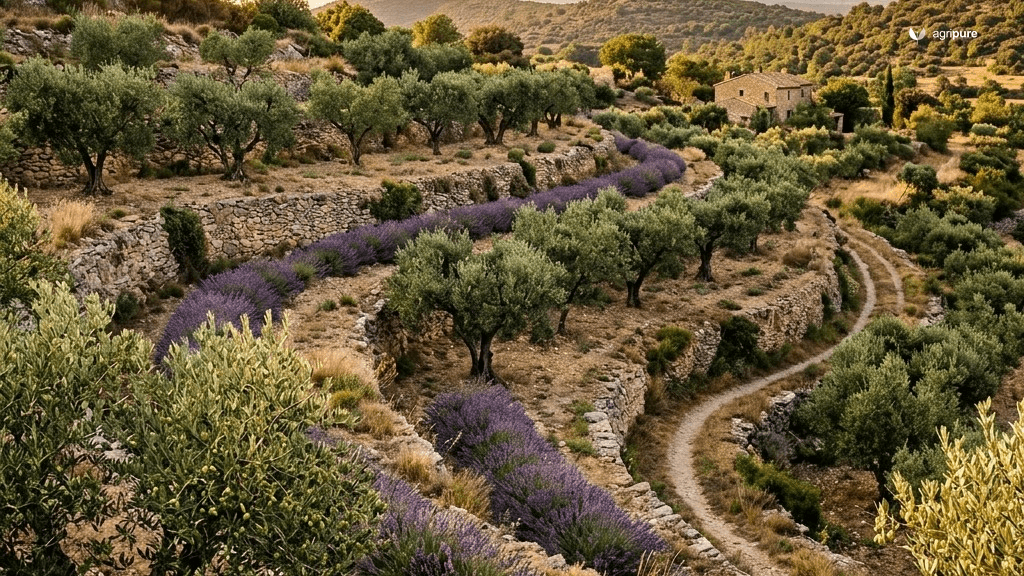
A drought-tolerant lavender and rosemary shrub cluster thriving in dry, rocky Mediterranean soil.
Xeriscaped planting showing established low-water shrubs resilient against dry summers.
The three systems answer slightly different questions, so a quick orientation helps before you scan the table.
- USDA zones (1-13) rank average winter cold in 10°F bands; higher numbers are warmer. A plant listed “USDA 6-9” should reliably overwinter in zones 6 through 9.
- RHS ratings (H1a-H7) run the opposite direction: H7 is the hardiest (below -20°C), H1a the most tender (needs above 15°C). They describe how plants cope with cold, not just how cold it gets.
- Australian bands here are descriptive climate zones (arid, mediterranean, warm-temperate, subtropical, tropical, cool-temperate) rather than a numbered cold scale, because heat and rainfall, not frost, usually set Australian limits.
One caveat the USDA map cannot capture: drought tolerance is almost always conditional on establishment. Nearly every species below needs one to three seasons of supplemental water to root deeply before it can carry itself through dry spells. “Drought-tolerant” is a description of a mature, established plant, not a transplant.
Quick-reference table
Species | Habit | USDA | RHS | AU band(s) | Standout role |
|---|---|---|---|---|---|
Russian olive (Elaeagnus angustifolia) | Shrub/small tree | 2-7 | H7 | cool-temperate, arid | Cold-hardy nitrogen-fixing windbreak |
Fourwing saltbush (Atriplex canescens) | Shrub | 4-9 | H6 | arid, mediterranean | Saline-soil forage shrub |
Jujube (Ziziphus jujuba) | Tree | 6-11 | H5 | warm-temperate, arid | Drought-hardy fruit tree |
Wild pistachio (Pistacia atlantica) | Tree | 7-9 | H5 | arid, mediterranean | Climax shade tree & rootstock |
Athel tamarisk (Tamarix aphylla) | Shrub/tree | 8-11 | H4 | arid, subtropical | Saline desert windbreak |
Hopbush (Dodonaea viscosa) | Shrub | 9-11 | H2 | arid, mediterranean | Pioneer for erosion control |
Gum arabic (Acacia senegal) | Tree | 10-12 | H1c | arid, tropical | Sahel nitrogen-fixer |
The cold end: USDA zones 2-5
If your winters bottom out below -20°C, your candidate list is short but real. The standout is Russian olive (Elaeagnus angustifolia), hardy all the way down to USDA zone 2 (RHS H7), which makes it one of the most cold-tolerant drought plants in cultivation. Native to southern Europe and central Asia, it fixes nitrogen on its roots, prefers alkaline soils, and was planted across the Great Plains and Rocky Mountain shelterbelts by the U.S. Soil Conservation Service precisely for its toughness in dry, cold, windy country.
A serious caveat comes with it: Russian olive is listed as a noxious weed in many U.S. states and outcompetes native riparian vegetation. In dryland Pakistan, the Mediterranean, or Central Asia where it is native or long-naturalized it can be a valuable windbreak and wildlife plant; in North America, check your state’s noxious-weed list before planting and prefer a native alternative where one exists.
Reaching slightly warmer, fourwing saltbush (Atriplex canescens) is hardy from USDA 4 (RHS H6) and is the workhorse of saline, sodic, and just plain difficult arid soils. It is one of the most palatable browse shrubs in the western U.S., with protein and fat levels comparable to alfalfa, and as an evergreen it holds forage value through winter and drought when little else is green.
The temperate-arid heart: USDA zones 6-7
This band, covering much of the Mediterranean basin, the Iranian plateau, northern Pakistan’s valleys, the U.S. Southwest’s higher elevations, and inland Australia’s cool-temperate fringes, is where the choice gets genuinely rich.
Jujube: the dryland orchard tree
Jujube (Ziziphus jujuba), the Chinese date, is hardy across USDA 6-11 (RHS H5) and is arguably the most rewarding drought-tolerant fruit tree for hot, dry climates. Established trees tolerate temperatures near -10°F yet fruit best in zones 8 and warmer; they grow from sea level to around 5,500 feet on poor, rocky, sandy, or alkaline soils, need little pruning, and are rarely troubled by pests. For a smallholder wanting fruit from marginal land, few trees pay off as reliably.
Wild pistachio: the climax shade tree
Wild pistachio (Pistacia atlantica), the Mt. Atlas mastic, sits at USDA 7-9 (RHS H5) and is a slow-growing, long-lived climax species native to North Africa, the Mediterranean basin, and western Asia through Iran. It thrives on poor calcareous soils in rocky terrain and is highly drought- and heat-tolerant. Two roles make it valuable: it is a respected reforestation species for degraded arid and semi-arid Mediterranean land, and it is widely used as a vigorous, drought- and salinity-resistant rootstock for cultivated pistachio (Pistacia vera). If you are building toward a mature, self-sustaining dryland canopy, this is a tree to plant for the next generation.
The hot, dry end: USDA zones 8-10
Where frost is rare and heat is the real test, the palette shifts toward true desert specialists.
Athel tamarisk for saline windbreaks
Athel tamarisk (Tamarix aphylla), hardy USDA 8-11 (RHS H4), is the largest Tamarix and an evergreen with feathery scale-like foliage. Native to arid North Africa, the Middle East, and southern Asia, it sends a taproot many metres deep and laterally, letting it hold saline, drought-prone ground that defeats most species. It has served as a windbreak and shade tree for decades in the dry western U.S., central and western Australia, and across Egyptian and Middle Eastern new-land schemes, where shelterbelts cut wind erosion and crop evapotranspiration losses.
Note that Tamarix aphylla is far better behaved than the invasive shrubby tamarisks (such as T. ramosissima); it rarely sets viable seed in cultivation, but it is still worth confirming local regulations before large plantings.
Hopbush: the fast pioneer
Hopbush (Dodonaea viscosa) is a fast-growing evergreen shrub for USDA 9-11 (RHS H2) found wild across warm regions worldwide. Its leaves carry a sticky resin that gives them a varnished look and sharply cuts water loss, making it genuinely heat- and drought-hardy. It is a textbook pioneer: planted for soil erosion control, dune stabilization, and as a quick revegetation nurse and windbreak hedge on dry, rocky ground where slower climax species need shelter to establish.
The arid tropics: USDA zones 10-12
At the frost-free hot end, the standout is a different kind of plant entirely—a true desert legume. Gum arabic (Acacia senegal, syn. Senegalia senegal), hardy USDA 10-12 (RHS H1c), is the backbone of Sahelian agroforestry. It grows on as little as 100-400 mm of annual rainfall, tolerates dry seasons of eight to eleven months, and withstands mean maximum temperatures of 45°C, dry wind, and sandstorms. Beyond the gum it yields, it fixes nitrogen, stabilizes soil with a wide lateral root system, and is intercropped with millet, watermelon, and forage grasses in Sudan’s traditional “gum gardens.” For the truly hot, truly dry, frost-free smallholding, it is a multipurpose anchor.
Putting it together: a layered dryland planting
The strongest drought plantings stack these roles rather than choosing one. A practical sequence on degraded arid land looks like this:
- Establish pioneers first. Fast, tough species like hopbush or saltbush break wind, shade the soil, and create the microclimate slower trees need.
- Add nitrogen-fixers. Russian olive (cold zones) or gum arabic (hot zones) build fertility on bare mineral ground.
- Plant your climax canopy. Wild pistachio or a productive jujube goes in once the site is sheltered, aiming at the long-lived, self-sustaining layer.
- Water deliberately through establishment. Deep, infrequent irrigation for one to three years trains deep roots; frequent shallow watering produces the opposite of drought tolerance.
Frequently asked questions
Does a high drought tolerance mean I never have to water?
No. Almost every species here is drought-tolerant only once established, which usually takes one to three growing seasons of deep, occasional watering while roots reach down. After that, mature plants can carry themselves through dry spells, but the establishment phase is non-negotiable.
How do I convert my UK or Australian climate to a USDA zone?
Use the RHS rating and AU band as a bridge rather than seeking an exact match. The systems measure cold differently: USDA uses average annual minima, RHS uses absolute minima. Treat the overlap as approximate. As a rough guide, RHS H7 aligns with the coldest USDA zones (around 4 and below), H5 with zones 6-7, and H2-H3 with the frost-light zones 9-10.
Are any of these plants a weed risk?
Yes, two especially. Russian olive is a declared noxious weed across much of North America, and shrubby tamarisks are invasive in U.S. riparian systems (though athel tamarisk itself is far less aggressive). Always check your local or state noxious-weed list before planting, and favor a native equivalent where one fills the same niche.
Sources
- USDA Forest Service, Fire Effects Information System — Atriplex canescens (fourwing saltbush)
- USDA NRCS Plant Guide — Russian olive (Elaeagnus angustifolia)
- USDA Forest Service, Fire Effects Information System — Tamarix aphylla (athel tamarisk)
- World Agroforestry Centre (ICRAF) — Acacia senegal agroforestry tree database
- North Carolina Extension Gardener Plant Toolbox — Ziziphus jujuba
- Hardiness zone systems (USDA and RHS) — overview and comparison